


About this worksheet
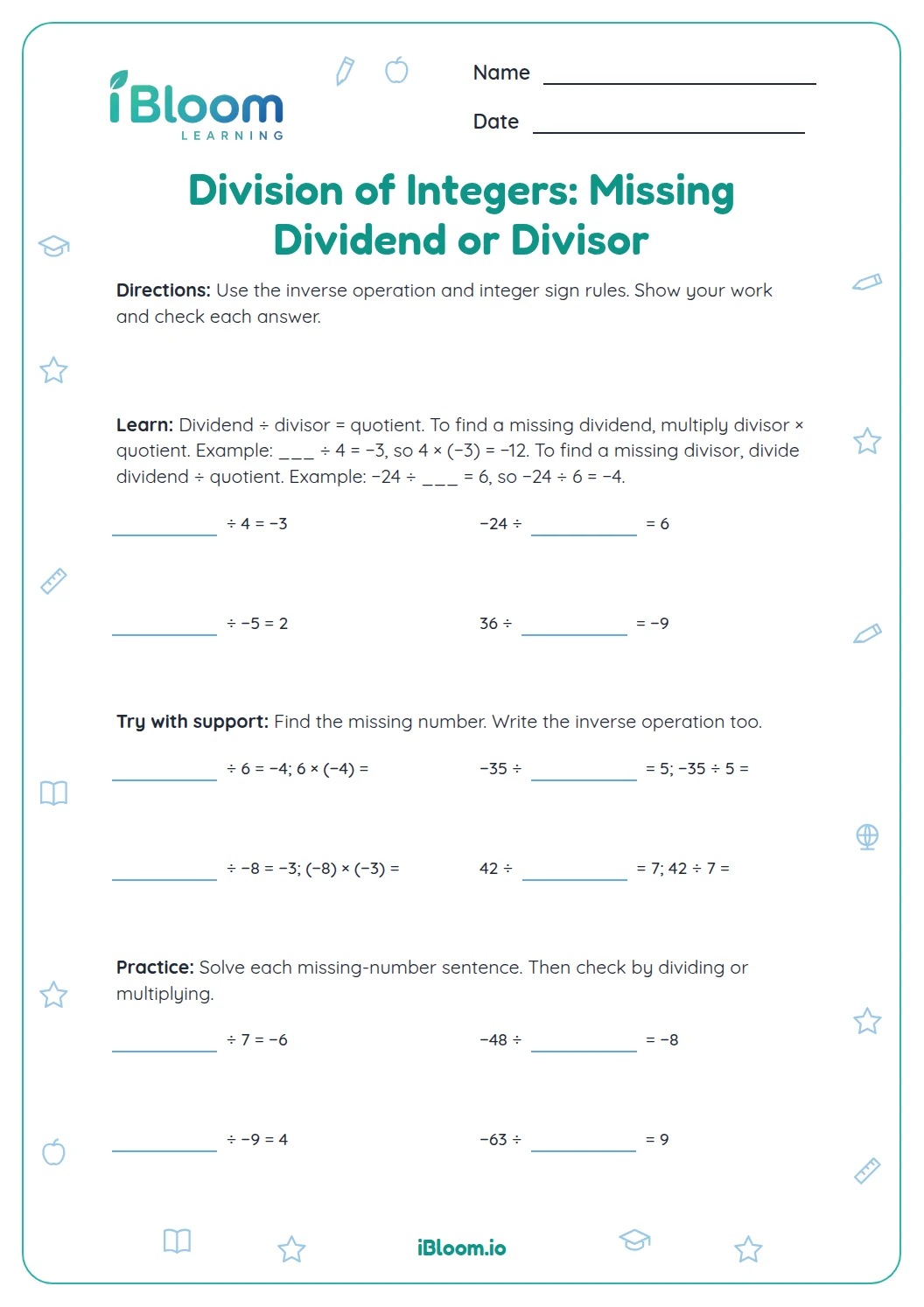
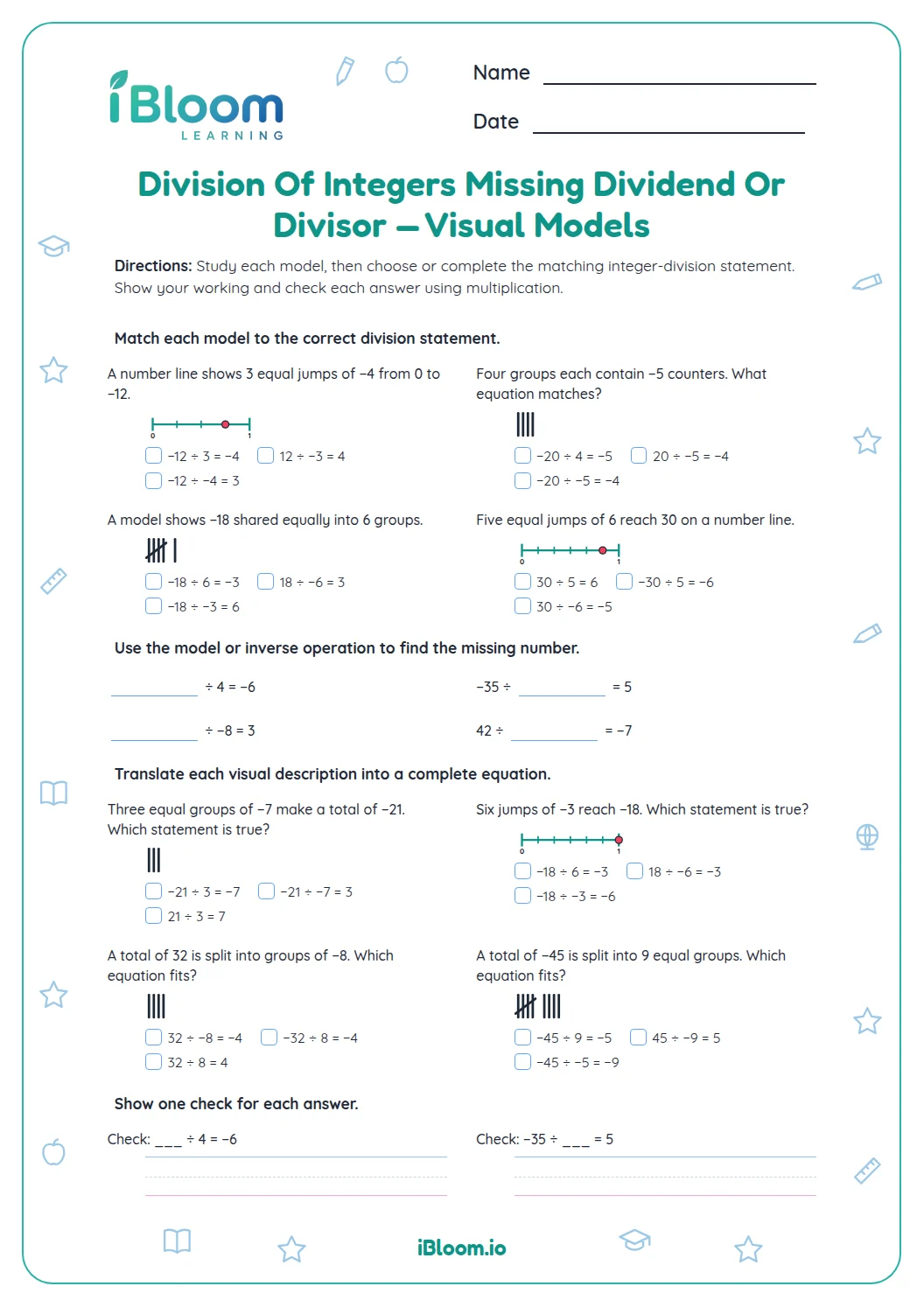
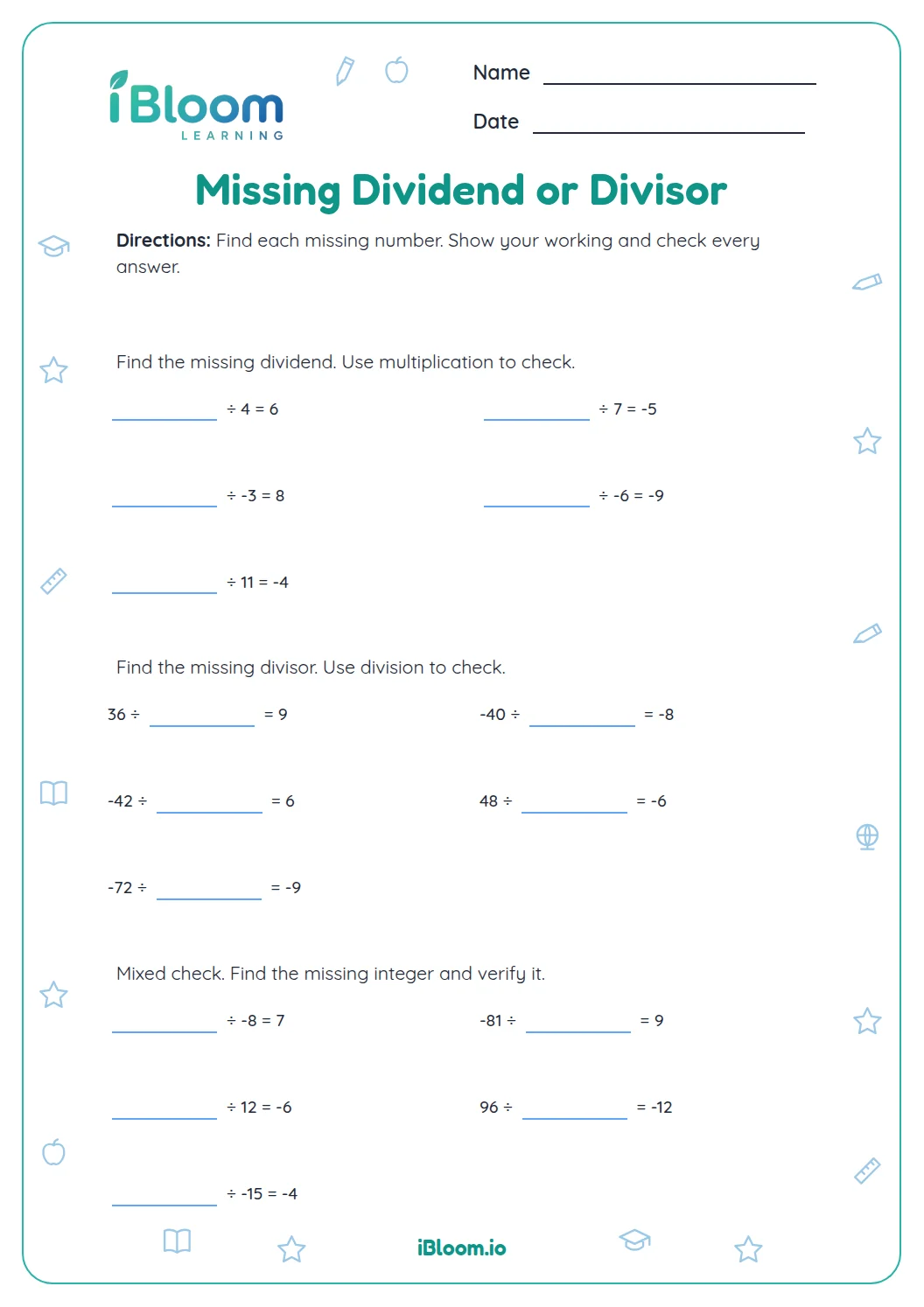
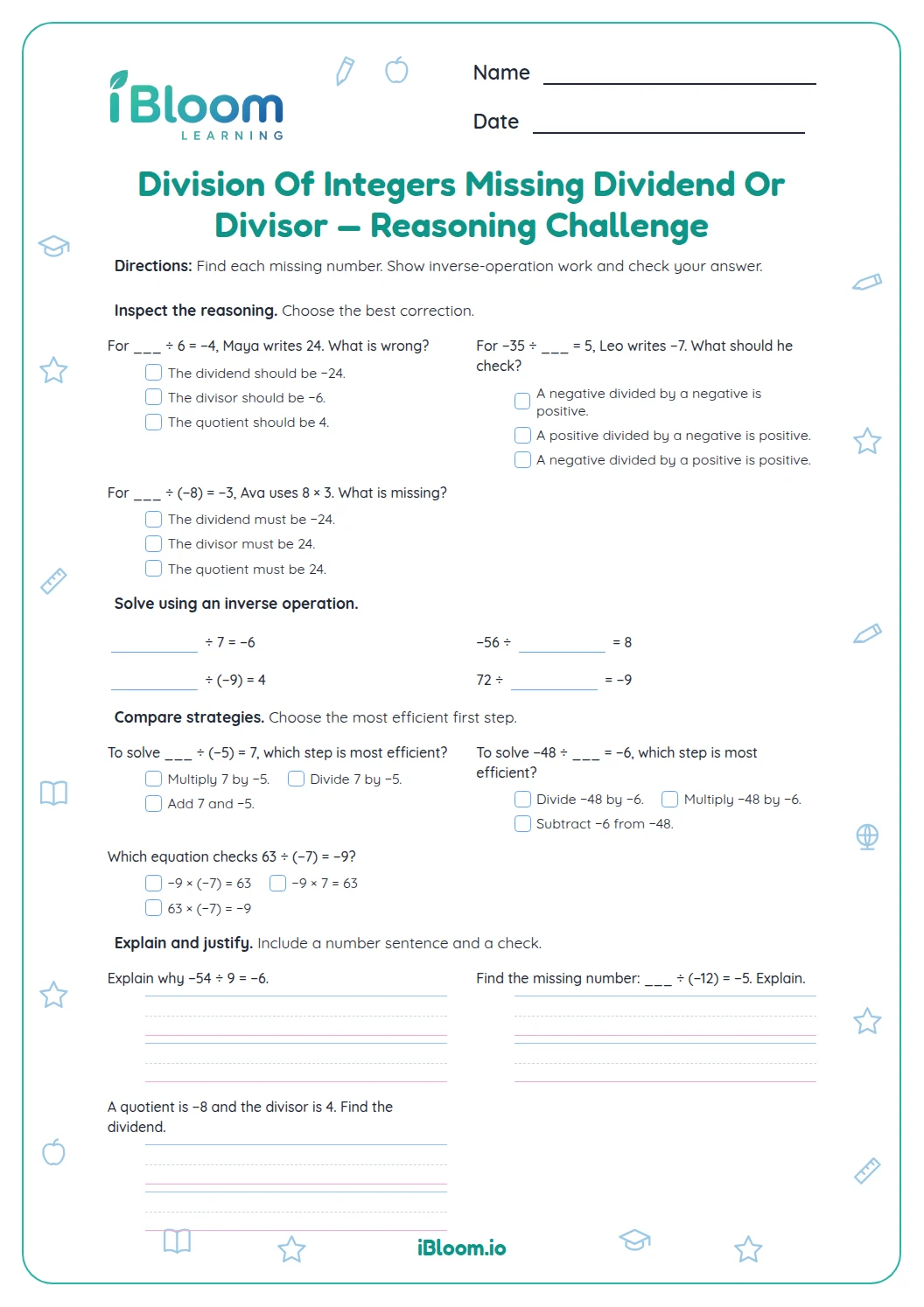
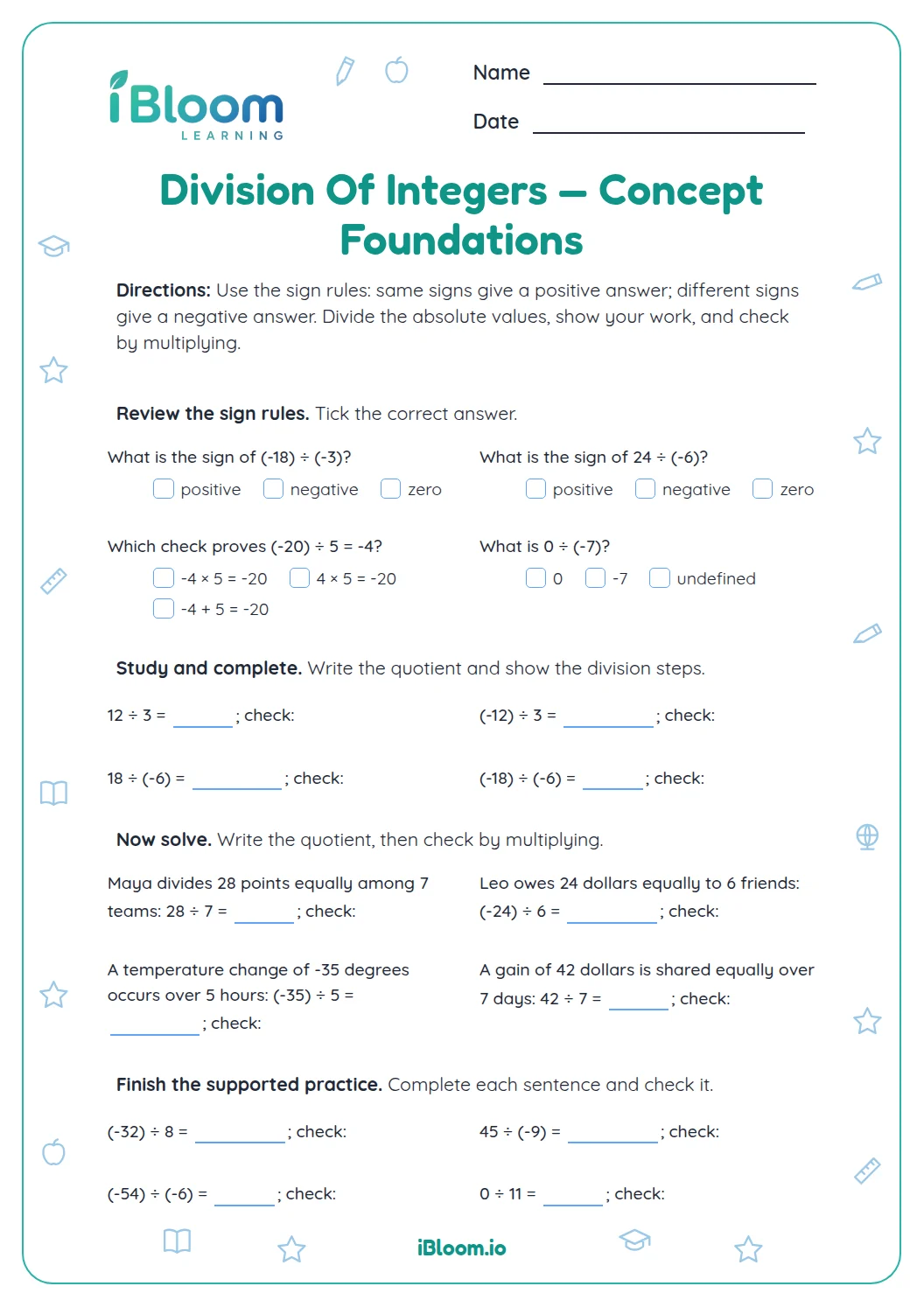
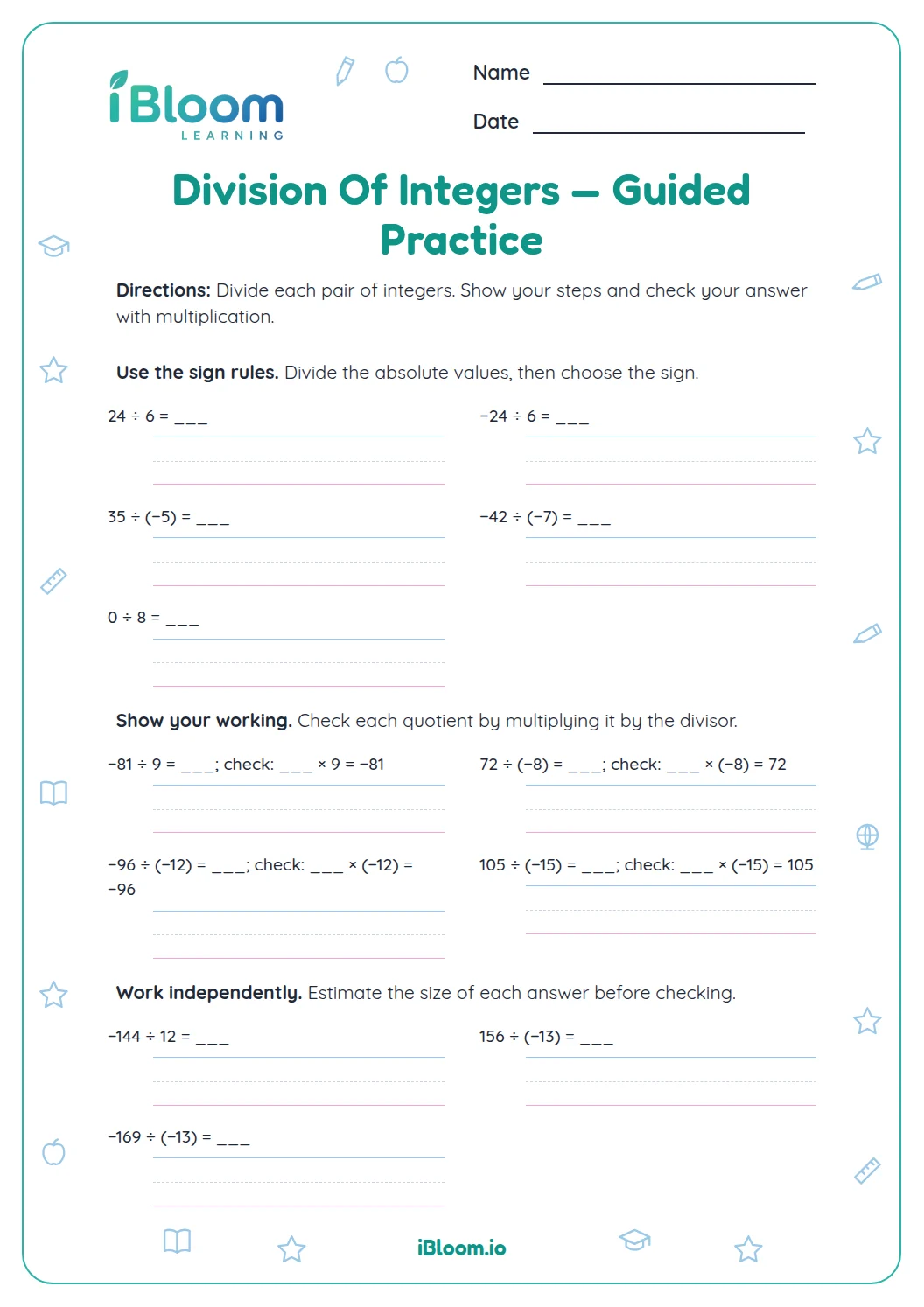
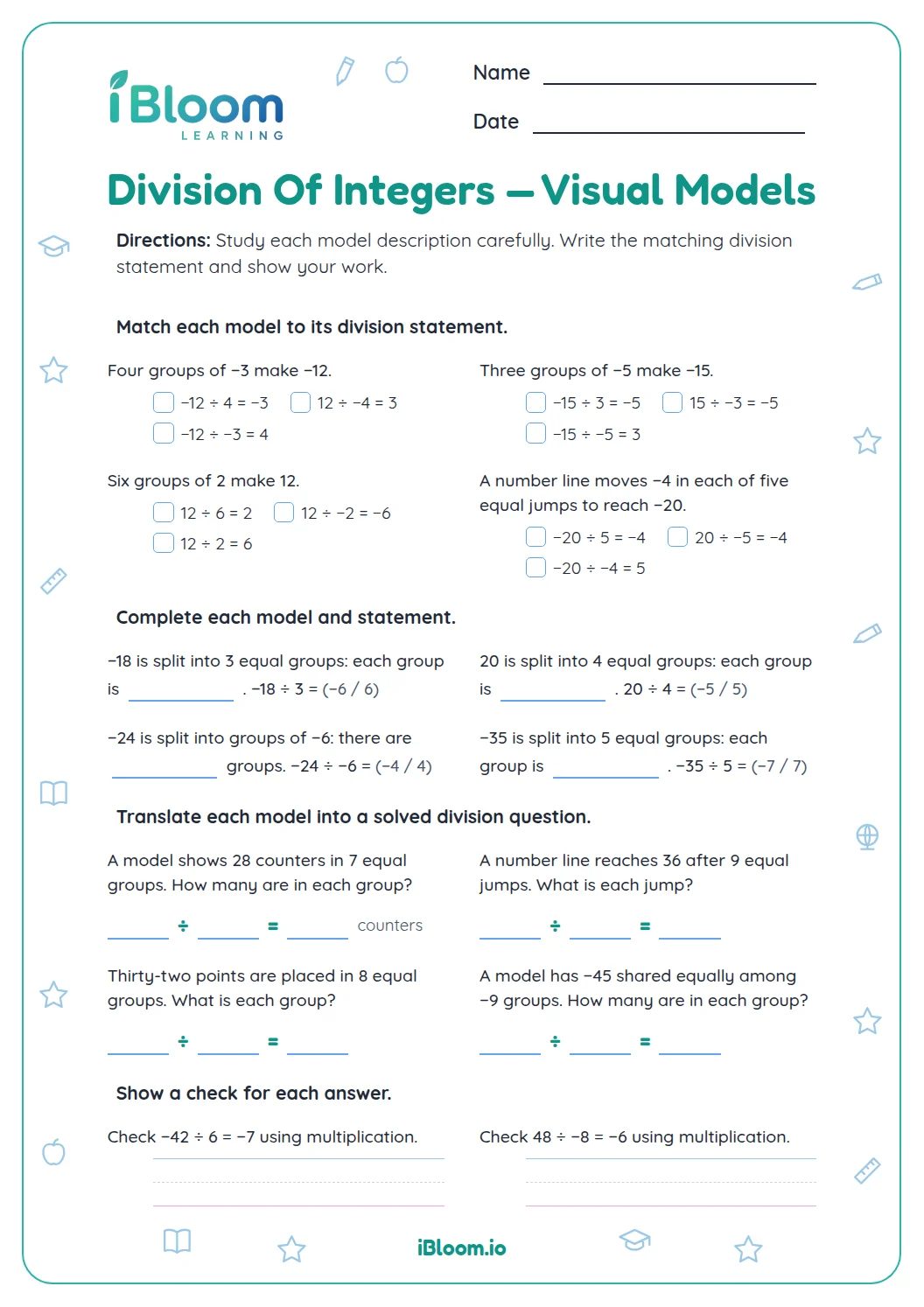
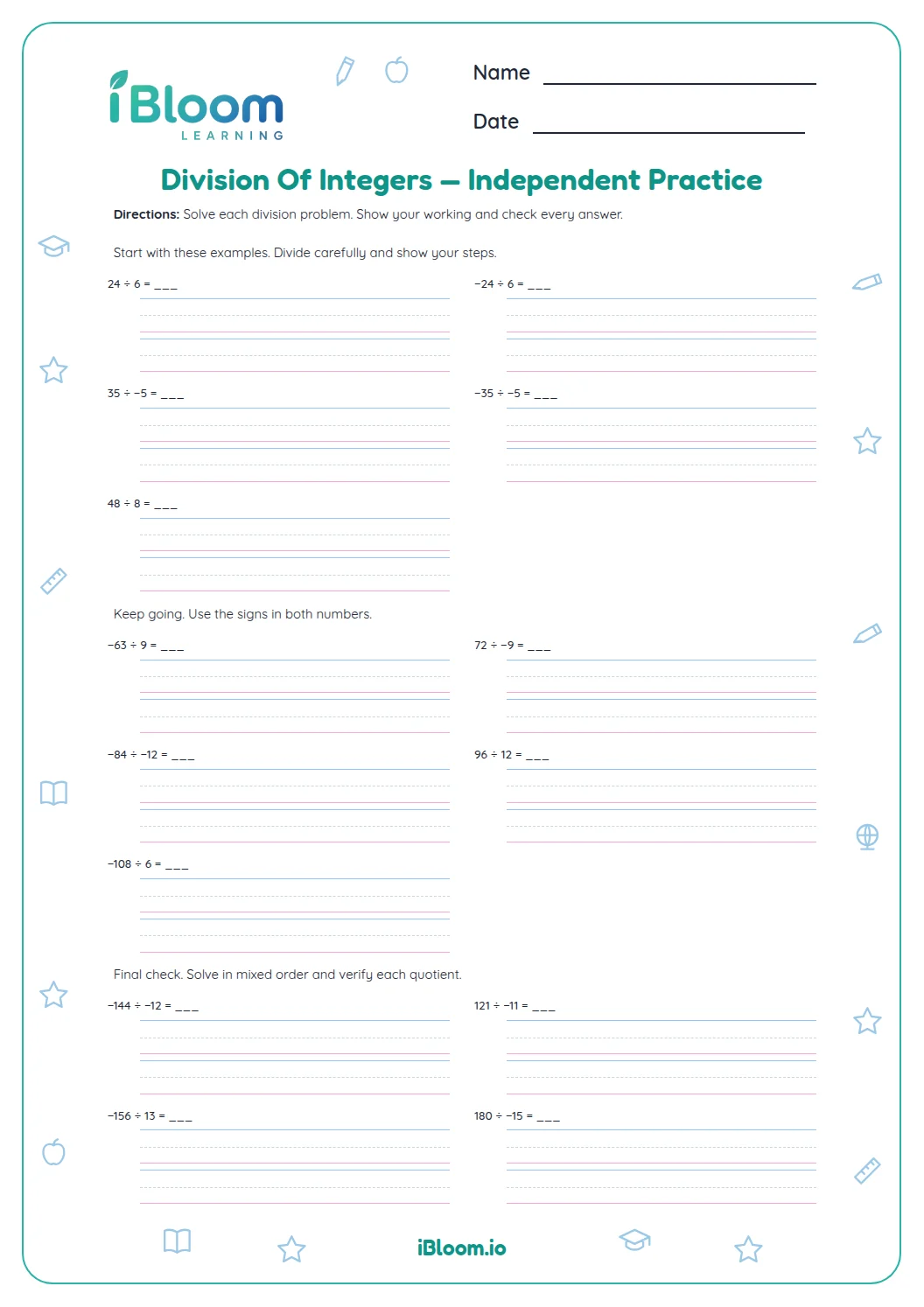
This free two-page worksheet gives Grade 6 students guided practice with integer division. Students use a known divisor and quotient to find a dividend, reverse the relationship to find a missing divisor, and solve quotient and equal-change problems. The signed equations connect division to multiplication and practice CCSS 7.NS.A.3. A separate answer key covers all 16 questions.
Aligned to 7.NS.A.3
How do you find a missing dividend?
In a division equation, dividend ÷ divisor = quotient. To find the dividend, multiply the divisor by the quotient. In question 1, the unknown number divided by −4 equals 6, so the dividend is 6 × (−4), or −24.
Check by putting −24 back into the original equation: −24 ÷ (−4) = 6. The two negatives make a positive quotient.
- 1___ ÷ (−4) = 6
- 26 × (−4) = −24
- 3Check: −24 ÷ (−4) = 6
How do you find a missing divisor?
Use the dividend and quotient to identify the number that was divided by. For −45 ÷ ___ = 9, the missing divisor is −5 because −45 ÷ (−5) = 9. A negative divided by a negative gives a positive quotient.
For every missing-value problem, test the result in the original equation. Checking helps catch a sign error even when the size of the number is right.
How does signed division describe a change?
A decrease can be represented by a negative total change. If a decrease of 72 points is shared over 8 rounds, each round changes by −9 points: −72 ÷ 8 = −9.
The last part applies division to equal changes in points, meters, account balances, and steps. The sign describes the direction of change; the quotient gives the amount per equal group.
What is included in the practice?
The 16 questions are arranged in four parts: missing values, divisor-focused items, mixed integer division, and four short applications. The first questions give a known quotient or divisor; later items mix the unknown position and use signs in context.
A separate answer key lists the signed value for each problem. Recheck a response by multiplying the quotient by the divisor when a dividend is missing.
A routine for solving integer division
- 1Mark the dividend, divisor, and quotient in the equation.
- 2For a missing dividend, multiply divisor × quotient.
- 3For a missing divisor, use the dividend and quotient to find the factor.
- 4Decide the sign: matching signs give a positive quotient; different signs give a negative quotient.
- 5Substitute the missing value and check the original division sentence.
- 6For an equal-change story, divide the signed total change by the number of equal groups.
Integer division errors to catch
The mistake
Using a positive dividend in ___ ÷ (−4) = 6.
The fix
A positive quotient needs matching signs, so the dividend is negative: −24.
The mistake
Writing 5 for the missing divisor in −45 ÷ ___ = 9.
The fix
The quotient is positive, so both numbers must be negative: −45 ÷ (−5) = 9.
The mistake
Dropping the negative sign from a decrease shared among groups.
The fix
Keep the change signed: −72 ÷ 8 = −9 points per round.
Common Core alignment
The equations and short situations use signed division to solve mathematical and real-world problems.
Solve integer division equations and signed-change problems.
On this sheet: Students solve signed division equations and equal-change situations.
Show the official wordingHide the official wording
Solve real-world and mathematical problems involving the four operations with rational numbers.
What to practice next
Make more practice
Further reading
Questions parents and teachers ask
What is a missing dividend?
The dividend is the number being divided. In ___ ÷ (−4) = 6, multiply the divisor −4 by the quotient 6 to find the dividend −24. Substituting it back gives −24 ÷ (−4) = 6, which checks the answer. The dividend is the first number in a division sentence.
How do you find a missing divisor?
Use the known dividend and quotient, then check which signed number makes the equation true. In −45 ÷ ___ = 9, the divisor is −5 because a negative divided by a negative gives a positive quotient of 9. Multiplication reverses division and makes a useful check.
How do the signs work in integer division?
When the dividend and divisor have the same sign, the quotient is positive. When their signs differ, the quotient is negative. The worksheet mixes both cases, so students should decide the quotient sign before calculating or filling the missing value.
What kinds of questions are on the sheet?
The 16 questions include missing dividends, missing divisors, complete division sentences, and four equal-change situations. The first three parts focus on equations; the final part applies signed quotients to points, meters, balances, and steps. The stories use equal groups so each quotient has a clear meaning.
Does the worksheet include an answer key?
Yes. A separate answer-key page lists all 16 answers, including units where a question asks for a change per round, hour, or step. Use multiplication to check a missing dividend or divisor against its original equation. Units in the final section name the kind of change being shared.
Which standard does the worksheet practice?
The questions align with CCSS 7.NS.A.3, solving mathematical and real-world problems with rational-number operations. Here, students solve integer division equations and divide signed changes into equal groups. The standard describes the operations used in both the equations and situations. Signed numbers are central.