






About this worksheet
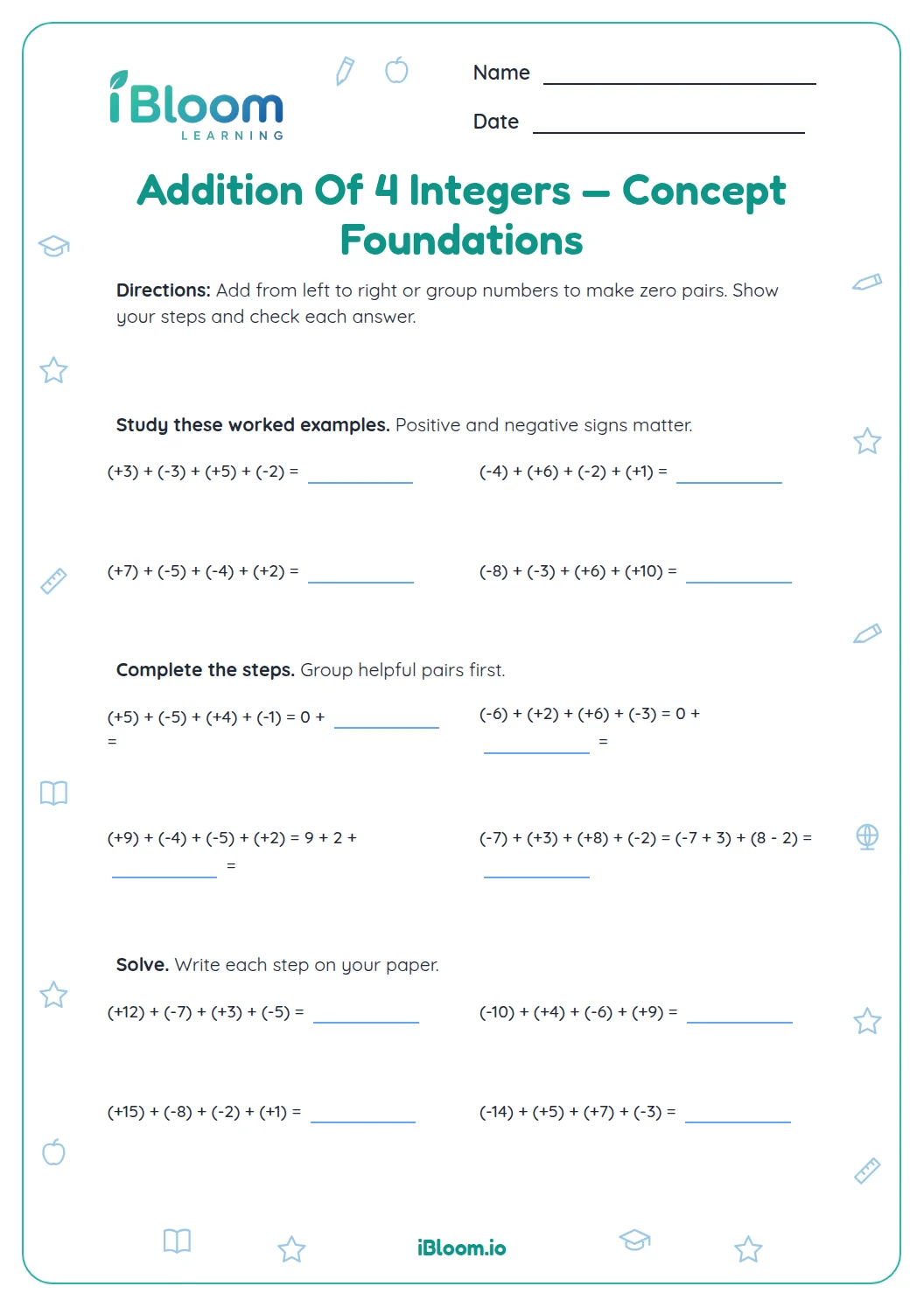
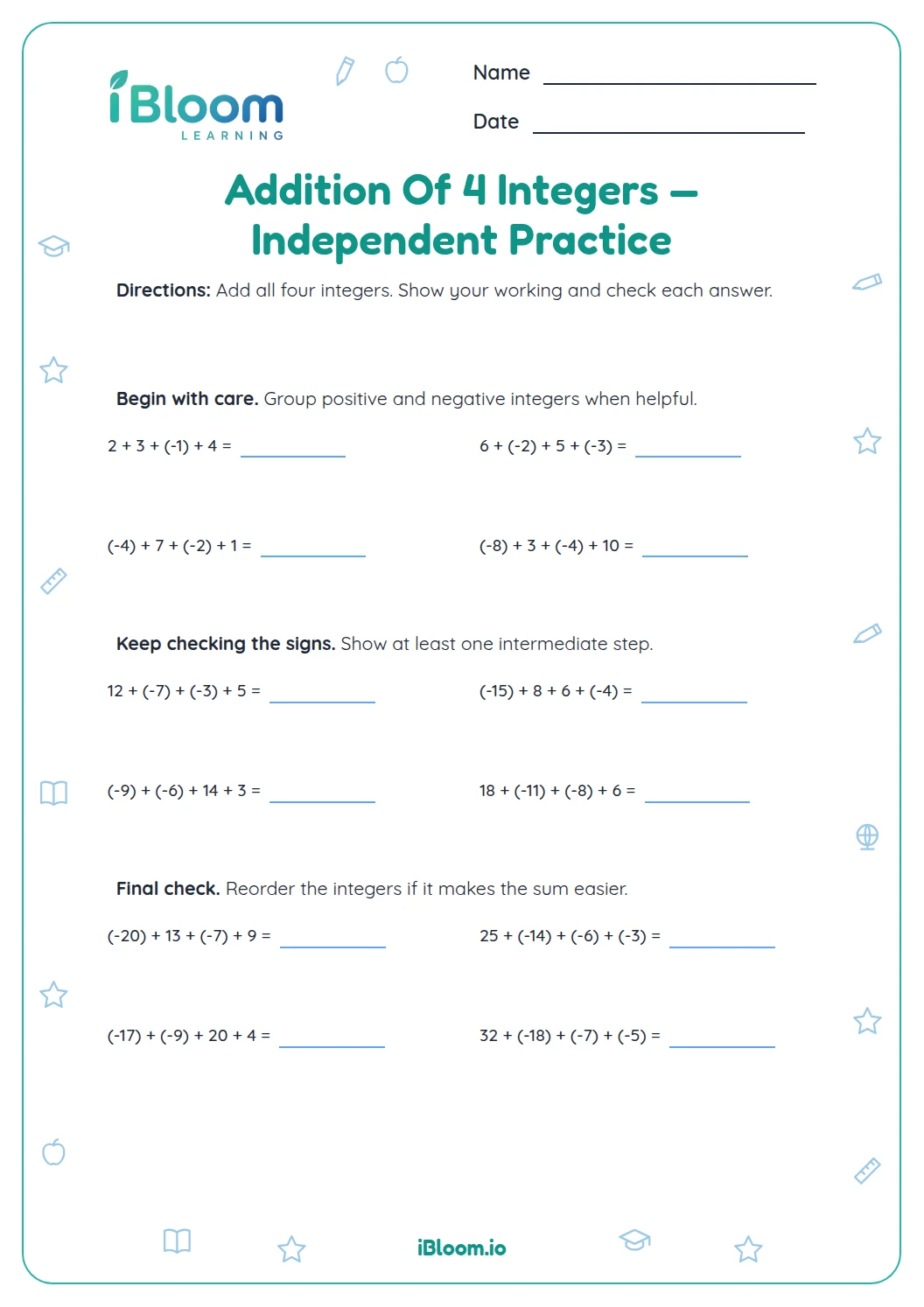
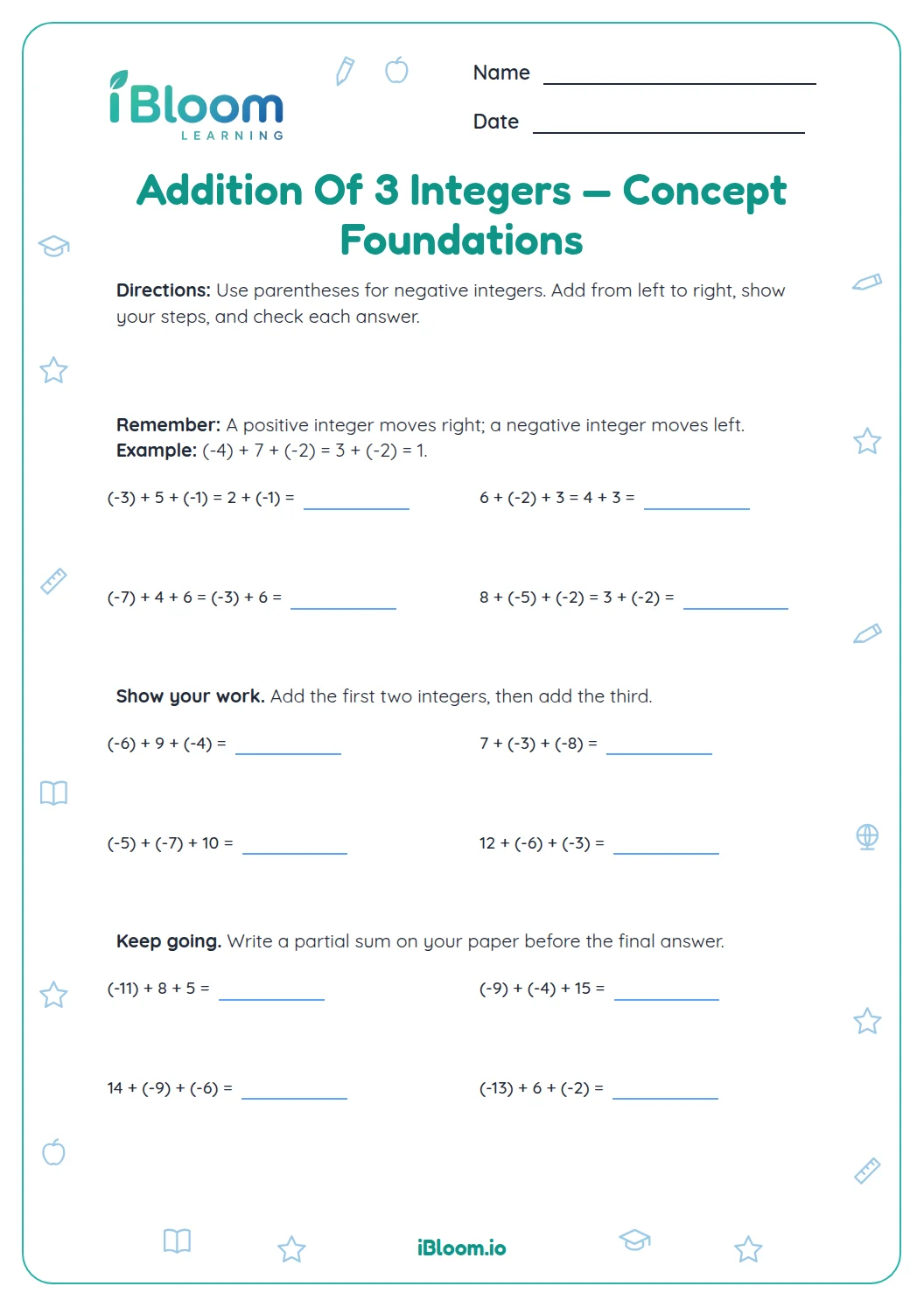
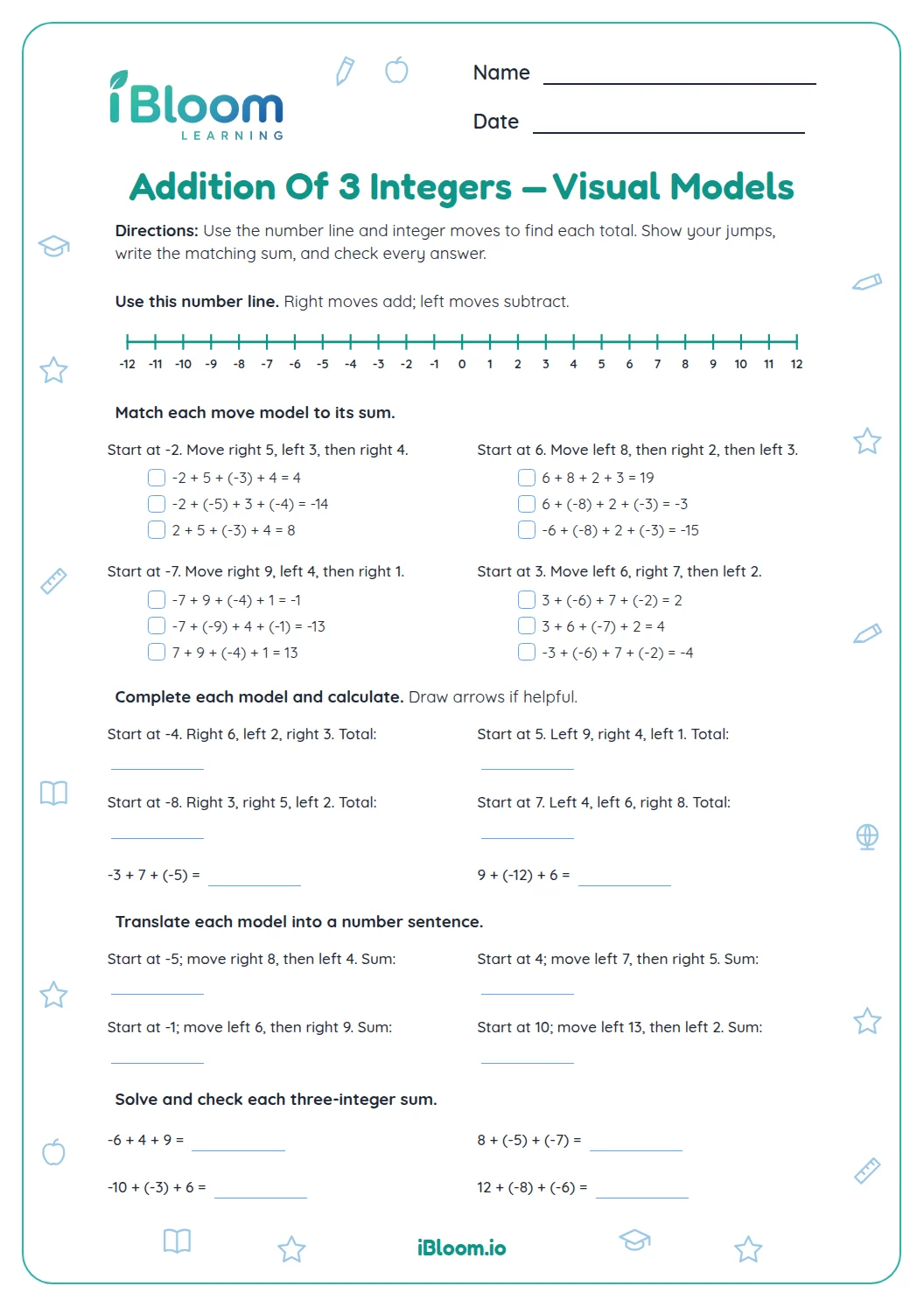
This Grade 6 guided worksheet practices adding four signed integers in each expression. Students group positive and negative values, combine partial totals, and check the final sign. All 16 questions provide room for working, and a separate answer key lists the results. The signed-addition skill aligns with CCSS 7.NS.A.1.b.
Aligned to 7.NS.A.1.b
How can you add several integers?
A positive integer moves right on a number line; a negative integer moves left. With four addends, grouping the signs can reduce the number of steps. Find the positive total and the negative total separately, then compare their distances from zero.
Keep the sign attached to each integer. In 8 + (−5) + (−6) + 4, the positive values total 12 and the negative values total −11, so the sum is 1.
- 18 + (−5) + (−6) + 4
- 2Positive total: 8 + 4 = 12
- 3Negative total: −5 + (−6) = −11
- 412 + (−11) = 1
What is on the practice pages?
Part A introduces grouping and combining, and Part B provides eight more expressions for independent practice. Every question contains four signed integer addends and has working space.
- Every question contains four integer addends
- Show positive and negative partial sums in the work area
- Check the final sign by comparing the two partial totals
How do you check the sign?
If the positive total has the greater absolute value, the answer is positive. If the negative total is farther from zero, the answer is negative. Equal totals would make zero; none of these items is designed to hide a sign ambiguity.
A four-step routine
- 1Copy each signed integer carefully.
- 2Group the positive values and find their total.
- 3Group the negative values and find their total.
- 4Combine the two partial totals.
- 5Check that the sign matches the larger distance from zero.
Integer addition mistakes to watch for
The mistake
Adding the absolute values of all four numbers and making the result positive.
The fix
Keep positive and negative groups separate before combining them.
The mistake
Treating two negative addends as a subtraction.
The fix
Add their magnitudes and keep the negative sign, such as −5 + (−6) = −11.
The mistake
Choosing the sign from the first addend.
The fix
Compare the final positive and negative totals; the group farther from zero determines the sign.
Common Core alignment
The worksheet practices signed integer addition, using the Grade 6 number-line understanding of positive and negative values.
Interpret addition of positive and negative numbers.
On this sheet: Grouping signed integers applies addition of positive and negative values and checks which direction determines the result.
Show the official wordingHide the official wording
Understand p + q as the number located a distance |q| from p, in the positive or negative direction depending on whether q is positive or negative. Show that a number and its opposite have a sum of 0 (are additive inverses).
What to practice next
Make more practice
Further reading
Questions parents and teachers ask
What does grouping by sign mean?
Add the positive integers together, then add the negative integers together. Combine those two partial totals at the end. For 8 + (−5) + (−6) + 4, the partial totals are 12 and −11, so the result is 1. Each expression remains visible while students record intermediate totals in the working area.
Does every problem have four integers?
Yes. Each of the 16 expressions contains four signed integer addends. Parentheses mark negative values, and the work boxes provide room to record intermediate steps. This keeps the negative sign attached to each value throughout the addition steps. Students can verify the final value by recombining the signed integers in the original expression.
How can students check the sign?
Compare the positive and negative partial totals. The group farther from zero determines the sign, and the difference between their distances gives the answer’s magnitude. Equal distances would result in zero. For example, 12 and negative 11 are one unit apart, so the answer is positive.
Is a number line required?
No. Students can group values by sign, use a number line, or combine pairs in another clear way. The directions encourage grouping and showing steps, and each problem has working space. Each answer box sits beside the expression, with room to record short working steps.
What is in the answer key?
The separate key shows the result for each four-integer expression. Students can compare their final values and review their own grouping steps in the spaces provided. The key lists final values; students may use any clear, correct grouping strategy. Students can verify the final value by recombining the signed integers in the original expression.