





About this worksheet
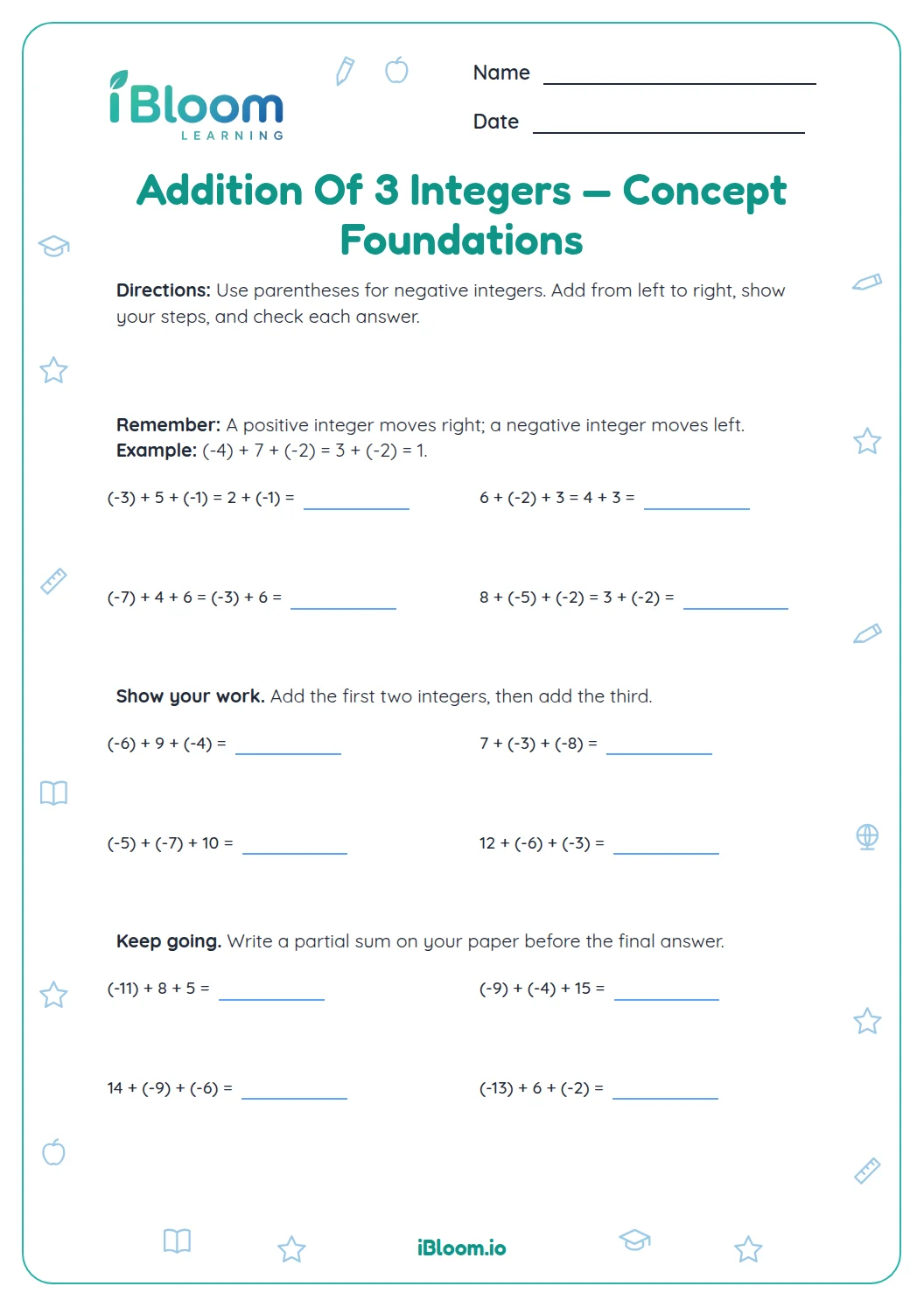
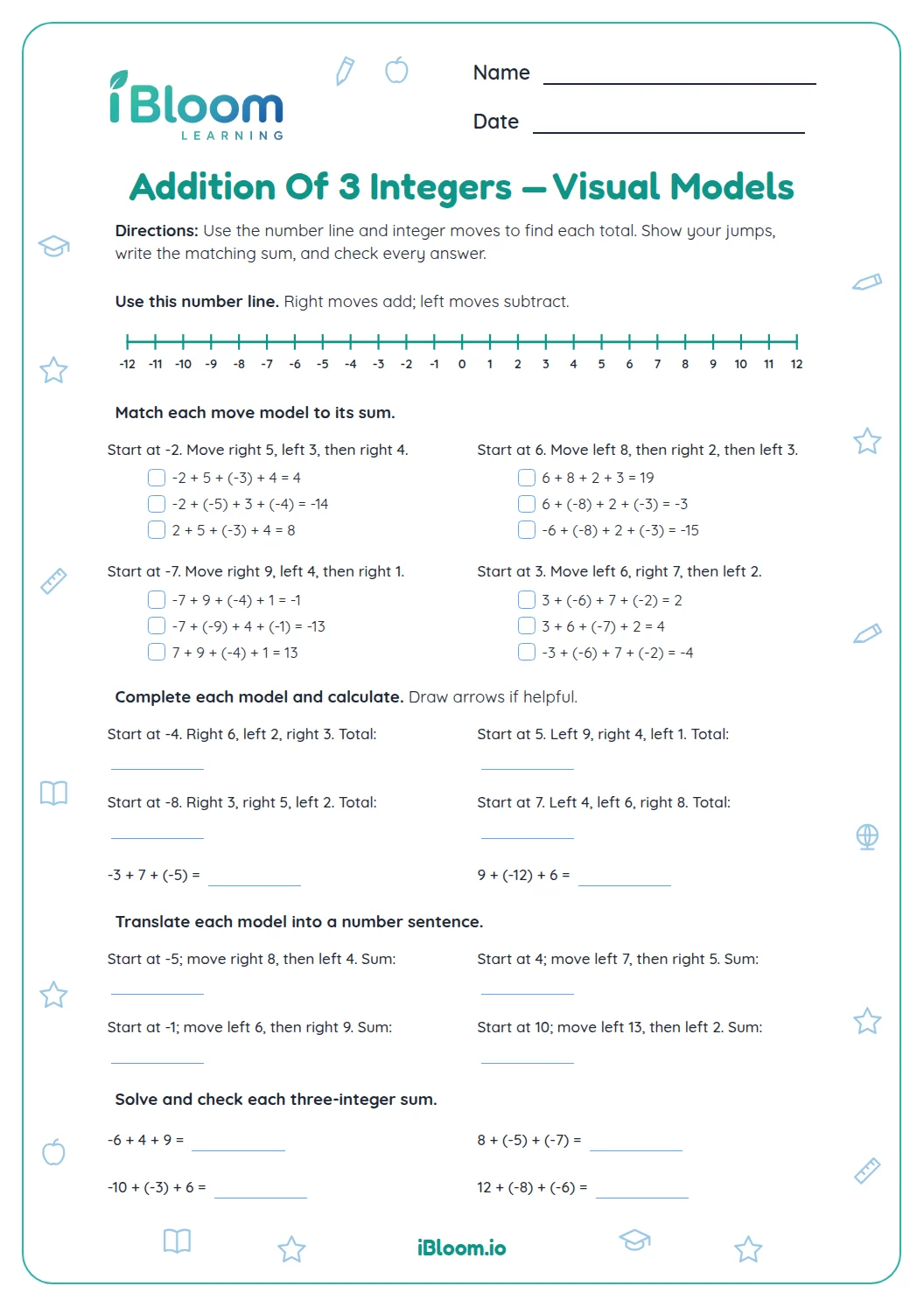
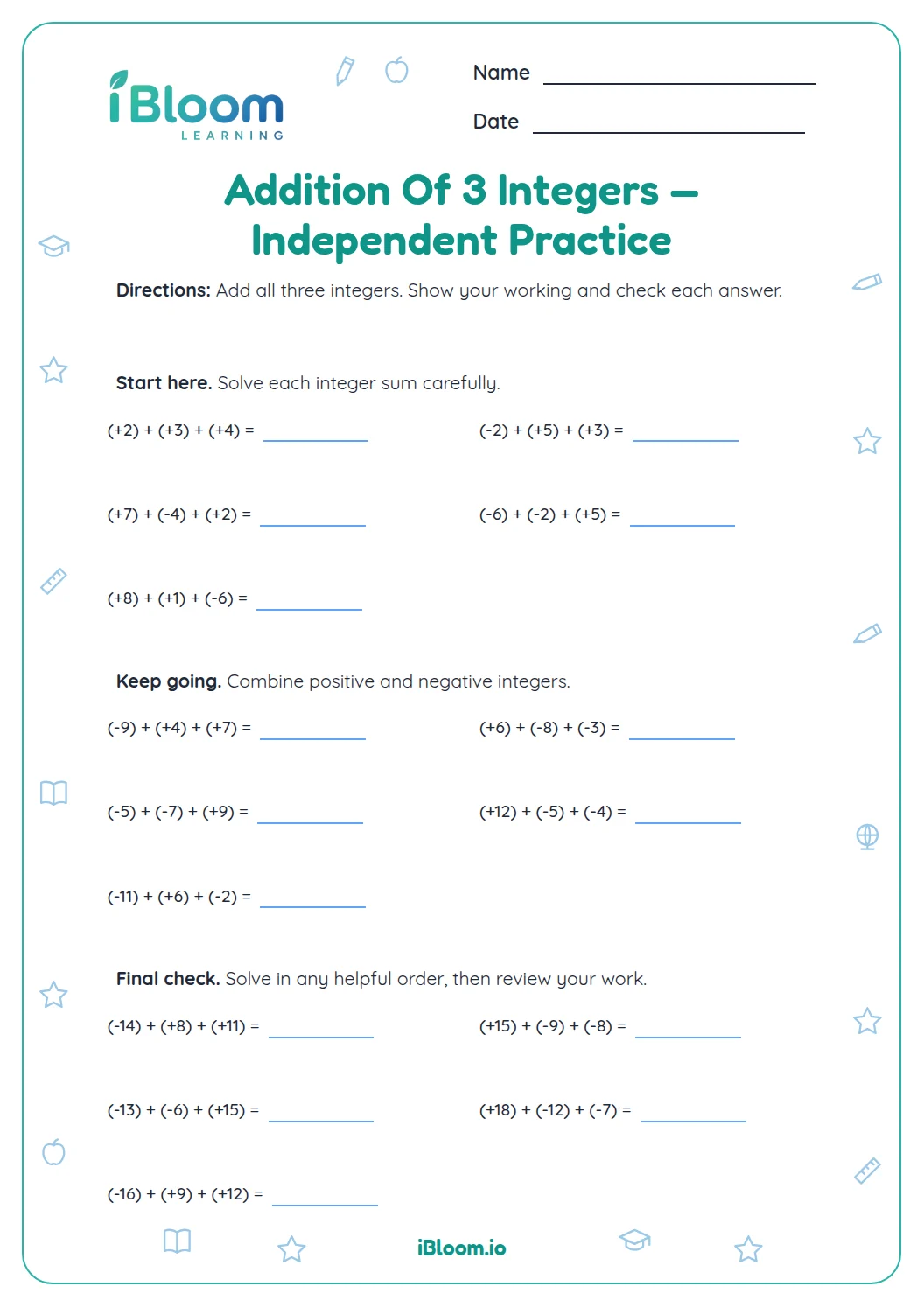
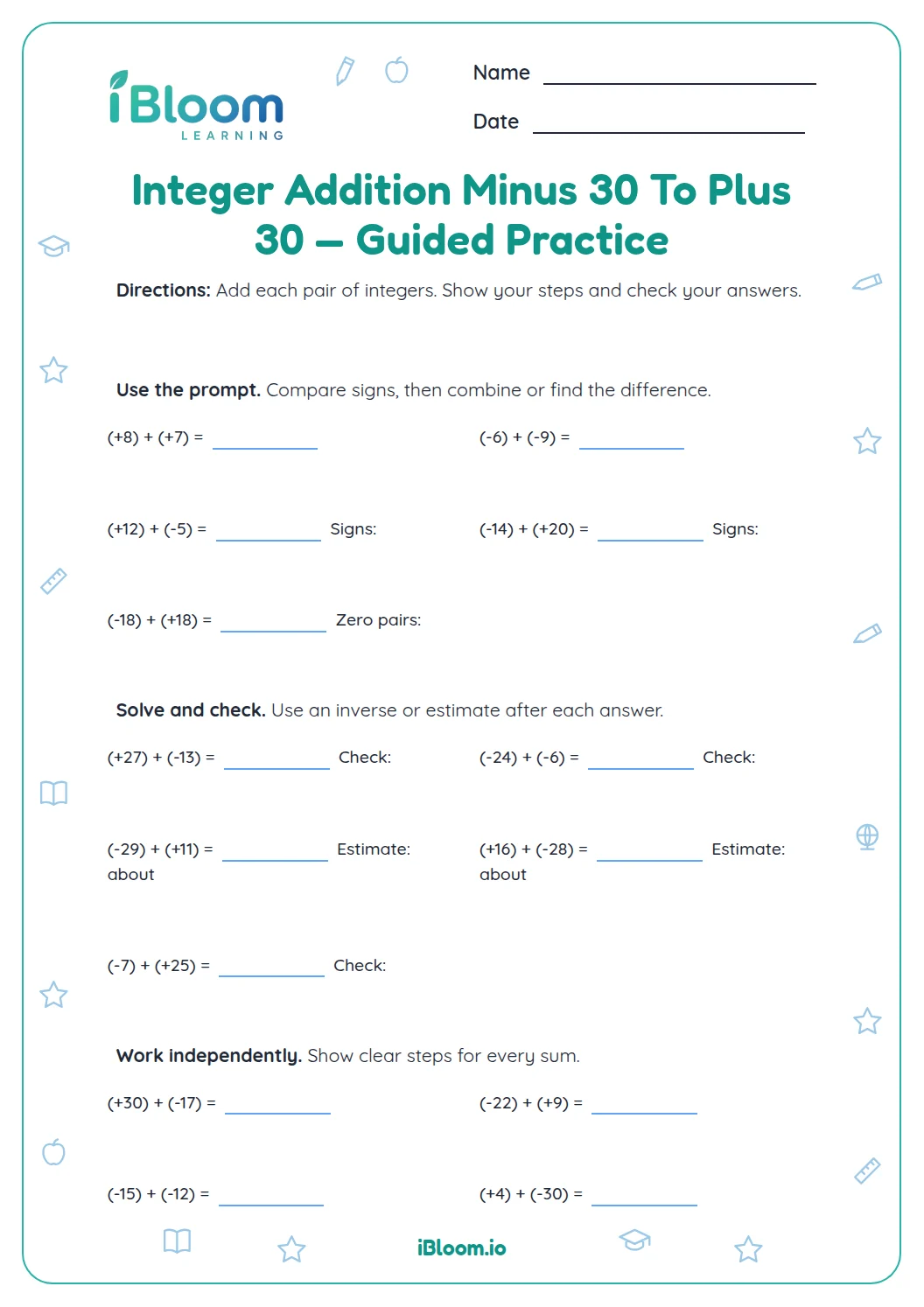
This Grade 6 integer worksheet gives 16 missing-addend questions, beginning with two number-line models and moving to equations and real-world signed changes. Students identify the signed jump from a starting integer to a sum, then use inverse addition to solve more challenging blanks. A separate answer key supports checking. The number-line work practices Common Core 7.NS.A.1.b.
Aligned to 7.NS.A.1.b
How does a number line show the missing addend?
A positive addend moves right; a negative addend moves left. The distance between A and B tells how many units, and the direction tells the sign.
In question 1, A is at −6 and B is at 4. Moving from −6 to 4 is 10 units right, so the missing addend is 10.
- 1Start at A = −6.
- 2Move right to B = 4.
- 3The signed jump is +10.
- 4−6 + 10 = 4.
How can inverse addition find a blank?
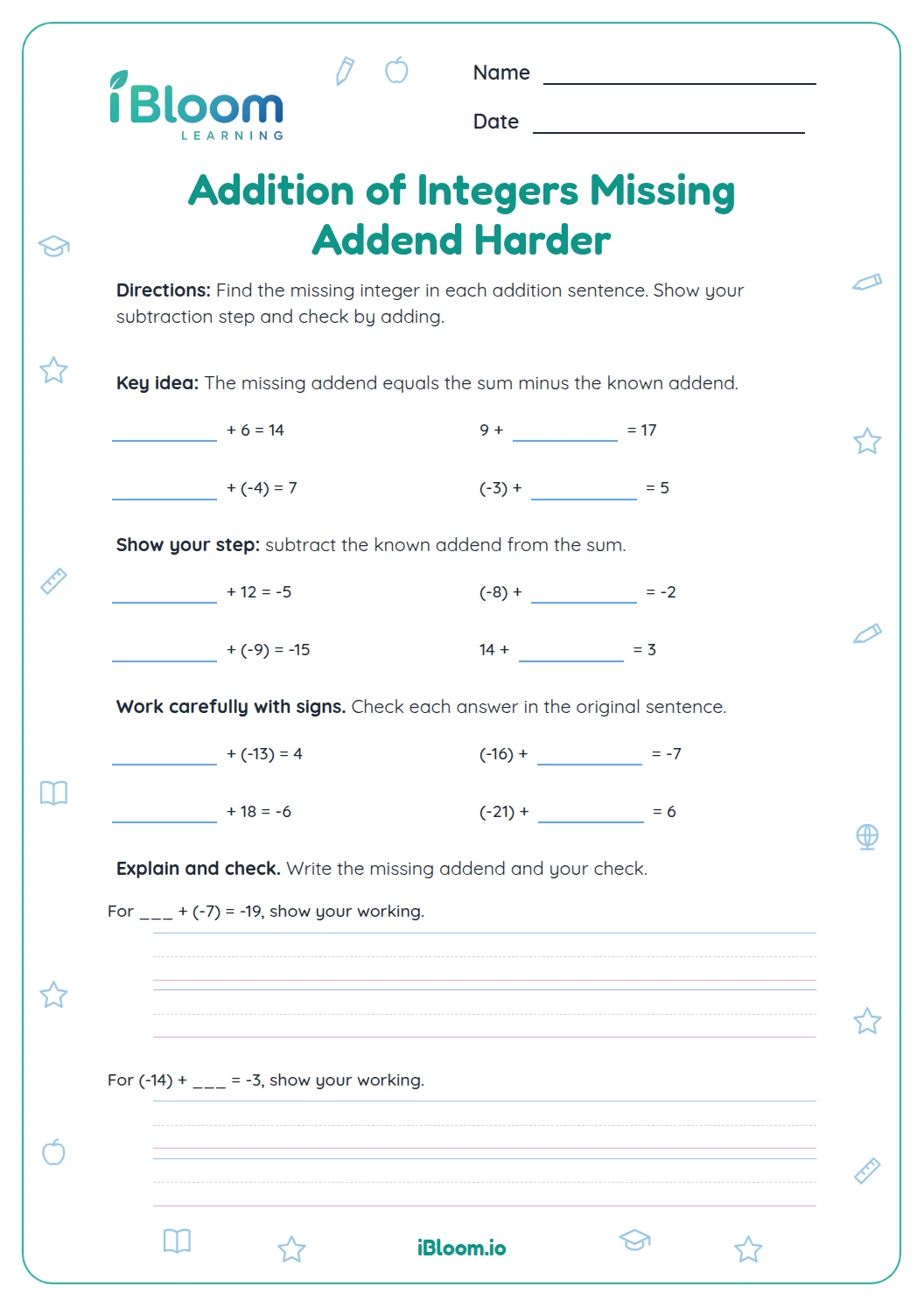
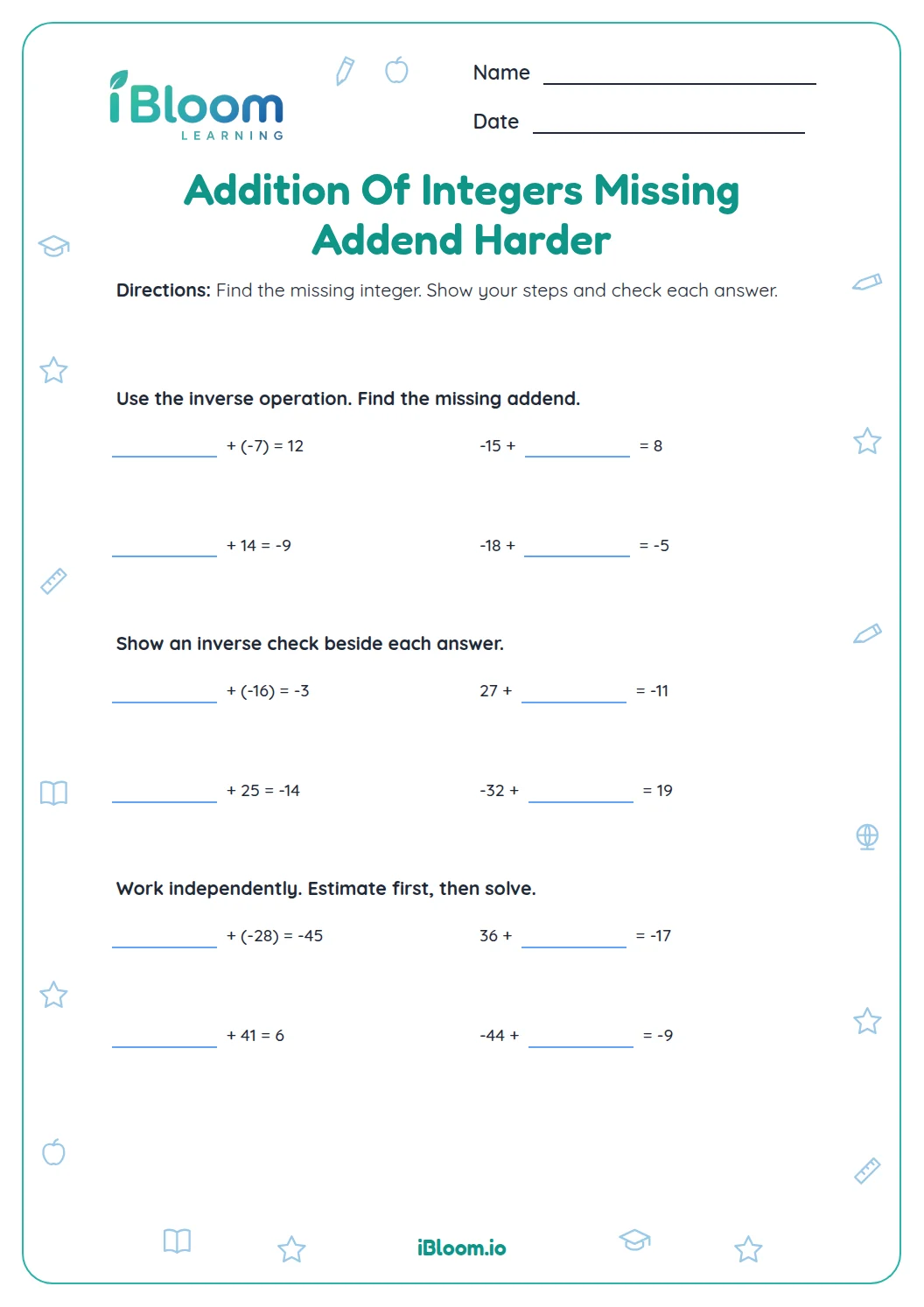
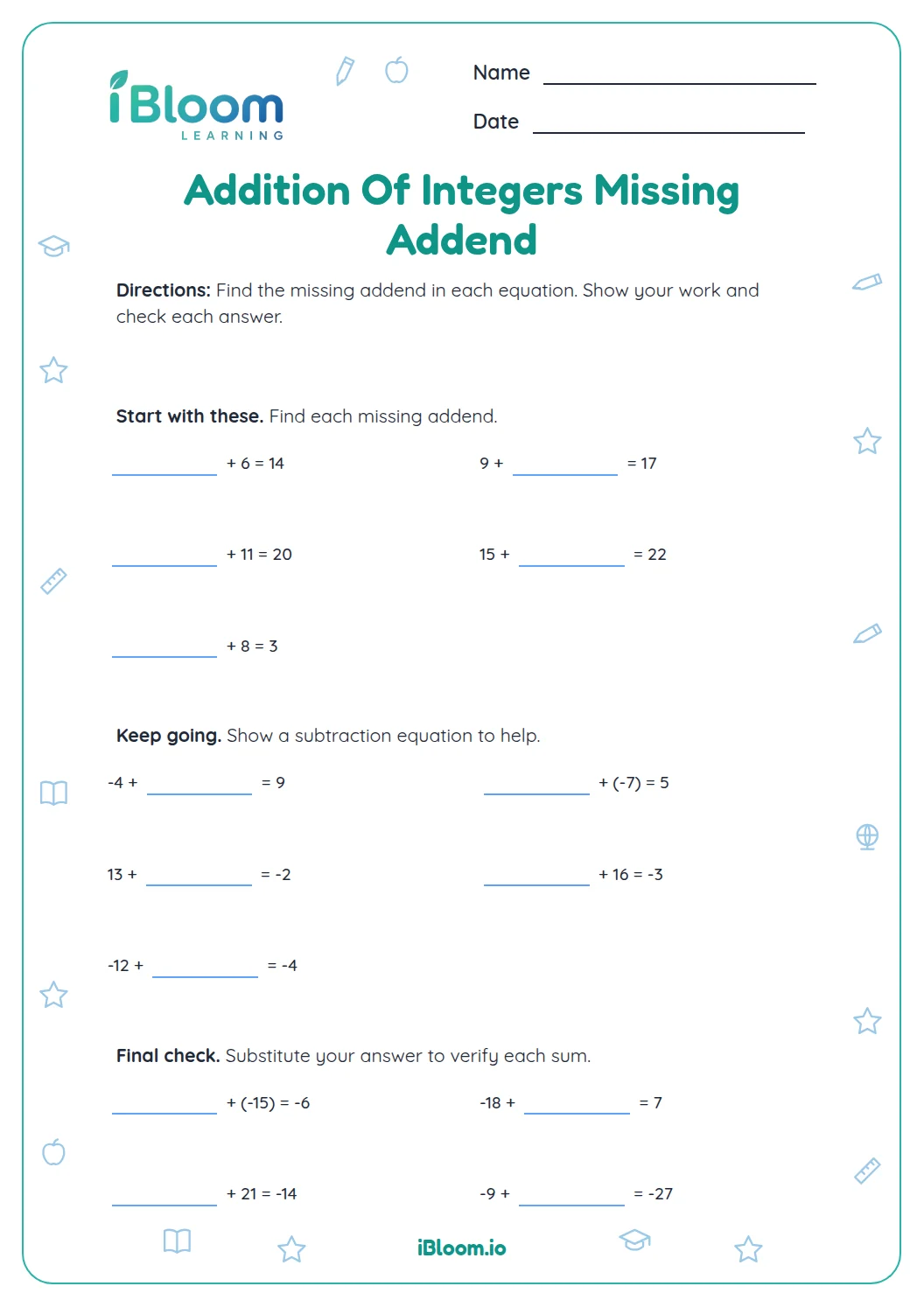
If a blank plus a known addend equals a sum, subtract the known addend from the sum to find the blank. Then substitute your result to check the equation.
Question 5, −14 + ___ = 9, needs an addend that moves from −14 up to 9, a positive jump of 23.
How do signed changes work in a story?
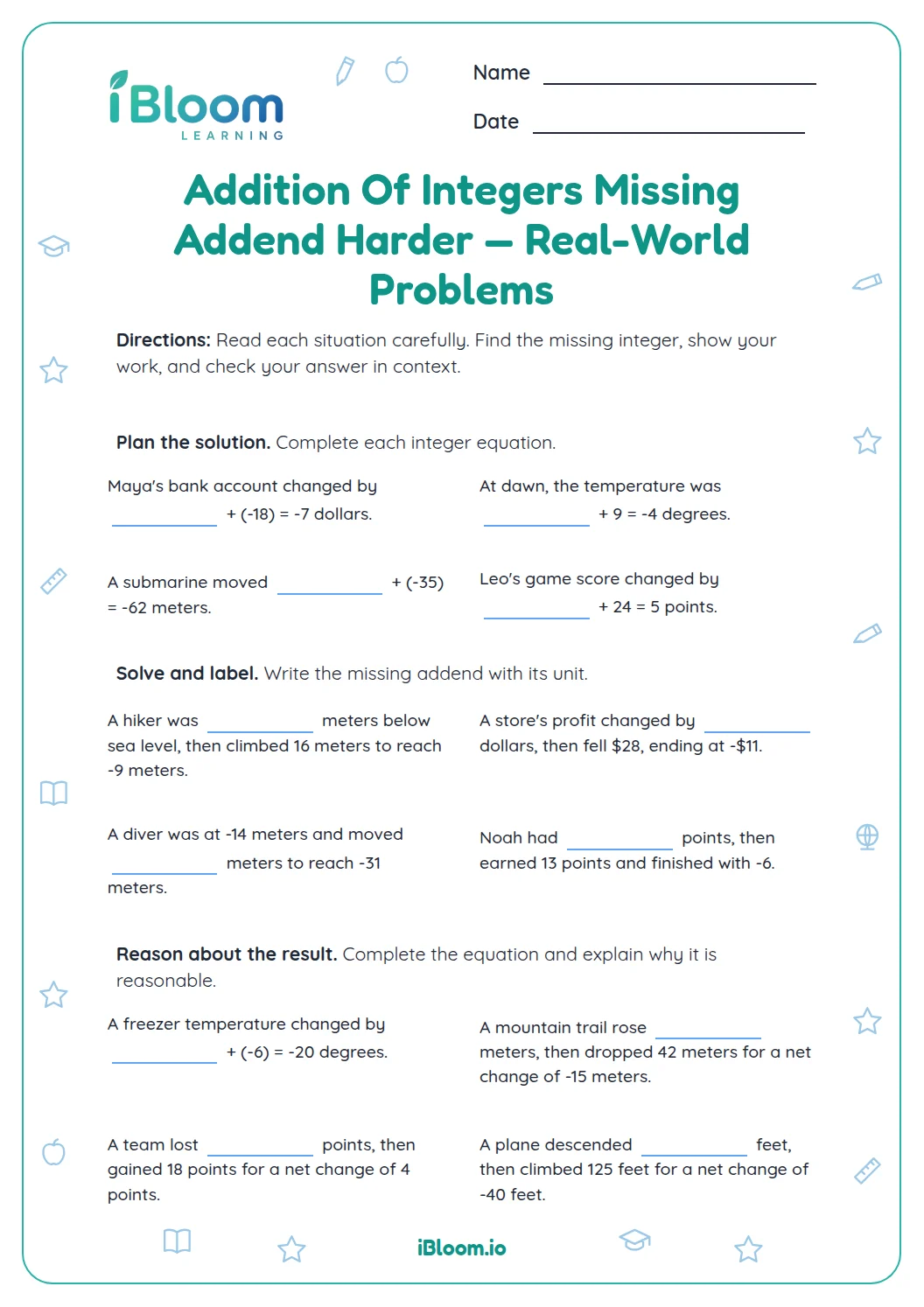
Find the ending value minus the starting value. A positive result means the value increased; a negative result means it decreased.
For question 13, a hiker goes from −18 m to 7 m: 7 − (−18) = 25, so the change is +25 m.
How to use this worksheet
- 1On a number line, identify the starting value A and ending value B.
- 2Count the distance between them and note whether the jump goes left or right.
- 3For an equation, undo the known addend with subtraction.
- 4Check by substituting the missing integer back into the sum.
- 5For a story, compute ending value minus starting value.
Common slips and helpful fixes
The mistake
Using distance only and forgetting the sign.
The fix
Check whether the jump moves left or right.
The mistake
Subtracting the known addend in the wrong order.
The fix
Isolate the blank: sum minus known addend.
The mistake
Treating a negative start as positive.
The fix
Mark the starting point first, then count the jump from there.
Common Core alignment
These activities practice the stated Common Core skill through the worksheet questions.
Use signed jumps on a number line to find an integer addend.
On this sheet: Students find the signed jump from a starting integer to a sum and solve related equations.
Show the official wordingHide the official wording
Understand p + q as the number located a distance |q| from p, in the positive or negative direction depending on whether q is positive or negative. Show that a number and its opposite have a sum of 0 (are additive inverses). Interpret sums of rational numbers by describing real-world contexts.
What to practice next
Make more practice
Further reading
Questions parents and teachers ask
How do I read the number-line questions?
Point A is the starting integer and point B is the sum. Count the units from A to B: a move right is positive, and a move left is negative. That signed distance is the missing addend. For the first model, moving from −6 to 4 is a jump of +10.
Why does a missing addend use subtraction?
Subtraction reverses addition. If a blank plus a known integer equals a sum, subtract the known addend from the sum to find the blank. Then check by adding your result back. For example, __ + (−16) = 12 has the solution 28 because 28 + (−16) = 12.
How should students read the negative signs?
Read a value such as −6 as “negative six.” In an equation, distinguish that sign, which belongs to the number, from the operation sign between two values. The number-line models help show that negative integers lie to the left of zero.
What does change mean in the story questions?
Change is the ending value minus the starting value. A positive result means the value increased; a negative result means it decreased. Moving from 12 meters to −9 meters is a change of −21 meters because −9 − 12 = −21.
How many models and practice questions are there?
There are 16 questions: two number-line models, ten missing-addend equations, and four signed-change situations. They are spread across two worksheet pages, with a separate two-page answer key. Students can check each equation by substituting the missing integer and adding; the models show signed differences.