





About this worksheet
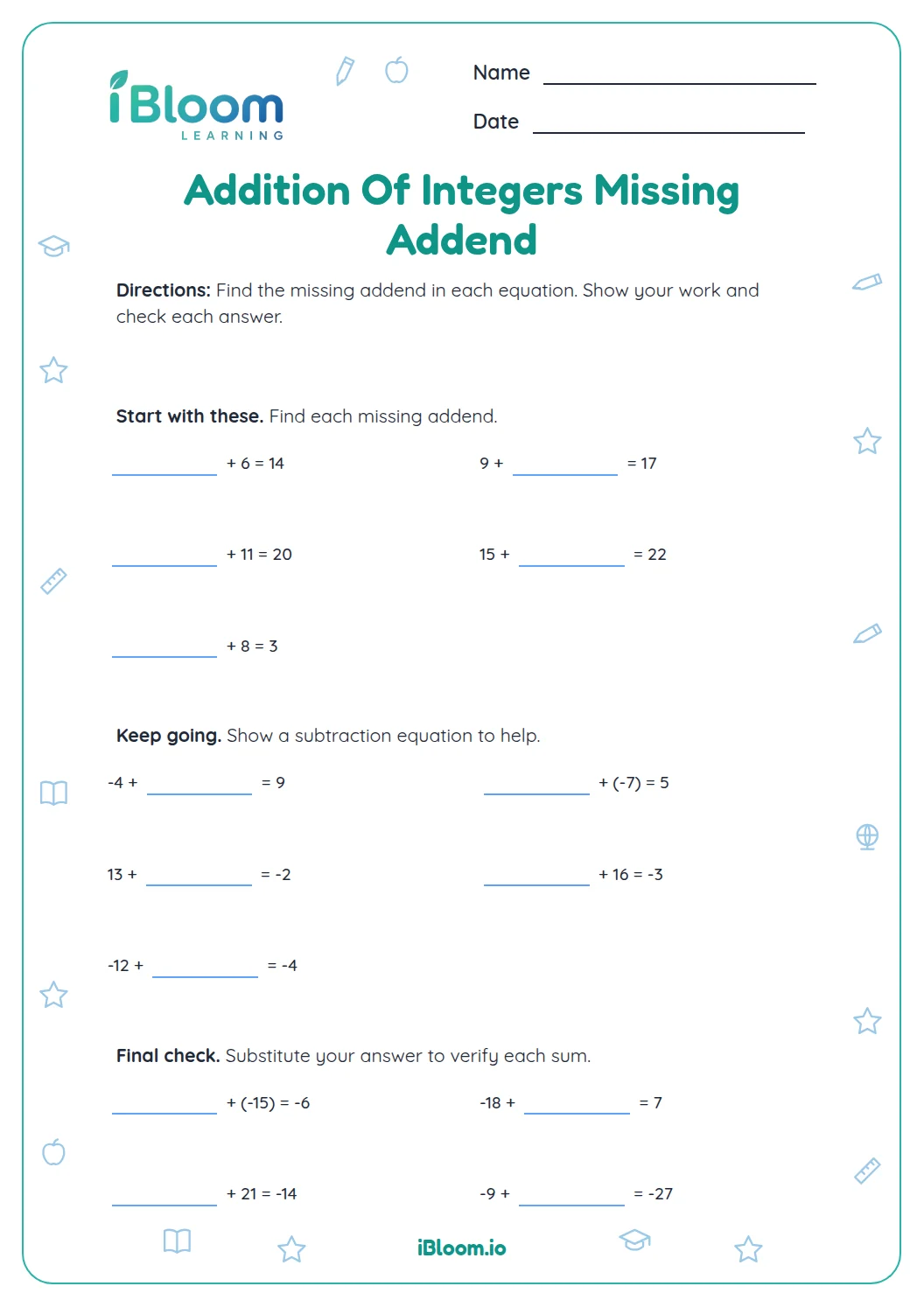
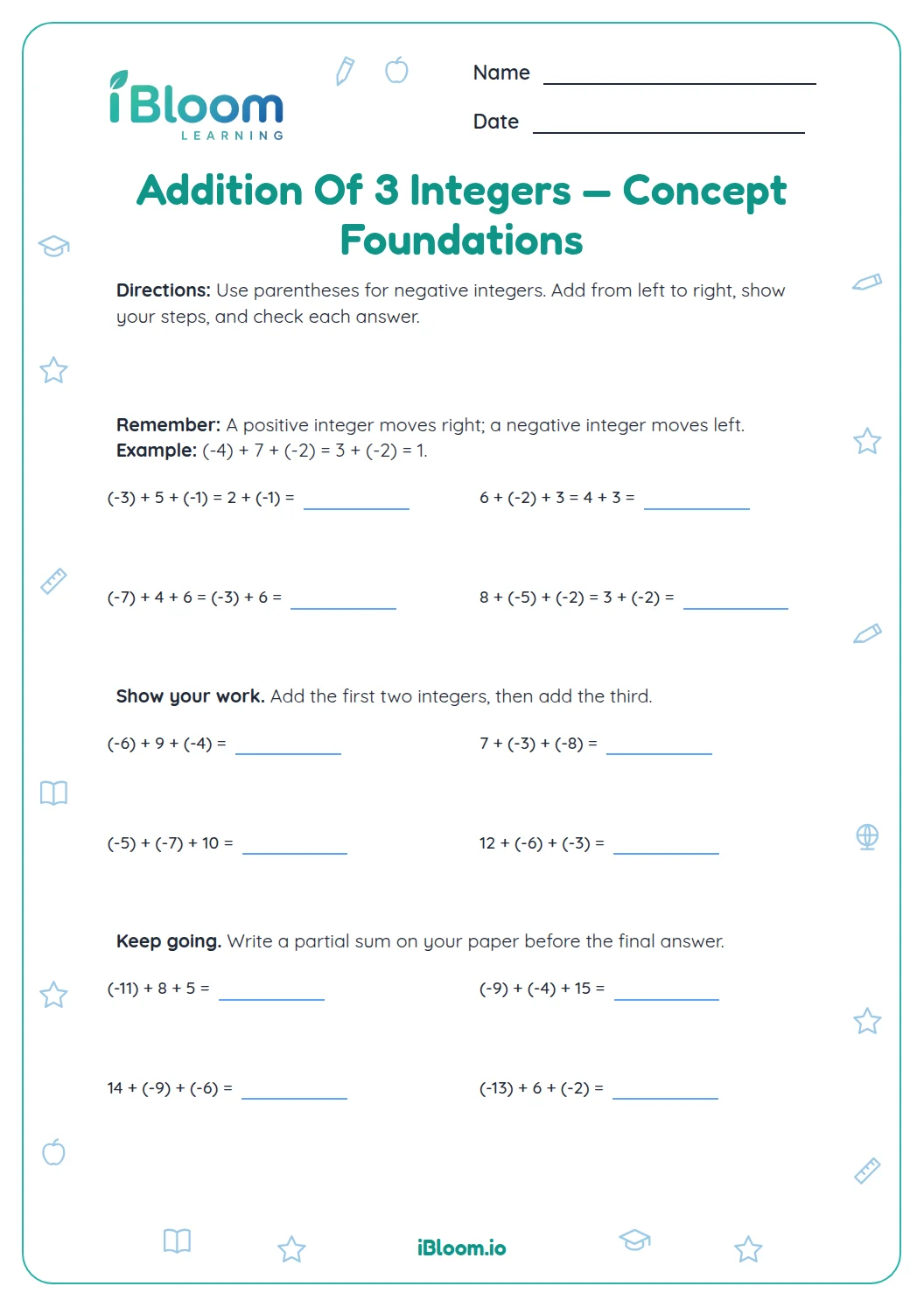
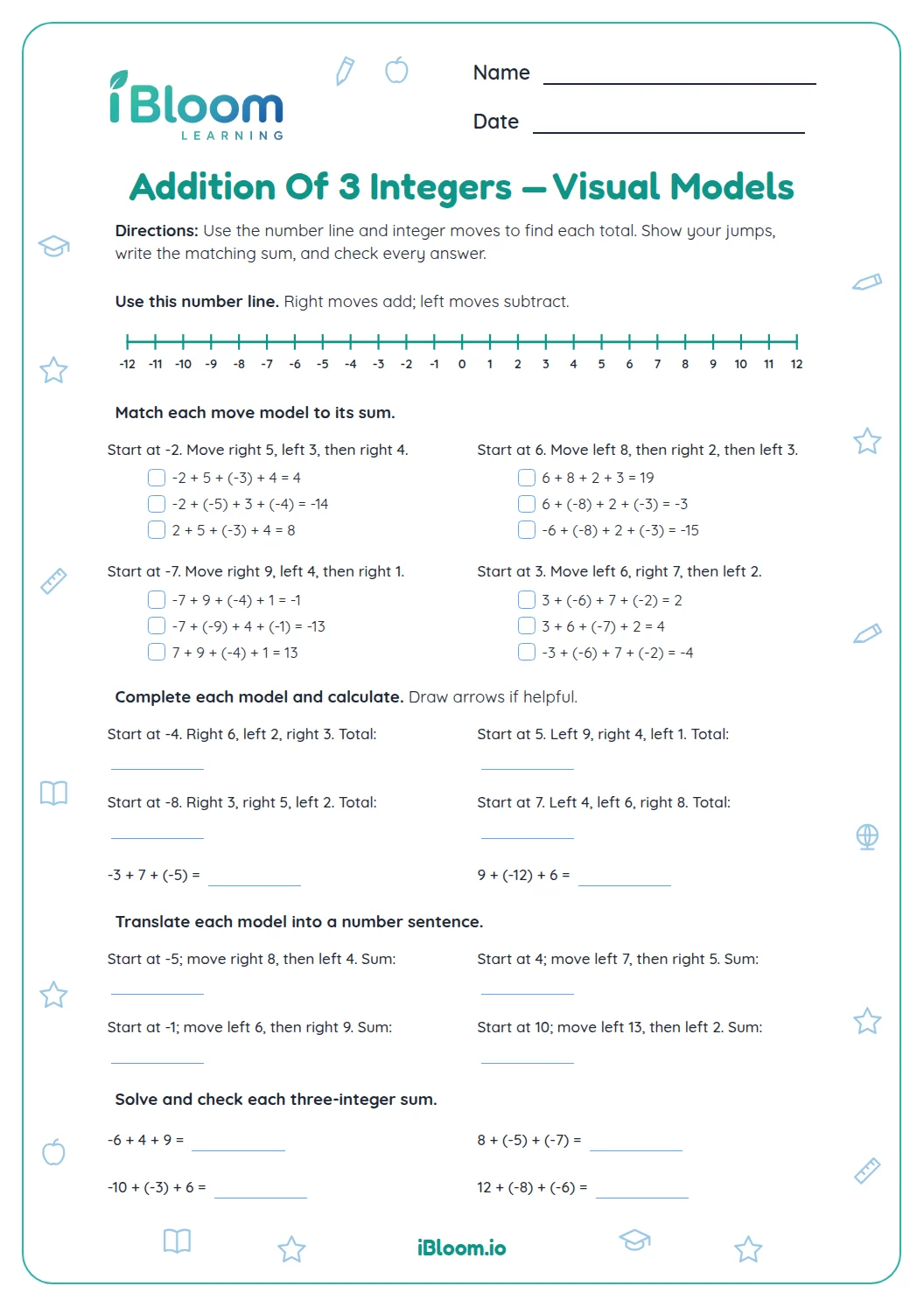
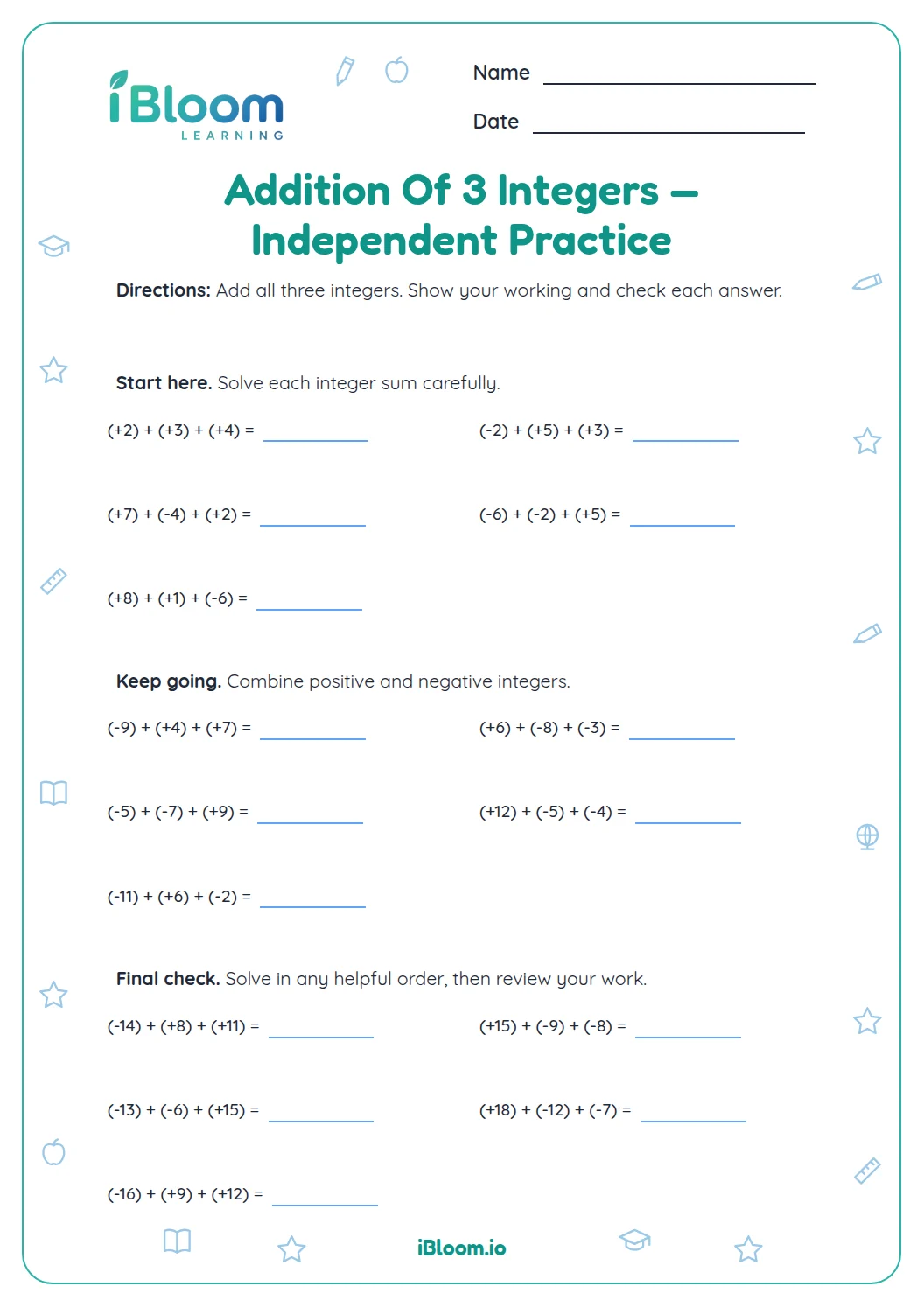
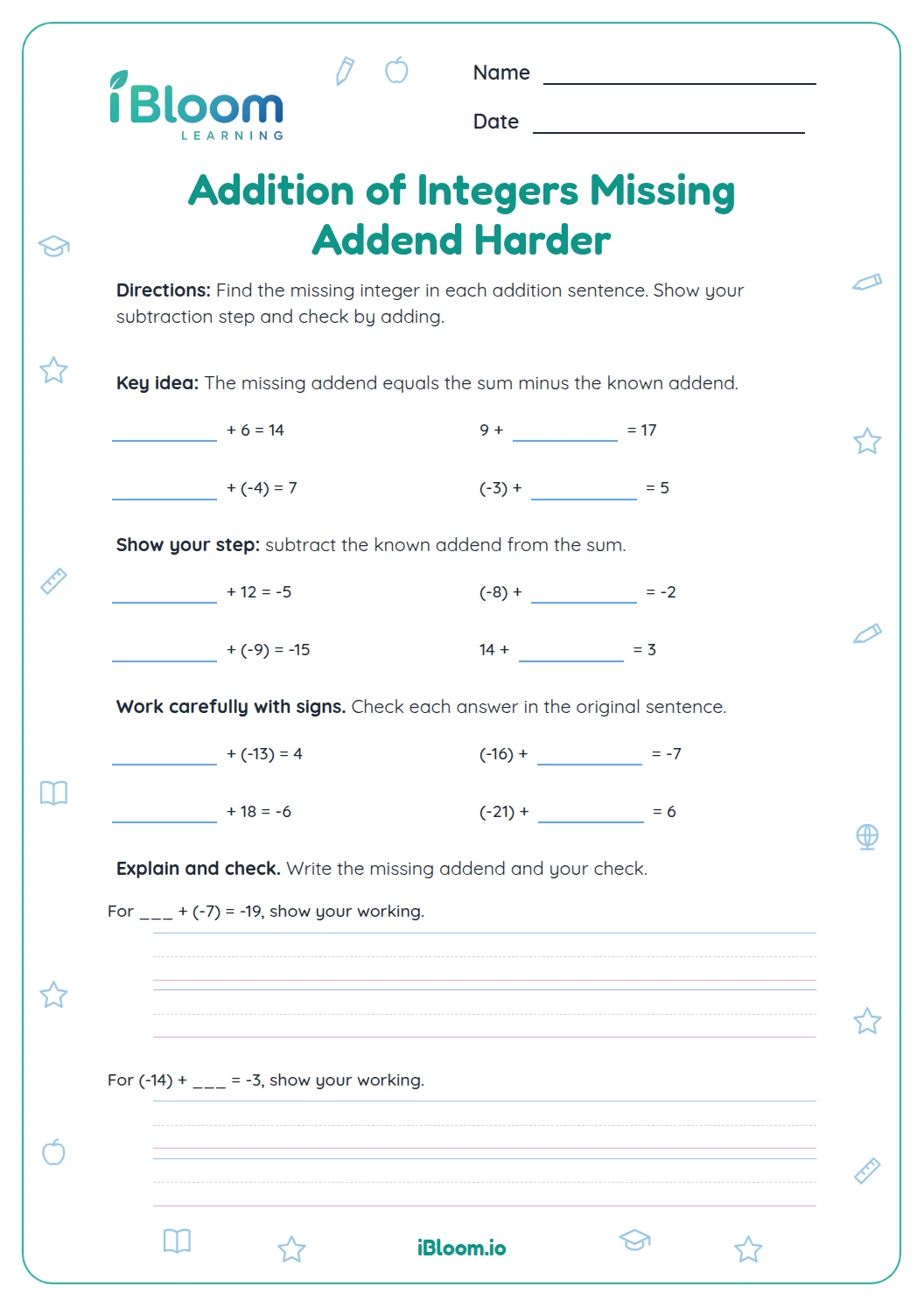
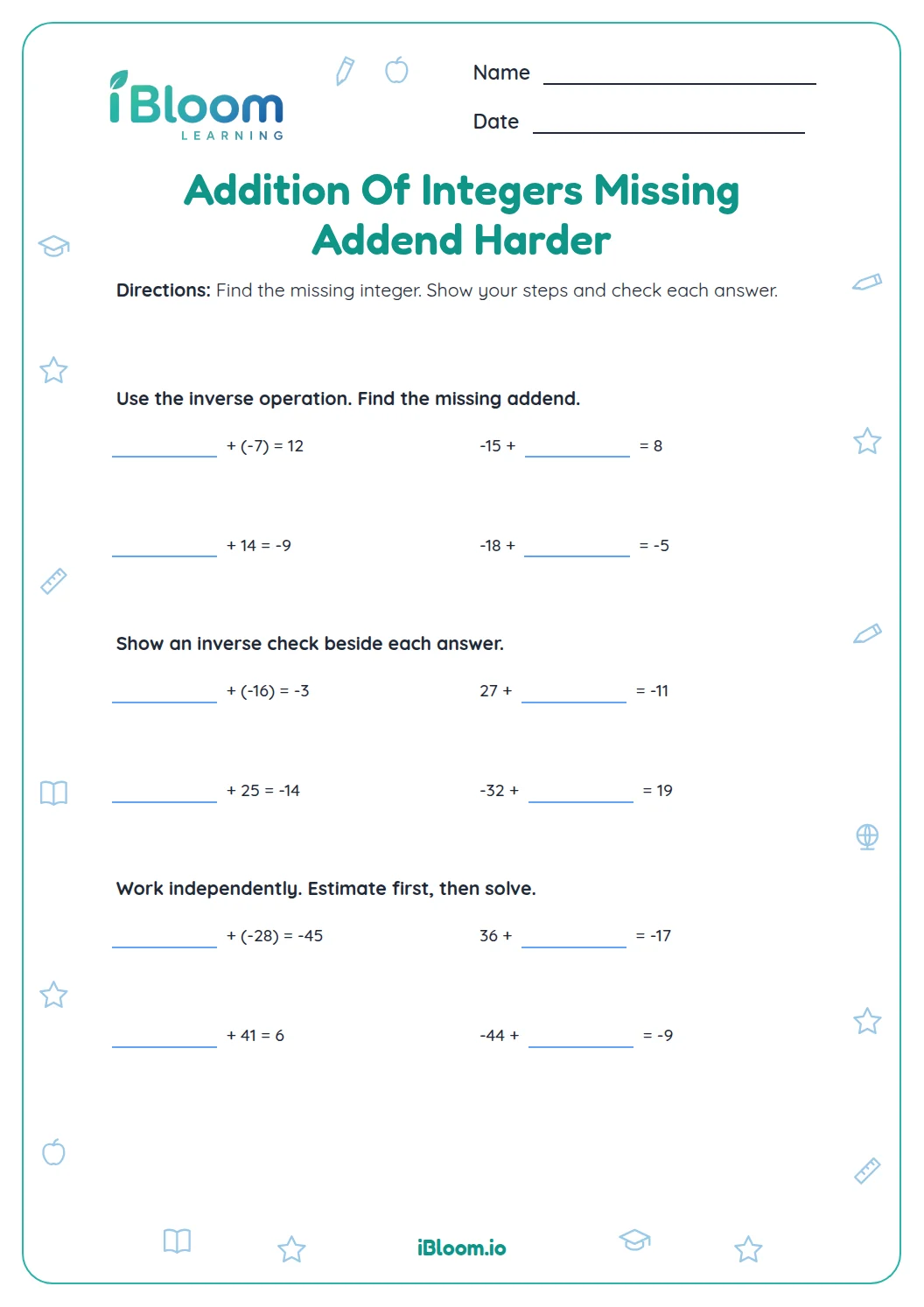
This Grade 6 printable gives learners 14 addition equations with positive and negative integers and missing addends. Two questions include number-line models; the remaining equations build practice finding an unknown addend and checking the signed sum. A separate answer key lists each missing value.
How does a number line show an addend?
A number line shows addition as movement from a starting value to a sum. A positive addend moves right; a negative addend moves left.
In question 1, the move from −4 to 3 is seven units to the right, so the missing addend is +7.
- 1−4 + ___ = 3
- 2Start at −4 and finish at 3.
- 3Move 7 units right.
- 4Missing addend = +7
How can I solve without a model?
Use subtraction to undo the known addend: missing addend = sum − known addend. Keep track of subtracting a negative, which is the same as adding its opposite.
How can I check the answer?
Substitute the missing value into the original equation and add. The result should match the given sum, including its sign.
How to use this worksheet
- 1Identify the starting value and the sum.
- 2Use the number line to see the direction of movement.
- 3Subtract the known addend from the sum.
- 4Pay attention when the known addend is negative.
- 5Substitute your value and check the equation.
Common mistakes and quick fixes
The mistake
Using the distance as the addend without checking its sign.
The fix
Compare the start and sum: moving right is positive, and moving left is negative.
The mistake
Subtracting a negative as though it were positive.
The fix
Use sum − known addend; subtracting a negative is adding its opposite.
The mistake
Changing the given sum while solving.
The fix
Keep the sum fixed and substitute the missing value to check the equation.
What to practice next
Make more practice
Questions parents and teachers ask
What is a missing addend?
A missing addend is the number that completes an addition equation. In −4 + ___ = 3, the value is +7 because moving seven units right from −4 lands on 3. The worksheet uses two number-line models and more signed equations for practice.
How many number lines are included?
Two questions include number-line models, and the worksheet has 14 missing-addend equations altogether. The first model shows the move from −4 to 3; the second shows the move from −6 to 8. The remaining items can be solved with subtraction and checked by adding.
How do I find the missing addend without a model?
Subtract the known addend from the sum: missing addend = sum − known addend. For example, if ___ + (−9) = −3, calculate −3 − (−9) = 6. Substitute 6 back into the equation to confirm that the sum is −3.
Why does the sign of the answer matter?
An addend records both the size and direction of a change. A move right on the number line is positive, and a move left is negative. The number of spaces gives the distance, while the direction determines the sign of the missing addend.
How can a learner check an answer?
Put the missing integer back into the original equation and add. For example, −4 + 7 = 3, so +7 completes the first question. On a number-line model, also check that the direction and number of unit steps connect the starting point to the sum.