





About this worksheet
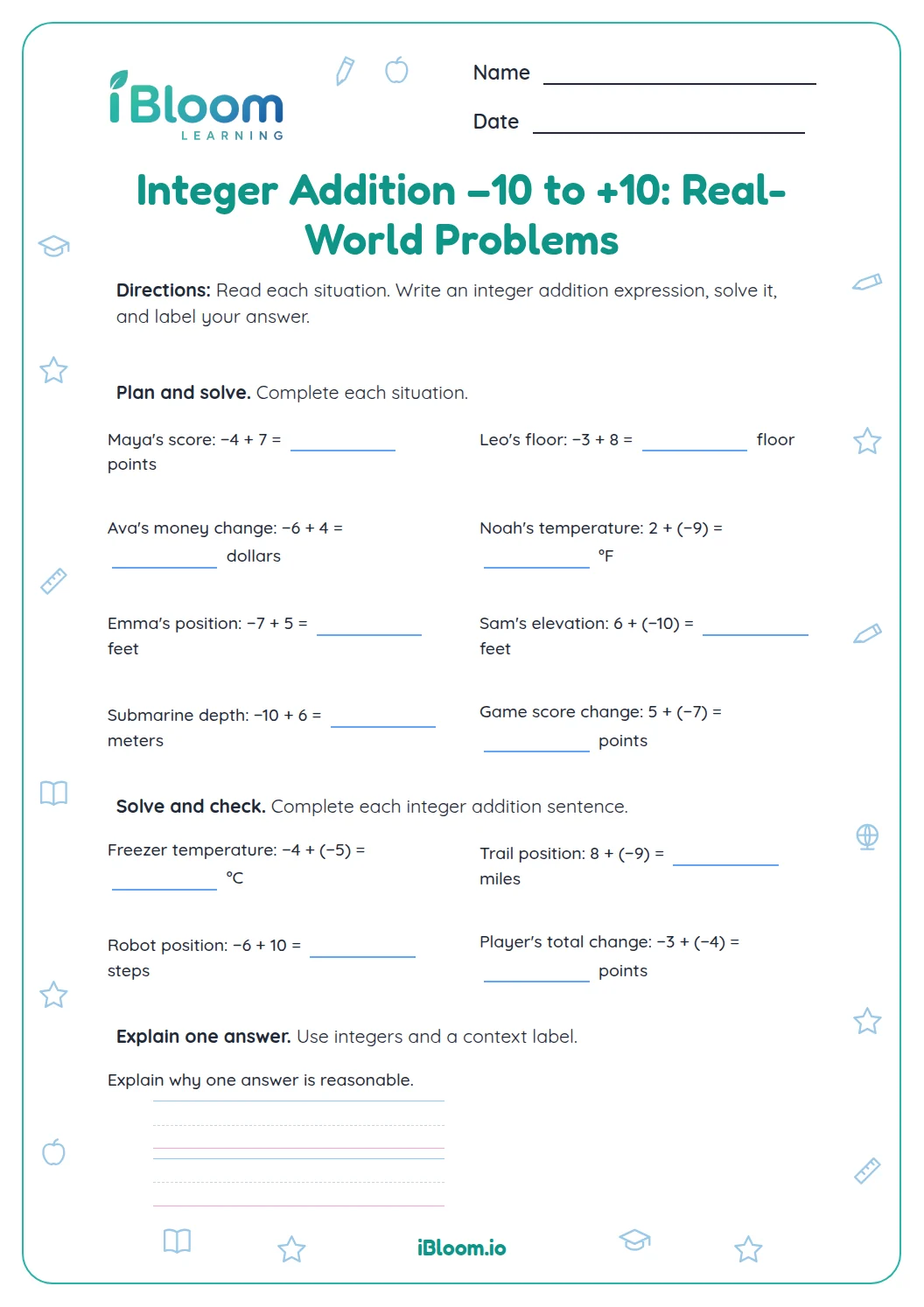
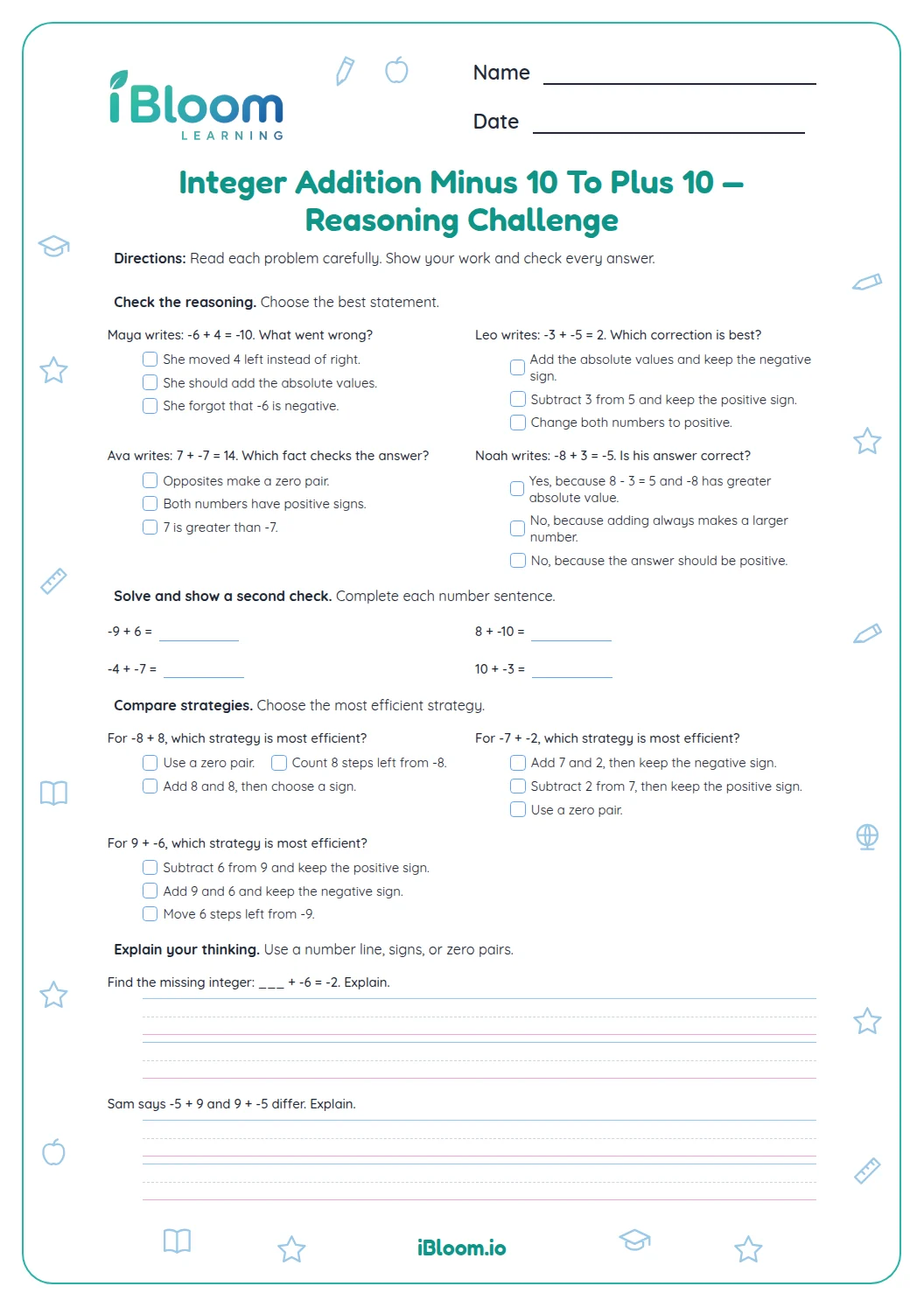
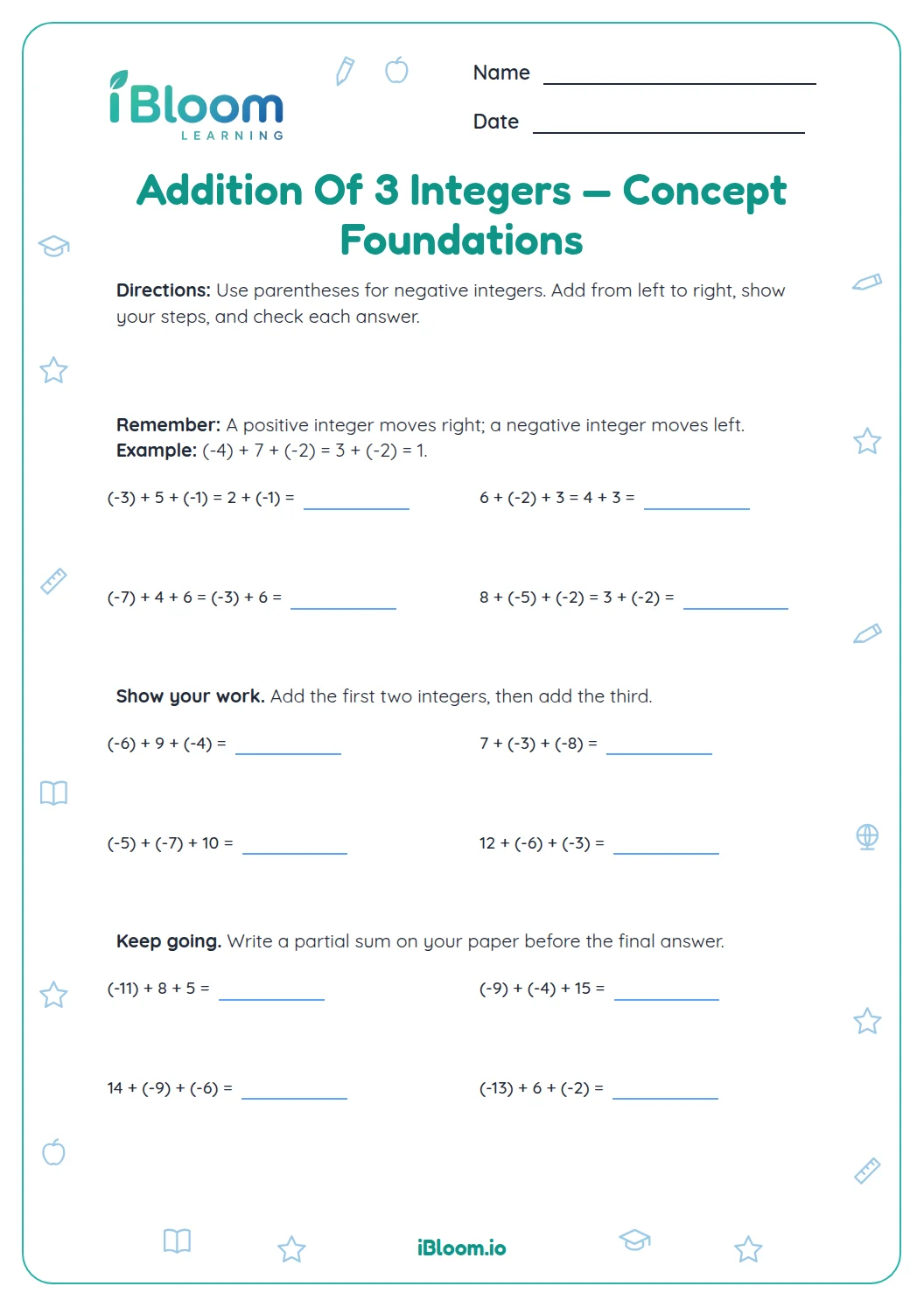
This free Grade 6 printable practices adding positive and negative integers from −10 to +10. Part A connects a starting value and a signed move to an endpoint on a number line. Part B builds fluency with nine sums, including zero and same-sign addends. Part C applies signed addition to temperature, a score, and an elevator floor. A separate answer key is included.
Aligned to 6.NS.C.5
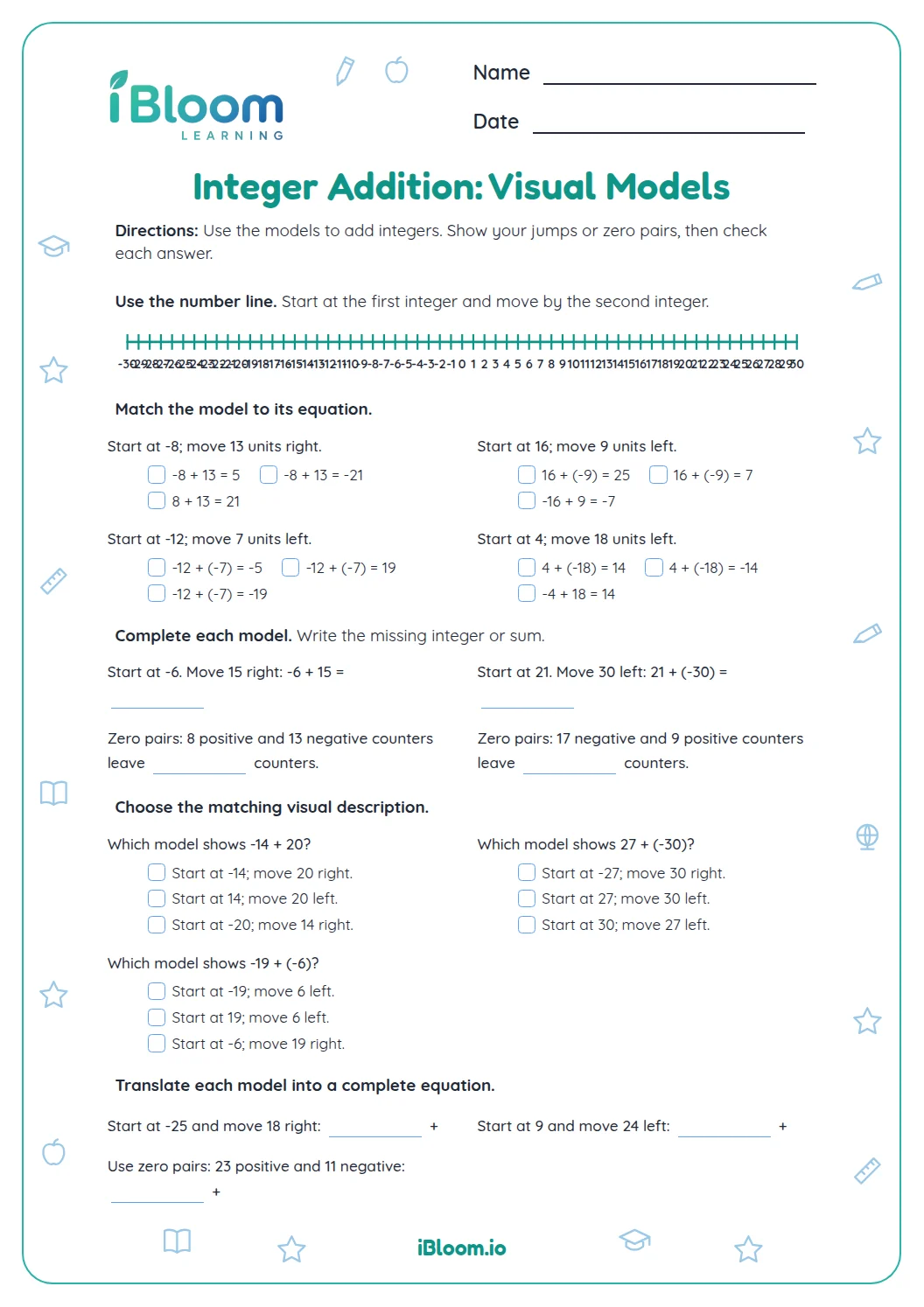
How do the number-line models show a sum?
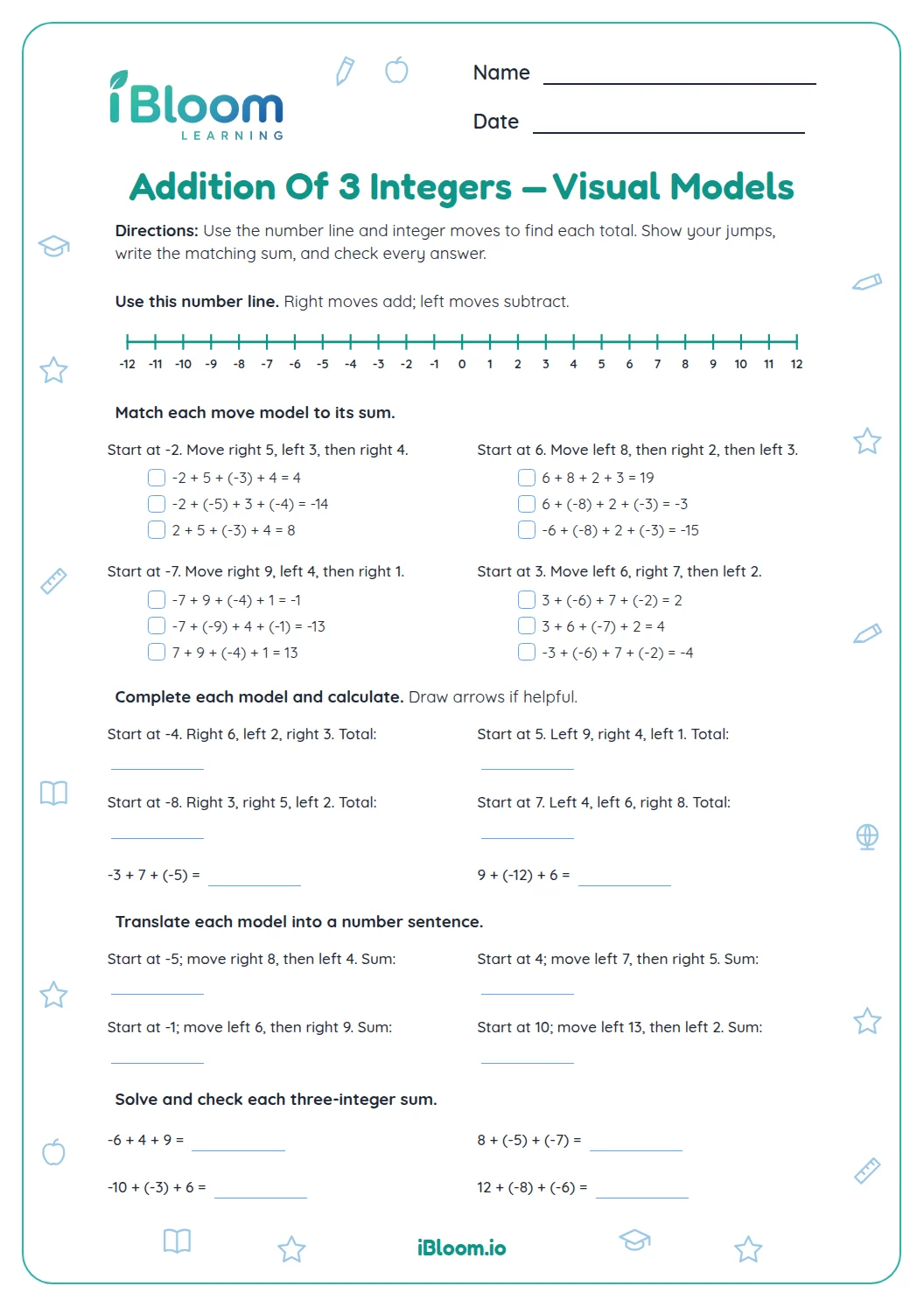
Use the labeled starting point, then follow the signed move: positive means right and negative means left. The endpoint is the sum.
In question 1, start at −4 and move 7 units right. The endpoint is 3, so −4 + 7 = 3.
How do you add integers with different signs?
When the signs differ, compare the distances from zero and subtract the smaller distance from the larger. Keep the sign of the addend farther from zero. In 9 + (−7), the result is 2.
How can a signed sum describe a change?
Write the starting value plus the signed change. A temperature at −6°F that rises 9°F is −6 + 9 = 3°F. Keep the unit and the context attached to the result.
How to use this worksheet
- 1Read the first addend as the starting location.
- 2Use the sign of the second addend to choose left or right.
- 3Count one tick per unit, then record the landing value.
- 4For Part B, use the same jump reasoning without a printed line.
- 5For each situation, write an equation before solving.
- 6Check whether the final sign matches the direction and size of the change.
Common mistakes and quick fixes
The mistake
Treating a negative second addend as a move right.
The fix
A negative addend means move left; check the sign before counting.
The mistake
Adding absolute values for opposite signs.
The fix
Compare distances from zero and keep the sign of the addend farther from zero.
The mistake
Dropping the starting value in a situation.
The fix
Write start + change = result, then attach the context unit.
Common Core alignment
This page uses positive and negative values to model integer sums.
Use positive and negative values to describe opposite changes in each sum.
On this sheet: Integer number-line jumps model opposite directions; the last part applies changes to temperatures, positions and scores.
Show the official wordingHide the official wording
Understand that positive and negative numbers are used together to describe quantities having opposite directions or values (e.g., temperature above/below zero, elevation above/below sea level, credits/debits, positive/negative electric charge); use positive and negative numbers to represent quantities in real-world contexts, explaining the meaning of 0 in each situation.
What to practice next
Further reading
Questions parents and teachers ask
How do the number-line models show integer addition?
Each model names a starting integer and a move. For question 1, begin at −4 and move seven unit steps right; the endpoint is 3, so −4 + 7 = 3. The key lists the endpoint for both models, and students can check the direction and distance.
What kinds of sums are included?
Part B contains nine signed sums with positive and negative addends, including two negative addends and a sum of zero. The values include −10 and +10. Students compare distances from zero when signs differ, then keep the sign of the greater distance. The answer key lists every sum.
How should students solve the change situations?
Identify the starting value and signed change, then add them. For the temperature question, −6°F + 9°F = 3°F. The three contexts are temperature, a game score, and an elevator floor. Writing the signed equation helps preserve the direction and unit of the change.
Does the worksheet include an answer key?
Yes. The answer key is a separate two-page printable. It gives the endpoints, sums, and context answers so students can check each response after finishing a section and revisit a move or sign that led to an error. It is useful for correction after independent work.
What does the “minus 10 to plus 10” range mean here?
The addends and starting values use integers in the stated range, including −10 and +10. Some sums and final positions fall outside that interval; for example, −10 + (−7) equals −17. The range describes the integers used in the practice, not a limit on every result.