




About this worksheet
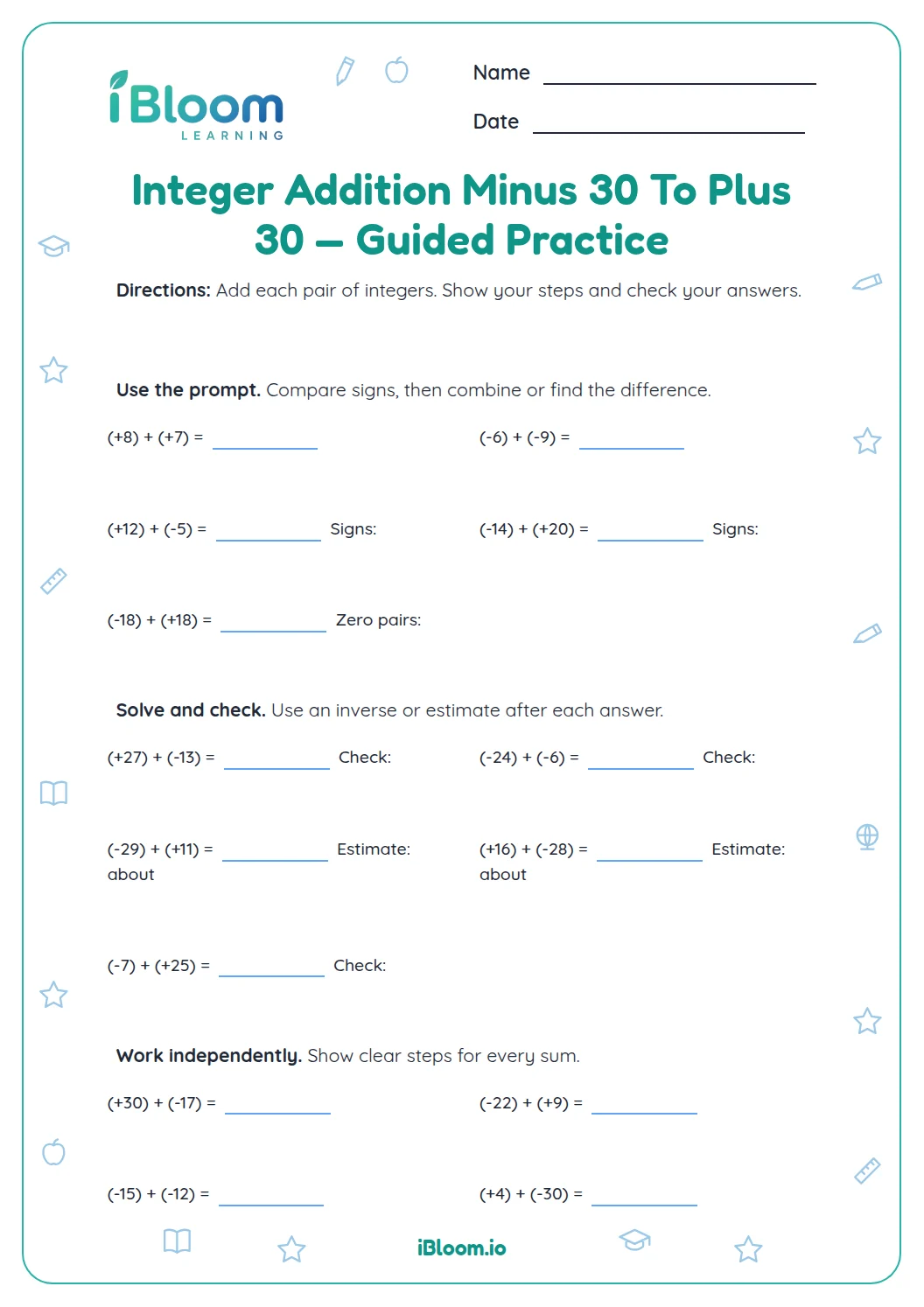
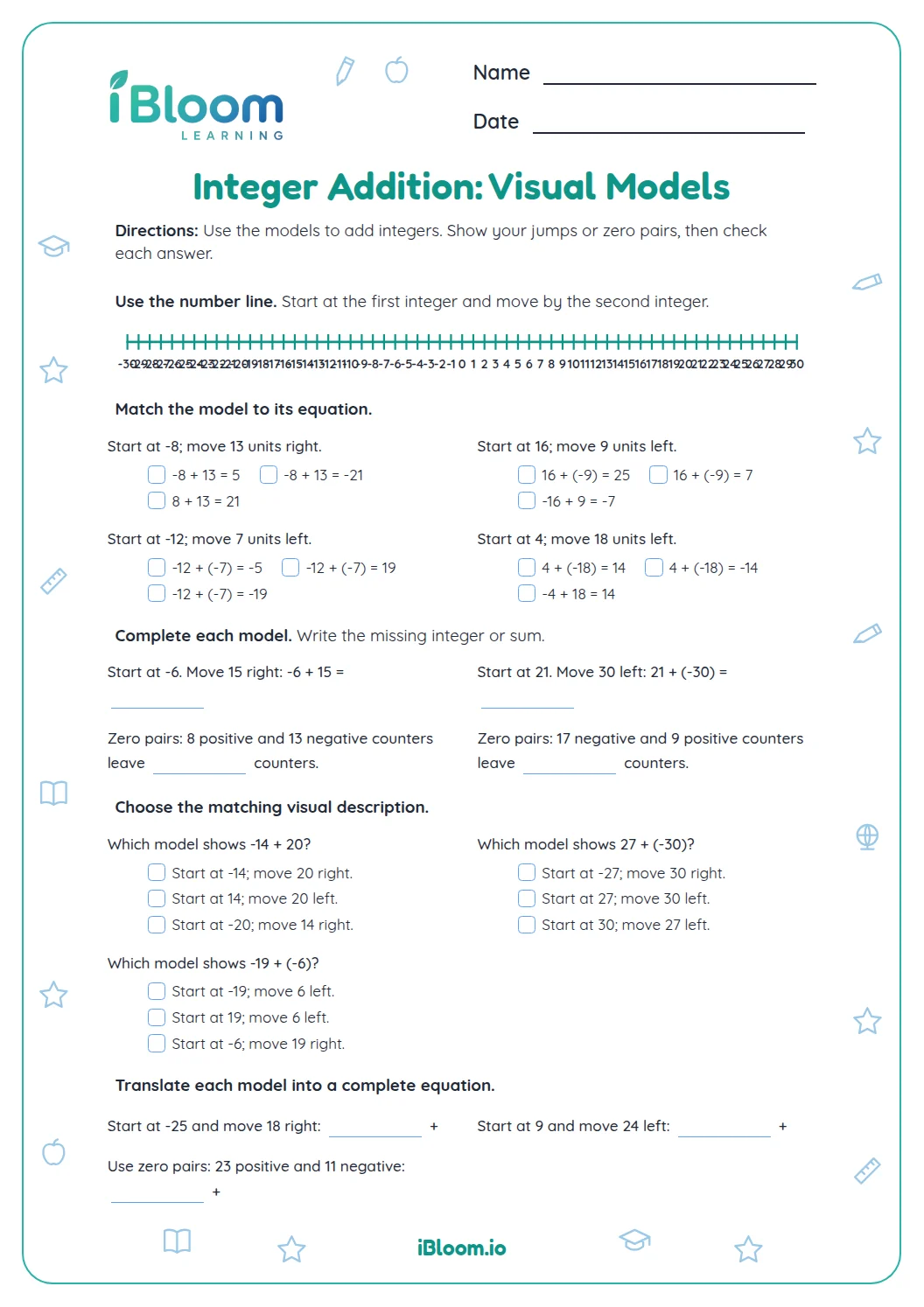
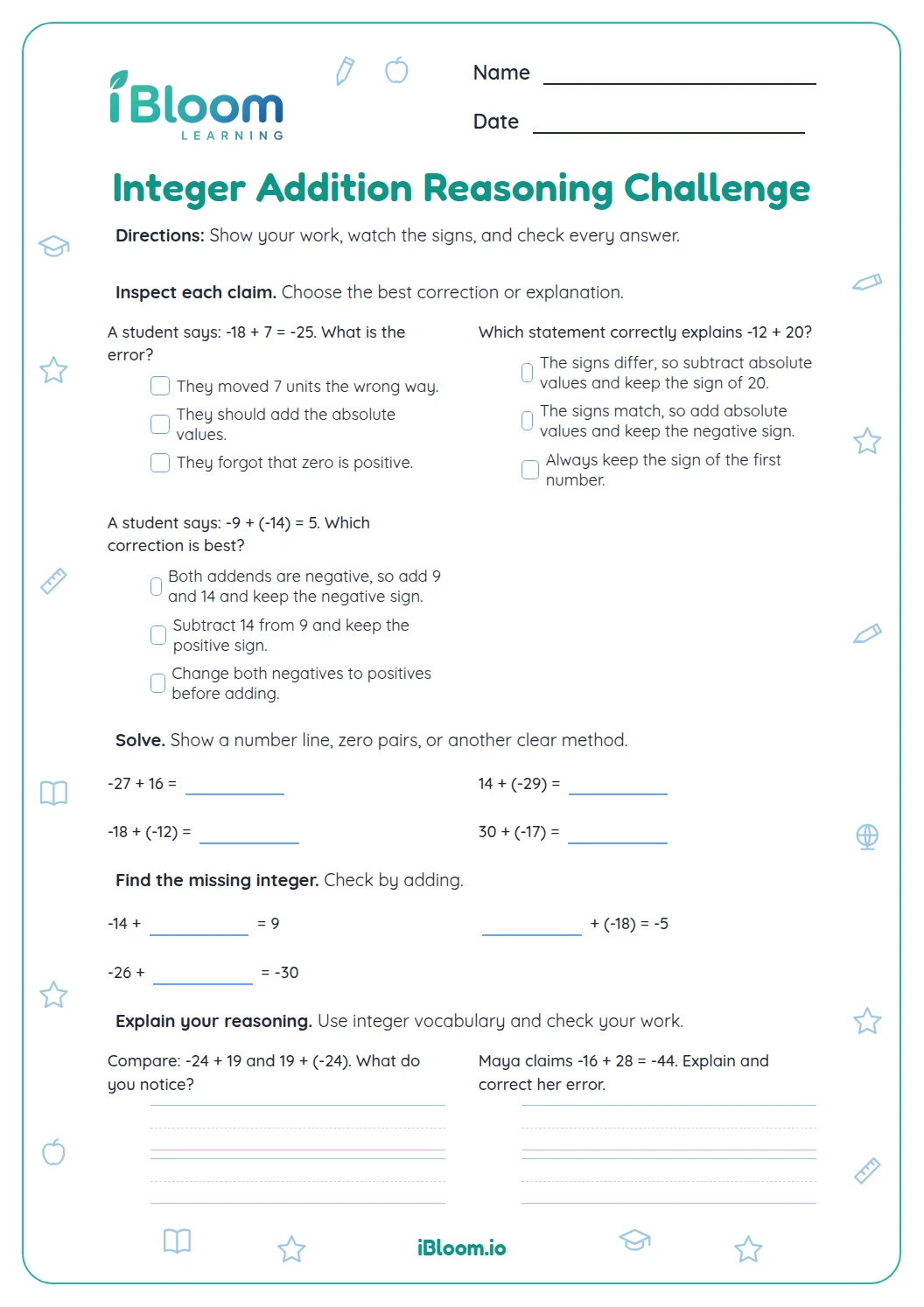
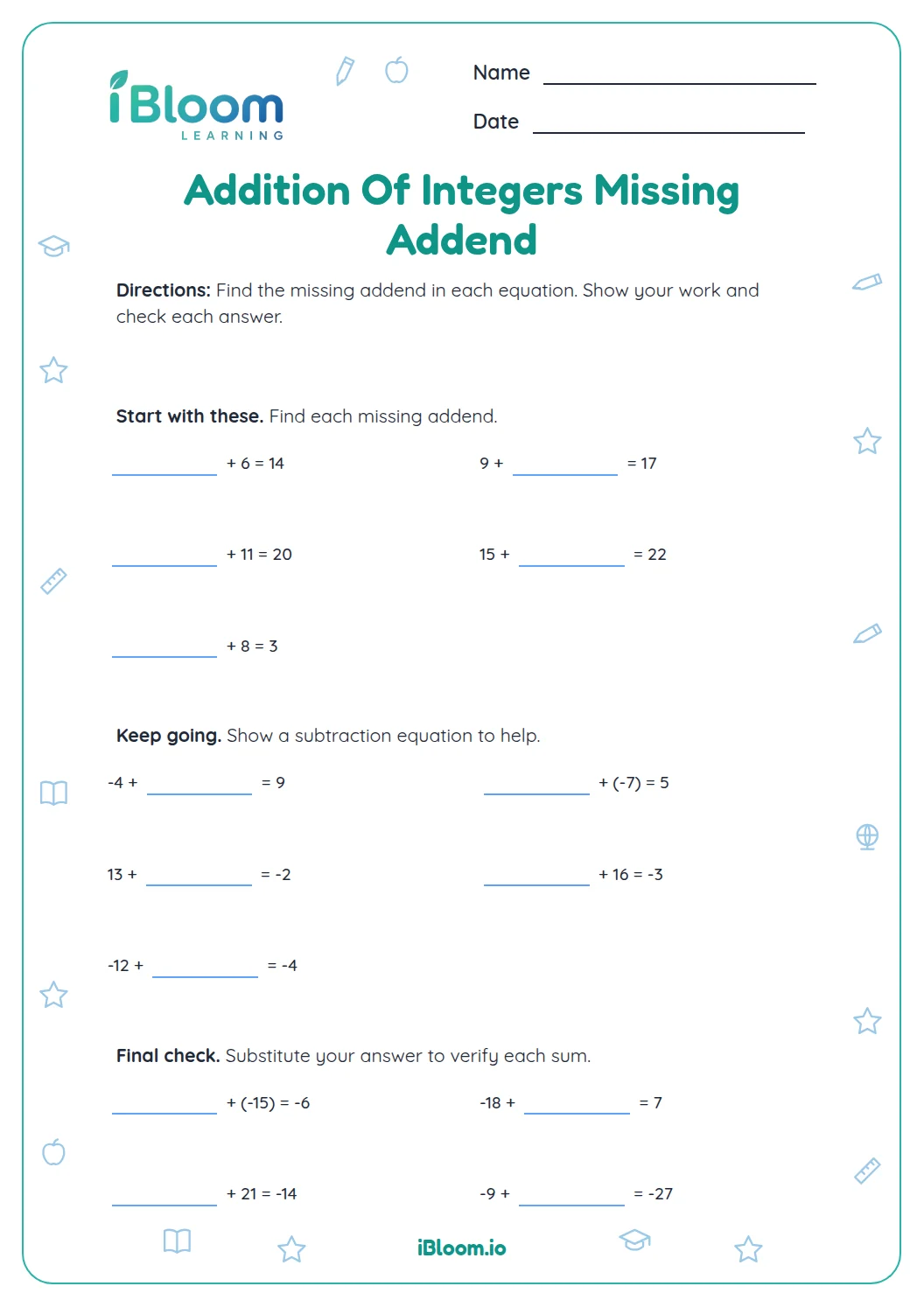
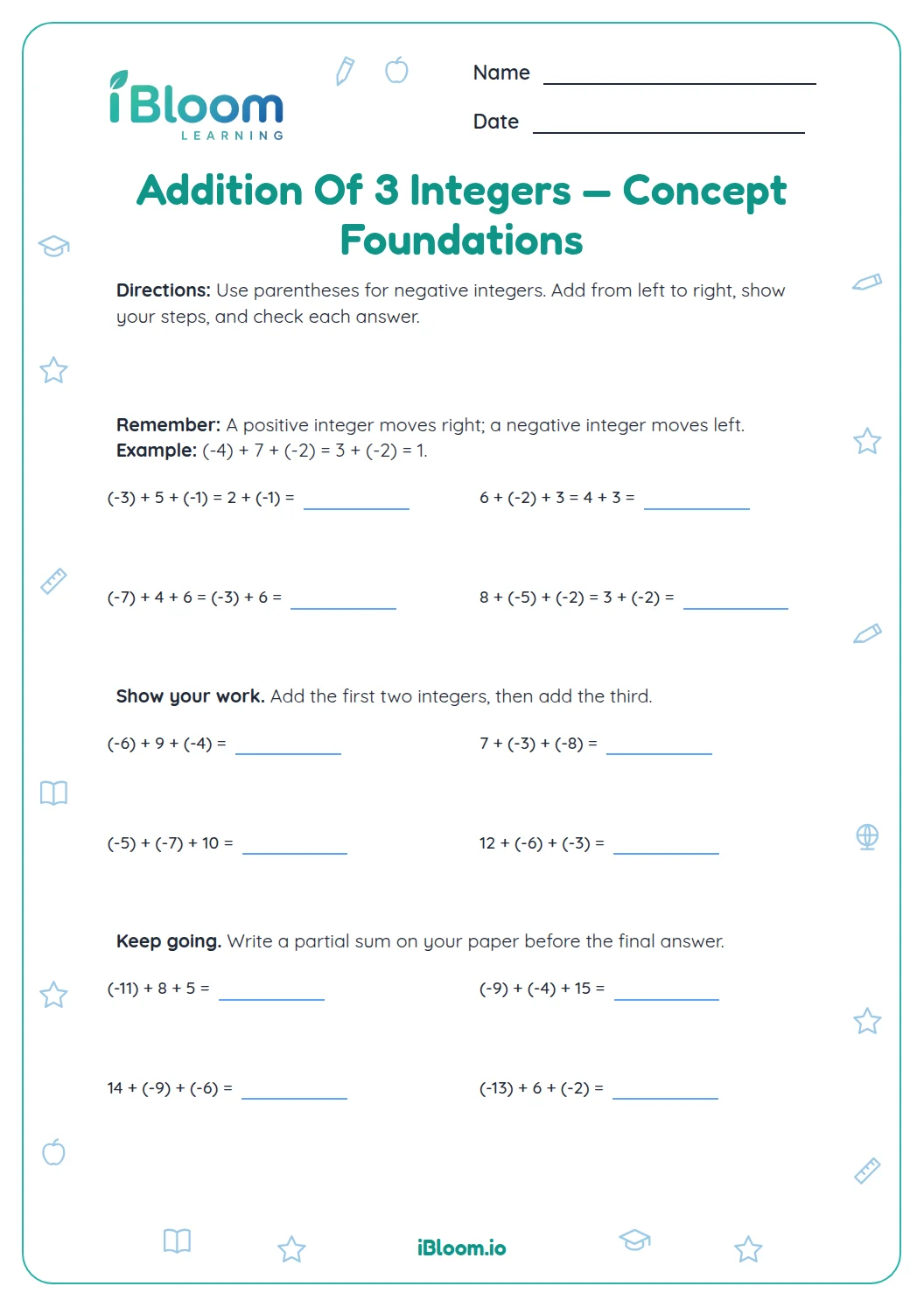
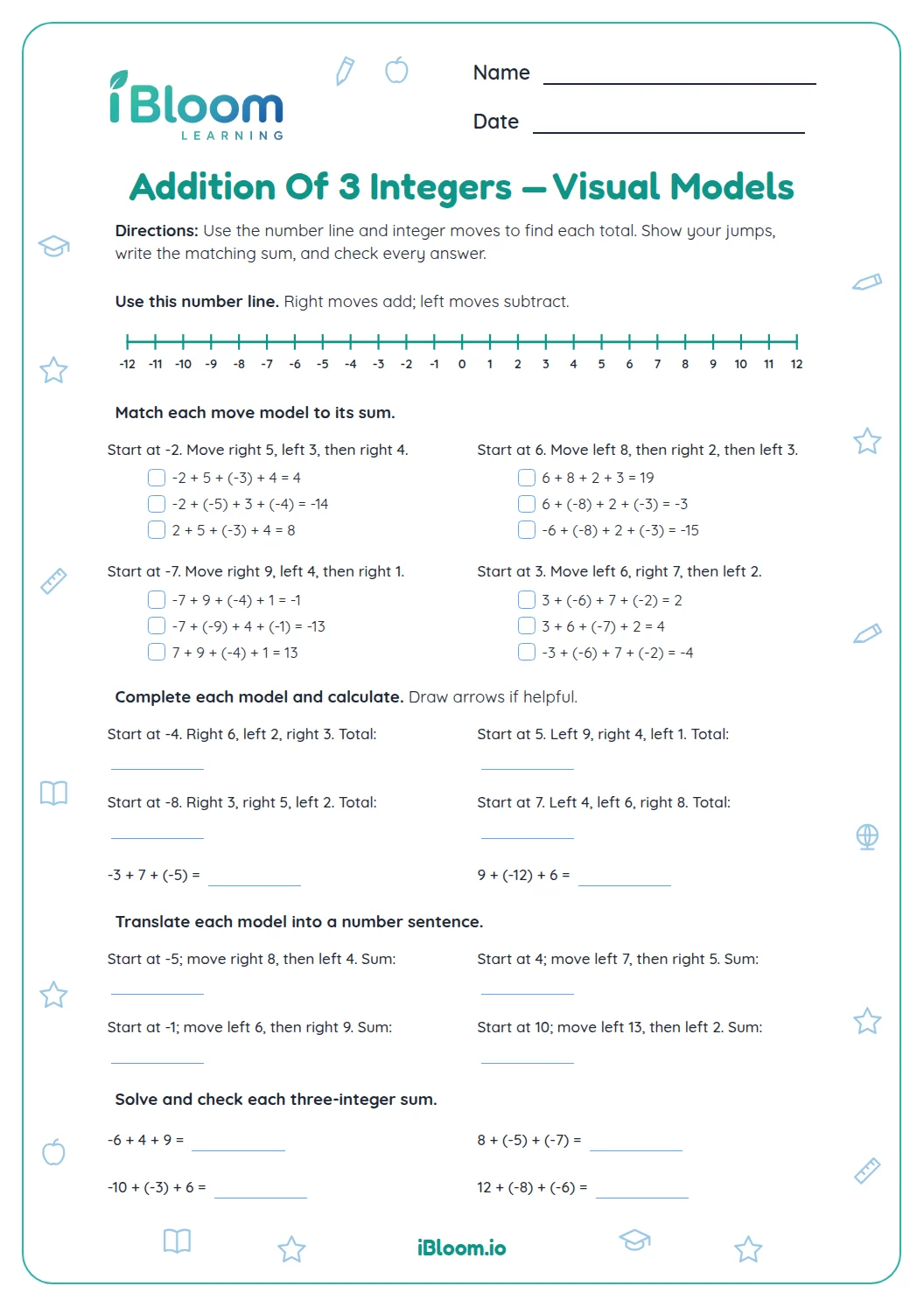
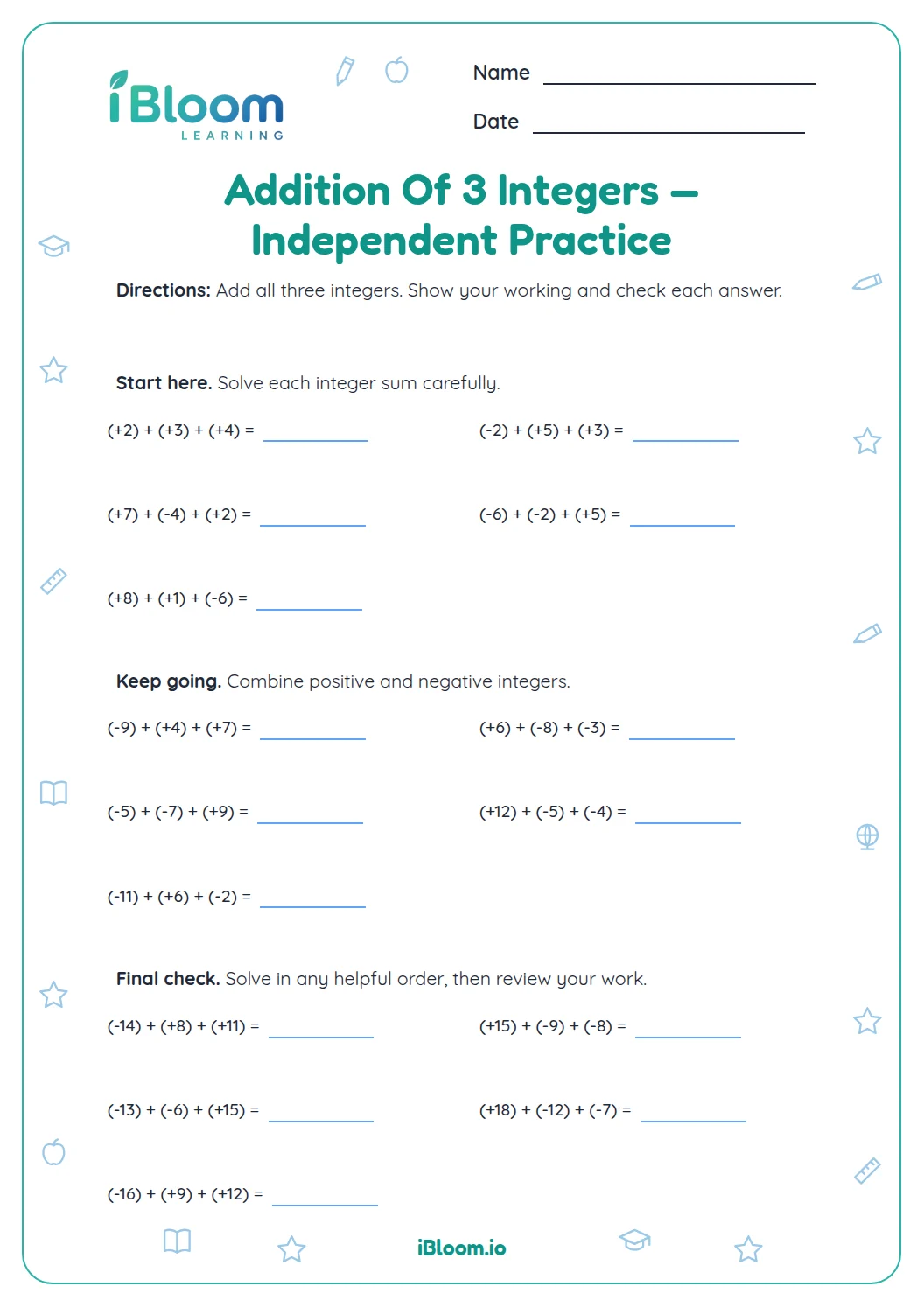
This free two-page Grade 6 worksheet provides 36 integer addition problems. Part A has four sums using opposites or zero, Part B has six same-sign sums, and Part C has six different-sign sums. Part D adds twenty mixed problems so students decide which rule to use. Every integer from −30 to +30 appears as an addend, and all sums stay within that range. The work practices signed addition and additive inverses in Common Core 7.NS.A.1b. A separate two-page key gives every sum.
Aligned to 7.NS.A.1b
What happens when both addends have the same sign?
Both addends move the total in the same direction. Two positive integers give a positive sum, and two negative integers give a negative sum. For −18 + (−12), combine 18 and 12 and keep the negative sign: −30.
Part B alternates positive and negative pairs. Students should read the signs before beginning the arithmetic, then keep the sign attached to the answer.
How do different signs affect the sum?
Different signs act in opposite directions. Compare the numbers’ distances from zero, subtract the smaller distance, and use the sign of the number farther from zero. This gives a quick way to decide whether the sum should be positive or negative.
- 1Question 11: −24 + 9 = ___
- 2Distances from zero: 24 and 9.
- 324 − 9 = 15. The negative addend is farther from zero.
- 4Answer: −15.
What should children notice about opposites and zero?
Opposites have the same distance from zero on opposite sides, so they add to zero. In Part A, −25 + 25 and 18 + (−18) both equal zero.
Adding zero leaves a number unchanged. Compare 0 + (−16) with −11 + 0: the location of the zero changes, but its effect stays the same.
How to use this worksheet
- 1Read both addends, including their signs.
- 2Decide whether the signs are the same or different.
- 3Use distances from zero to calculate the size of the answer.
- 4Write the answer with its sign.
- 5Check opposite pairs and zero sums before comparing with the key.
Mistakes to catch and correct
The mistake
Writing 30 for −18 + (−12).
The fix
Both addends are negative, so the sum is −30.
The mistake
Writing −33 for −24 + 9.
The fix
The addends move in opposite directions; subtract 9 from 24 and keep the negative sign.
The mistake
Writing 25 for −25 + 25.
The fix
Equal distances in opposite directions cancel to zero.
Common Core alignment
Add signed integers and recognize opposite numbers whose sum is zero.
On this sheet: Students calculate sums with positive and negative addends and identify opposite pairs.
Show the official wordingHide the official wording
Understand p + q as the number located a distance |q| from p, in the positive or negative direction depending on whether q is positive or negative. Show that a number and its opposite have a sum of 0 (are additive inverses). Interpret sums of rational numbers by describing real-world contexts.
What to practice next
Make more practice
Further reading
Questions parents and teachers ask
Does the range describe the addends or the answers?
Both the addends and the answers stay from −30 to +30 on this worksheet. Every integer in that range appears as an addend across the 36 sums. Parts A through C separate addition patterns; Part D mixes them so students must choose a rule for themselves.
Why are some negative numbers in parentheses?
Parentheses separate a negative addend from the addition sign so the expression is easier to read. For example, −7 + (−11) means adding negative seven and negative eleven. The parentheses do not change the value of −11; they help the student see that it is one signed number.
Is a plus sign required before a positive answer?
A leading plus sign is optional for positive answers on this sheet. Both 20 and +20 mean the same integer. A negative answer must include its minus sign, because 15 and −15 are different values. The answer key writes positive numbers without a leading plus sign.
How can my child check a different-sign sum?
Use the addition in reverse to check it. For question 11, the proposed answer is −15. Moving nine units back from −15 gives −24, the starting addend. Your child can also reason that adding a positive nine must move −24 closer to zero, not farther away.
Should this independent practice be timed?
Timing is optional; accurate signed sums are the priority. Allow about twenty to twenty-five minutes for all 36 problems, or use one page per session. If errors cluster in Parts C and D, revisit different-sign addition with smaller numbers before returning to the missed questions.