




About this worksheet
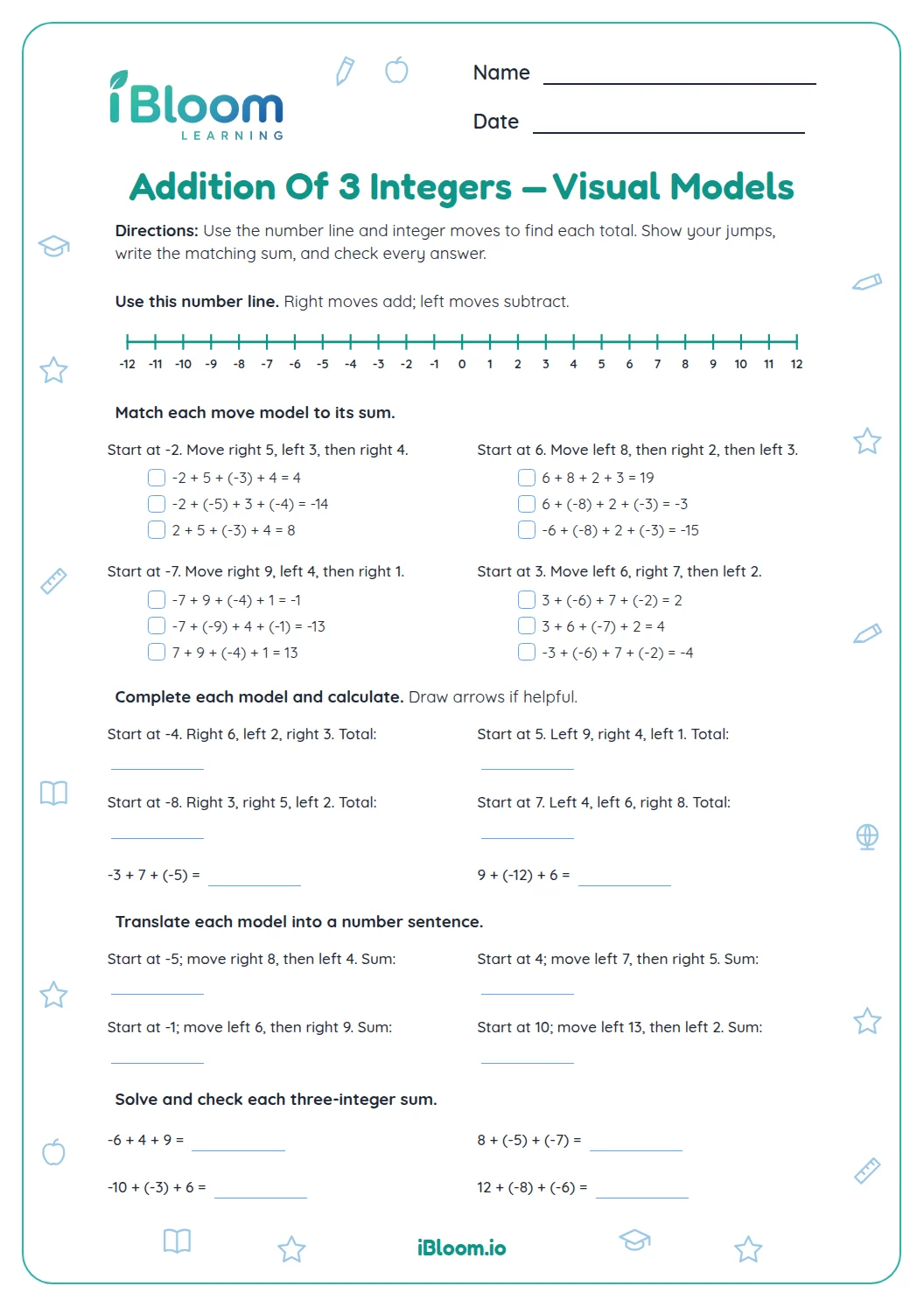
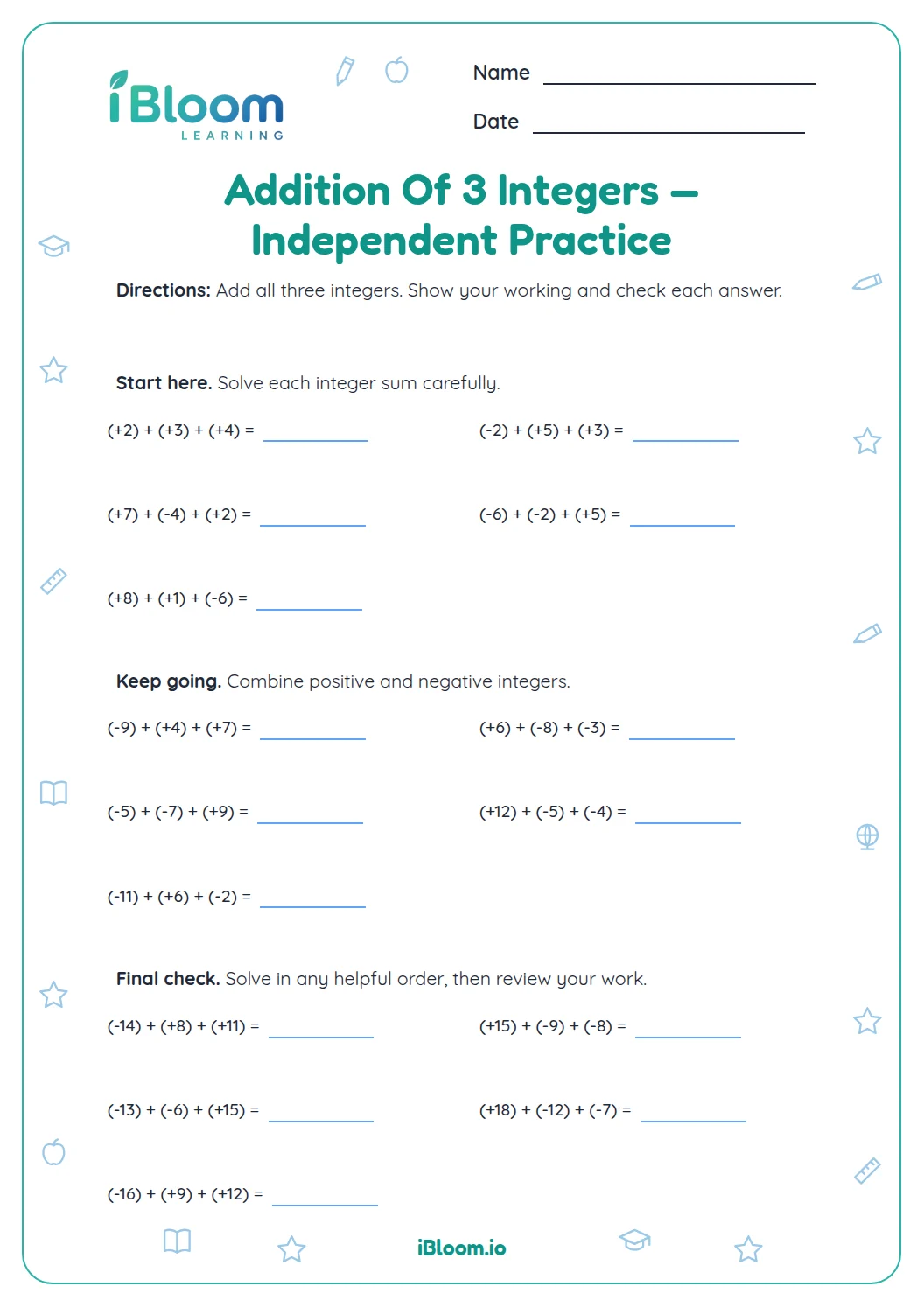
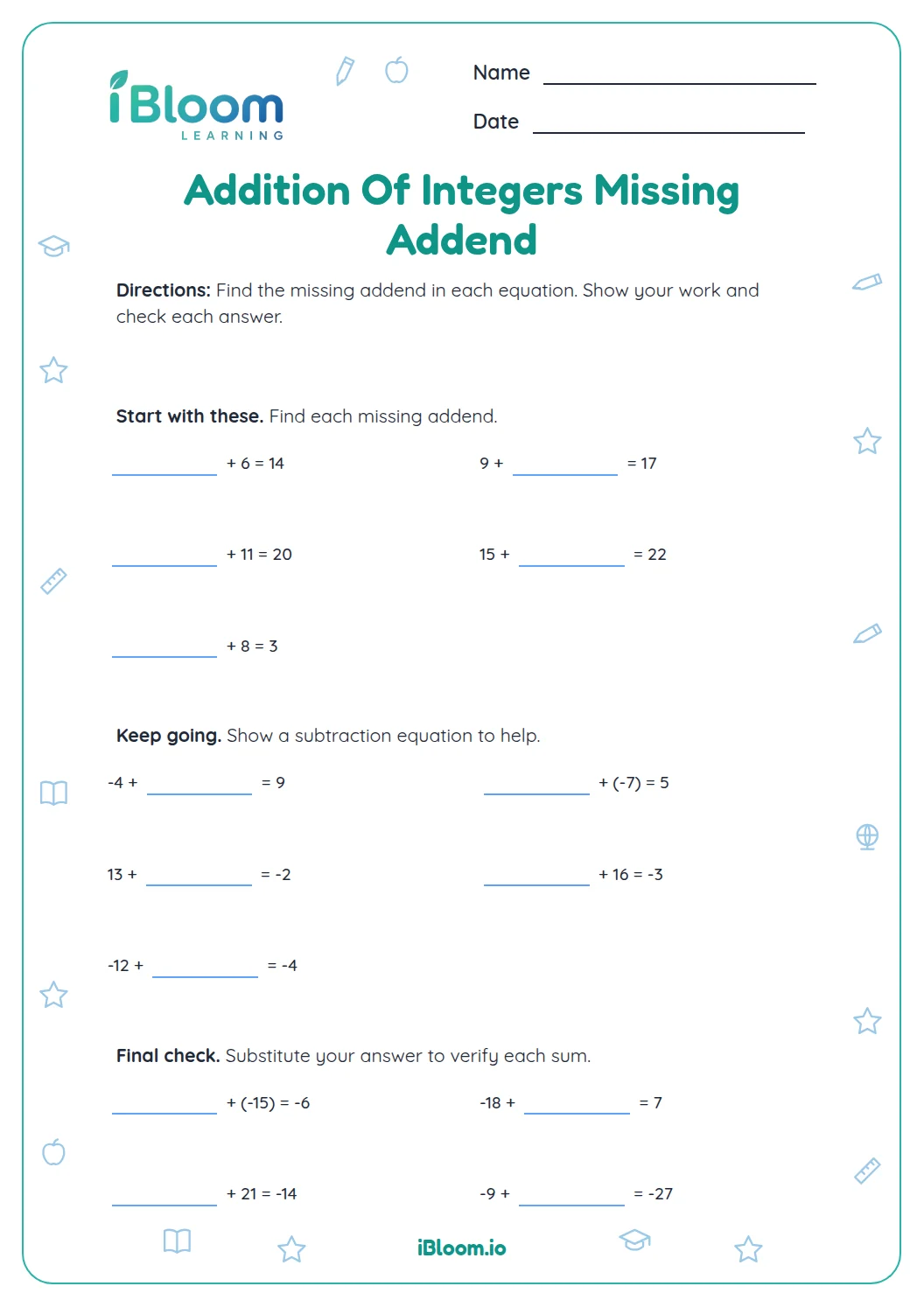
This free Grade 6 printable uses 14 integer addition stories based on the contexts in the original sheet: balances, floors, temperatures, scores, elevation, a lake, and a submarine. Students add signed changes and record a final value or position. The compact response rows keep the practice on two worksheet pages; a separate two-page key gives each result with its unit.
Aligned to 6.NS.C.5
How do rises and drops become integers?
A rise or deposit is positive; a drop or amount owed is negative. The story gives both a starting value and a signed change.
How do you find a final position?
Add the start and the change, then keep the unit or context. For example, Leo starts at −7 floors and rises 15: −7 + 15 = 8 floors.
- 1−7 + 15 = 8 floors
What is on the worksheet?
Fourteen compact story questions cover balances, floors, temperatures, scores, and positions, including values near both ends of the −30 to +30 range.
How to solve each story
- 1Mark the starting value.
- 2Choose a positive sign for an increase and a negative sign for a decrease.
- 3Write the signed addition sentence.
- 4Add the integers.
- 5Attach the correct unit or position to the result.
Common mistakes and quick fixes
The mistake
Treating a deposit as a negative change.
The fix
An amount added to a balance is positive.
The mistake
Using the direction word as the answer sign without considering the start.
The fix
Add the signed change to the starting value.
The mistake
Leaving out the context unit.
The fix
Write dollars, degrees, points, meters, feet, or floors as needed.
Common Core alignment
Positive and negative integers represent gains and losses, rises and drops, or positions on opposite sides of zero.
Represent real-world quantities and opposite directions with positive and negative numbers.
On this sheet: Each context uses integer changes and final positions.
Show the official wordingHide the official wording
Understand that positive and negative numbers are used together to describe quantities having opposite directions or values (e.g., temperature above/below zero, elevation above/below sea level, credits/debits, positive/negative electric charge); use positive and negative numbers to represent quantities in real-world contexts, explaining the meaning of 0 in each situation.
What to practice next
Make more practice
Further reading
Questions parents and teachers ask
What kinds of stories are included?
The 14 questions use familiar settings from the original sheet: a bank balance, floors, temperatures, a score, elevation, a lake, a freezer, and a submarine. Each gives a starting value and one signed change. Students add the values and report the resulting balance, temperature, score, or position.
How do students choose the sign of a change?
An increase, rise, deposit, or earned score is positive. A decrease, drop, descent, or amount owed is negative. Students should identify the change first, write its sign, and then add it to the starting value before interpreting the answer.
Does the worksheet include multistep stories?
This version uses concise one-change stories so students can focus on integer addition and the meaning of the result. Each item still requires the learner to combine a signed change with a starting value and state the answer in its context.
How many pages does the printable have?
The worksheet has two pages with 14 questions, followed by a two-page answer key. The compact blanks leave room for each story and a short response without reducing the number of practice items. Students can complete the stories in order and check their signed sums afterward.
Why should students include units?
A signed number has meaning in its setting. The unit tells whether an answer is a balance in dollars, a temperature in degrees, a score in points, or a position in meters, feet, or floors. The key includes units where the story calls for them.