




About this worksheet
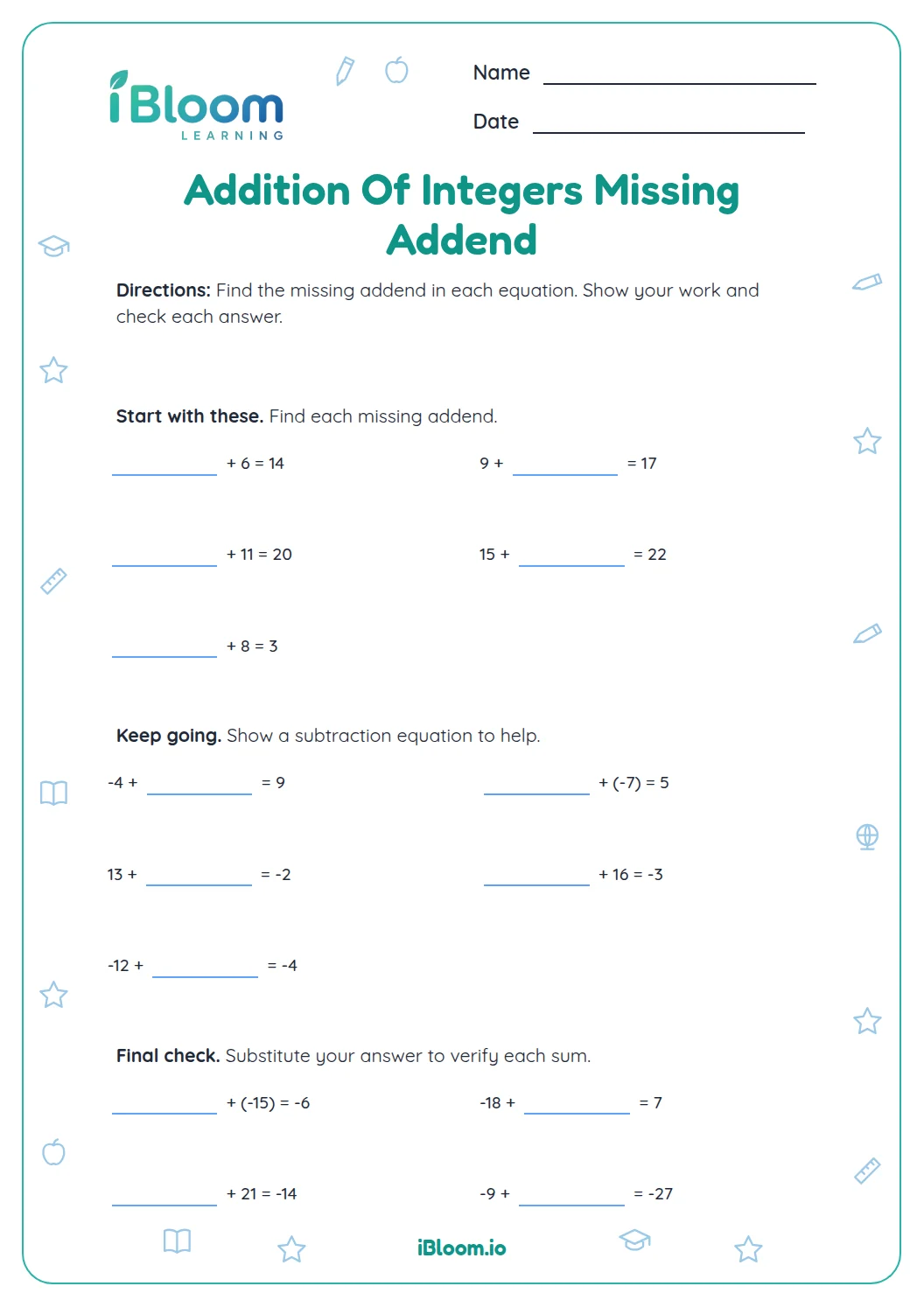
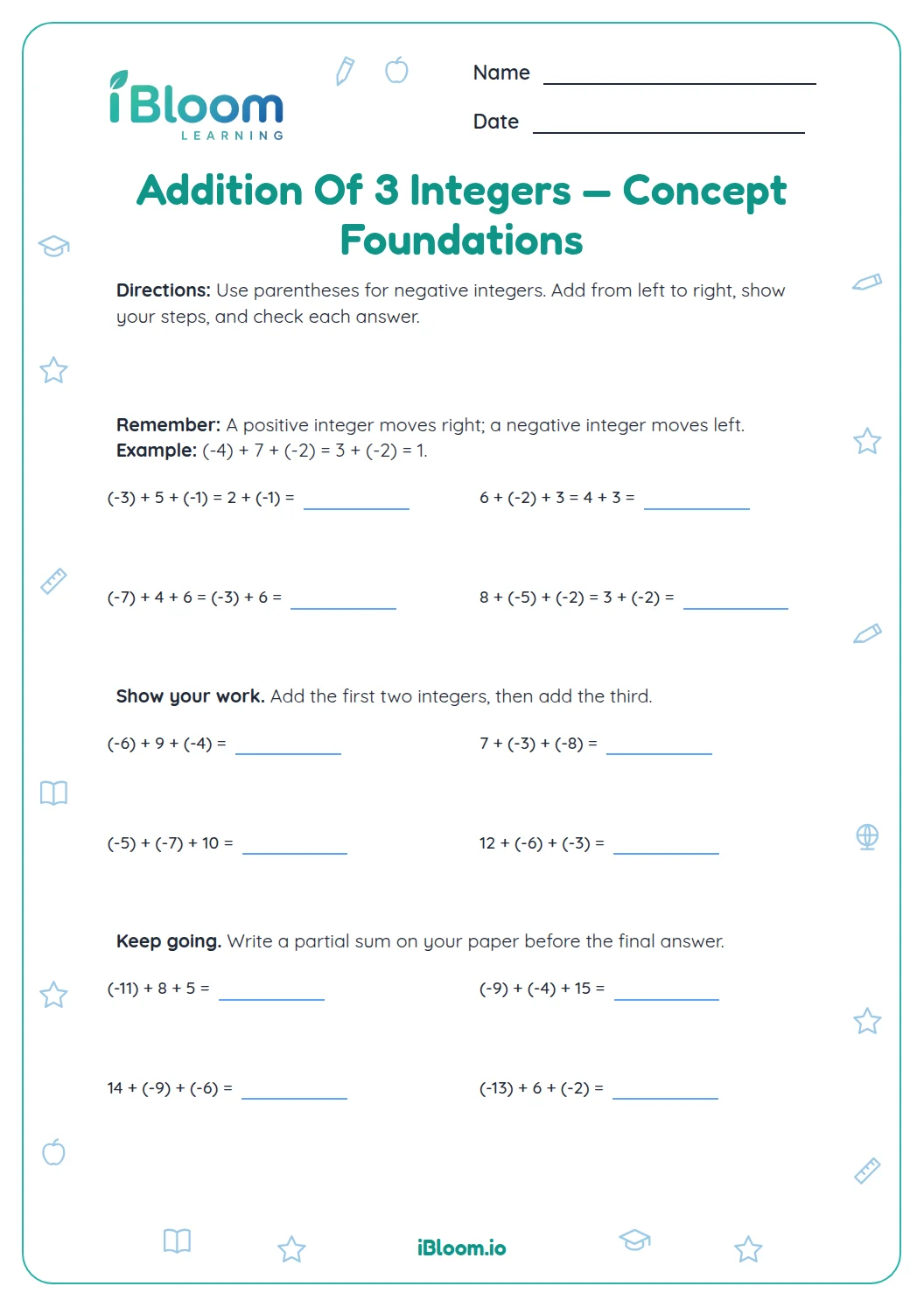
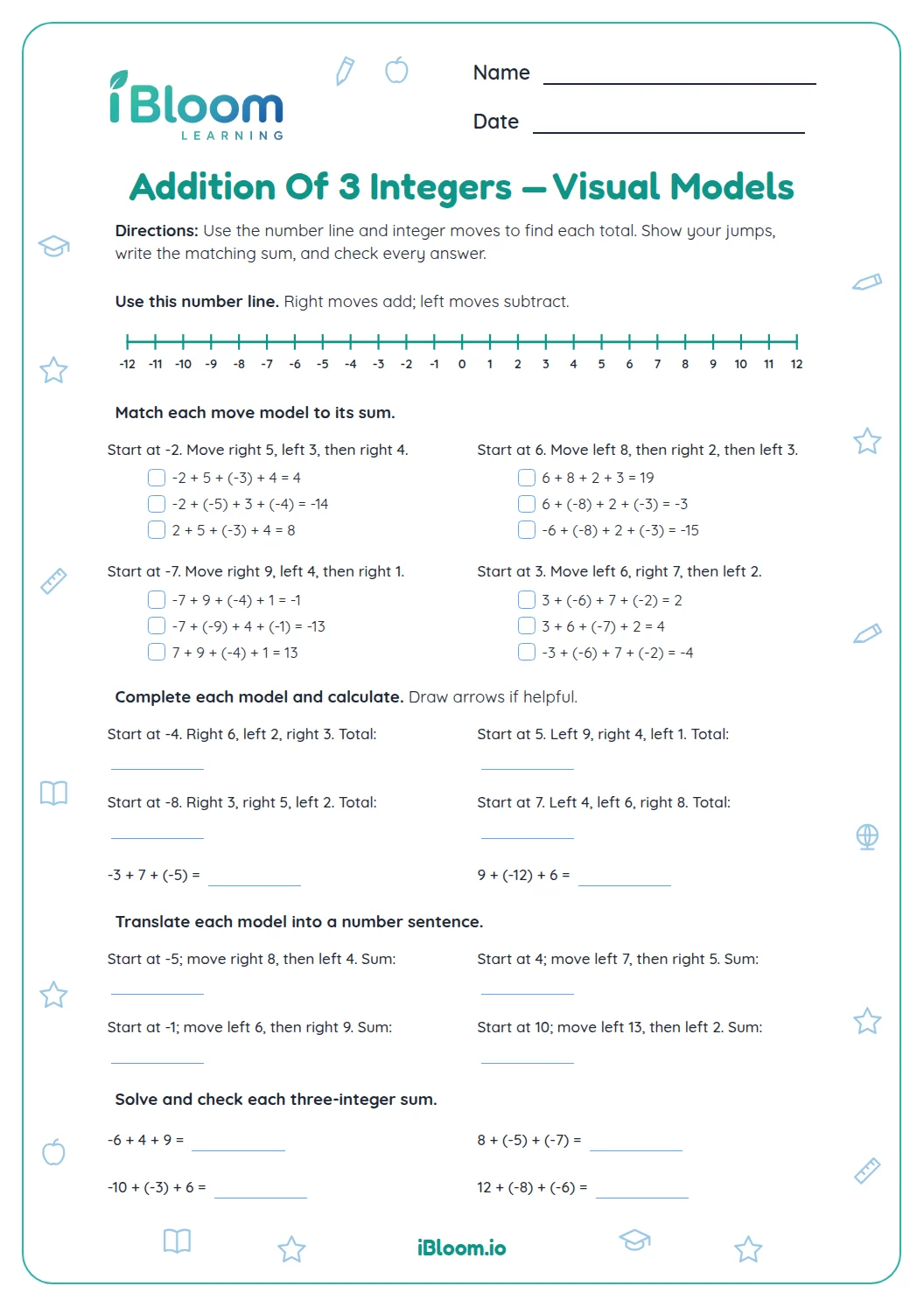
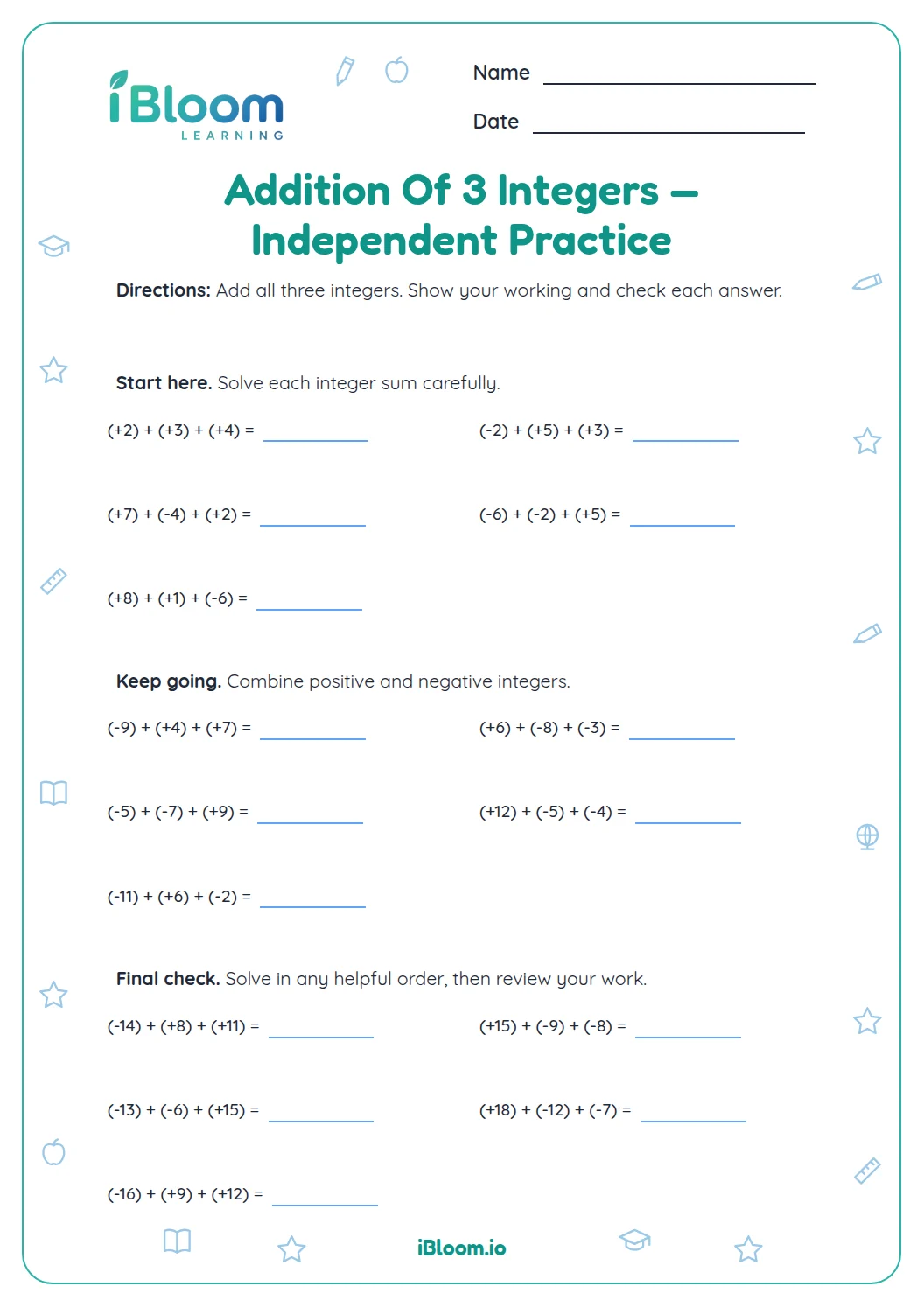
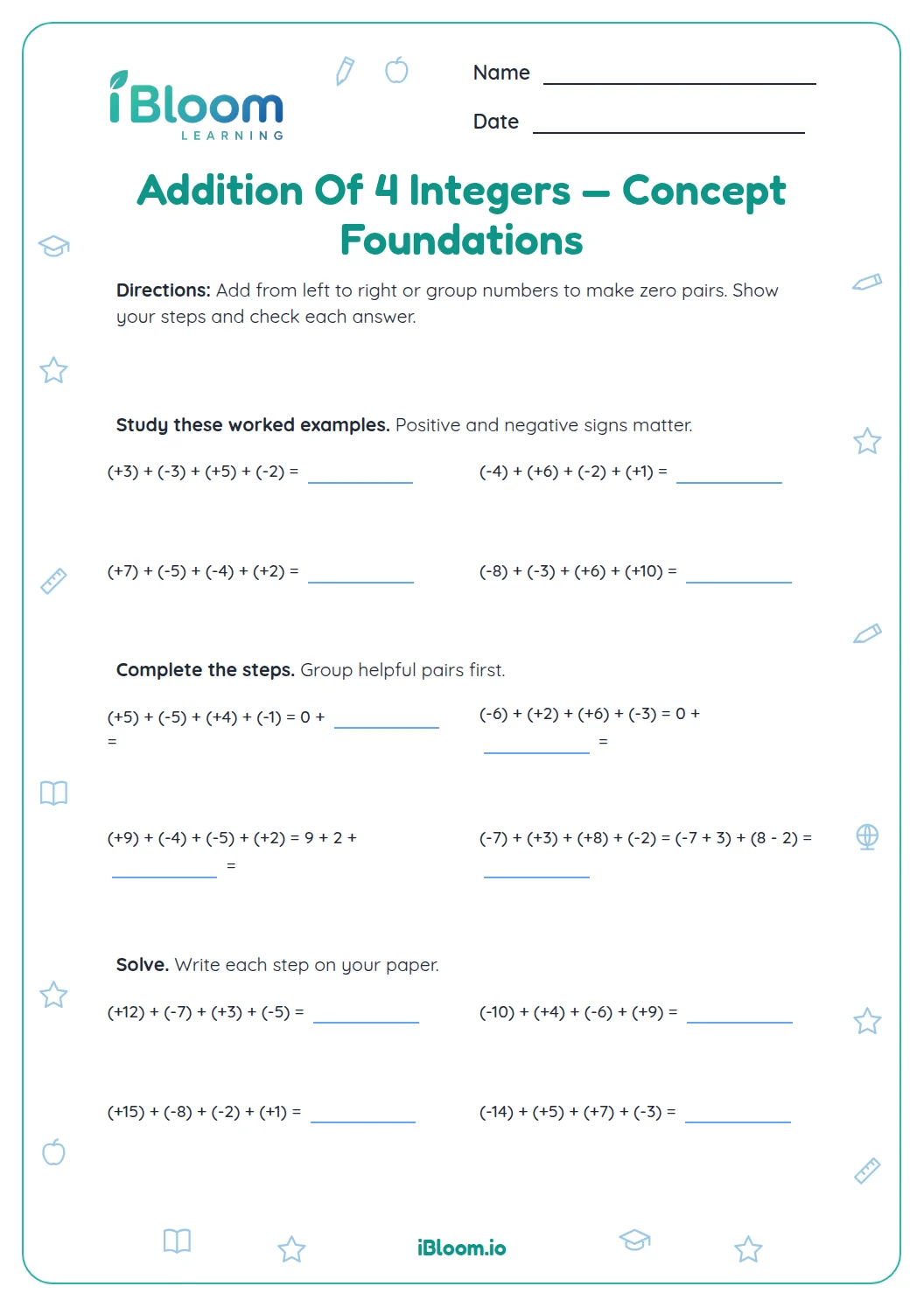
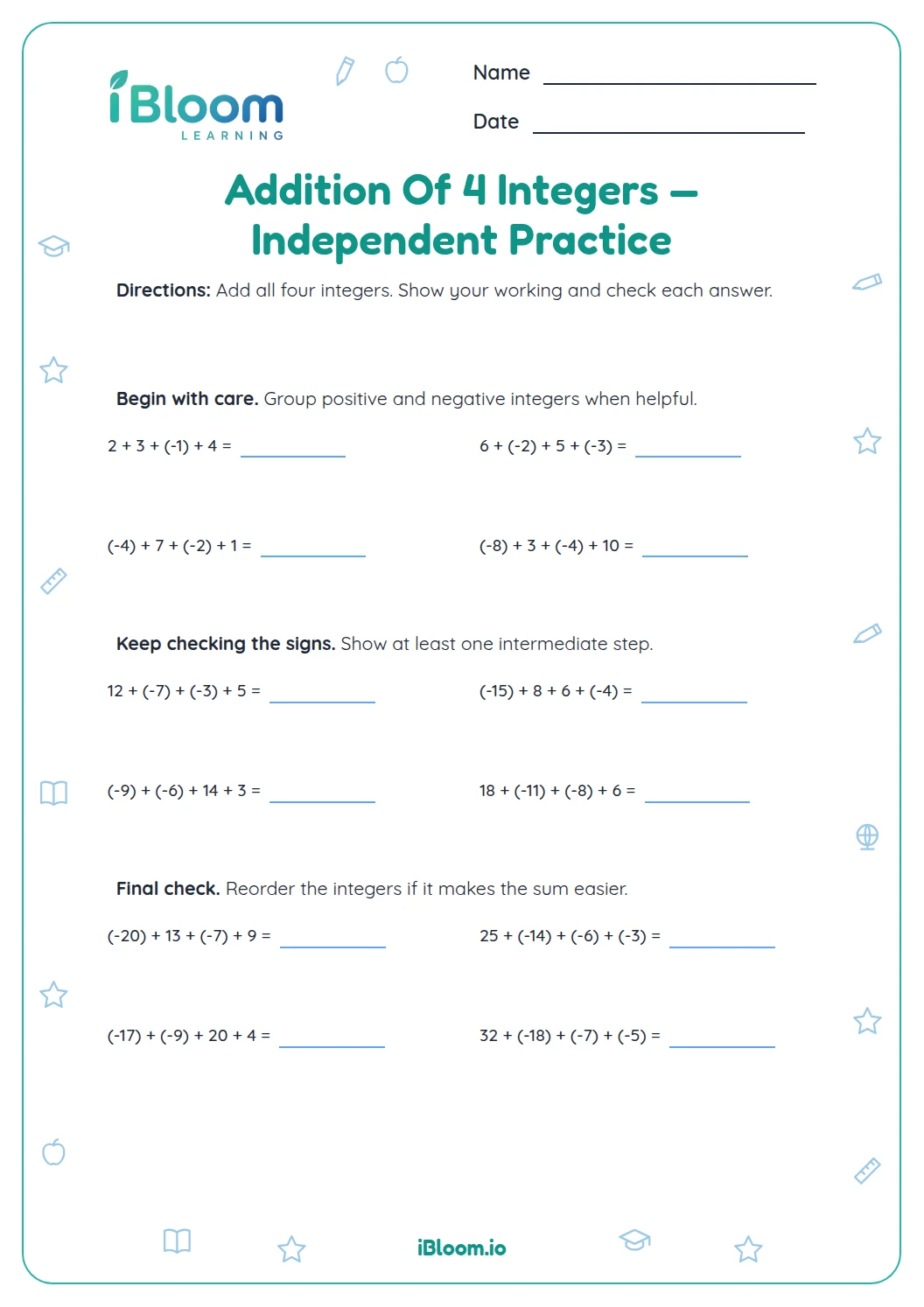
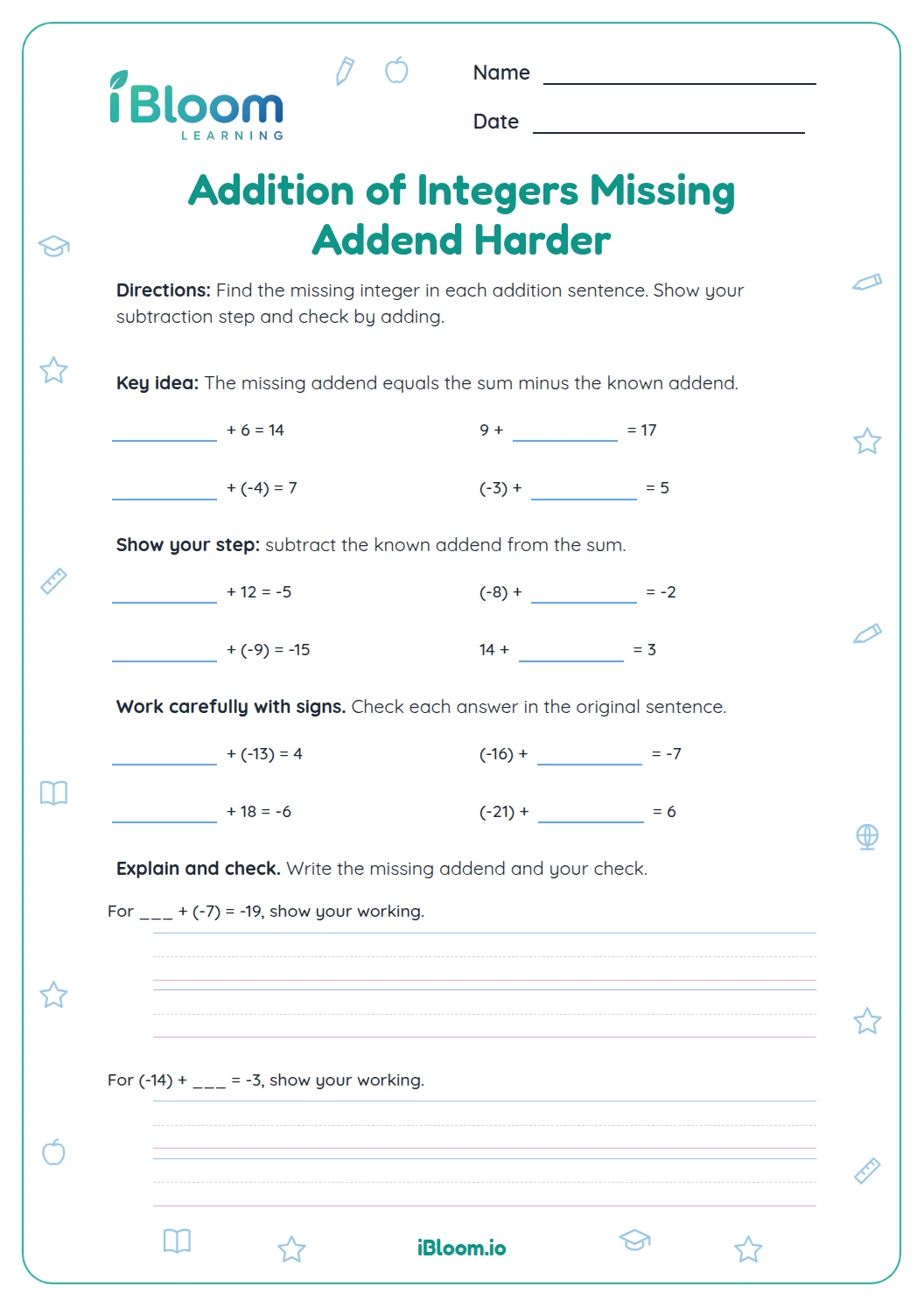
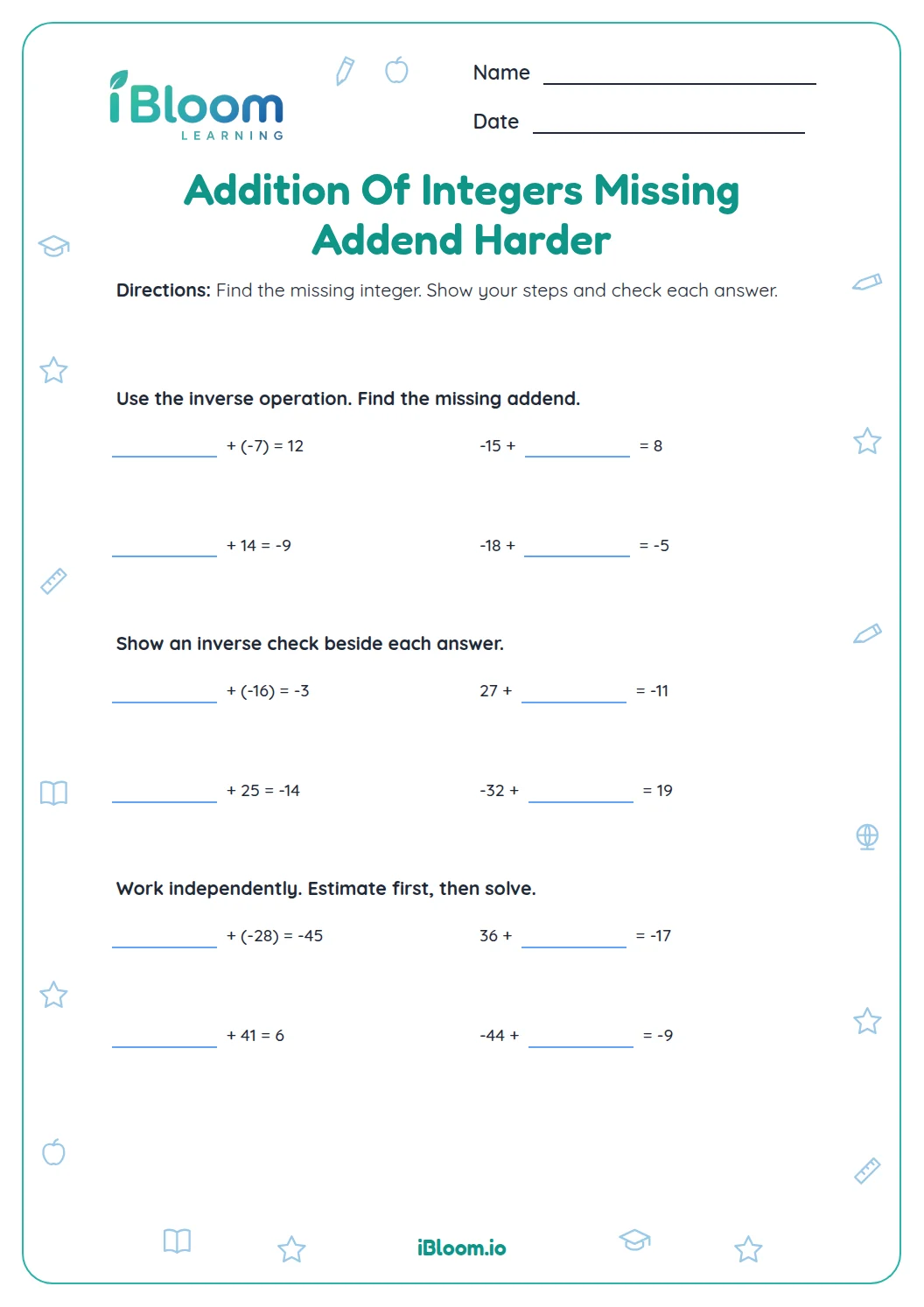
This free printable worksheet gives Grade 6 learners 16 missing-addend problems with positive and negative integers. Children find an unknown term in a sum, use addition and opposites to check their reasoning, and solve a temperature context. The questions move from direct equations to less familiar placements of the unknown, with a separate answer key. It connects to CCSS 7.NS.A.1.b, using operation properties to add and subtract rational numbers.
Aligned to 7.NS.A.1.b
How do I find an unknown addend?
A missing addend is the number that makes the addition equation true. Use the total and known addend to reason backward, then substitute the result to check.
- 1−8 + ___ = 3
- 2Think: −8 + 8 = 0, then add 3
- 3Missing addend = 11
- 4Check: −8 + 11 = 3
What if the known addend is negative?
Track the direction and size of each change. Adding a negative moves the total downward; adding a positive moves it upward. The unknown may be positive or negative.
How can I check a solution?
Substitute the missing number into the original equation and add. The result must match the stated sum, including its sign.
What is included in the worksheet?
There are 16 questions in three parts, with unknowns in different positions and one temperature context. A separate key lists each missing integer and the context answer.
How to use this worksheet
- 1Read the equation and locate the blank.
- 2Notice the sign of the known addend and the total.
- 3Use the opposite operation or count from the known addend to the total.
- 4Substitute your value into the original sum.
- 5Check that the total and its sign match.
- 6Use the key to review any equation that does not balance.
Common mistakes and quick fixes
The mistake
Ignoring the negative sign on an addend.
The fix
Read the sign with the number as one signed value.
The mistake
Changing the sign without checking the total.
The fix
Substitute the candidate number and add to verify.
The mistake
Assuming every missing addend is positive.
The fix
Compare the known addend with the total; the missing change may go either direction.
Common Core alignment
This worksheet practices the Common Core standard named below.
Use signed number relationships and real-world sums to solve missing-addend problems.
On this sheet: The unknown addends represent signed changes that move a starting integer to a stated sum.
Show the official wordingHide the official wording
Understand p + q as the number located a distance |q| from p, in the positive or negative direction depending on whether q is positive or negative. Show that a number and its opposite have a sum of 0 (are additive inverses). Interpret sums of rational numbers by describing real-world contexts.
What to practice next
Make more practice
Further reading
Questions parents and teachers ask
What is a missing addend?
A missing addend is the unknown number in an addition equation. In −8 + ___ = 3, the blank must raise the total from −8 to 3, so it is 11. Substituting 11 back into the original equation checks the answer.
How can I solve ___ + 6 = −2?
Find the number that becomes −2 after adding 6. Since −8 + 6 = −2, the missing addend is −8. Check by replacing the blank with −8 and adding, while keeping the negative sign attached to the number. Then check the signed result in the original equation.
Can a missing addend be negative?
Yes. In ___ + 6 = −2, the missing addend is −8. In −8 + ___ = 3, it is 11. The worksheet includes blanks in different positions so learners must use the equation’s signs and total each time. Substitute the number and confirm the equation balances.
How should learners check an answer?
Replace the blank with the proposed number and add. The result must match the original total, including its sign. For example, checking −8 in ___ + 6 = −2 gives −8 + 6 = −2, so the equation is true.
How does the temperature question work?
The temperature changed by −7 degrees and ended at 2°. Write starting temperature + (−7) = 2. The starting temperature was 9°, since 9 + (−7) = 2. This turns the context into the same missing-addend relationship used in the equations.
Is an answer key included?
Yes. The separate key gives the missing integer for each equation and the starting temperature. Encourage the learner to substitute each answer into its equation; that check makes sign mistakes easier to find than comparing numbers alone. This makes checking part of solving each problem.