







About this worksheet
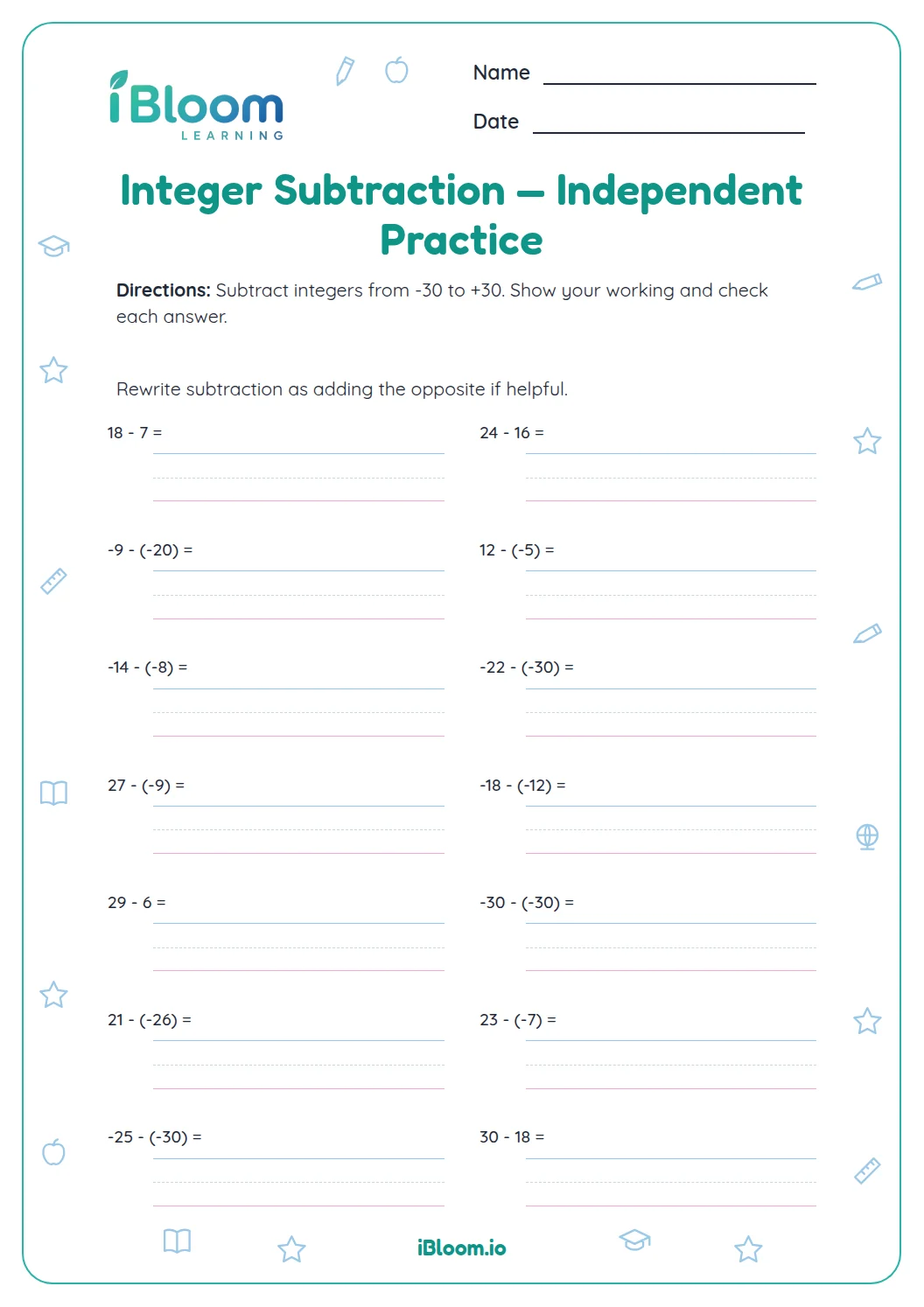
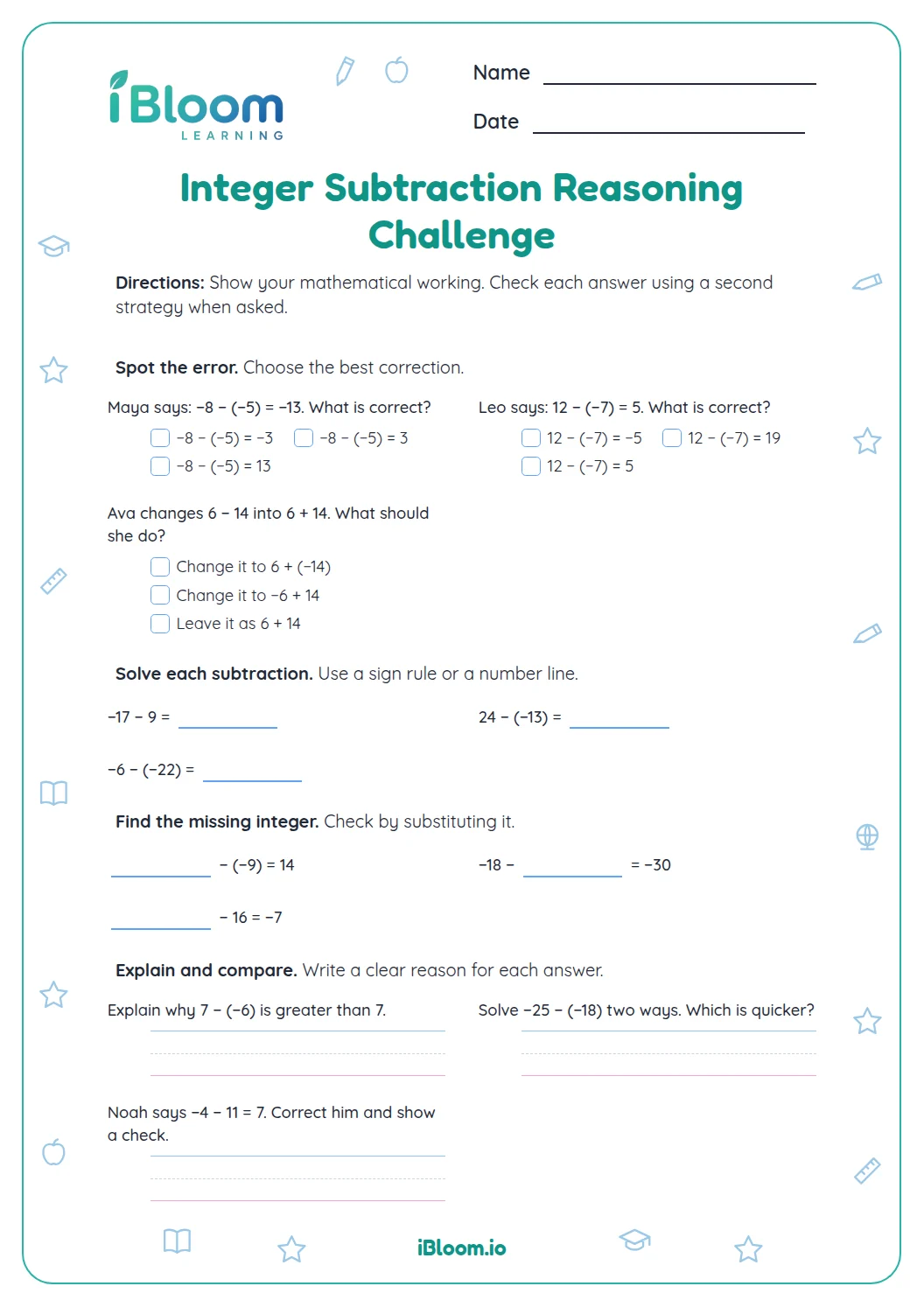
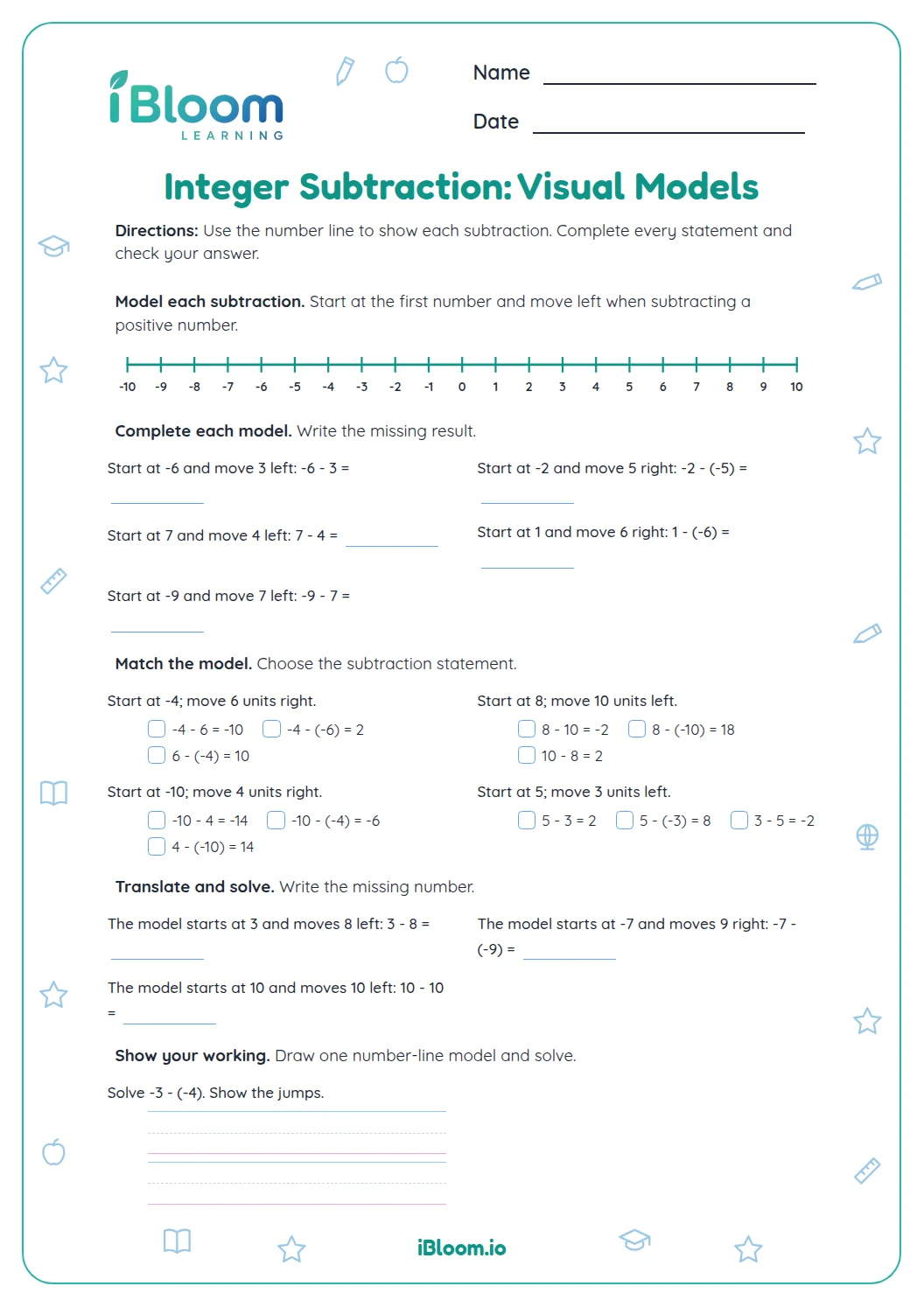
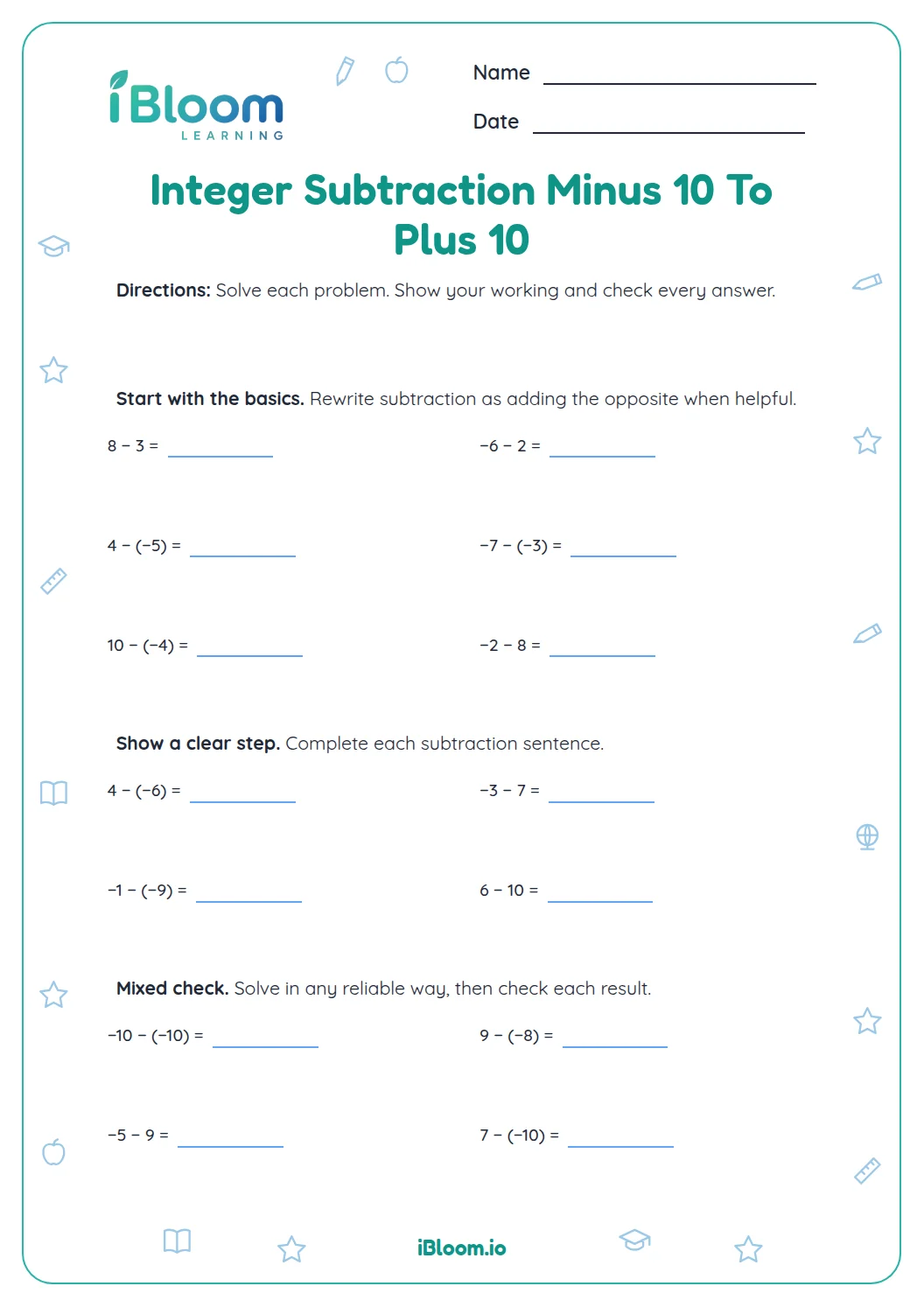
This Grade 6 worksheet practices integer subtraction from −30 to +30 with 14 problems across two pages. Four number-line questions ask students to mark a starting integer and show the endpoint after subtracting a positive or negative amount. Ten number sentences then build fluency with the same rule: subtracting a number is adding its opposite. A two-page answer key lists the results. The examples include moves that cross zero and results at both ends of the stated range.
How does subtraction move on a number line?
Subtracting a positive integer moves left. Subtracting a negative integer moves right, because taking away a negative is the opposite of adding a positive. The first number is the starting point; the second number determines the direction and distance.
For question 1, start at −8. Subtracting −5 means move right 5 units: −8 + 5 = −3. The number line helps show both the start and the direction.
- 1−8 − (−5) = −8 + 5 = −3
- 2Start at −8; move right 5 units.
What changes when a move crosses zero?
Zero separates negative and positive values, but the number line keeps equal steps in both directions. Track every unit as you move; do not change the operation merely because the path crosses zero.
Part B includes moves across zero and starts near the ends of the −30 to +30 range. Use the written rule to check: subtracting a number means adding its opposite.
How to use this worksheet
- 1Read the directions at the start of each part.
- 2Try the first question together and explain the clue or strategy.
- 3Complete the remaining questions, showing work where it helps.
- 4Use the answer key to check each response.
- 5Review any missed item by naming the step that changes the answer.
Common mistakes and quick fixes
The mistake
Moving right when subtracting a positive integer.
The fix
Subtract a positive by moving left; subtract a negative by moving right.
The mistake
Dropping the negative sign when the endpoint is below zero.
The fix
Read the endpoint as an integer, including its sign.
The mistake
Treating −a − (−b) as subtracting b.
The fix
Rewrite it as −a + b before finding the result.
What to practice next
Make more practice
Questions parents and teachers ask
What happens when I subtract a negative integer?
Subtracting a negative is the same as adding its opposite, so the number-line move goes right. For example, −8 − (−5) becomes −8 + 5 and ends at −3. The sign and magnitude both matter when identifying the endpoint.
How do I subtract a positive integer?
Subtracting a positive integer moves left on the number line. Start at the first integer and move left by the amount being subtracted. For example, 6 − 11 moves left 11 units and ends at −5, which is also checked by rewriting it as 6 + (−11).
What if a move crosses zero?
Keep moving one unit at a time through zero in the same direction. In 5 − (−12), start at 5 and move right 12 units, ending at 17. Crossing zero does not change the direction or restart the count.
Why use a number line for subtraction?
A number line makes the start, direction, and distance visible. It helps distinguish subtracting a positive from subtracting a negative. Students can also rewrite the expression by adding the opposite, then compare that result with the endpoint they marked.
How many problems and models are on the page?
There are 14 problems in all: four number-line models in the first part and ten subtraction sentences in the second. They use integers and results within −30 to +30. The key includes the sign for every result, including −30.
How do I subtract by adding the opposite?
Keep the first integer and change the subtraction to addition of the opposite. For example, 14 − 9 becomes 14 + (−9), which equals 5. This is the written check for the fourth number-line model, where a leftward move of 9 units ends at 5.