




About this worksheet
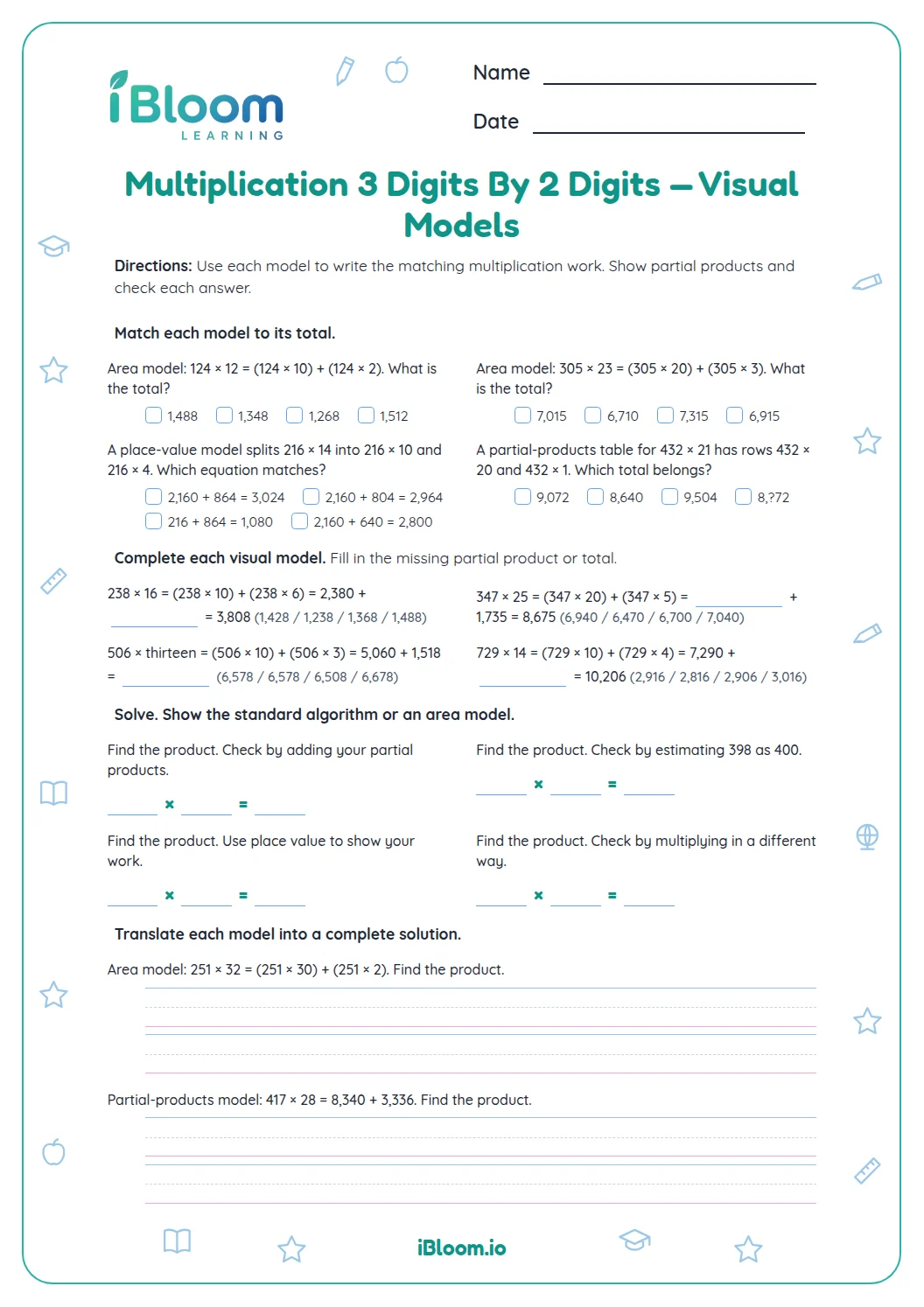
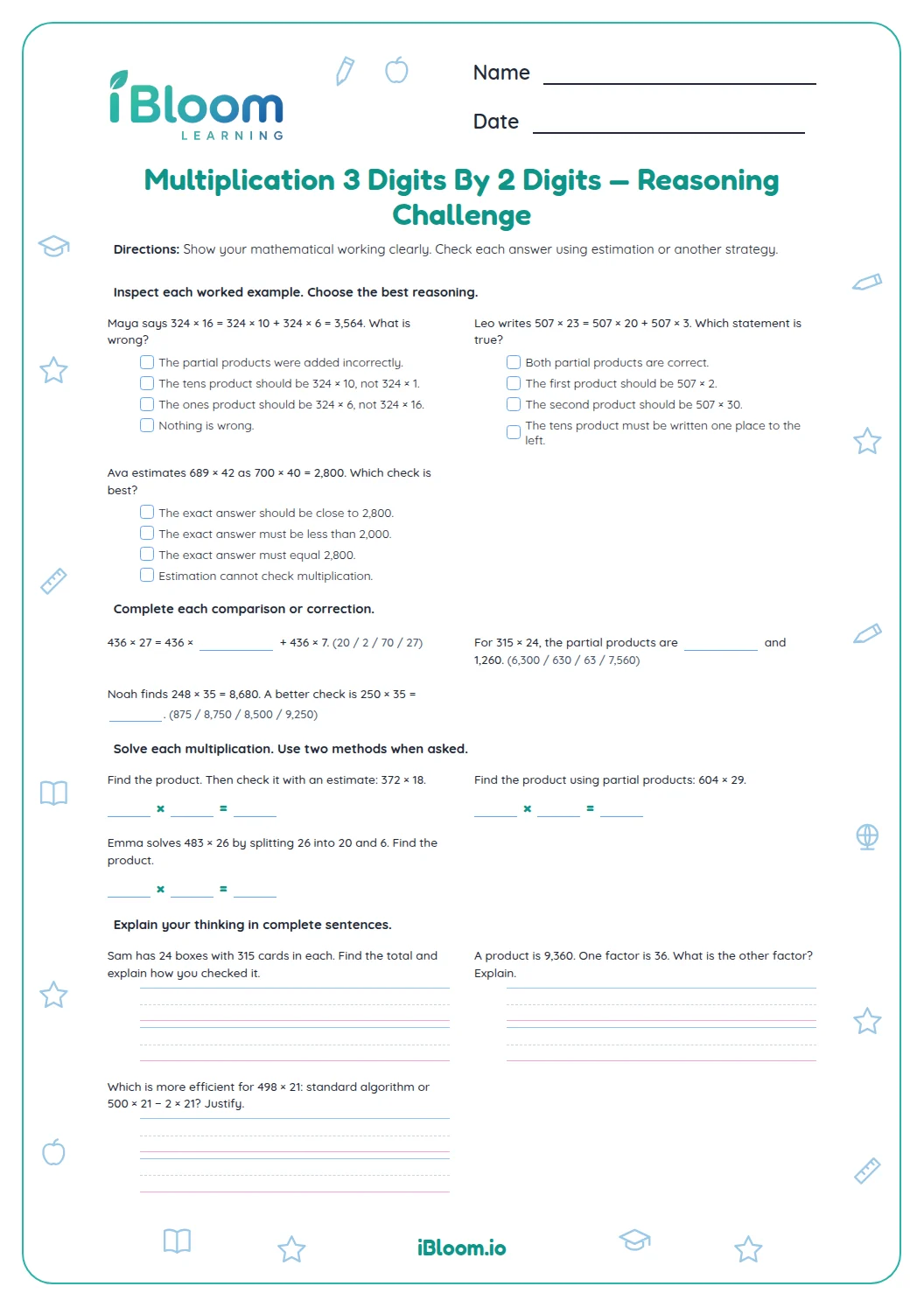
This concept worksheet makes the place-value structure of three-digit by two-digit multiplication explicit. Students decompose the two-digit factor into tens and ones, record partial products, and then solve exact products and two applications. The final products can be checked against an estimate. A worked answer key is included.
Aligned to 5.NBT.B.5
How does place value organize multiplication?
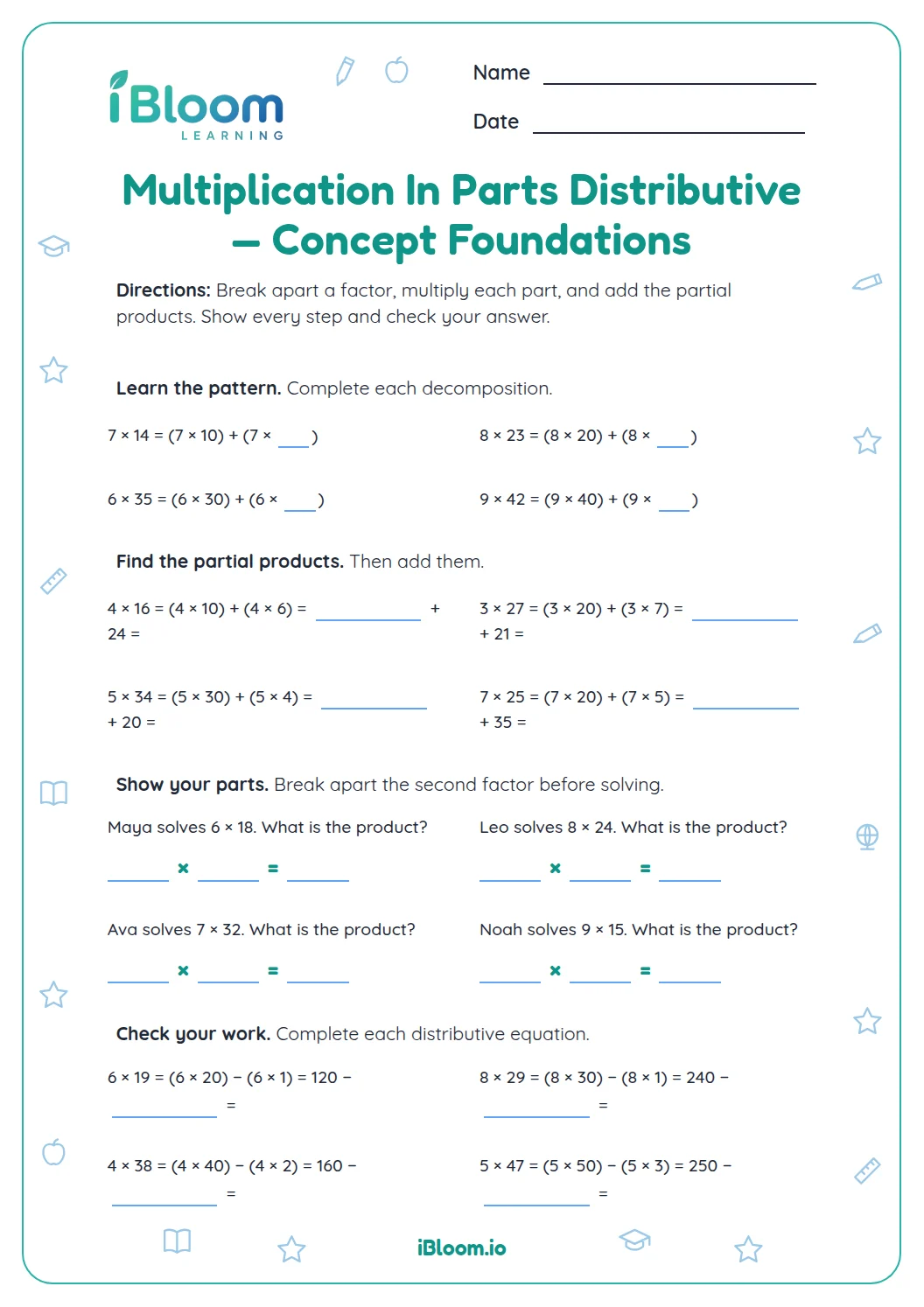
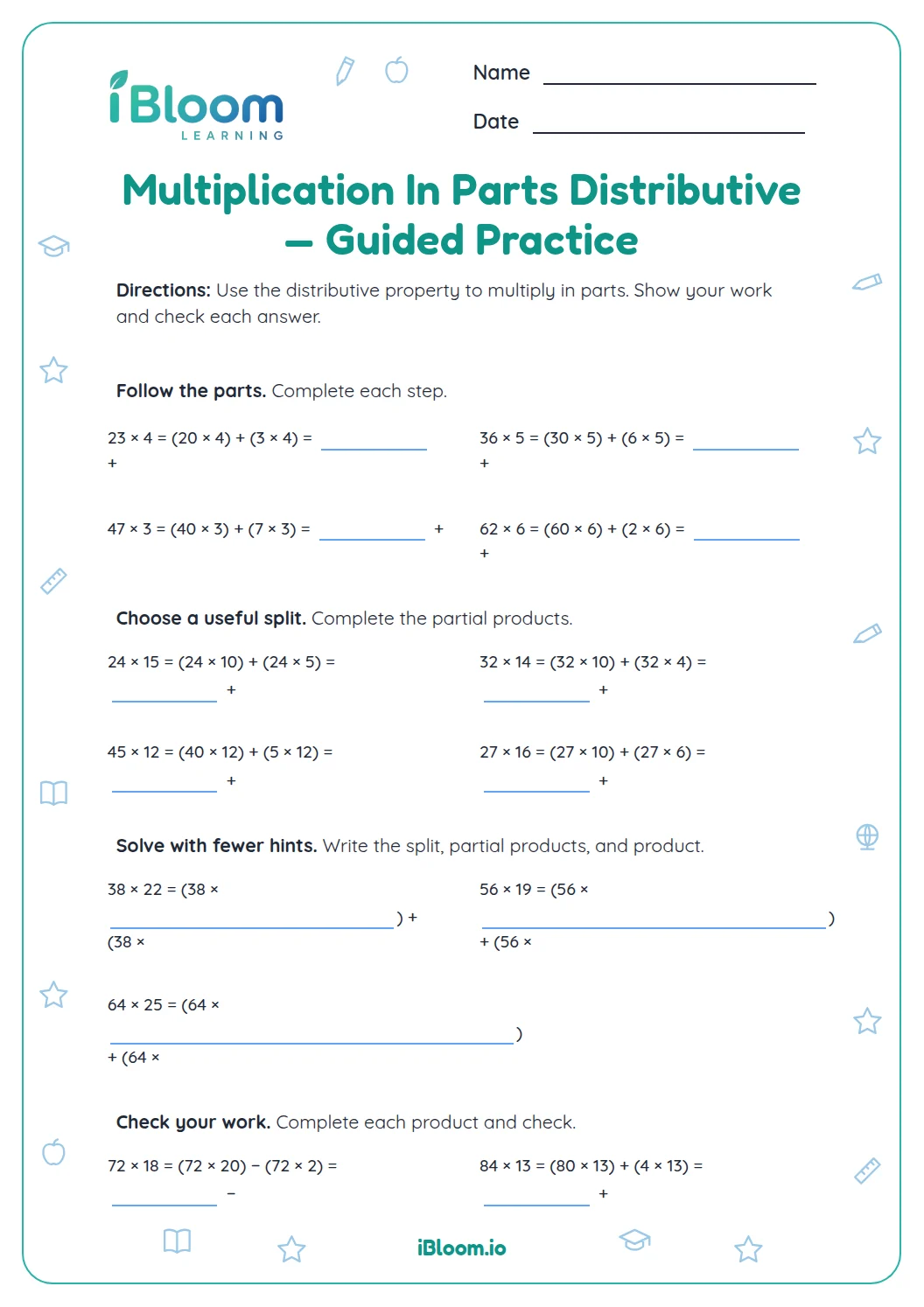
A two-digit factor has tens and ones. The number 24 is 20 + 4, so 315 × 24 can be split into 315 × 20 and 315 × 4. Adding those partial products gives the full product.
Keeping the tens value visible prevents a common error: treating 2 tens as 2 ones. An estimate also helps show whether the final product is reasonable.
What is on this worksheet?
Part A decomposes the two-digit factor. Part B records partial products in order. Part C practices complete multiplication and applies it to equal groups in a theater and a print shop.
How do partial products combine?
Question 5 splits 16 into 10 and 6. For 232 × 16, the partial products are 2,320 and 1,392; their sum is 3,712. The sum gives the full product.
A reliable multiplication method
- 1Rewrite the two-digit factor as tens plus ones.
- 2Multiply the three-digit factor by each part.
- 3Add the partial products.
- 4Estimate first or last to check the size of the answer.
Common multiplication errors
The mistake
Multiplying by the tens digit as if it were ones, such as using 2 instead of 20 in 24.
The fix
Write the place value explicitly: 24 = 20 + 4.
The mistake
Forgetting to combine both partial products.
The fix
Label the tens and ones products, then add them to get the total.
The mistake
Adding the two factors instead of multiplying them.
The fix
Find each partial product or use the multiplication equation, then combine the products.
The mistake
Dropping a zero from a product such as 315 × 20.
The fix
Read 20 as two tens and keep its place value when finding the product.
Common Core alignment
The method builds on the Common Core multi-digit multiplication standard.
Fluently multiply multi-digit whole numbers using the standard algorithm.
On this sheet: Students multiply three-digit and two-digit whole numbers by decomposing factors and combining partial products.
Show the official wordingHide the official wording
Fluently multiply multi-digit whole numbers using the standard algorithm.
What to practice next
Make more practice
Further reading
Questions parents and teachers ask
Why split a two-digit factor into tens and ones?
Splitting the factor makes place value visible and uses the distributive property. For example, 124 × 12 becomes 124 × 10 plus 124 × 2. Students can solve each partial product and then combine them, which helps explain why the standard multiplication algorithm works.
What is a partial product?
A partial product is the answer to multiplying by one part of a factor. For 315 × 24, the parts are 20 and 4, so 315 × 20 and 315 × 4 are the partial products. Adding those two results gives the complete product.
How can students check a product?
Estimate by rounding the factors to friendly numbers, then compare the estimate with the exact product. For example, 315 × 24 is near 300 × 20, or 6,000. The exact answer should be in the same general range. Students can also add their partial products again.
How can partial products check the final answer?
Multiply the three-digit factor by the tens part and by the ones part, then add those results. For 315 × 24, the parts are 20 and 4, so 315 × 20 and 315 × 4 combine to make the product. An estimate gives another quick check that the total is reasonable.
Why does the tens product end in a zero?
The tens part represents groups of ten. In 315 × 20, there are twenty groups of 315, which is twice as many as 315 × 10. The product is 6,300, so keeping the zero shows the place value of the factor 20.