



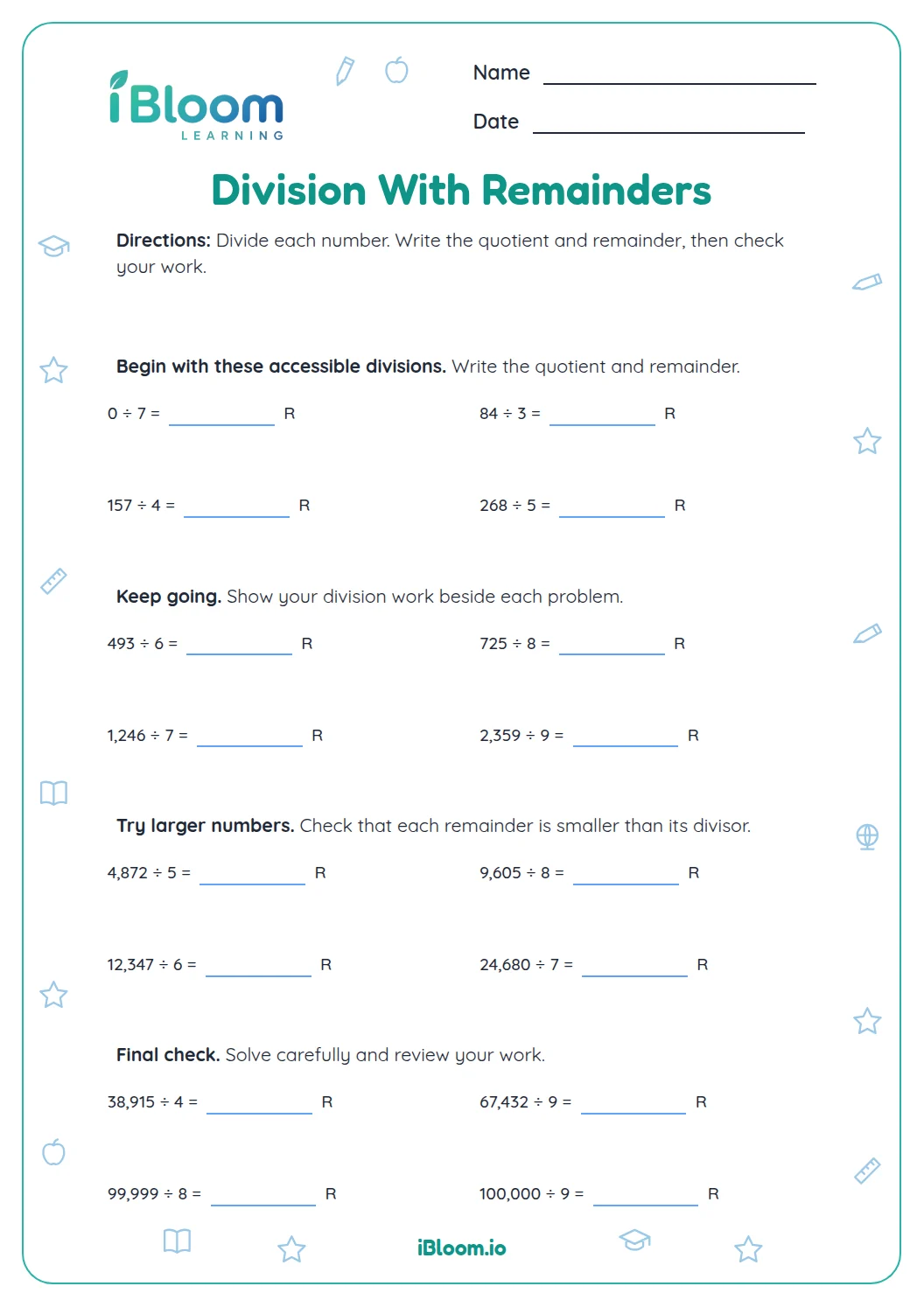
About this worksheet
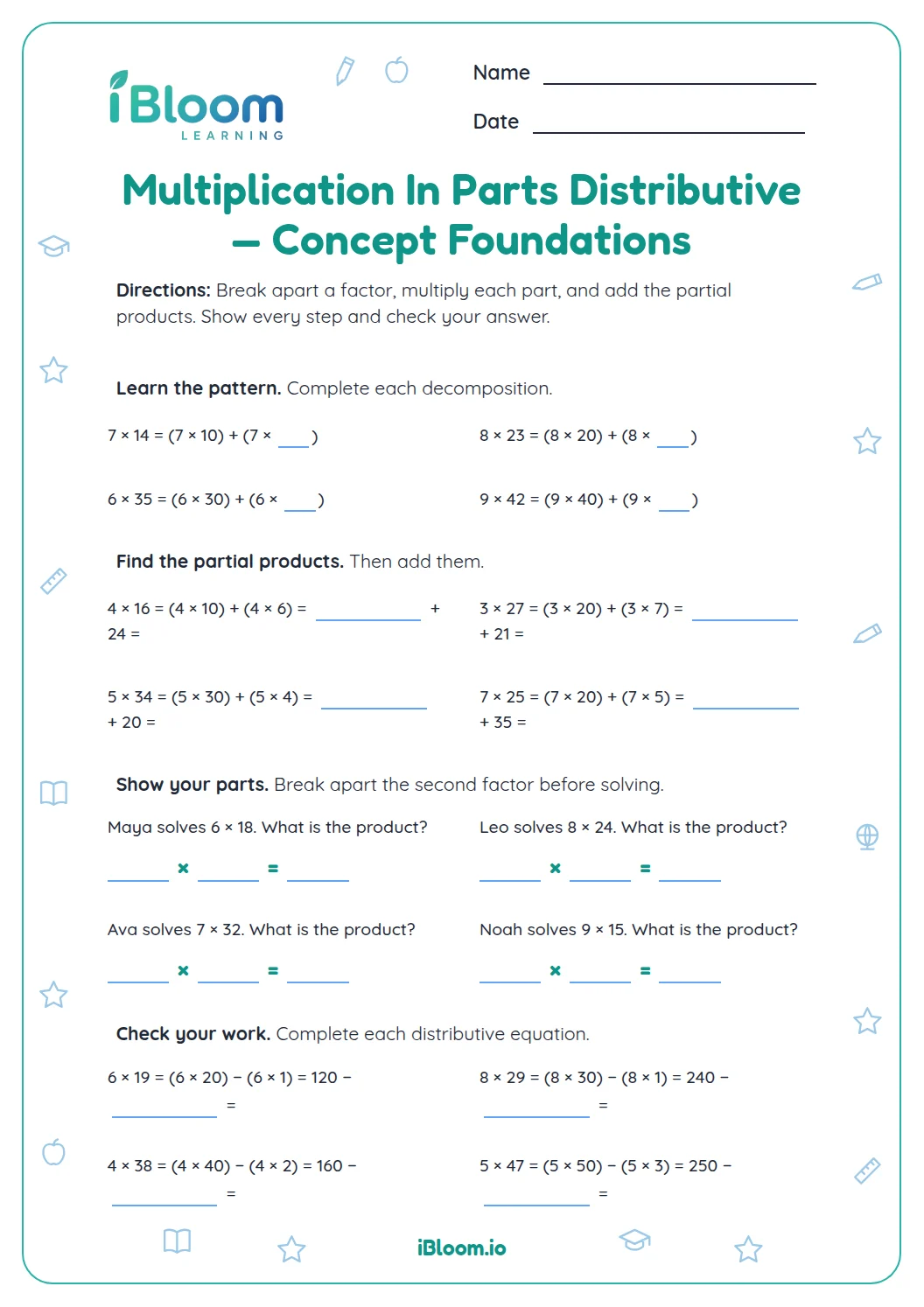
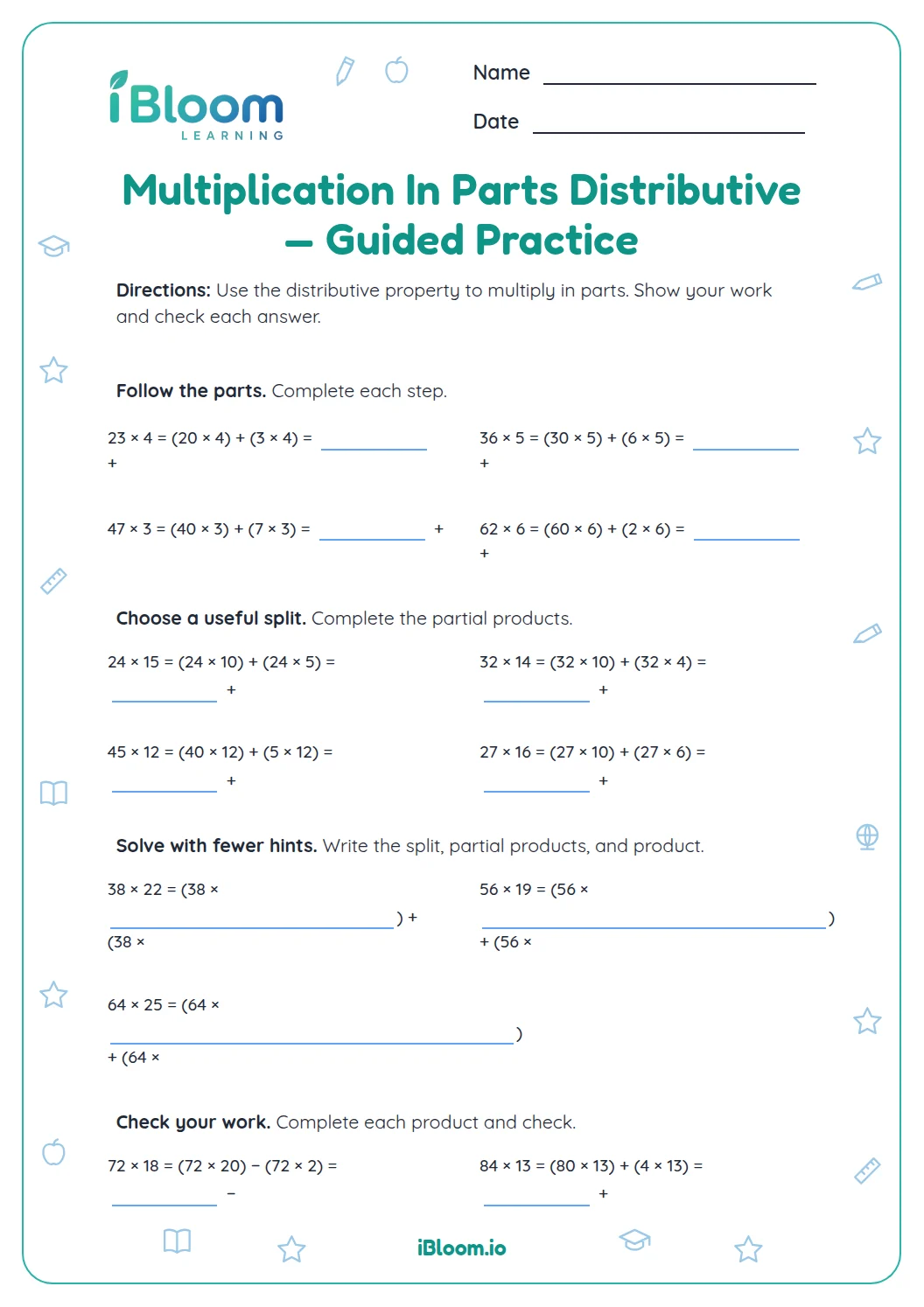
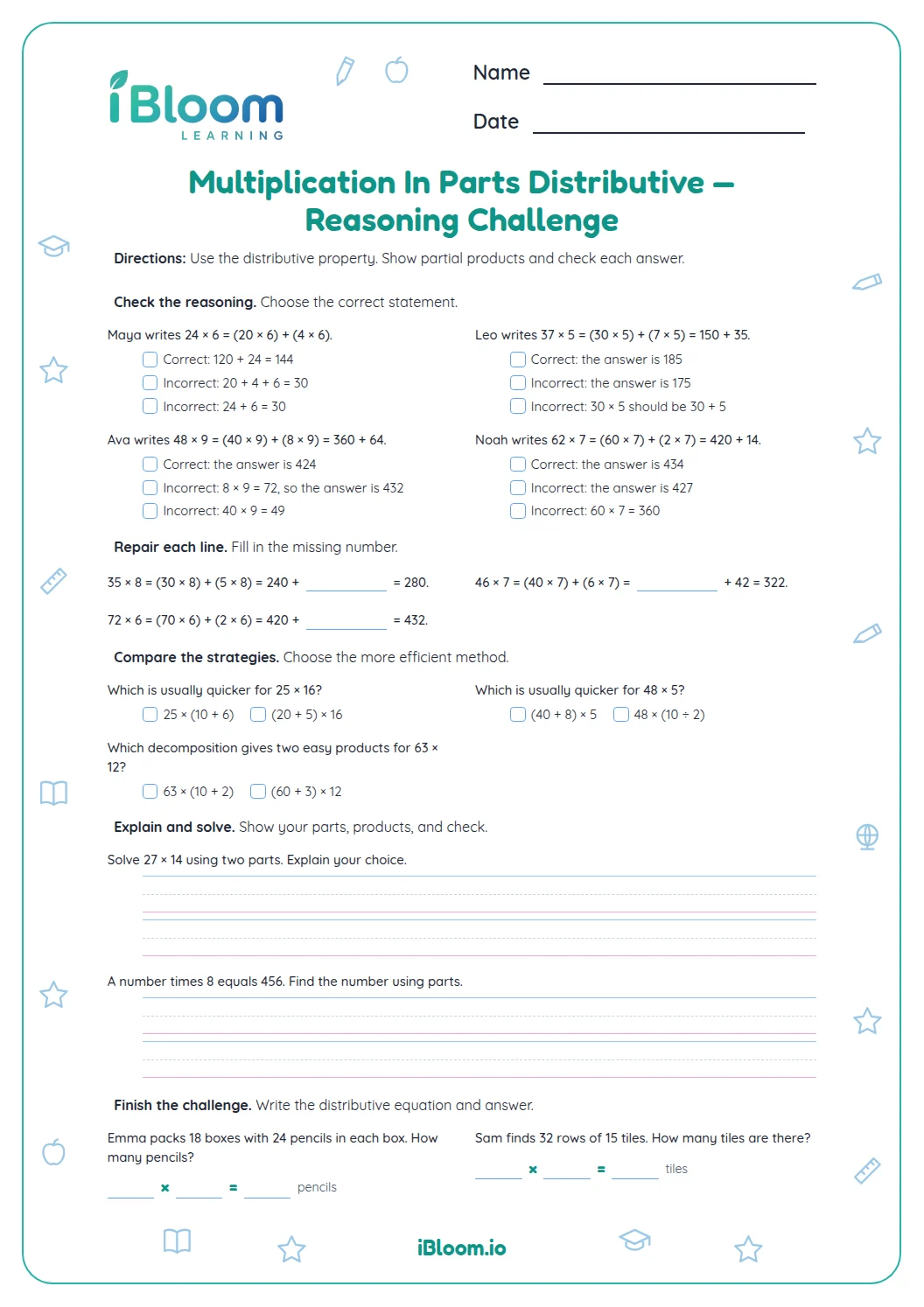
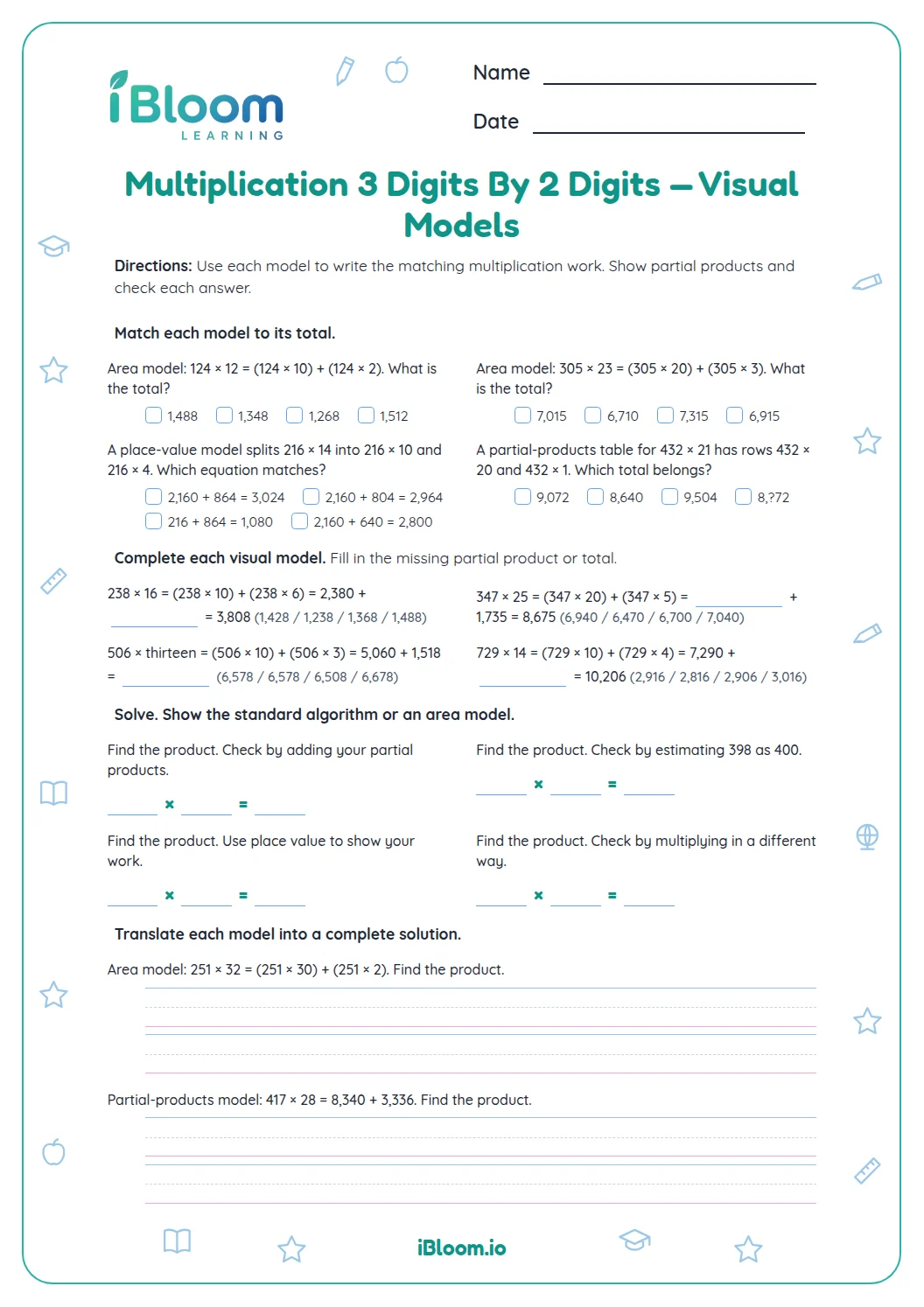
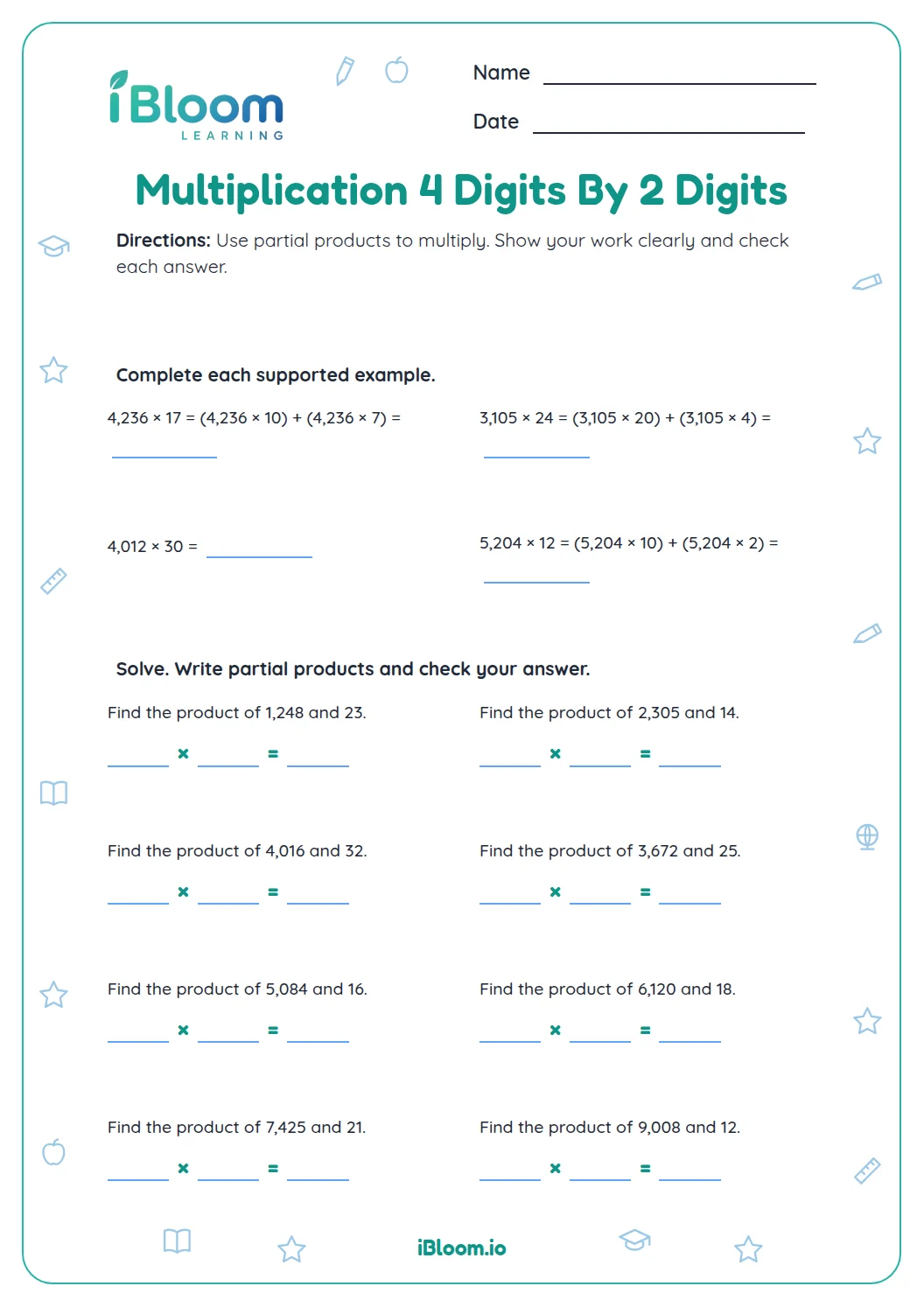
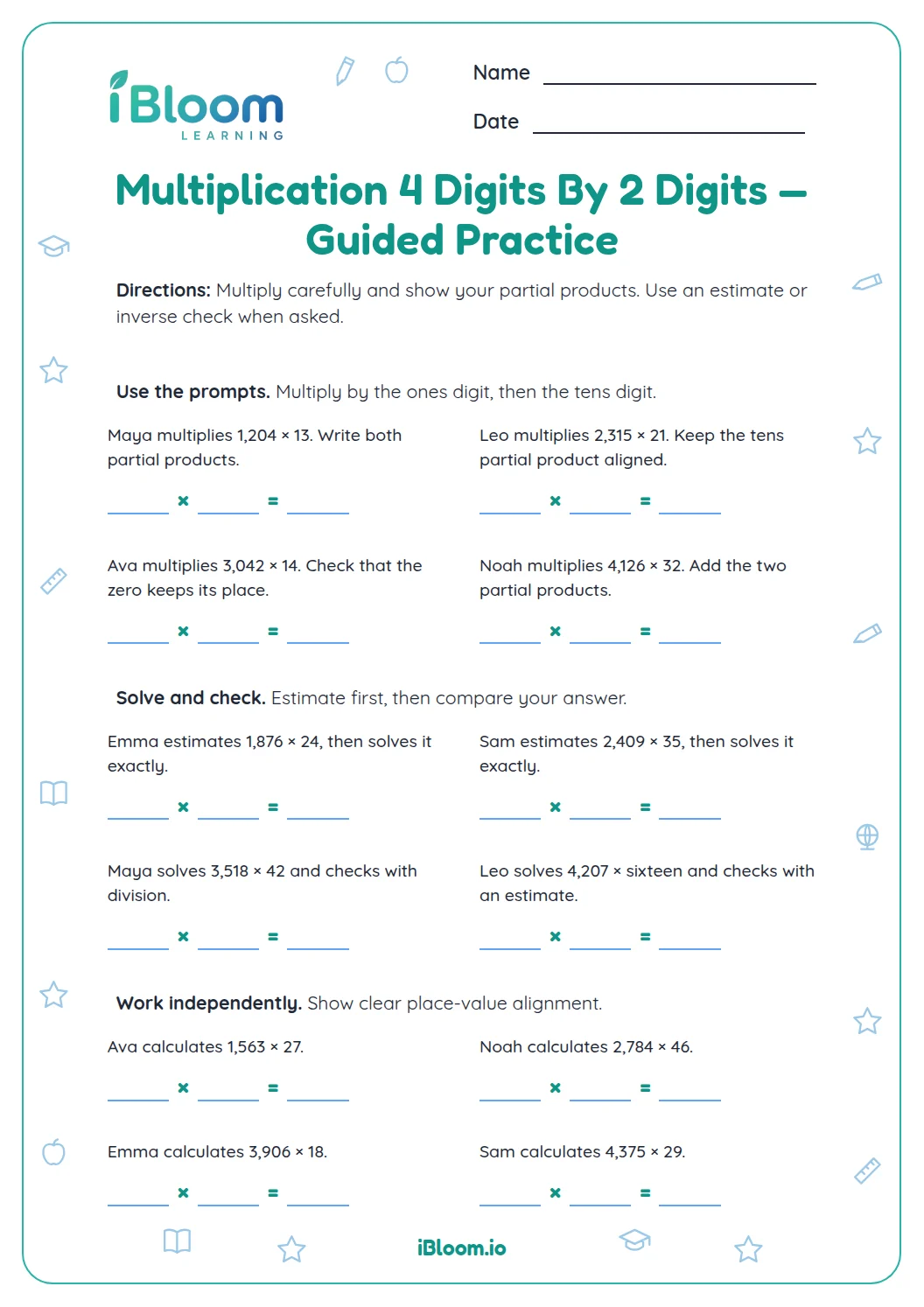
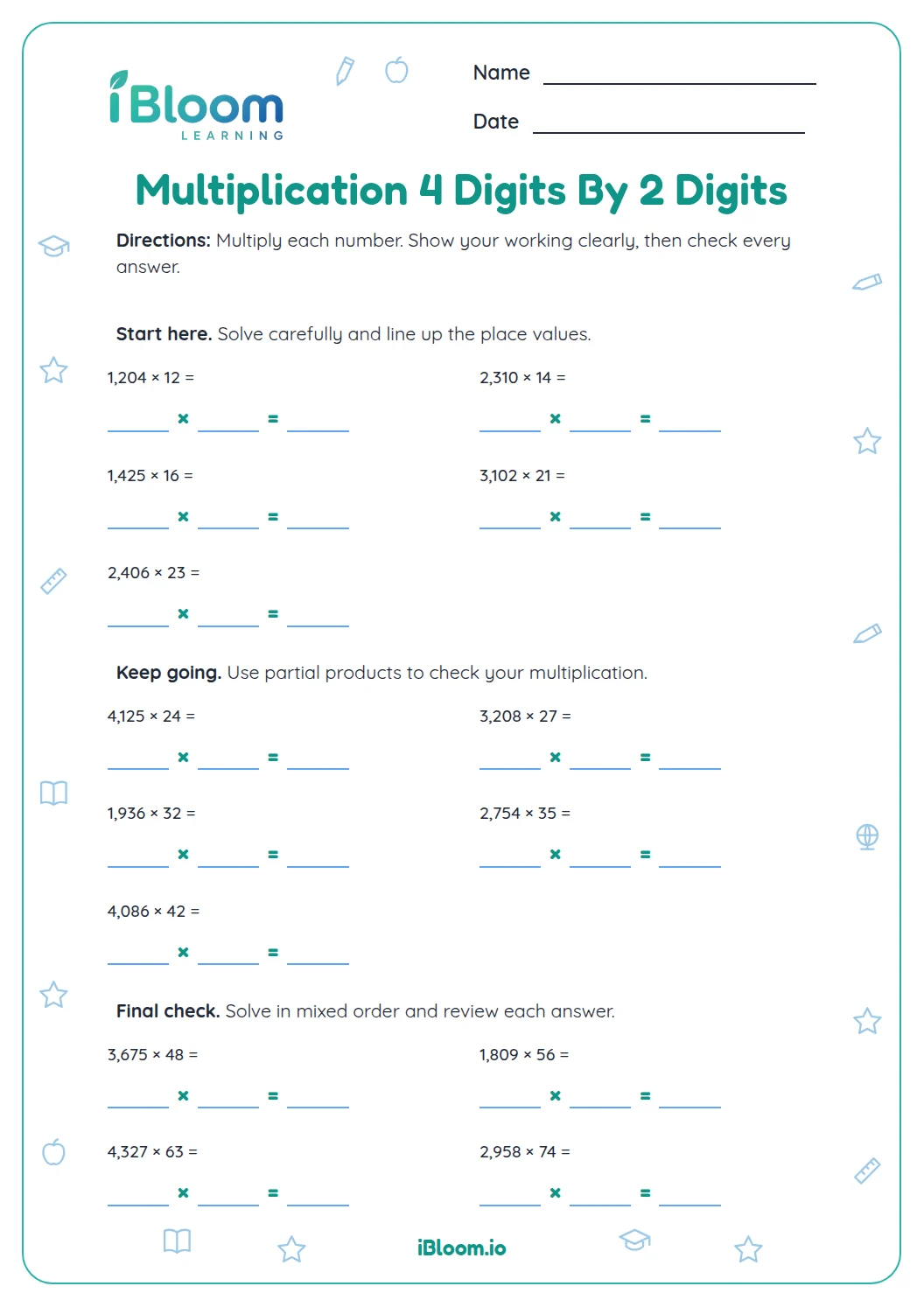
This Grade 6 printable practices multiplication in parts with whole-number factors. Students use decompositions, calculate partial products, and read a rectangle area model. The 14 questions fit on two worksheet pages and build from selected decompositions to independent calculations. A separate answer key lists products and model responses.
Aligned to 6.EE.A.3
How does multiplication in parts work?
Write a factor as a sum, multiply each addend by the other factor, and add. For instance, 23 × 4 becomes 20 × 4 plus 3 × 4, or 80 + 12 = 92.
- 123 × 4 = (20 × 4) + (3 × 4) = 80 + 12 = 92.
How do area models show the same idea?
A rectangle split into widths 20 and 4 has two smaller areas. With height 6, those areas are 20 × 6 and 4 × 6; their sum is the full rectangle’s area.
What is on the worksheet?
Part A practices decomposing factors. Part B completes partial products and reads an area model. Part C applies multiplication in parts with additional products.
How to use this worksheet
- 1Split one factor into place-value parts.
- 2Multiply each part by the other factor.
- 3Check that every part has a partial product.
- 4Add the partial products to find the total.
- 5Use area models to connect side lengths with the same calculation.
Mistakes to check
The mistake
Multiplying only one part of a split factor.
The fix
Write one partial product for every addend in the decomposition.
The mistake
Adding the partial products incorrectly.
The fix
Compute each smaller product first, then add them.
The mistake
Reading rectangle side lengths as separate products to choose between.
The fix
Multiply the height by each width part, then combine the areas.
Common Core alignment
This worksheet practices equivalent expressions by decomposing factors and finding products.
Use the distributive property to split a factor and generate an equivalent product.
On this sheet: Students decompose factors and use the distributive property to find products.
Show the official wordingHide the official wording
Apply the properties of operations to generate equivalent expressions. For example, apply the distributive property to the expression 3 (2 + x) to produce the equivalent expression 6 + 3x; apply the distributive property to the expression 24x + 18y to produce the equivalent expression 6 (4x + 3y); apply properties of operations to y + y + y to produce the equivalent expression 3y.
What to practice next
Make more practice
Further reading
Questions parents and teachers ask
How many questions are on the worksheet?
There are 14 questions in three parts. The practice starts with supported examples and moves toward applying multiplication in parts in short responses. A separate answer key is included with the printable so students can check their work afterward.
What grade is this printable for?
This worksheet is written for Grade 6. The directions and examples use the same skill throughout, with the last part asking students to apply it more independently. An adult can read a prompt aloud or talk through the first example before students continue.
Does it include an answer key?
Yes. A separate answer key is included after the worksheet pages. It gives the expected answer for selected-response items and sample responses for open-ended questions, so students can compare their reasoning rather than look for only one possible sentence.
How long will it take?
Plan for about 20 minutes to read the directions, complete all 14 questions, and check answers. Writing responses may take longer for some students. The printable can also be completed in separate short sessions at home or in class.
How should students use the examples?
Break one factor into place-value parts, multiply each part by the other factor, and add the partial products. For example, 23 × 4 = (20 × 4) + (3 × 4) = 80 + 12 = 92. The rectangle models show the same parts as areas.