





About this worksheet
This free printable gives Grade 6 students 14 real-world multiplication activities using partial products. Four questions ask students to choose a useful split, and ten ask them to calculate context-based products, including two with space to show work. The separate answer key lists the correct splits and totals with units. The practice uses place-value strategies from Common Core 4.NBT.B.5.
Aligned to 4.NBT.B.5
How do partial products solve a multiplication problem?
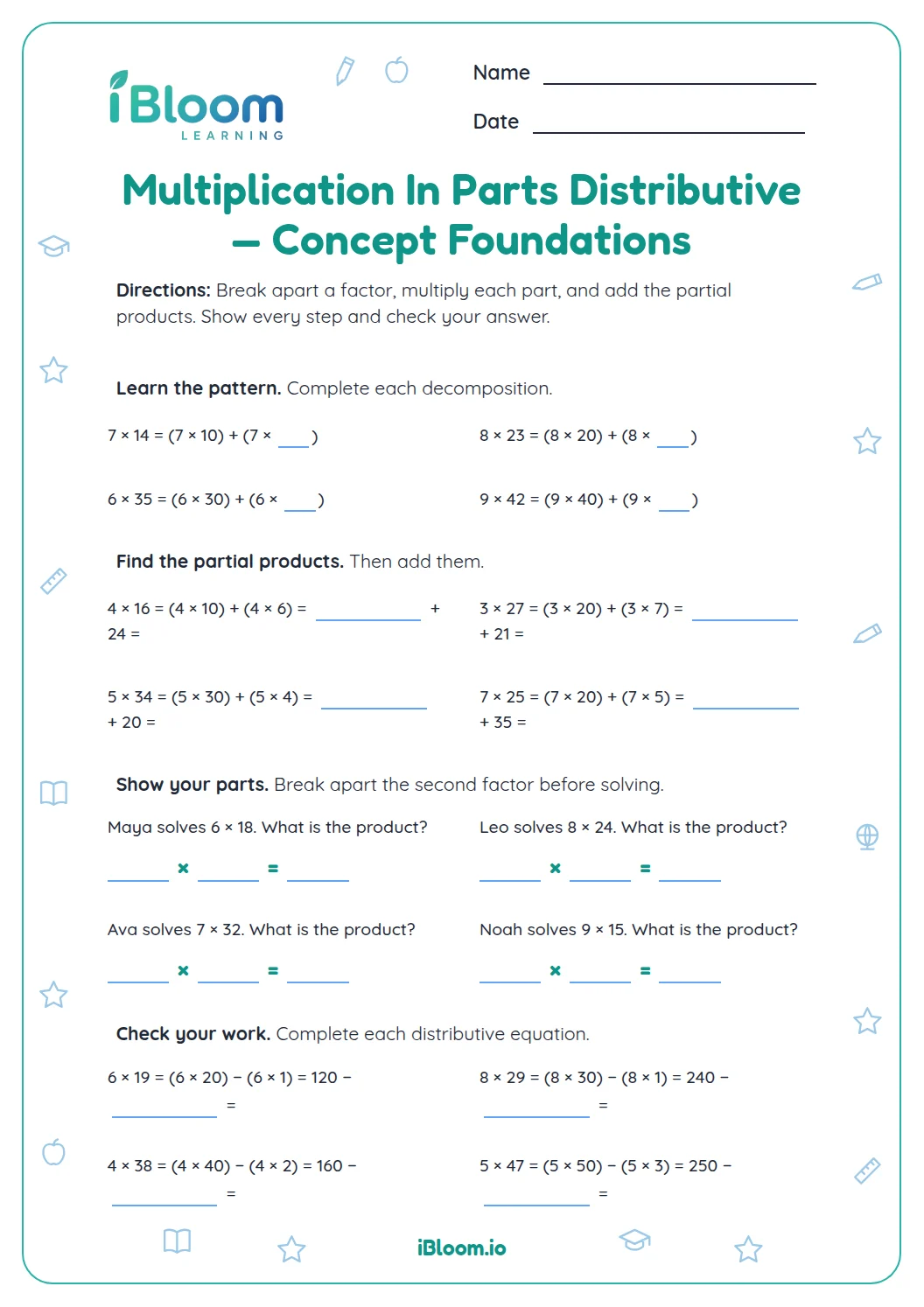
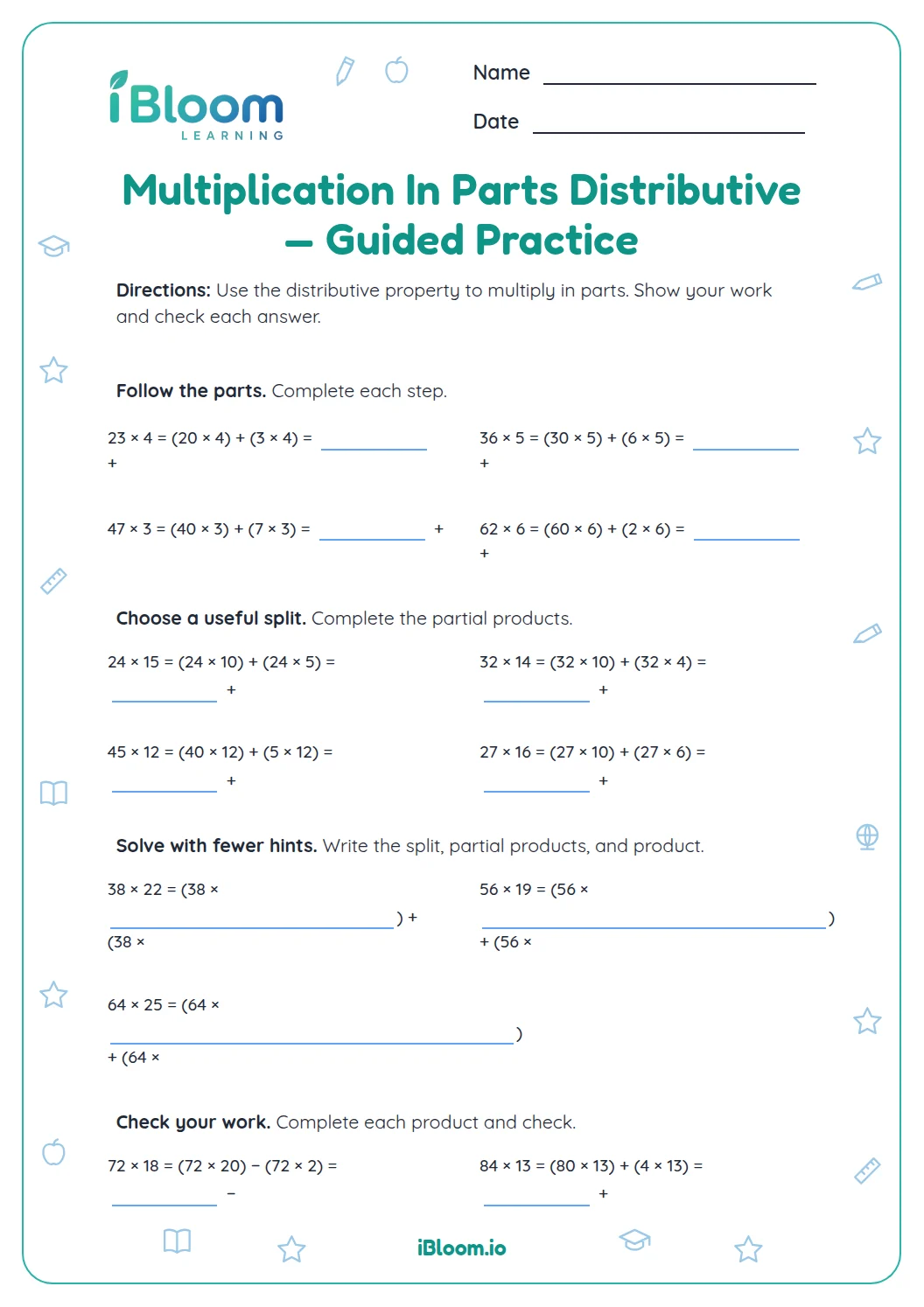
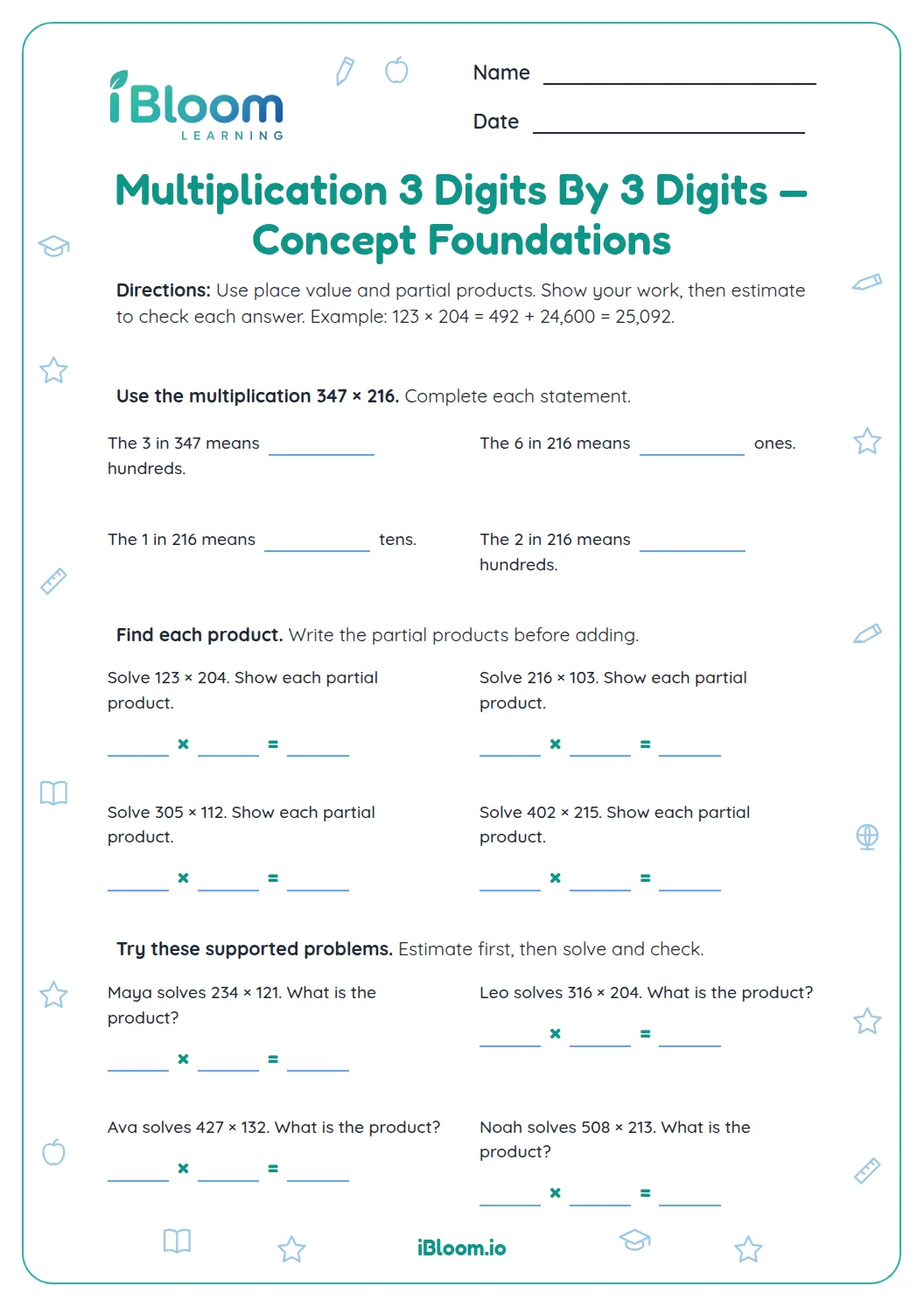
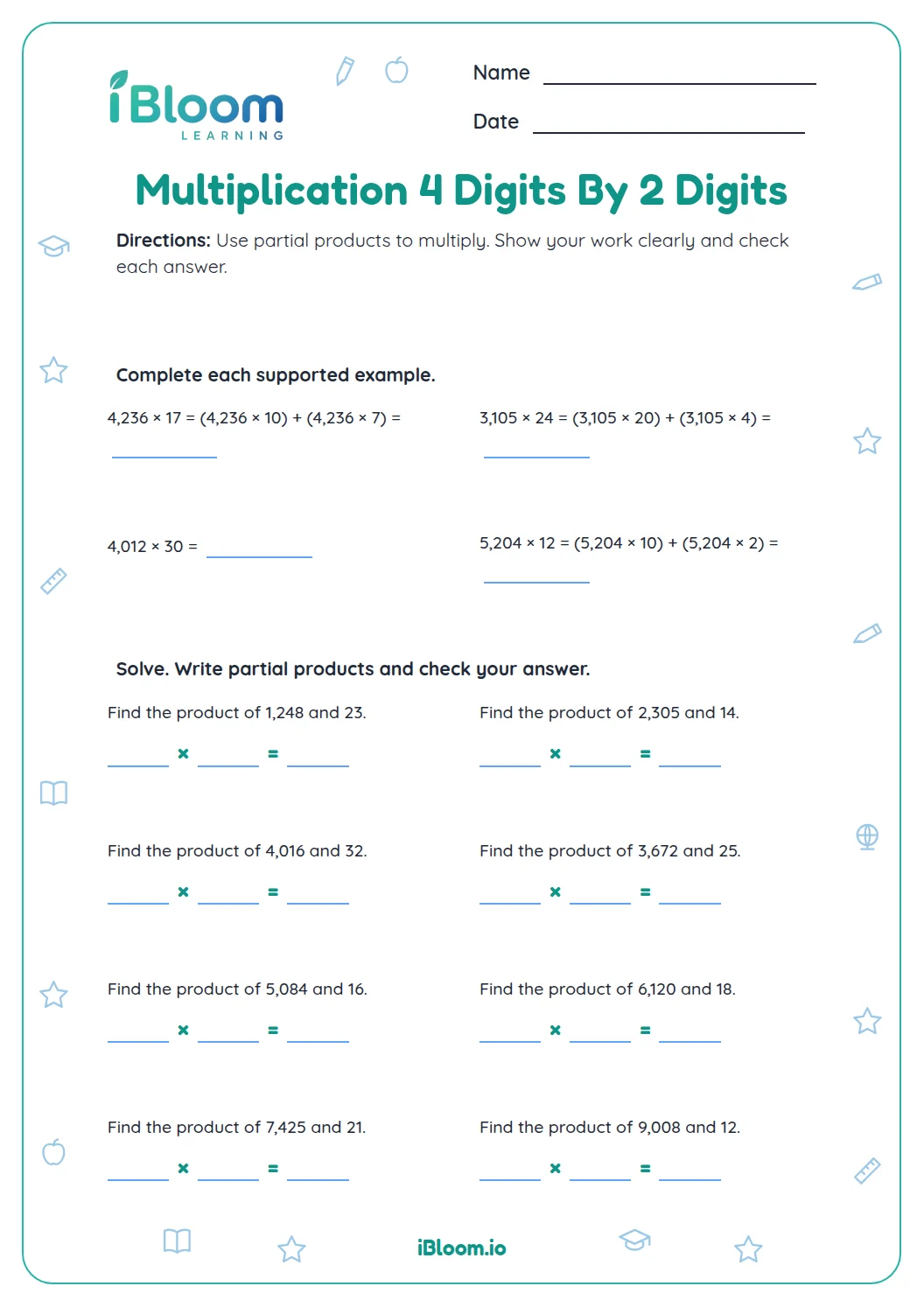
Split one factor into tens and ones, multiply each part, and combine. Question 1 asks about 24 stickers in each of 6 folders: (20 × 6) + (4 × 6) = 120 + 24 = 144 stickers.
How does the method work with two two-digit factors?
Choose a factor that is convenient to split. For question 8, 32 bags × 24 marbles can be (30 × 24) + (2 × 24) = 720 + 48 = 768 marbles. The same idea works if the other factor is split instead.
How can students tell whether a product is reasonable?
For a compact context such as 18 cartons with 25 eggs each, split 18 into 10 + 8: 250 + 200 = 450 eggs. Estimating first helps check the product and its unit.
How to solve the problems
- 1Write the number of groups multiplied by the amount in each group.
- 2Split one factor into tens and ones, such as 32 = 30 + 2.
- 3Multiply each part by the other factor.
- 4Add the partial products and attach the correct unit.
- 5Estimate to check whether the product is sensible.
- 6Use the key to review the calculation, not just the final total.
Common slips and quick fixes
The mistake
Splitting 32 into 3 and 2 instead of 30 and 2.
The fix
Write the tens value explicitly: 32 = 30 + 2.
The mistake
Forgetting one partial product.
The fix
Make a separate line for each part before adding.
The mistake
Adding the partial products incorrectly or dropping the unit.
The fix
Re-add the partial products and label the total in context.
Common Core alignment
This sheet practices the following Common Core skill.
Multiply whole numbers using place value and properties of operations.
On this sheet: The contexts use one-digit and two-digit factors and ask students to find products by splitting a factor into place-value parts.
Show the official wordingHide the official wording
Multiply a whole number of up to four digits by a one-digit whole number, and multiply two two-digit numbers, using strategies based on place value and the properties of operations. Illustrate and explain the calculation by using equations, rectangular arrays, and/or area models.
What to practice next
Make more practice
Further reading
Questions parents and teachers ask
What does multiplication in parts mean?
It means splitting a factor into place-value parts, multiplying each part, and adding the partial products. For 24 × 6, use (20 × 6) + (4 × 6) = 120 + 24 = 144. Then check that the split parts still add to 24 and both products are included.
How many real-world problems are included?
There are 14 activities in three parts: four split choices, two multiplication problems with working space, and eight product questions. The answer key gives the correct split or product, including its unit, for each context. Students can use the key to review the method after solving.
Why use the distributive property?
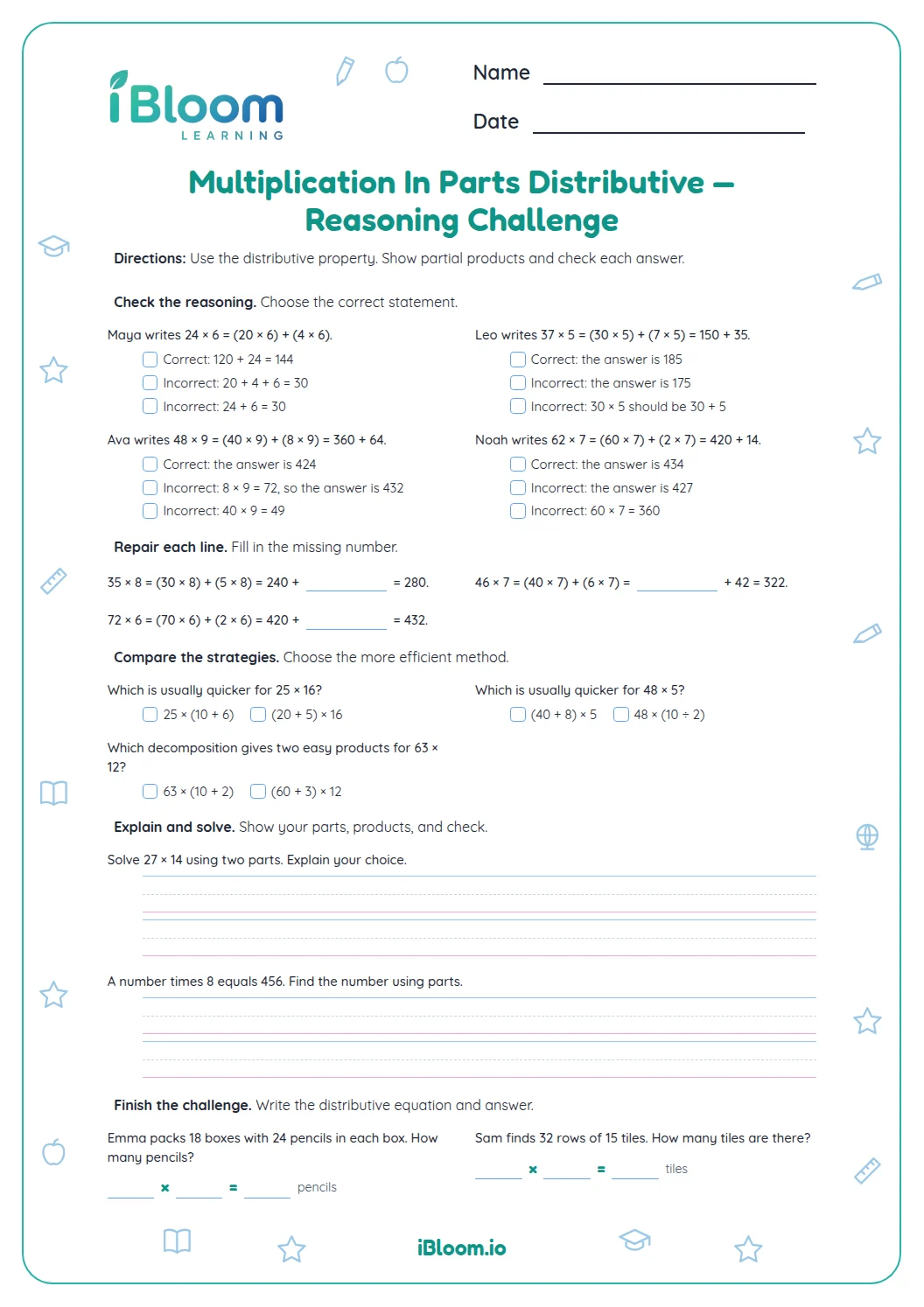
Breaking a factor apart can make a product easier to calculate mentally or on paper. The parts must still combine to the original factor, and the partial products must be added to get the full total. The partial products make the place-value steps visible and easier to check.
What should students write in the answer?
For a problem with working space, write a multiplication equation, split one factor into tens and ones, and add the partial products. Include the unit, such as pencils or seats; for money, write the dollar total. The other choice questions ask for an equivalent split or result.
How can students check a product?
Estimate first, then multiply the parts and add them. For 18 cartons of 25 eggs, 10 × 25 is 250 and 8 × 25 is 200; 250 + 200 = 450 eggs. That total is reasonable because it is a little less than 20 cartons of 25.