
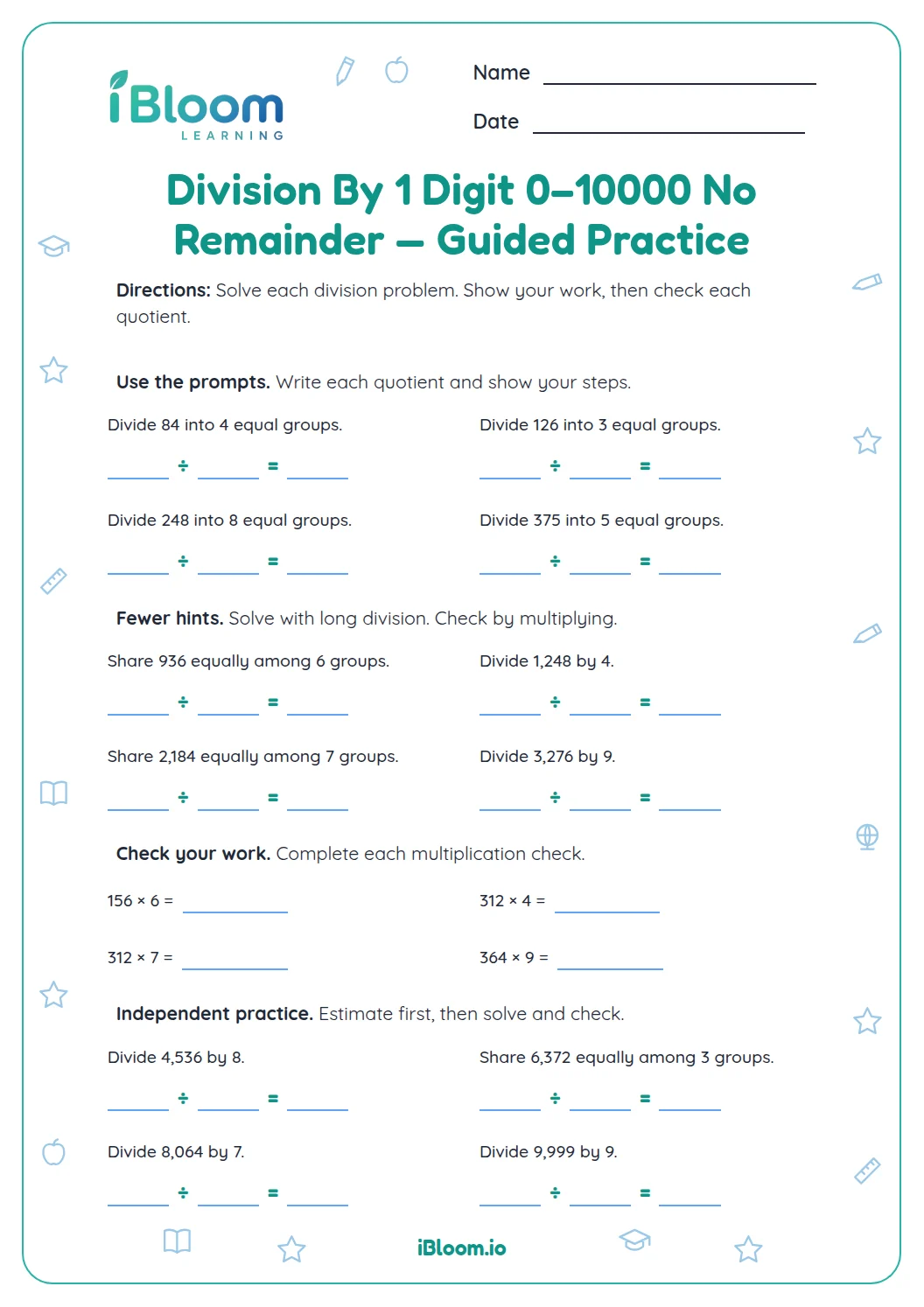
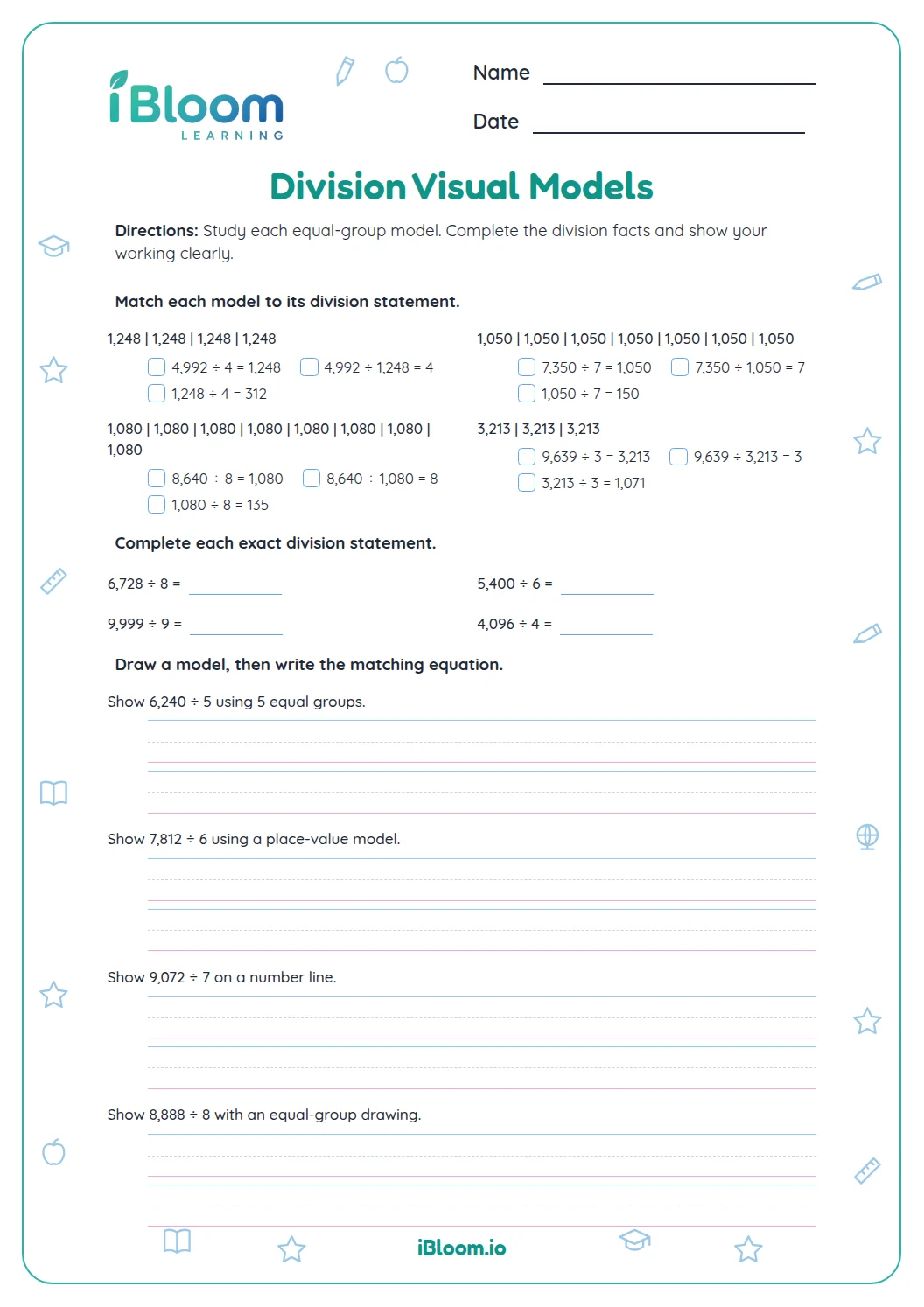
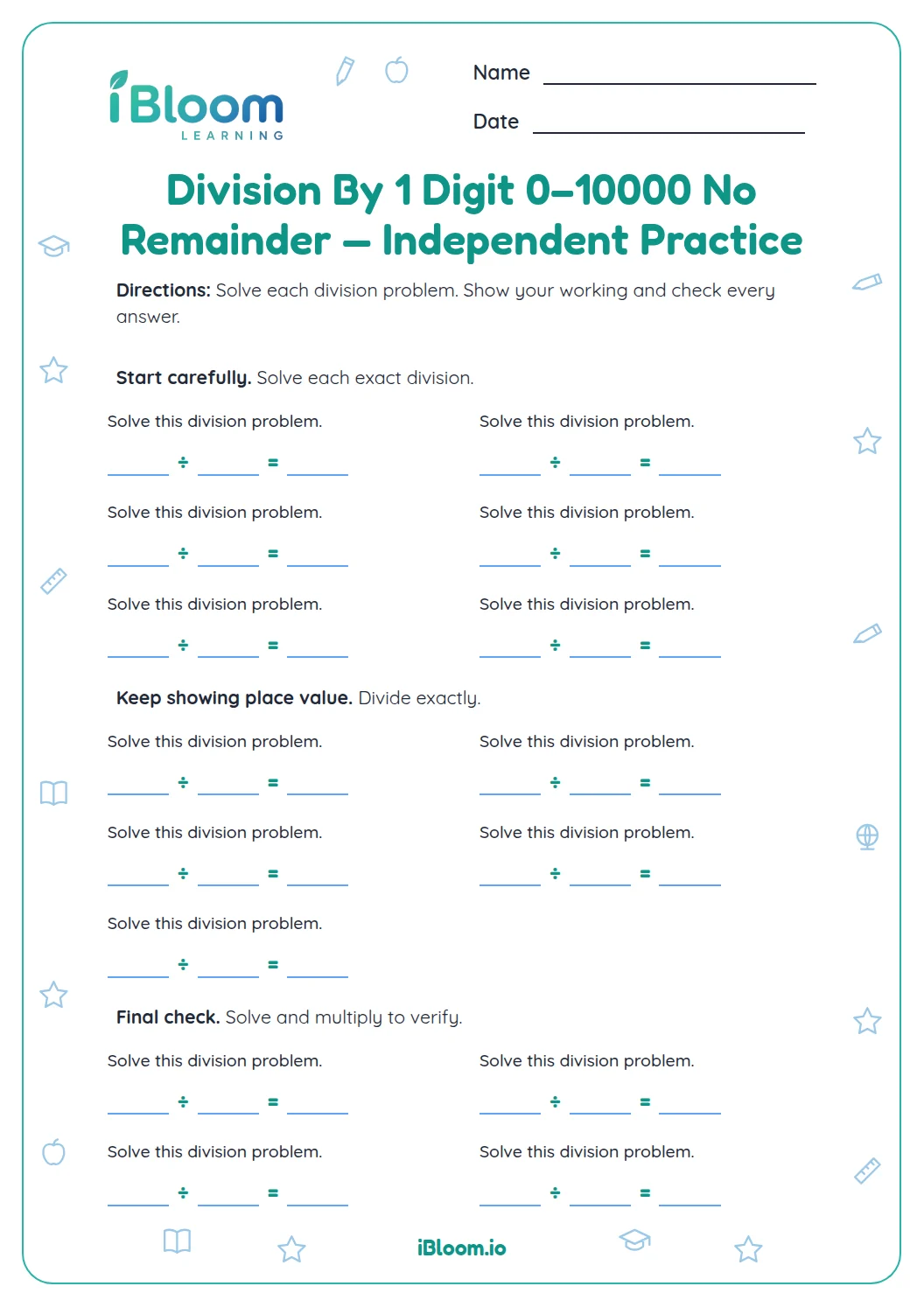
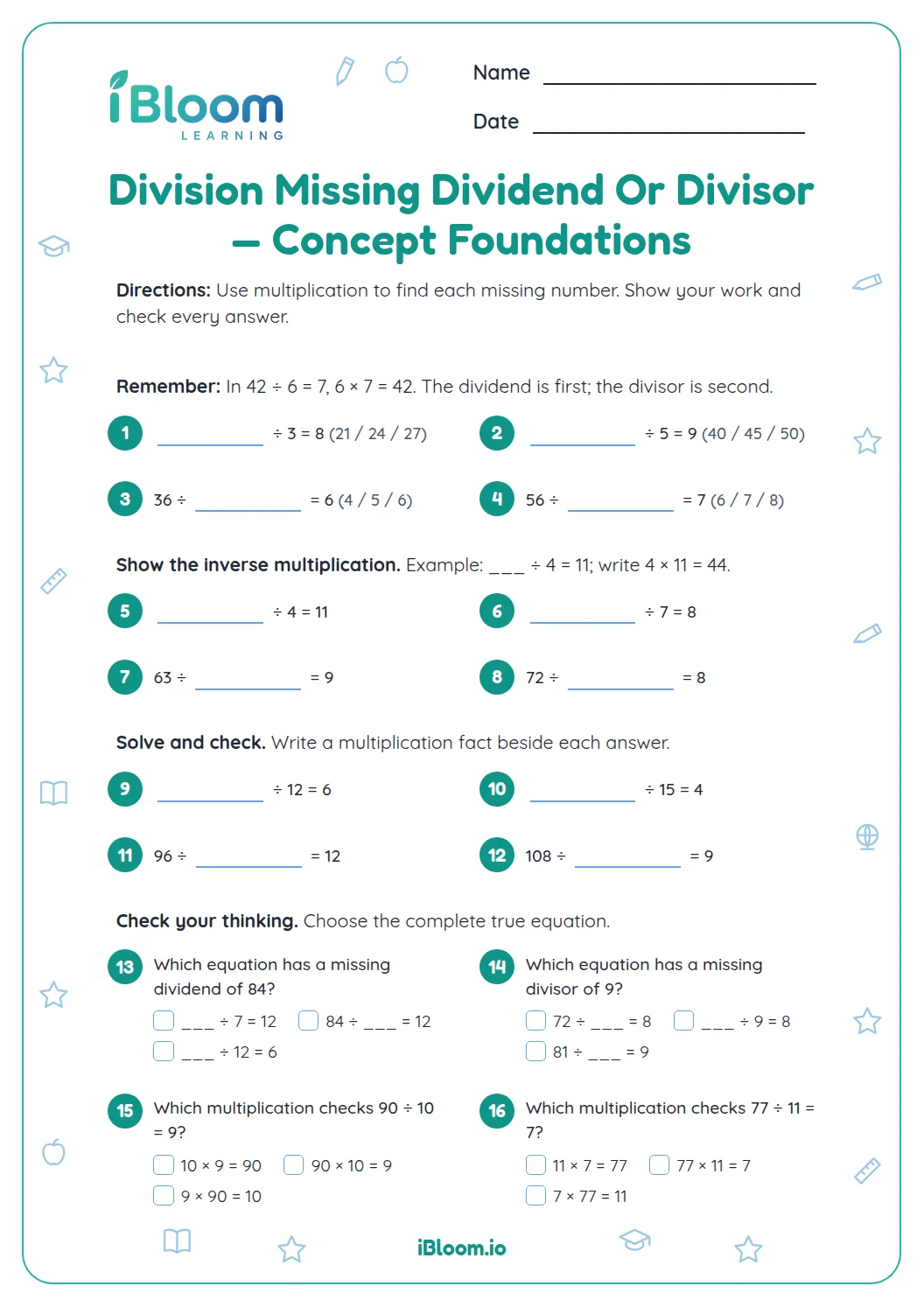
About this worksheet
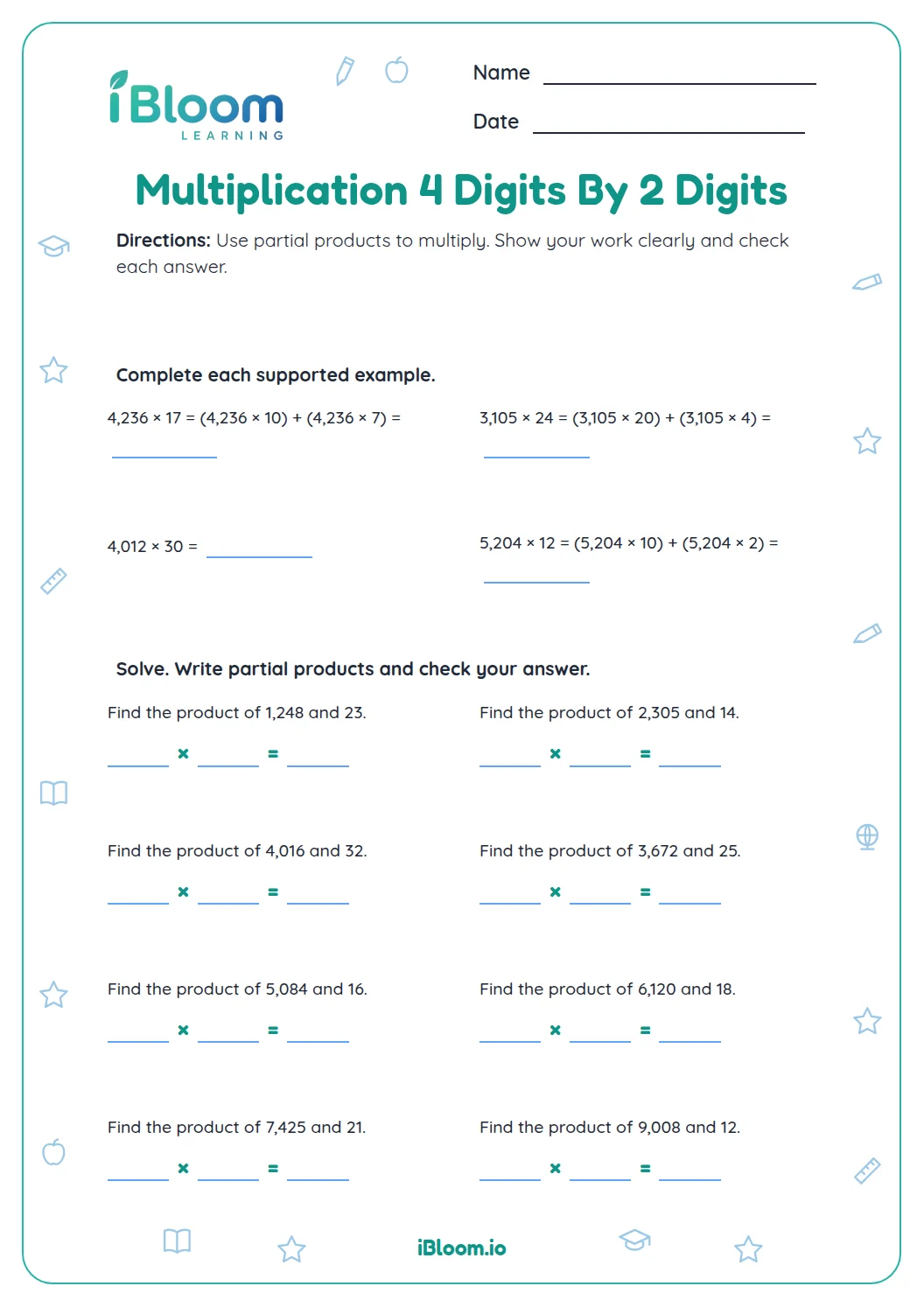
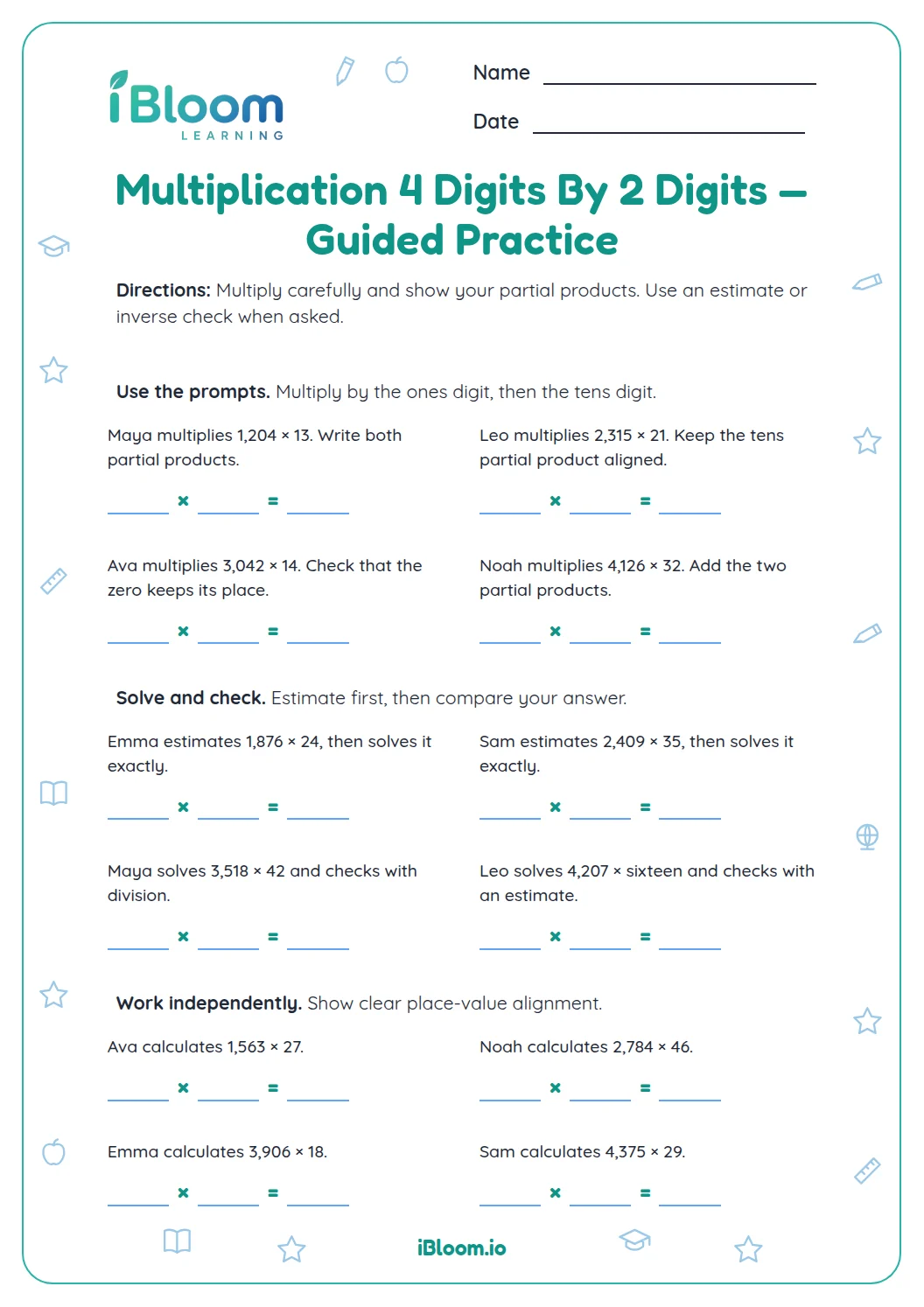
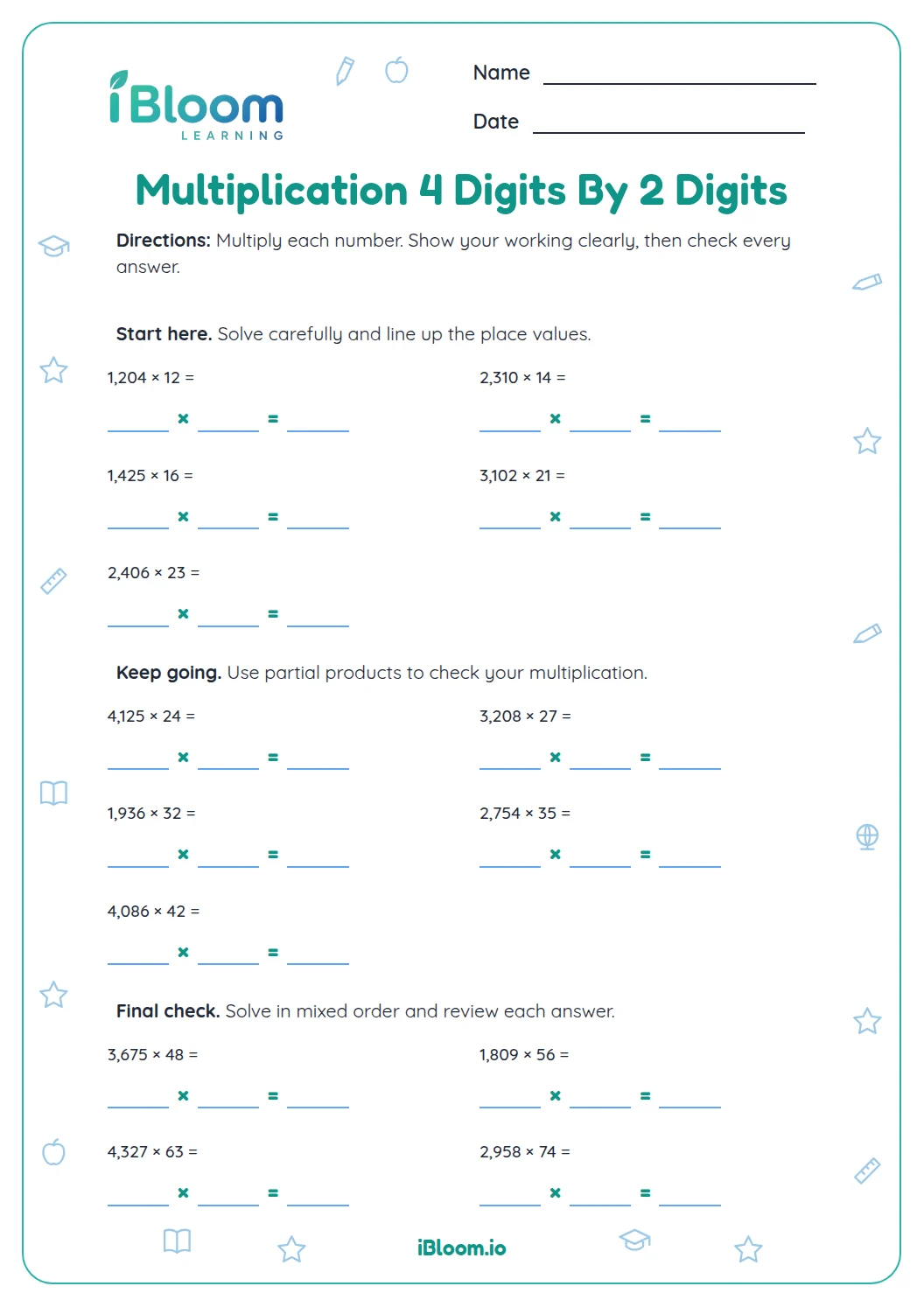
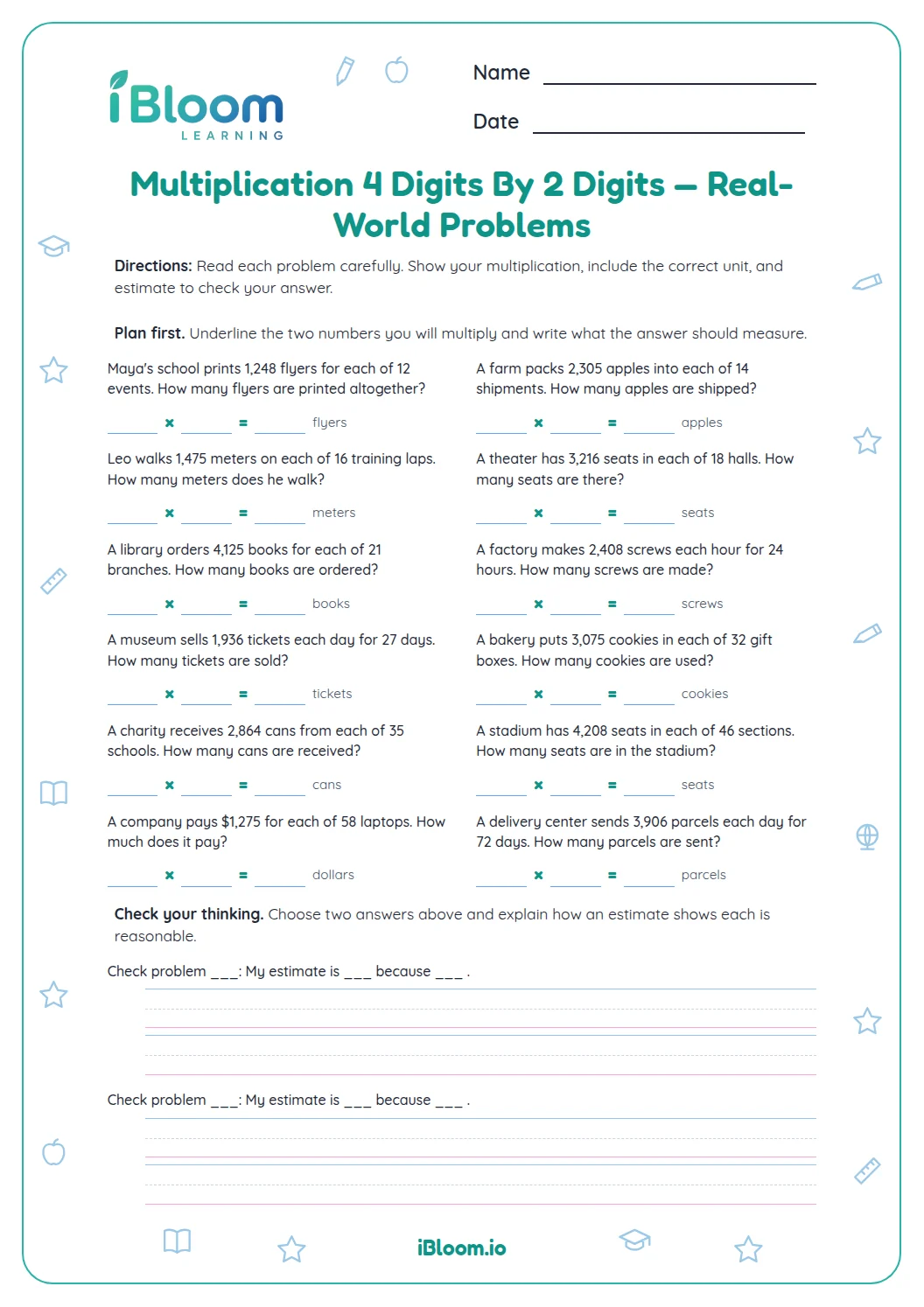
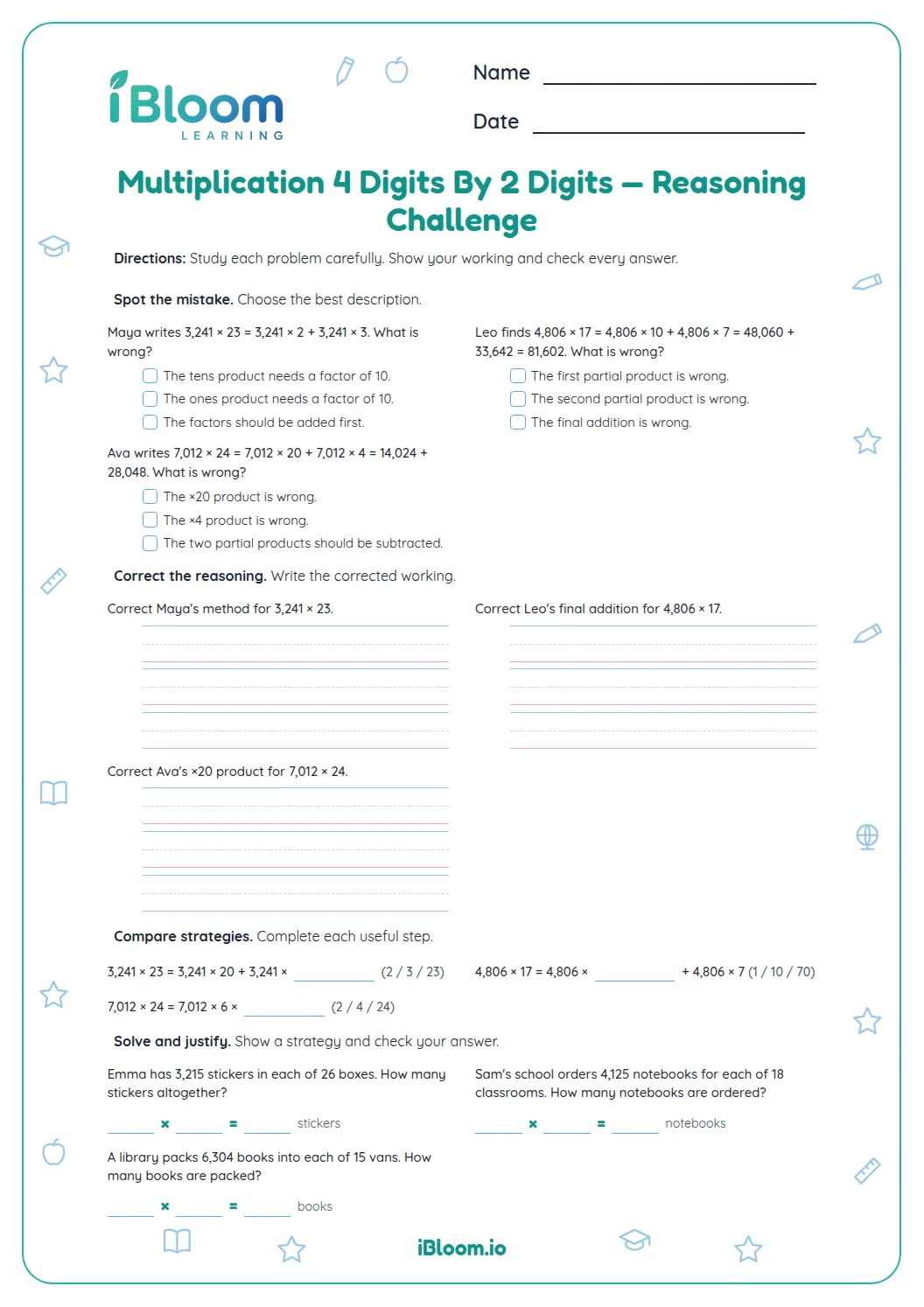
This Grade 6 printable worksheet practices four-digit by two-digit multiplication with a partial-products table on every problem. Students split the two-digit factor by place value, find each partial product, and combine them for the full product. The answer key lists the products for all 14 questions.
How do the tables show partial products?
Each table separates the two-digit factor into its tens and ones. Students multiply by each part and combine those partial products to find the full product.
How does the table model 1,234 × 12?
Split 12 into 10 and 2. Multiply 1,234 by both parts, then add the two results.
- 11,234 × 10 = 12,340
- 21,234 × 2 = 2,468
- 312,340 + 2,468 = 14,808
How can students check the product?
Estimate first, then verify both partial products and their sum. For 1,234 × 12, a result near 1,200 × 12 = 14,400 is reasonable.
How to use this worksheet
- 1Read the directions at the top of the page together.
- 2Complete the first item slowly and explain the thinking aloud.
- 3Work through the remaining questions in order.
- 4Use the answer key to check each response.
Common mistakes and quick fixes
The mistake
Rushing past a key detail in the prompt.
The fix
Underline the numbers or words that matter before answering.
The mistake
Giving an answer without checking how it fits the question.
The fix
Reread the whole prompt and make sure the response answers it.
The mistake
Stopping after a first attempt.
The fix
Compare the response with the answer key and correct any slip.
What to practice next
Make more practice
Questions parents and teachers ask
What is a partial product?
A partial product is the result of multiplying by one place-value part of a factor. In 1,234 × 12, the parts are 10 and 2, so the partial products are 12,340 and 2,468. Students can point to the matching source detail and explain the choice before checking the key.
How many problems are on this worksheet?
There are 14 problems. Each uses a four-digit number and a two-digit factor, with a table that separates the tens and ones for partial-products work. Ask the learner to name the source detail or calculation that supports the answer before opening the key.
What should students do after finding the partial products?
Add the partial products to get the full product. For 1,234 × 12, students combine 12,340 and 2,468 to get 14,808. Have the student identify the matching source clue and explain how it supports the answer before checking the key.
Why does the table show tens and ones separately?
Separating the two-digit factor by place value makes the distributive steps visible. Students multiply by the tens part and the ones part, then combine those results. Ask the learner to name the source detail or calculation that supports the answer before opening the key.
Is an answer key included?
Yes. A separate answer key lists each full product. Students can check their partial products as well as their final total against the method shown in the question table. Students can point to the matching source detail and explain the choice before checking the key.