






About this worksheet
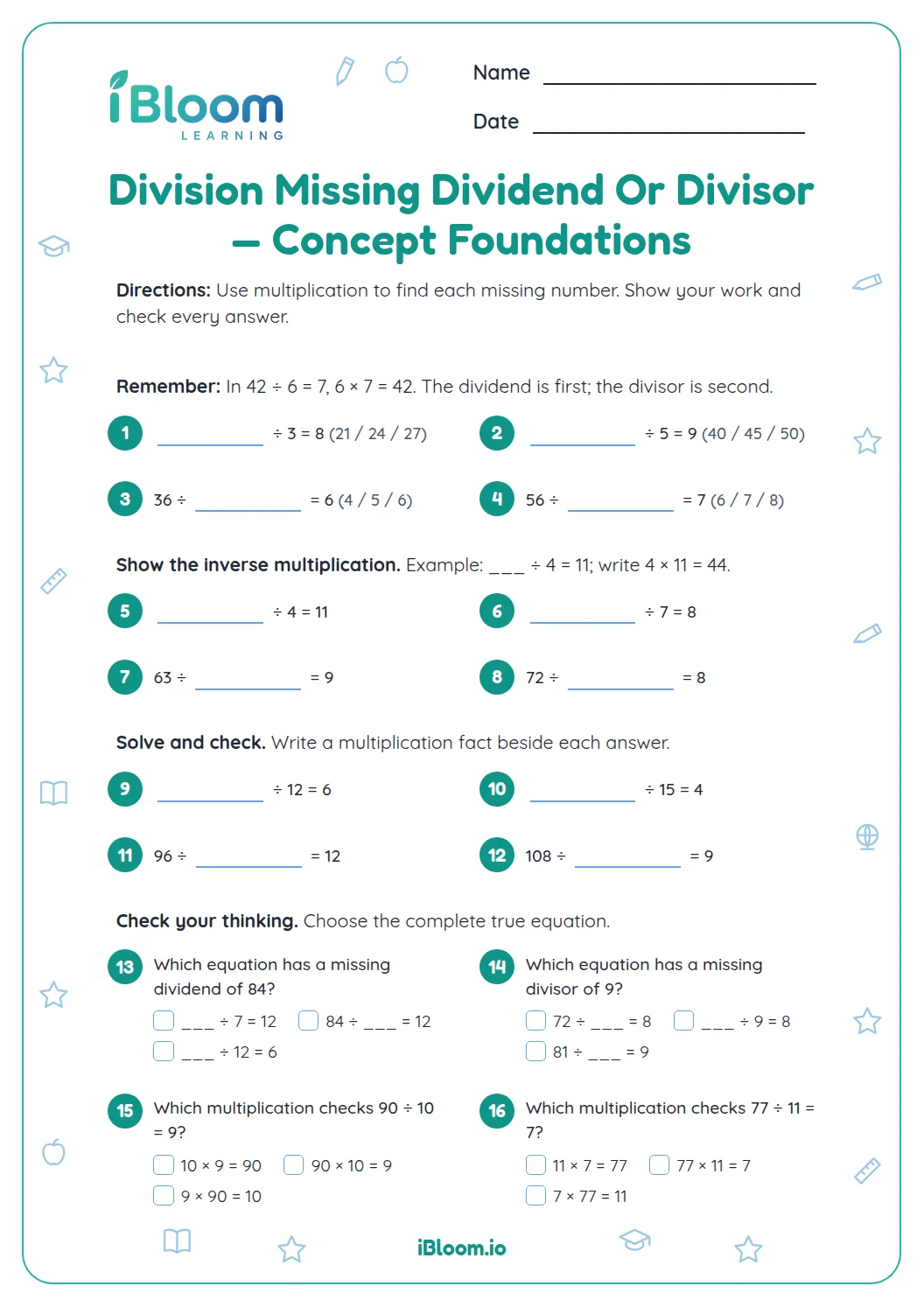
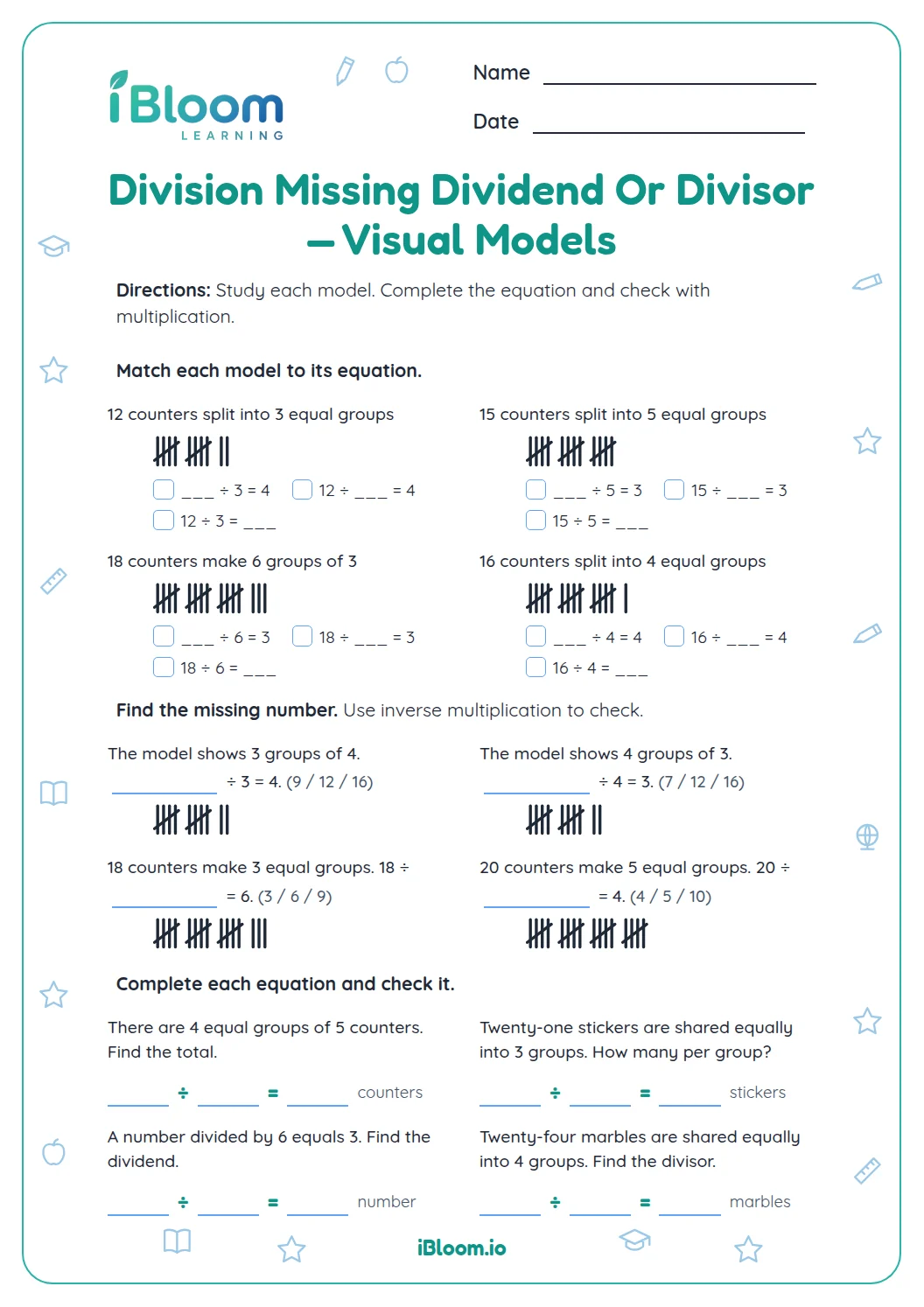
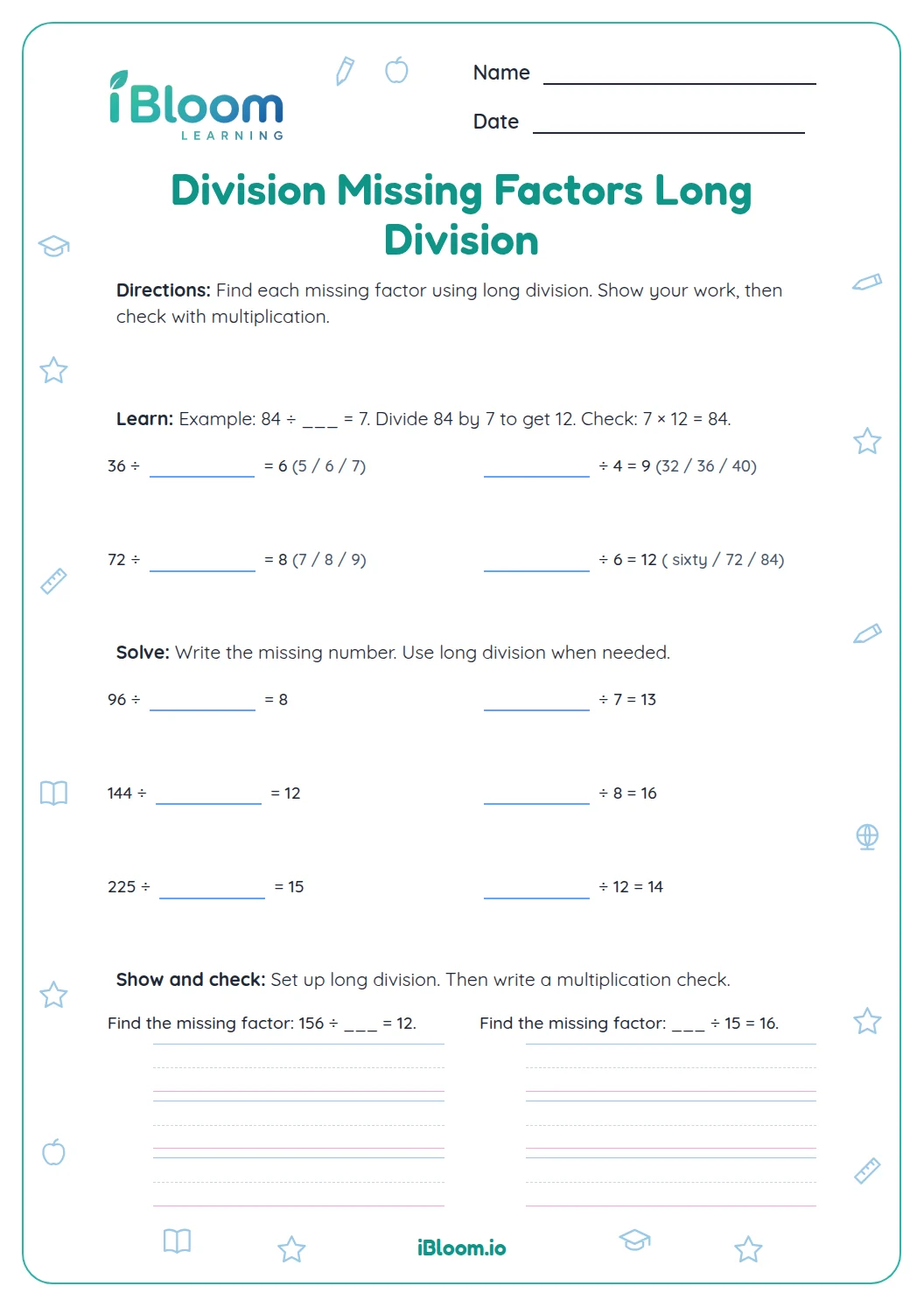
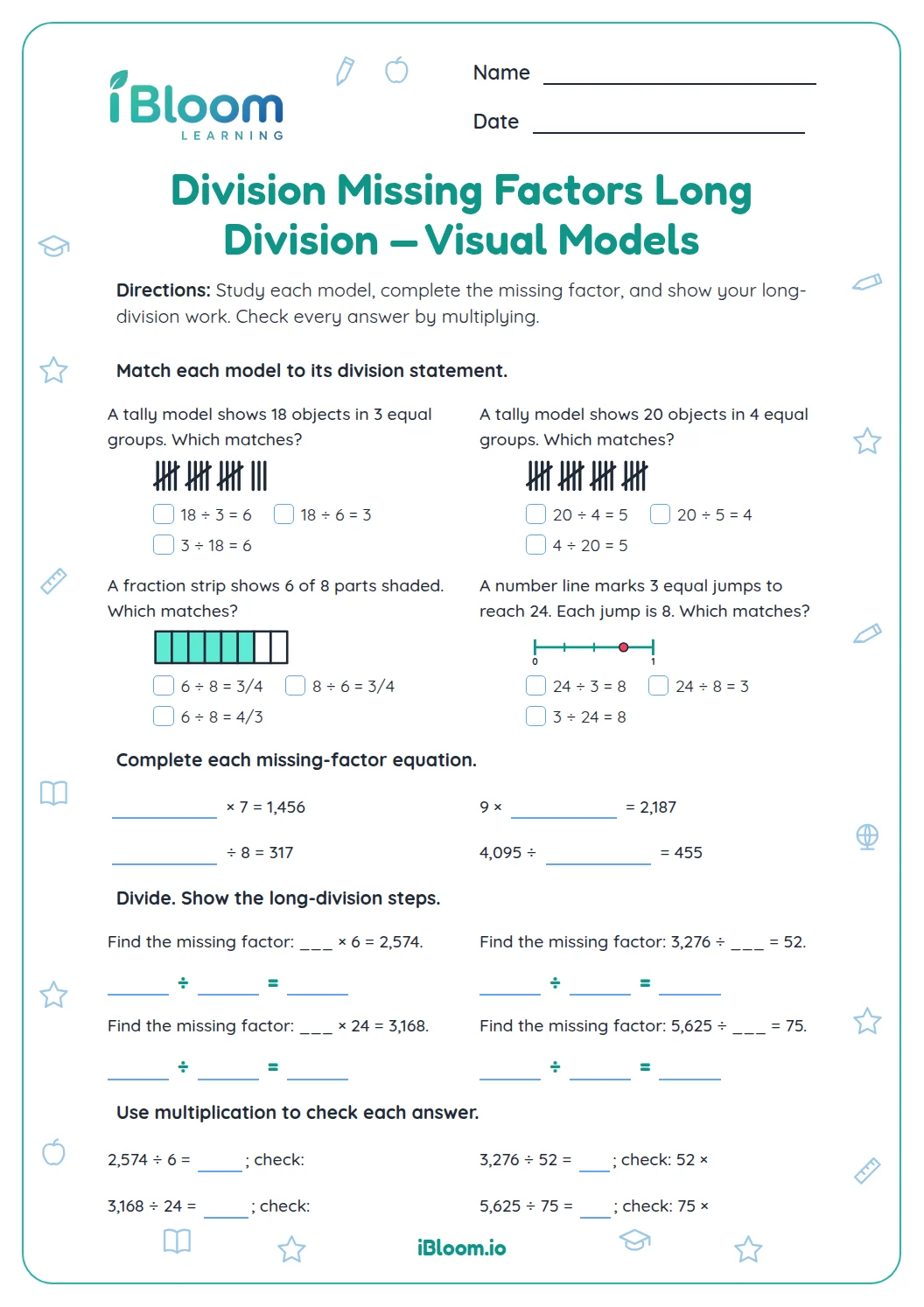
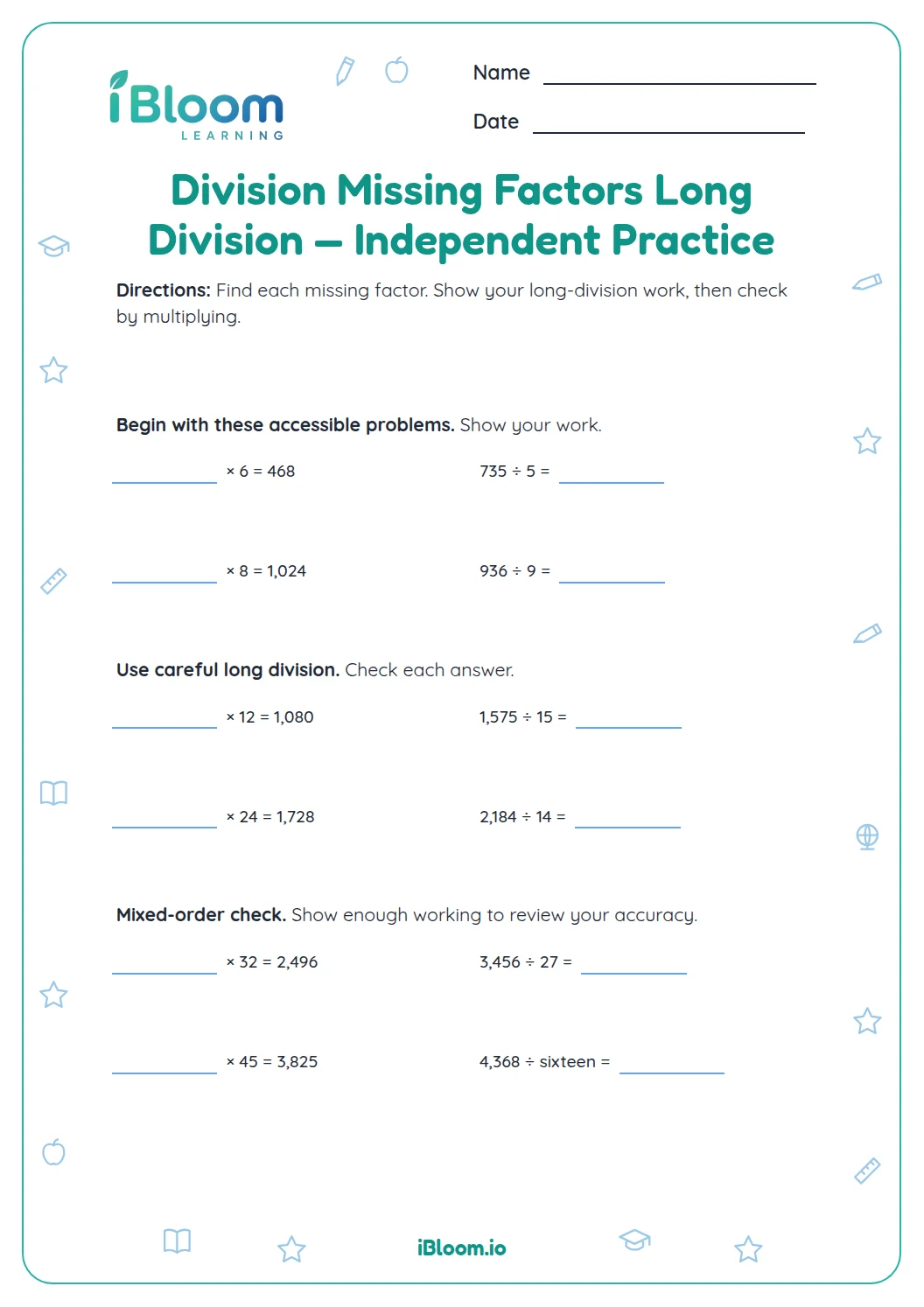
This free Grade 6 worksheet practices finding a missing dividend or divisor by using the relationship between multiplication and division. Part A gives six missing dividends; Part B gives six missing divisors. Part C applies both ideas to two packing problems with larger numbers. Students complete each division equation and show a multiplication check. The work practices Common Core 3.OA.A.4, finding an unknown whole number in an equation. Every division is exact, and the separate answer key supplies all fourteen answers, including units for the packing problems.
Aligned to 3.OA.A.4
Which number is missing in the equation?
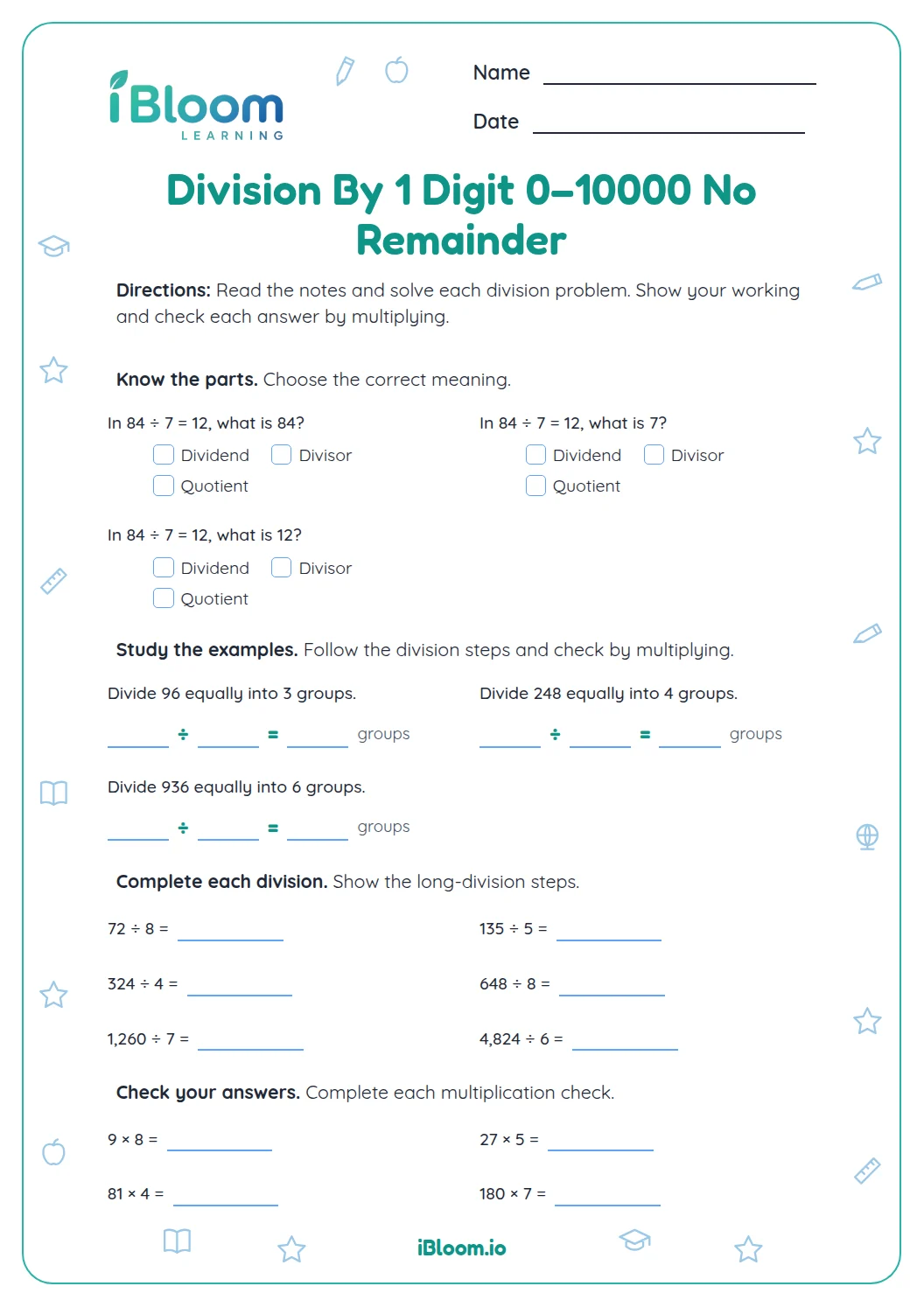
In dividend ÷ divisor = quotient, the dividend is the amount being divided, the divisor tells the group size or number of equal groups, and the quotient is the result. Before calculating, point to the blank and identify its role.
The position matters. In ___ ÷ 3 = 8, the missing dividend is 3 × 8 = 24. In 36 ÷ ___ = 6, the missing divisor is the number that multiplies by 6 to make 36.
How can students find and check a missing divisor?
Use the known dividend and quotient to find a missing factor. You can recall a multiplication fact or divide the dividend by the quotient. Then put the answer back in the original equation and write a multiplication check.
- 136 ÷ ___ = 6
- 2Think: ___ × 6 = 36.
- 36 × 6 = 36, so the missing divisor is 6.
- 4Replace the blank: 36 ÷ 6 = 6.
How is the independent practice organized?
Part A uses multiplication facts to recover dividends from 24 to 91. Part B gives dividends from 36 to 225 and asks for divisors from 6 to 15. These separate parts let students practice each blank position before using the relationship in a story.
Part C gives a division equation with each packing story. The pencil problem asks for the total in ___ ÷ 18 = 24. The bead problem asks for the number of bags in 1,440 ÷ ___ = 48. Larger numbers make the final pair more demanding.
How to use this worksheet
- 1Review the names dividend, divisor, and quotient with one equation.
- 2Have students identify the missing number’s role before solving Part A.
- 3In Part B, turn the division into a multiplication fact with a missing factor.
- 4Complete the division equation printed with each packing problem in Part C.
- 5Replace each blank with its answer and multiply the divisor by the quotient to check.
Mistakes to check and how to fix them
The mistake
Dividing 8 by 3 to solve ___ ÷ 3 = 8.
The fix
The missing dividend is the starting total: 3 × 8 = 24.
The mistake
Multiplying 36 by 6 to solve 36 ÷ ___ = 6.
The fix
Find the factor in ___ × 6 = 36. The missing divisor is 6.
The mistake
Writing 48 bags because the story says 48 beads per bag.
The fix
The 48 is the amount in each bag. Find how many groups of 48 make 1,440: 48 × 30 = 1,440.
Common Core alignment
Find missing dividends and divisors by relating division to multiplication.
On this sheet: Students find missing whole numbers in division equations and check them with multiplication.
Show the official wordingHide the official wording
Determine the unknown whole number in a multiplication or division equation relating three whole numbers. For example, determine the unknown number that makes the equation true in each of the equations 8 × ? = 48, 5 = _ ÷ 3, 6 × 6 = ?
What to practice next
Make more practice
Further reading
Questions parents and teachers ask
Does this sheet practice both missing dividends and missing divisors?
Yes. Part A has six missing dividends, and Part B has six missing divisors. Part C adds one story for each situation. The blank changes position between the first two parts, so students must decide whether the known numbers should be multiplied or divided.
How large are the numbers on this worksheet?
The first twelve equations use completed dividends from 24 to 225 and divisors from 3 to 15. The two packing problems then use larger totals: 432 pencils and 1,440 beads. Students apply the same multiplication–division relationship to every problem, even when the numbers grow.
How should students find a missing divisor in Part B?
Use a related multiplication fact or divide the dividend by the quotient. In question 7, 36 ÷ ___ = 6 becomes ___ × 6 = 36. The missing divisor is 6. Students should write the multiplication check and then reread the completed division equation.
How do the two packing problems connect to the equations?
The printed equations make the missing number’s role clear. For the pencils, ___ ÷ 18 = 24 asks for the starting total, 432. For the beads, 1,440 ÷ ___ = 48 asks for the number of bags, 30. Both answers can be checked by multiplying.
What should I check besides the final answers?
Check that each completed division statement is true and that each word problem has the correct unit. A correct product or quotient in the working can still be copied into the wrong place. The key lists all fourteen answers, including pencils and bags for Part C.