





About this worksheet
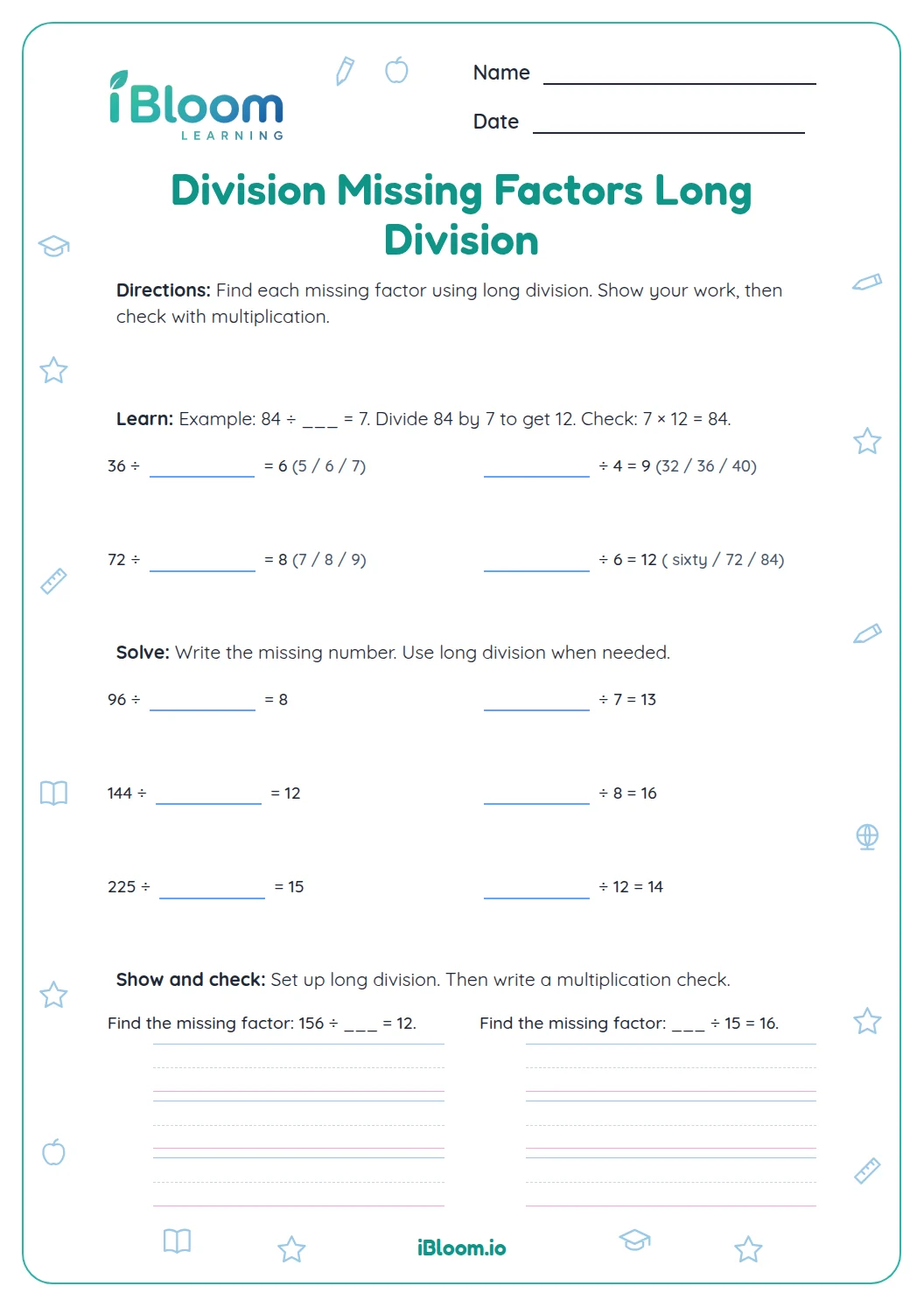
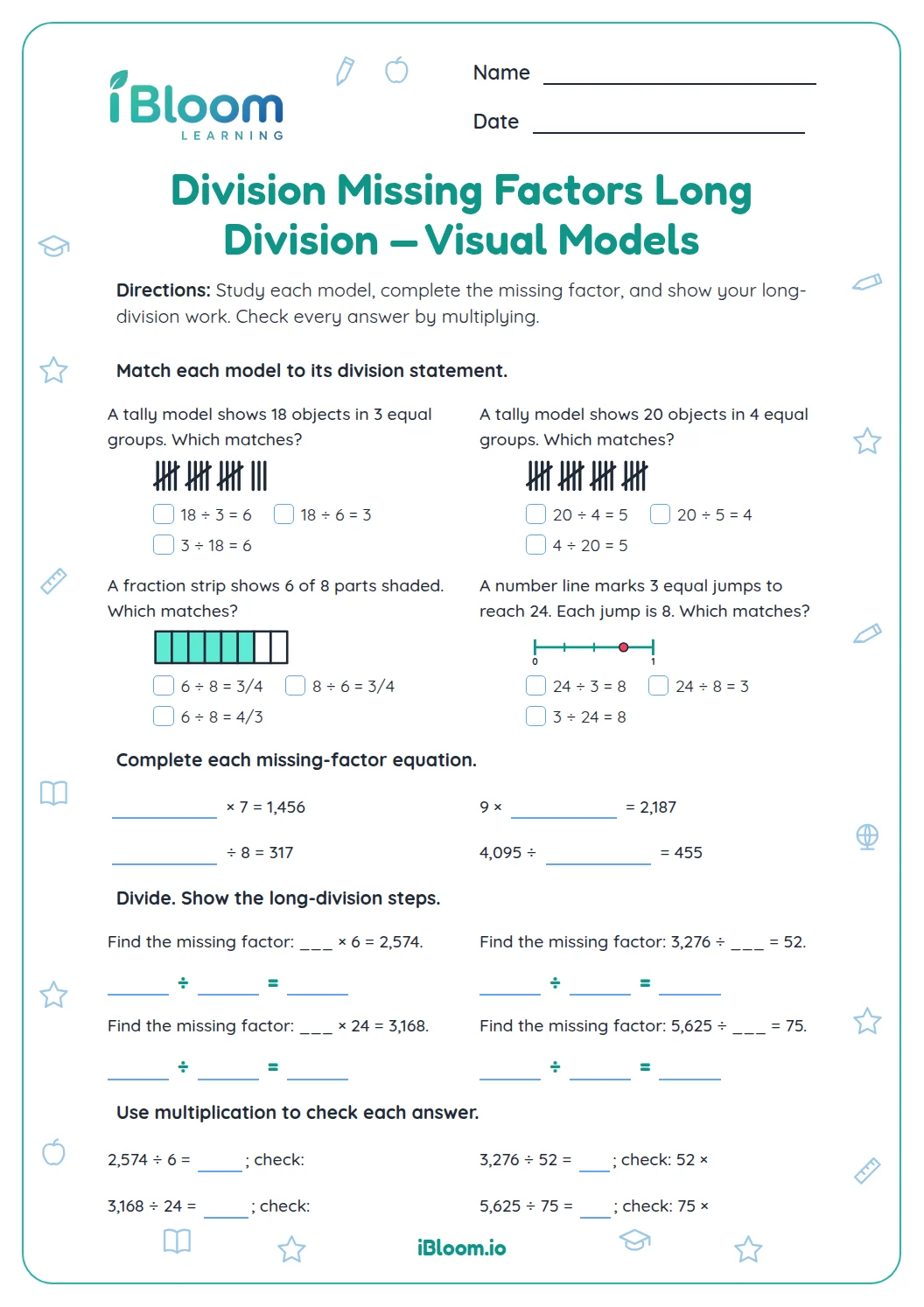
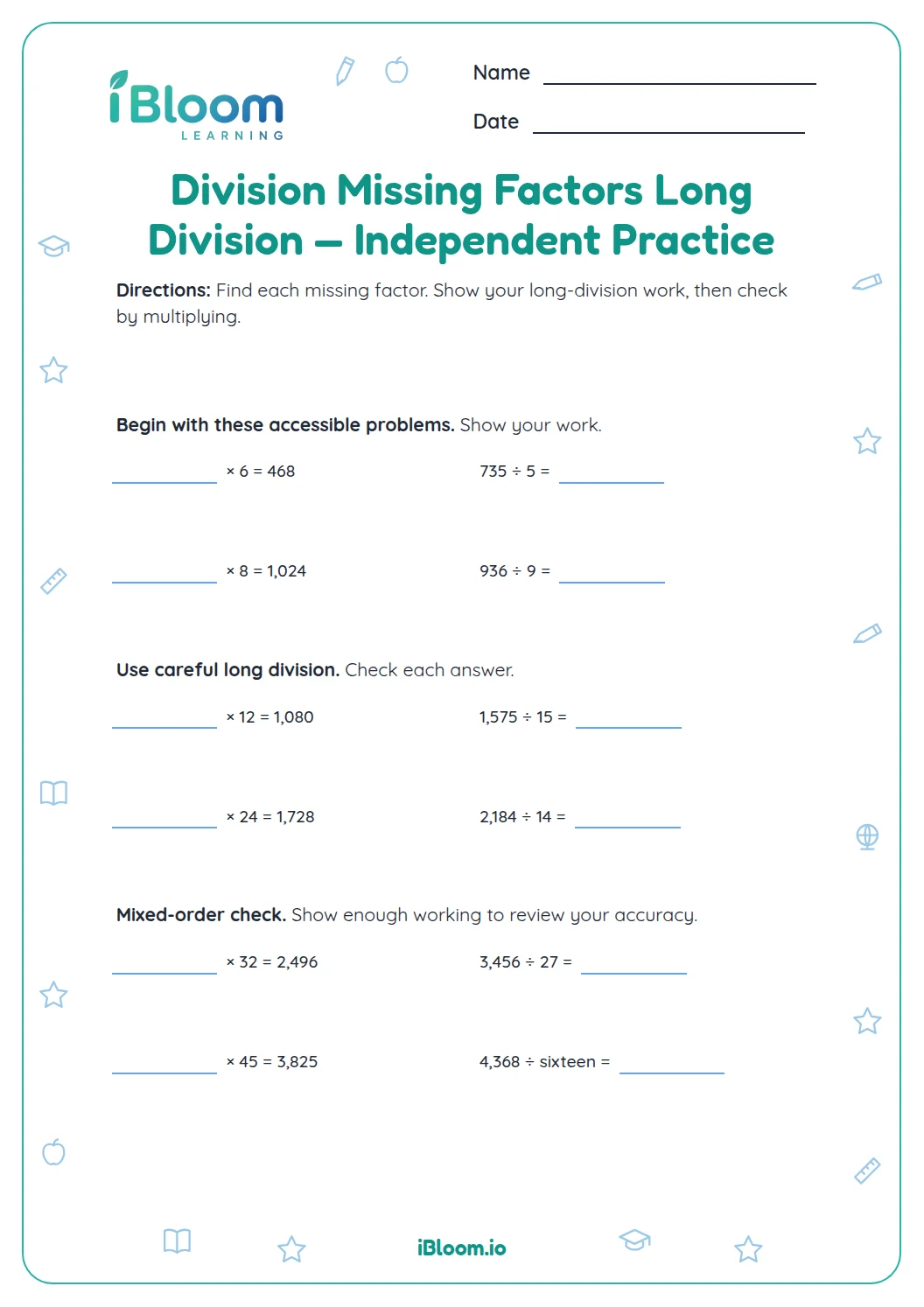
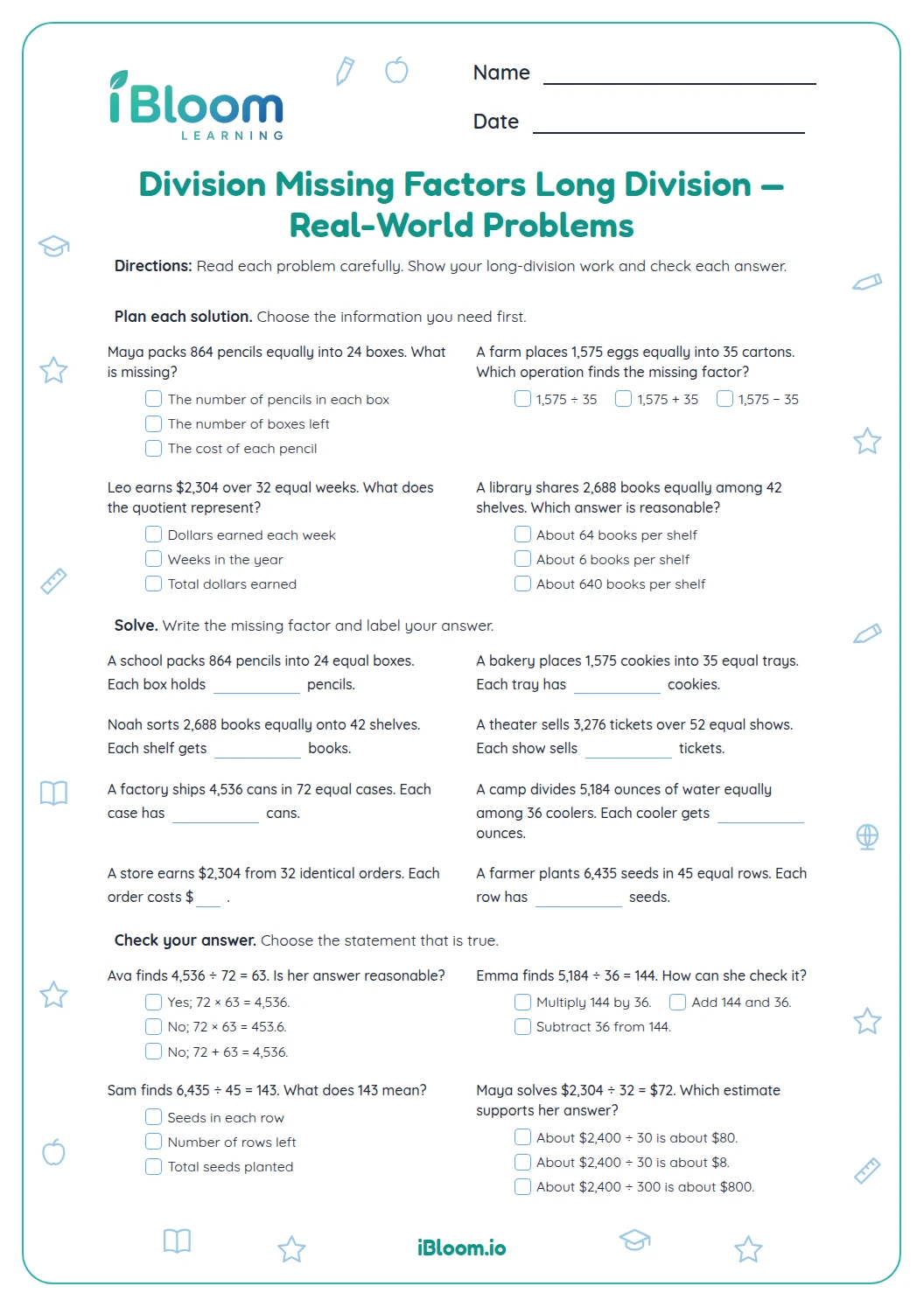
This free printable Grade 6 worksheet shows that a missing factor is a division problem in disguise. In 32 × ___ = 928, the missing factor is 928 ÷ 32, so children use long division and then check by multiplying. Part A has four missing factors, Part B has four missing divisors such as 1,598 ÷ ___ = 34, and Part C has three word problems with space to work. Each part starts with a hint that names the division to do. It practices Common Core 6.NS.B.2 and 5.NBT.B.6, and a separate answer key is included.
Aligned to 6.NS.B.2 and 5.NBT.B.6
How is a missing factor a division problem?
Multiplication and division undo each other. If 32 × 29 = 928, then 928 ÷ 32 = 29 and 928 ÷ 29 = 32. So when one factor is missing, divide the product by the factor you do have.
Question 1 asks for the missing factor in 32 × ___ = 928. The hint at the top of Part A says to work out 928 ÷ 32, and long division does the rest.
- 132 × ___ = 928
- 2Divide the product by the known factor: 928 ÷ 32
- 332 goes into 92 two times: 2 × 32 = 64, and 92 − 64 = 28
- 4Bring down the 8 to make 288. 32 goes into 288 nine times: 9 × 32 = 288
- 5Quotient: 29
- 6Check: 32 × 29 = 928
Why is a missing divisor also found by dividing?
In 1,598 ÷ ___ = 34, the answer, 34, is the quotient. A divisor times the quotient gives the dividend, so the missing divisor is the dividend divided by the quotient: 1,598 ÷ 34 = 47. That is why the hint at the top of Part B tells children to divide the dividend by the quotient.
Part B uses the same skill as Part A with the numbers in a different place, which makes children think about what each number in a division sentence means.
What is on this worksheet?
Eleven questions on two pages, in three parts. The products and dividends go up to 4,284, and every factor, divisor and quotient has two digits.
- Part A, Find the missing factor: 32 × ___ = 928 and three more, with the missing number in either position
- Part B, Find the missing divisor: four sentences like 1,598 ÷ ___ = 34
- Part C, Word problems: seats in rows, bolts in boxes and rolls on trays, with an answer box and working space
- Answer key on its own pages
How to use this worksheet at home or in class
- 1Warm up with a fact family. Write 6 × 7 = 42 and ask which two division sentences it makes.
- 2Read the hint at the top of Part A together. Then do question 1 slowly, writing each long-division step.
- 3Estimate before dividing. 928 ÷ 32 is close to 900 ÷ 30 = 30, so the answer should be near 30.
- 4Check every answer by multiplying. If the product does not match, find the step where the division went wrong.
- 5In Part B, ask which number is the quotient and which is the divisor. The hint names the division to do.
- 6In Part C, write the equation first, such as 24 × ___ = 1,368, then divide. Compare with the answer key.
Common mistakes and quick fixes
The mistake
Multiplying instead of dividing, for example working out 32 × 928 to find the missing factor.
The fix
Ask whether the answer should be bigger or smaller than 928. A factor is smaller than the product, so divide.
The mistake
Dividing in the wrong order, like 32 ÷ 928 or 34 ÷ 1,598.
The fix
The largest number goes inside the long-division bracket. Say it aloud: 1,598 divided by 34.
The mistake
Subtracting wrongly after a quotient digit, such as 92 − 64 = 38 instead of 28.
The fix
Check each subtraction by adding back: 64 + 28 = 92. A leftover of 38 is also a warning sign, because it is bigger than the divisor 32, and a leftover must always be smaller than the divisor.
Common Core alignment
Most US states use the Common Core standards or a close state version. These standards describe the long-division work on this page.
Divide multi-digit numbers with the standard long-division steps.
On this sheet: Every question is solved by long division, with a three- or four-digit number and a two-digit number.
Show the official wordingHide the official wording
Fluently divide multi-digit numbers using the standard algorithm.
Divide up to four-digit numbers by two-digit numbers and explain the work.
On this sheet: Dividends reach four digits, divisors have two digits, and checking by multiplying uses the link between the two operations.
Show the official wordingHide the official wording
Find whole-number quotients of whole numbers with up to four-digit dividends and two-digit divisors, using strategies based on place value, the properties of operations, and/or the relationship between multiplication and division.
What to practice next
Make more practice
Further reading
Questions parents and teachers ask
What is the missing factor in 32 × ___ = 928?
The missing factor is 29. Divide the product by the factor you know: 928 ÷ 32 = 29. Check by multiplying, since 32 × 29 = 928. The same steps work for every Part A question, even when the missing factor comes first, as in ___ × 45 = 1,845.
How do you find the missing divisor in 1,598 ÷ ___ = 34?
Divide the dividend by the quotient: 1,598 ÷ 34 = 47. A divisor times the quotient gives the dividend, so 47 × 34 = 1,598. Children can use the same check for every Part B question, which also shows that the answer fits the sentence.
Why check a long-division answer by multiplying?
Multiplying undoes the division, so it catches a slip in any step. If 29 is right for 928 ÷ 32, then 32 × 29 must equal 928. If it does not, the child can look for the step where a subtraction or a quotient digit went wrong.
How can my child estimate before dividing?
Round both numbers to friendly ones. For 928 ÷ 32, think 900 ÷ 30 = 30, so the answer should be close to 30. The real answer, 29, is near that estimate. If a result is far from the estimate, something went wrong in the steps.
What equation should children write for the word problems?
Match the story to a missing factor. For the theater, 24 × ___ = 1,368, and 1,368 ÷ 24 = 57 rows. For the bakery, 36 × ___ = 1,008 gives 28 rolls on each tray. Writing the equation first shows which number the question wants.
Is there an answer key for this worksheet?
Yes. The answer key has its own two pages and lists every missing factor, every missing divisor and the three word problem answers with units. Print only the worksheet for your child, then use the key afterward to check each answer and any long-division steps that went wrong.