



About this worksheet
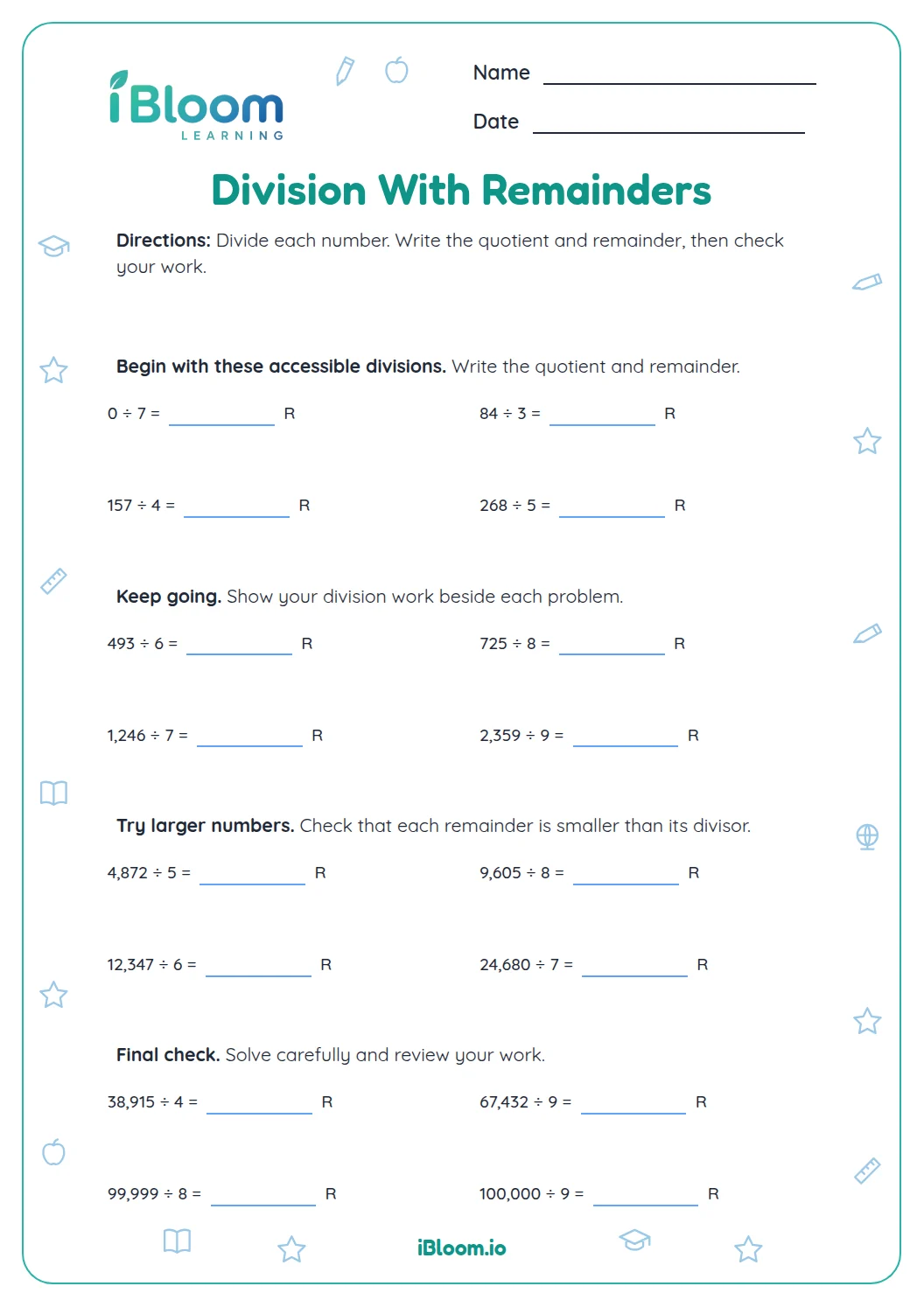
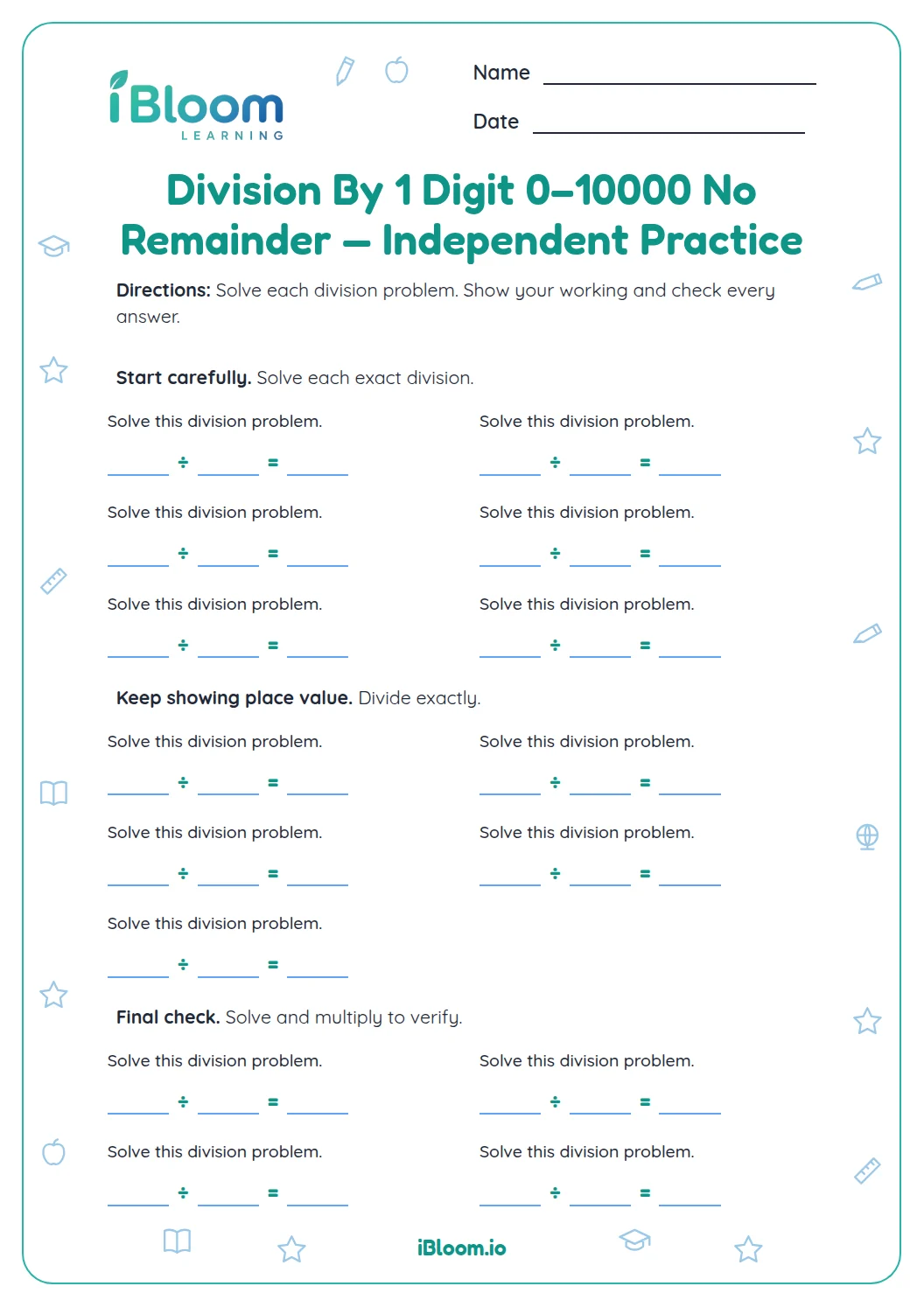
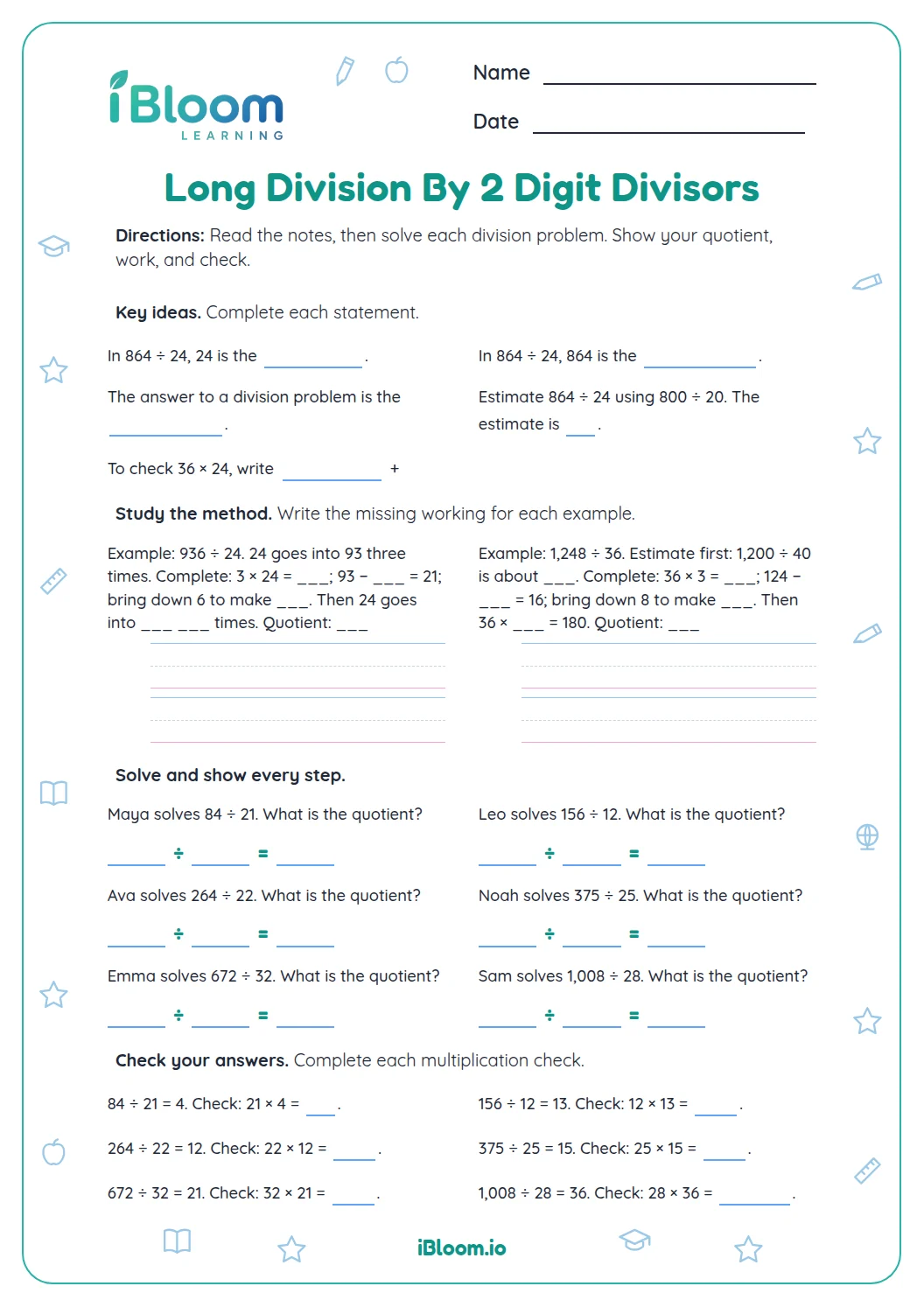
This Grade 6 printable builds quotient-and-remainder fluency with one-digit divisors and dividends up to 99,999. Students solve 16 multi-digit division problems, then can verify each result by multiplying the quotient by the divisor and adding the remainder. A separate answer key lists the results.
Aligned to 6.NS.B.2
How do you divide when there is a remainder?
Use the standard long-division steps: divide, multiply, subtract, and bring down the next digit. The remainder is what is left after the last subtraction.
For 437 ÷ 5, 5 goes into 43 eight times, leaving 3. Bring down 7 to make 37; 5 goes into 37 seven times, leaving 2. The quotient is 87 R 2.
- 1437 ÷ 5
- 25 goes into 43 eight times; remainder 3
- 3Bring down 7: 37 ÷ 5 = 7 R 2
- 4Answer: 87 R 2
How can you check a quotient and remainder?
Multiply the quotient by the divisor, then add the remainder. The total should equal the dividend. Also check that the remainder is less than the divisor.
How to use this worksheet
- 1Set up the dividend and divisor in long-division form.
- 2Divide the current part of the dividend.
- 3Multiply and subtract to find what remains.
- 4Bring down the next digit and repeat.
- 5Check quotient × divisor + remainder equals the dividend.
Common mistakes and quick fixes
The mistake
Writing a remainder as large as the divisor.
The fix
If the remainder is equal to or greater than the divisor, divide once more.
The mistake
Skipping a place in the quotient.
The fix
Write 0 when a place has no groups so later digits stay in the right place.
The mistake
Forgetting to bring down a digit.
The fix
After each subtraction, bring down the next dividend digit before dividing again.
Common Core alignment
This worksheet practices 6.NS.B.2 through its division by one-digit divisors with remainders questions.
Use the standard algorithm to divide large whole numbers by one-digit divisors.
On this sheet: The questions directly practice division by one-digit divisors with remainders.
Show the official wordingHide the official wording
Fluently divide multi-digit numbers using the standard algorithm.
What to practice next
Make more practice
Further reading
Questions parents and teachers ask
What does the remainder mean?
A remainder is the amount left after making as many equal groups as possible. It must be less than the divisor; otherwise, another complete group could be made. For instance, 437 ÷ 5 is 87 R 2, because 5 × 87 + 2 equals 437.
How can students check a division answer?
Multiply the quotient by the divisor, then add the remainder. For 437 ÷ 5 = 87 R 2, calculate 87 × 5 + 2 = 437. The check should reproduce the dividend, and the remainder should be smaller than the divisor.
Why might a quotient contain a zero?
A zero can hold a place when a partial dividend is smaller than the divisor. Keeping the zero in the quotient preserves place value for the digits that follow. Check by multiplying the complete quotient by the divisor and adding the remainder.
What method does the worksheet use?
Students use the standard long-division steps: divide, multiply, subtract, and bring down the next digit. Each problem has a one-digit divisor and a dividend up to 100,000. The key lists each quotient and remainder so learners can check all 16 results.
Is an answer key included?
Yes. The separate key gives each quotient and remainder. Students can use the multiplication check to confirm that their quotient and remainder rebuild the dividend. This gives families a concrete way to review the skill together after the worksheet is finished.