




About this worksheet
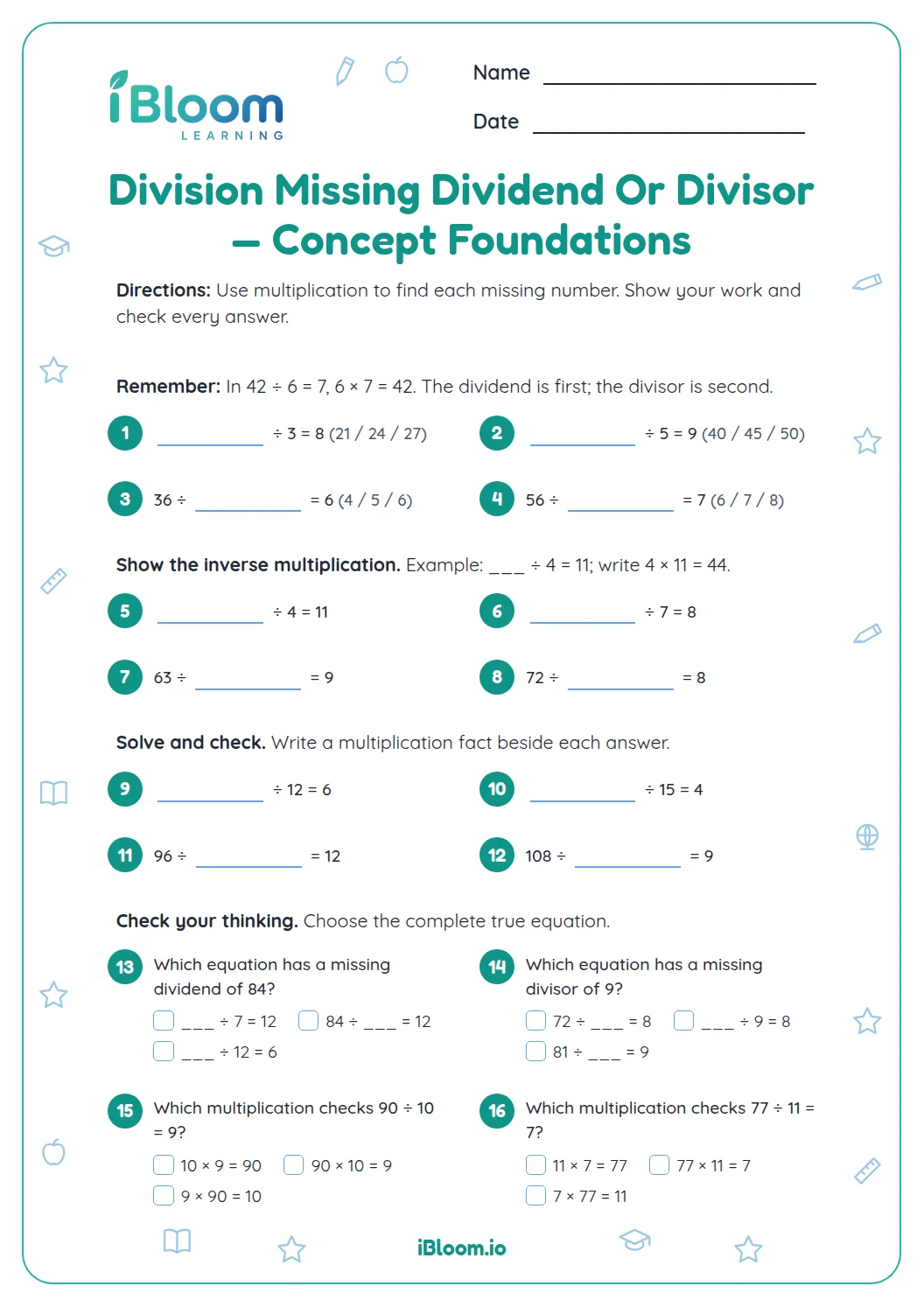
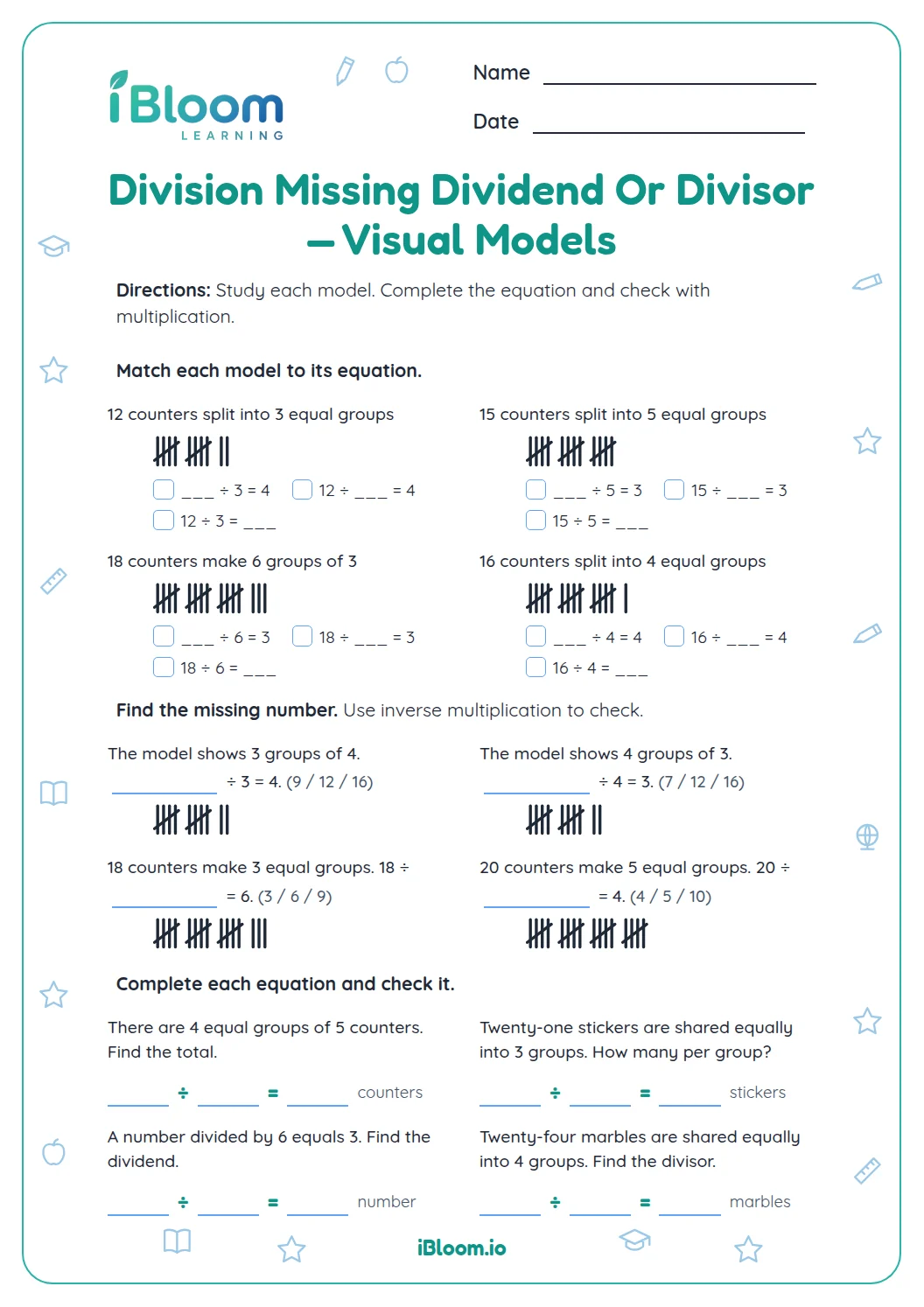
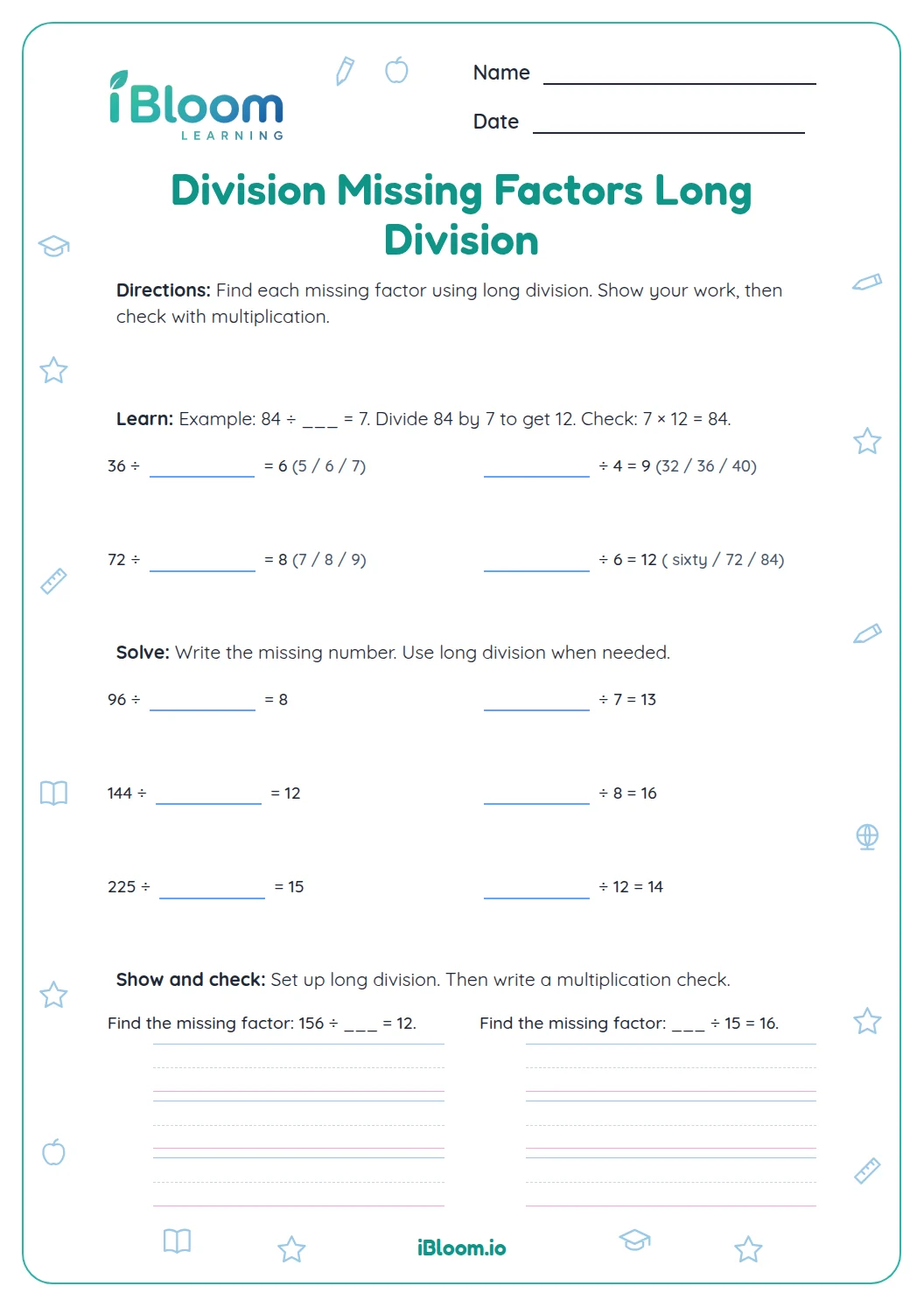
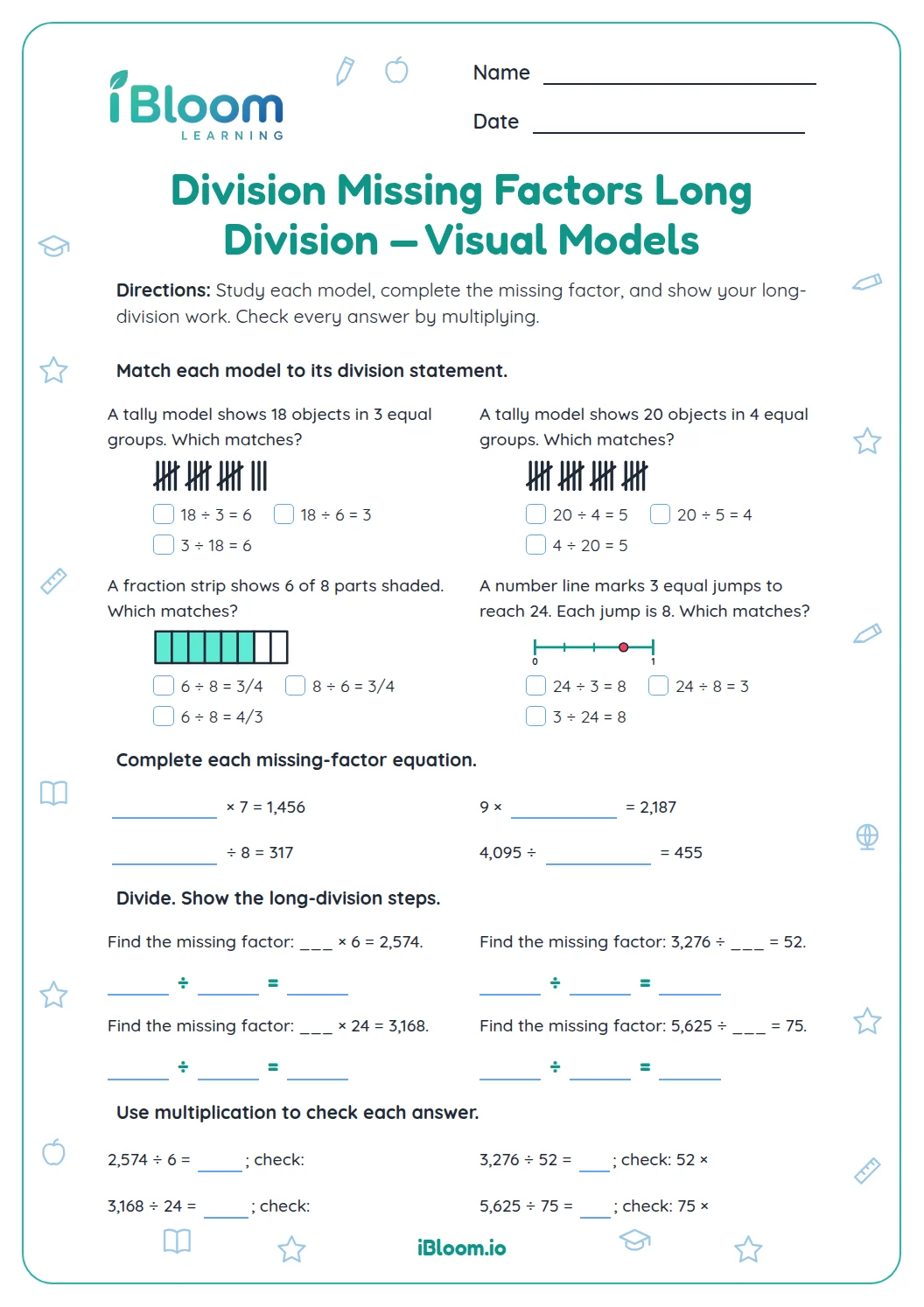
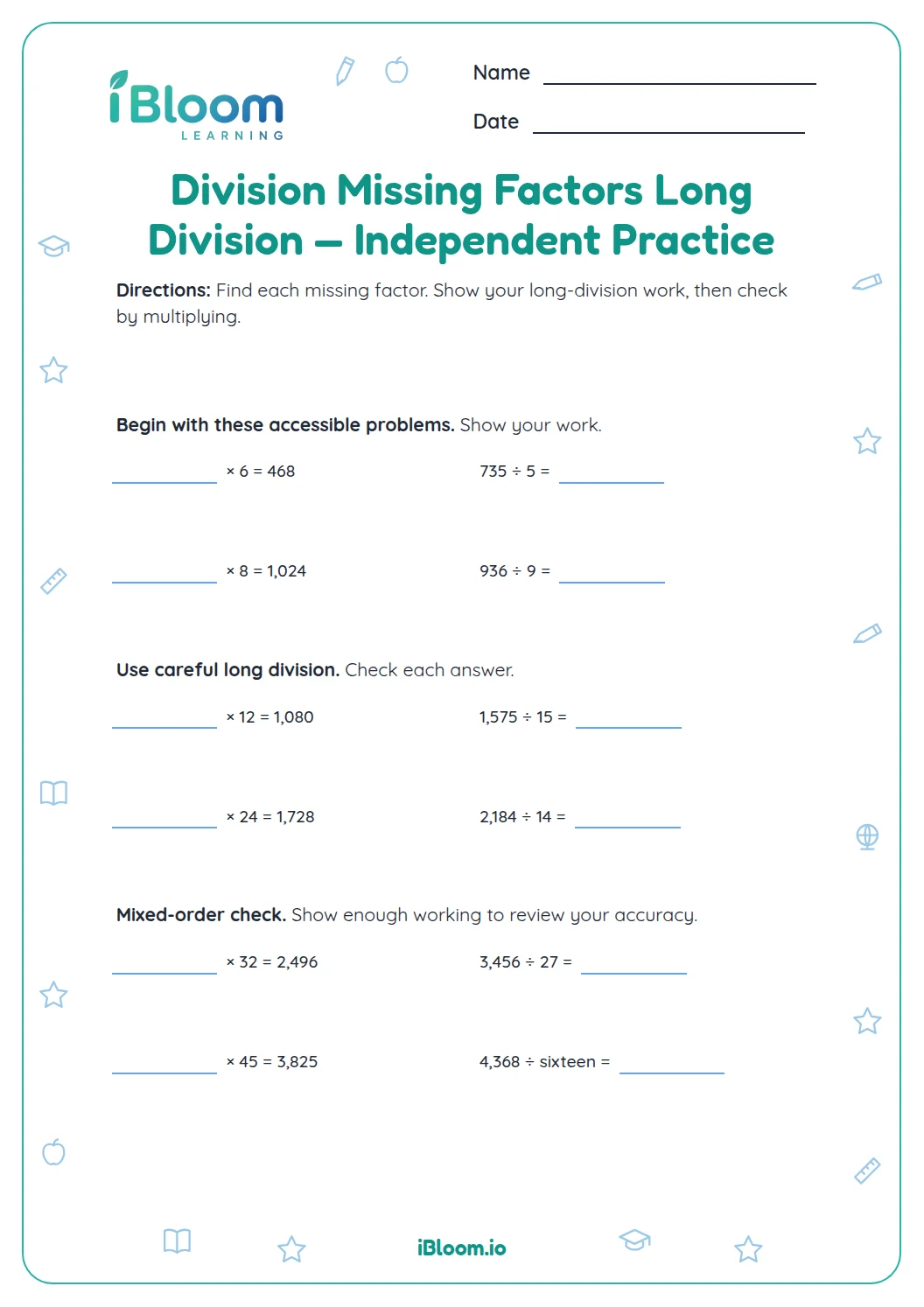
Find a missing dividend by multiplying the divisor by the quotient. Find a missing divisor by dividing the dividend by the quotient, then check with multiplication. The worksheet has 16 questions, and the answer key is included.
What skill does this worksheet build?
Find a missing dividend by multiplying the divisor by the quotient. Find a missing divisor by dividing the dividend by the quotient, then check with multiplication. The answer key gives a check for each item.
How can a learner solve one?
Multiply 8 × 9.
- 1___ ÷ 8 = 9
- 2Multiply 8 × 9.
- 3Answer: 72; check 72 ÷ 8 = 9.
What is included on the pages?
The worksheet has 16 questions across 3 activity parts. The answer key gives a check for every response.
How to use this worksheet
- 1Read the division equation and identify the missing number.
- 2If the dividend is missing, multiply divisor × quotient.
- 3If the divisor is missing, divide dividend ÷ quotient.
- 4Check each result with the related multiplication fact.
Common mistakes and quick fixes
The mistake
Using the quotient as the missing divisor.
The fix
Divide the dividend by the quotient, then test the result.
The mistake
Multiplying when the divisor is missing.
The fix
Use dividend ÷ quotient to find the divisor.
The mistake
Skipping the check.
The fix
Multiply divisor × quotient to see whether it equals the dividend.
What to practice next
Make more practice
Questions parents and teachers ask
How do you find a missing dividend?
Multiply the known divisor by the quotient. For question 1, 8 × 9 = 72, so 72 ÷ 8 = 9. Multiplication checks that the missing dividend is correct and shows why the product belongs in the blank. Ask the learner to point to the clue in the question and explain how it supports the answer.
How do you find a missing divisor?
Divide the dividend by the quotient. In 63 ÷ ___ = 7, calculate 63 ÷ 7 = 9, then check 9 × 7 = 63. The check confirms that 9 is the missing divisor. Ask the learner to point to the clue in the question and explain how it supports the answer.
What should a learner do after solving an equation?
Use the related multiplication fact to check it. If the divisor and quotient multiply to the dividend, the division equation is correct. For example, 12 × 8 = 96 checks 96 ÷ 12 = 8. Ask the learner to point to the clue in the question and explain how it supports the answer.
How do the word problems connect to the equations?
Both use equal groups. The marker problem multiplies 24 markers by 17 boxes to find a total. The sticker problem divides 504 stickers among 21 teams to find the amount in each group. Ask the learner to point to the clue in the question and explain how it supports the answer.
Is an answer key included?
Yes. The separate key gives all 16 answers, including 408 markers for the boxes and 24 stickers per team. Learners can use the related multiplication fact to check each division answer. Ask the learner to point to the clue in the question and explain how it supports the answer.