




About this worksheet
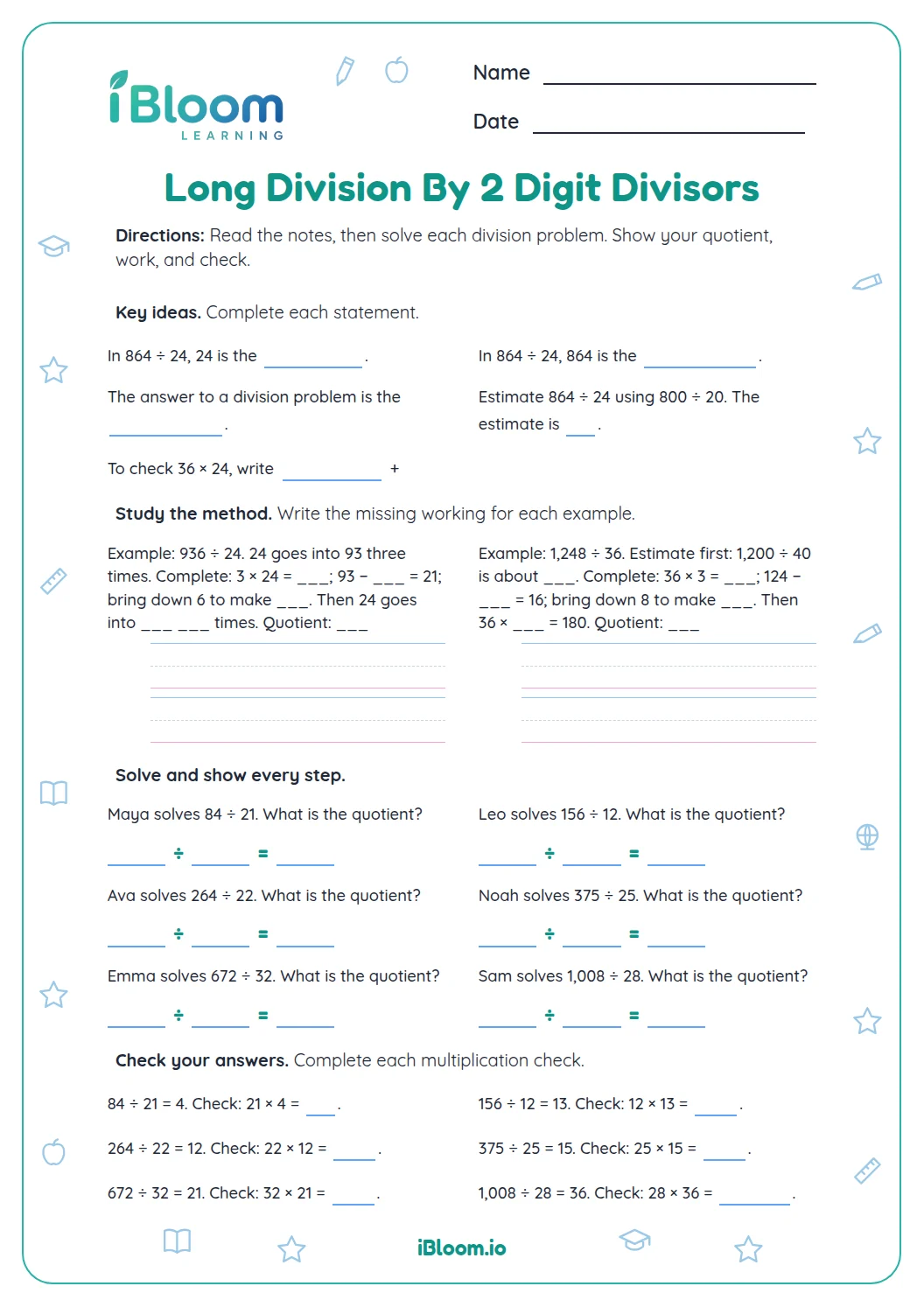
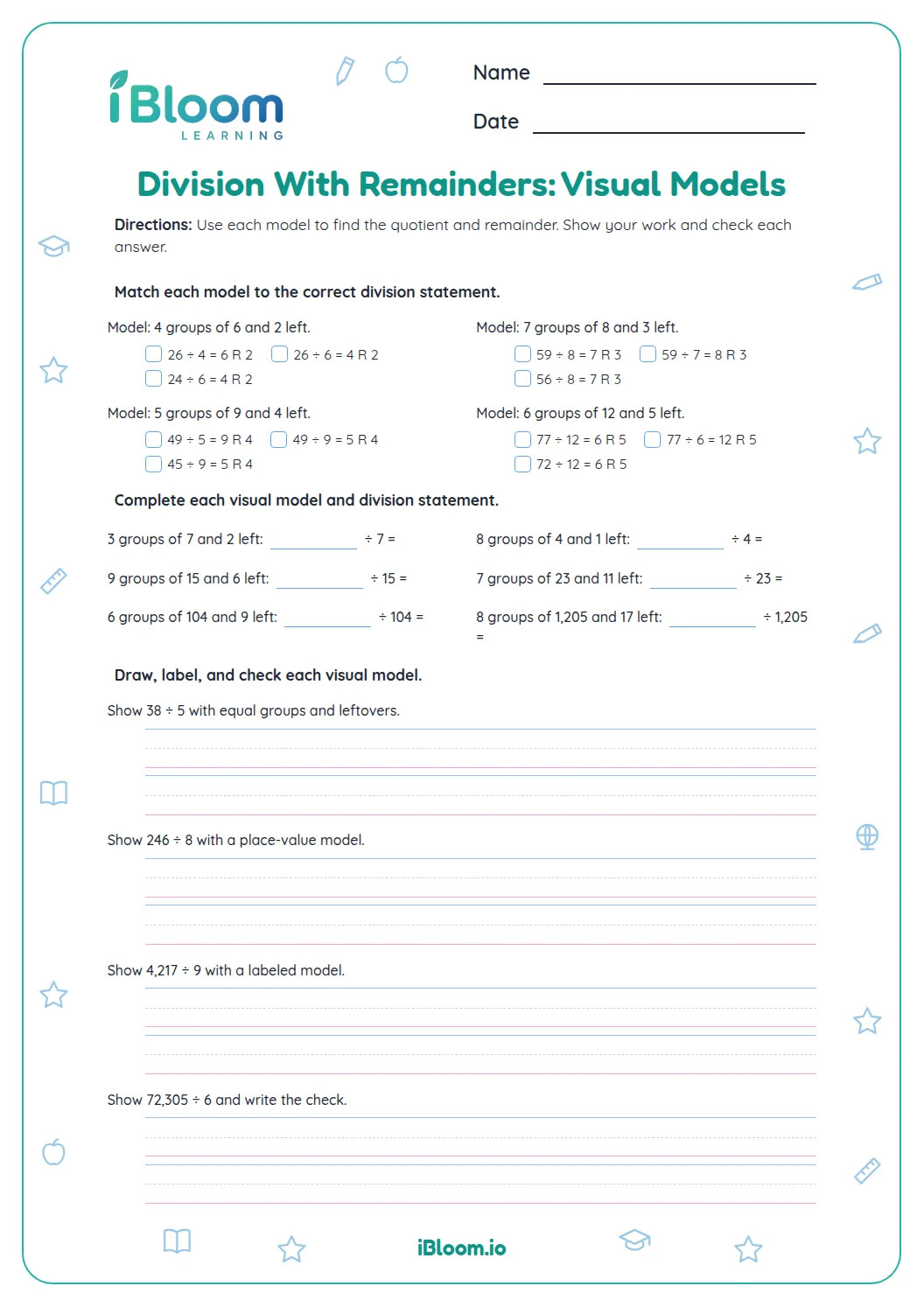
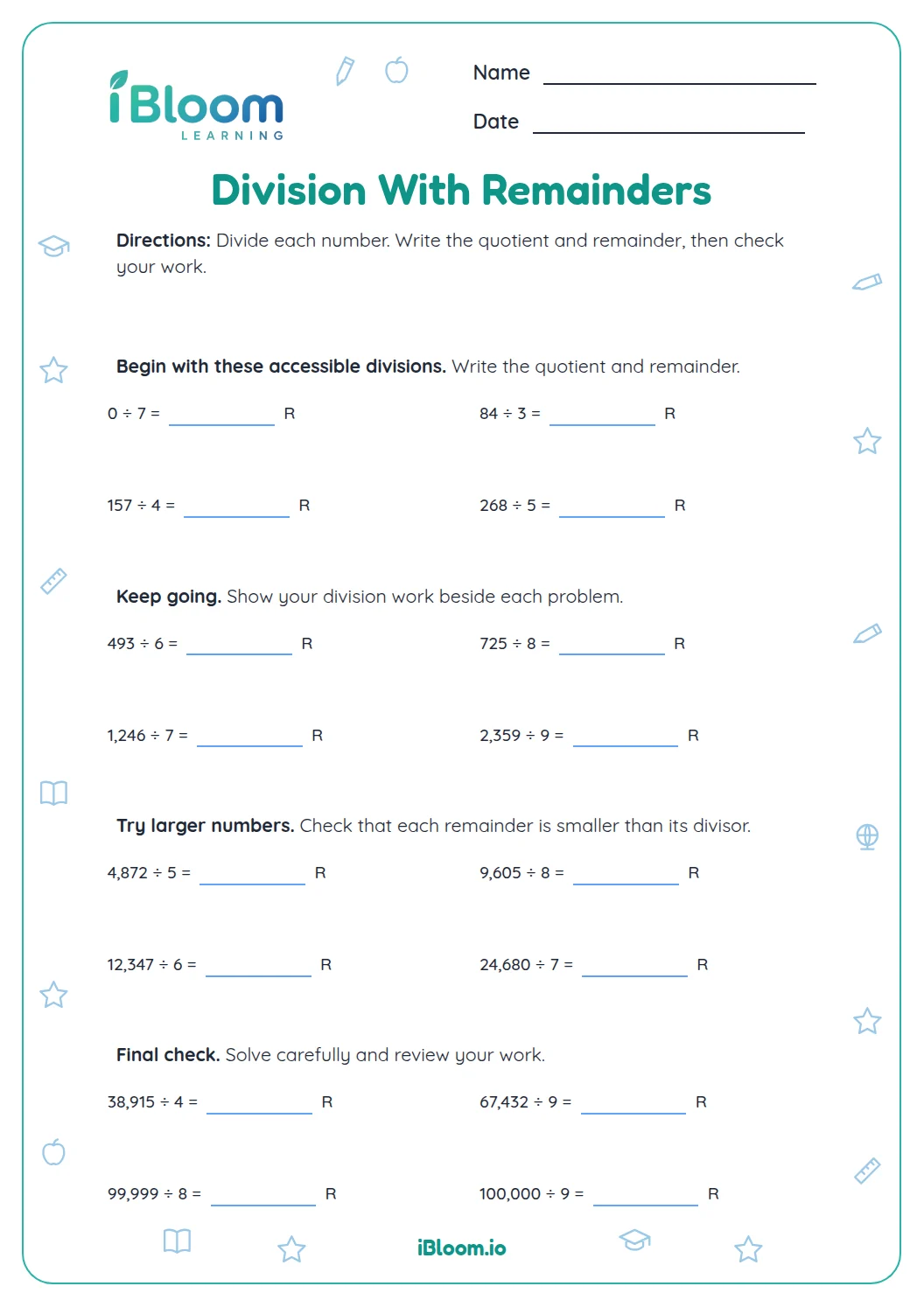
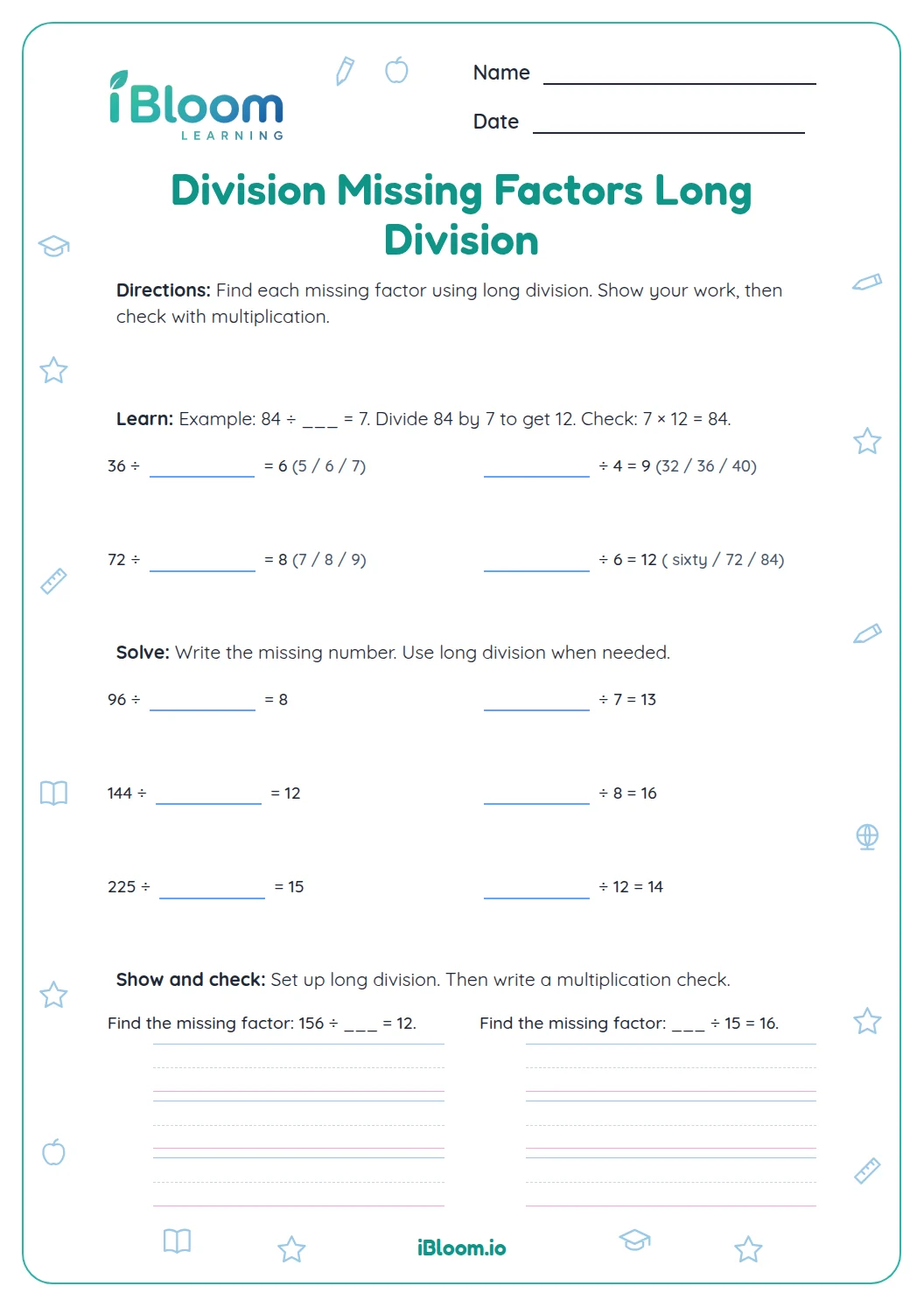
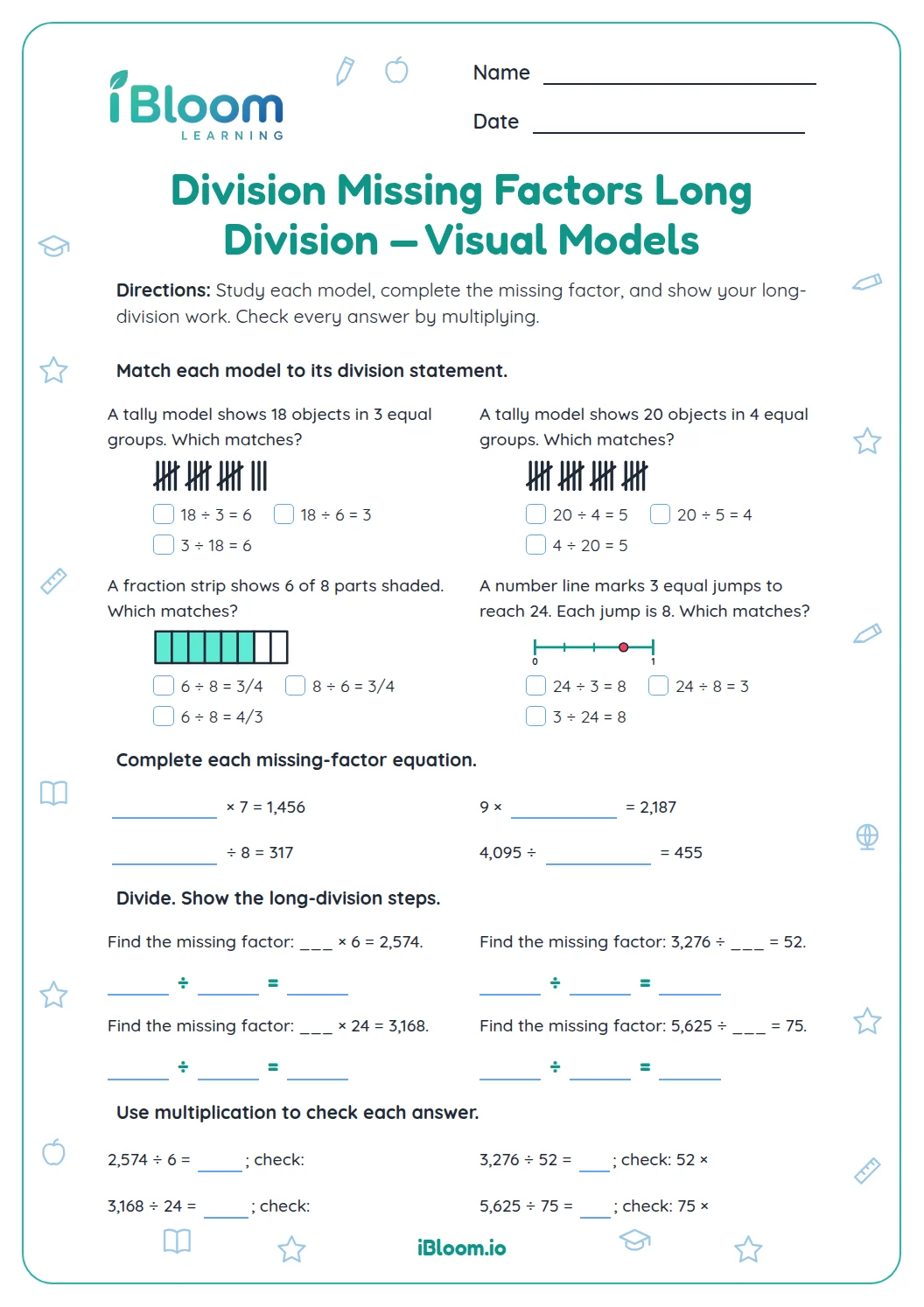
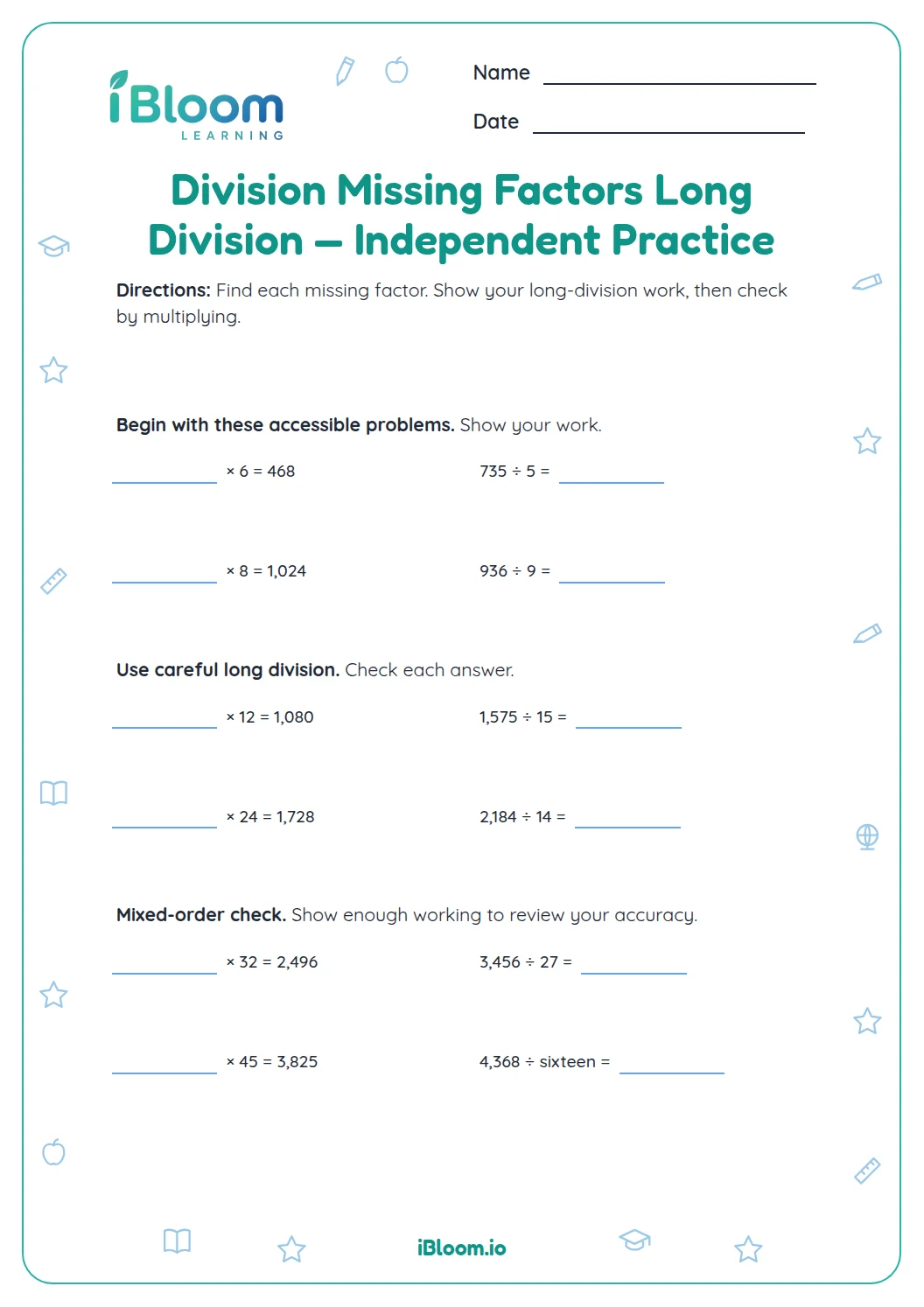
This free Grade 6 printable gives students 14 long-division problems with two-digit divisors. Part A connects equal jumps on number lines with division, then asks for exact quotients. Part B checks division with multiplication, and Part C practices remainders. Students show place-value steps in the work space. A separate answer key lists every result.
Aligned to 6.NS.B.2
How does place value organize long division?
Long division records how many groups fit into each place value, then carries the remainder to the next place. For example, 864 ÷ 24: 24 goes into 86 three times (72), leaving 14 tens; bring down 4 to make 144, which is 6 groups of 24. The quotient is 36.
Part A begins with equal-jump number lines to connect division with repeated groups, then moves to exact quotients. Part B asks you to verify each quotient by multiplying it by the divisor.
- 1864 ÷ 24
- 224 × 3 = 72; 86 − 72 = 14
- 3Bring down 4: 144
- 424 × 6 = 144
- 5Quotient: 36
How can multiplication check a quotient?
Multiply the divisor by the quotient. If the product matches the dividend, the division is consistent. For a remainder problem, add the remainder to the product; it must return the dividend.
What does the remainder tell you?
A remainder is what is left after making as many full groups as possible. It must be smaller than the divisor. In Part C, write the quotient first and the leftover amount after R.
How to use this worksheet
- 1Read the divisor and dividend before writing.
- 2Estimate how many groups fit in the leading digits.
- 3Multiply, subtract, and bring down the next digit.
- 4Check each quotient with multiplication.
- 5For a remainder, verify it is smaller than the divisor.
Common mistakes and quick fixes
The mistake
Writing a quotient digit before checking the product.
The fix
Multiply the divisor by that digit and confirm the product fits.
The mistake
Dropping a digit while bringing down.
The fix
Bring down one digit at a time and keep its place value.
The mistake
Leaving a remainder as large as the divisor.
The fix
Make one more group; a remainder must be less than the divisor.
Common Core alignment
This sheet practices multi-digit division with the standard algorithm.
Use the standard algorithm to divide multi-digit whole numbers.
On this sheet: Every problem uses long division with a two-digit divisor.
Show the official wordingHide the official wording
Fluently divide multi-digit numbers using the standard algorithm.
What to practice next
Make more practice
Further reading
Questions parents and teachers ask
How many problems are on the sheet?
There are 14 problems in three parts. Two use equal-jump number lines, two ask for exact quotients, six ask students to check by multiplication, and four ask for quotients with remainders. The key lists every result. Students can compare the models with their written work.
What should a student do with a remainder?
Write the number of full groups, then record the leftover amount after R. Check that the remainder is smaller than the divisor and that divisor × quotient + remainder equals the dividend. These checks work for every remainder problem on the sheet.
Does the answer key show the steps?
The key gives each correct quotient and remainder. Students can compare their written long-division steps with the result, then multiply the quotient by the divisor to check exact problems. For remainder items, add the remainder to that product.
What does Part B practice?
Part B combines division with a multiplication check. After finding the quotient, multiply it by the two-digit divisor and compare the product with the original dividend. This confirms each result. This confirms each result and helps catch a quotient digit error.
How long should this practice take?
Plan for about 25 minutes, including time to write division steps and check results. Complete one part at a time, comparing each quotient with multiplication before moving to the remainder problems. Allow extra time if students write every subtraction step.