




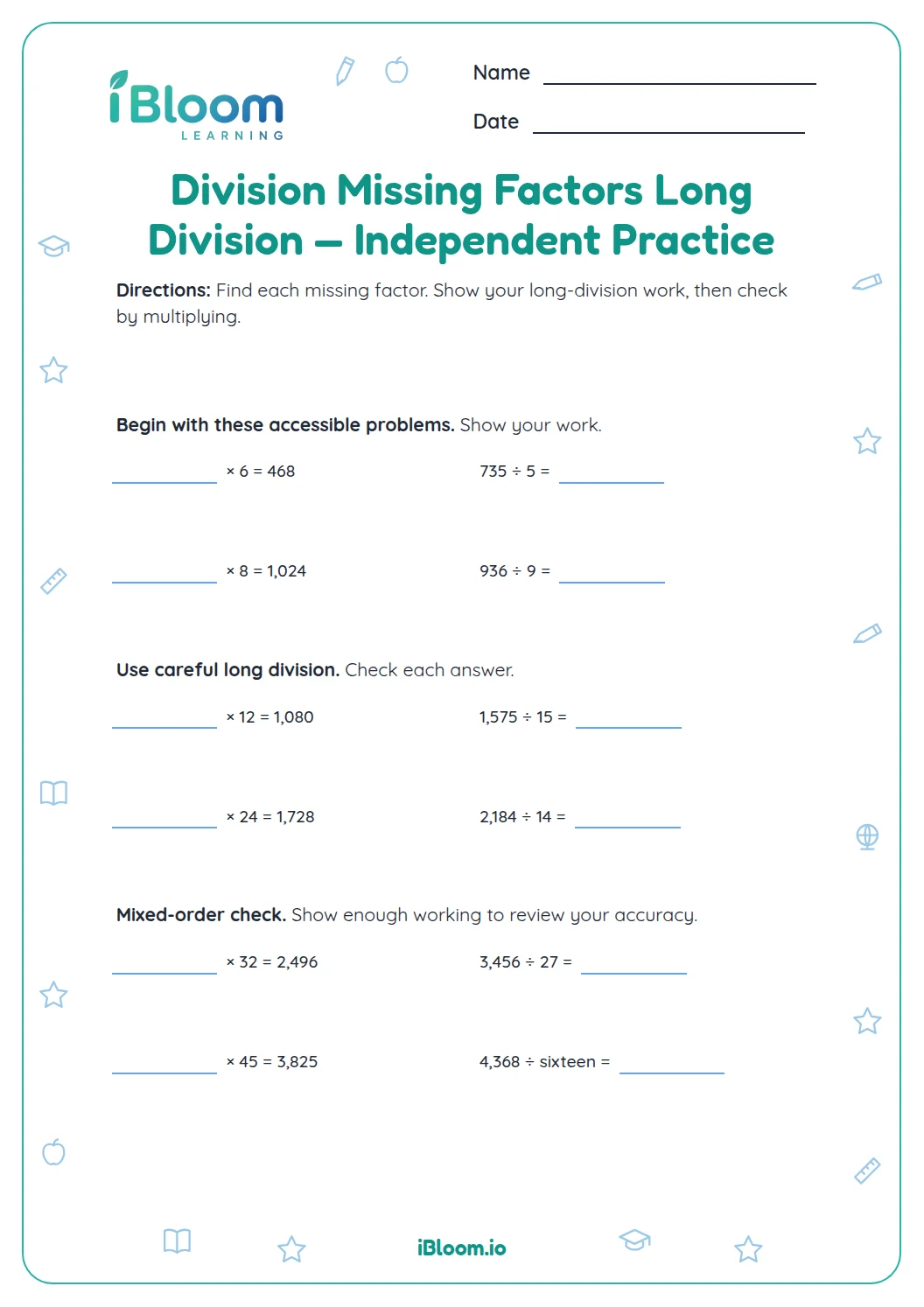
About this worksheet
This free printable Grade 6 worksheet pairs long division with decisions about whether an answer makes sense. Part A has four reasoning choices. Part B gives four calculations with two-digit divisors, including one to solve with both long division and partial quotients. Part C asks for a missing quotient and dividend. Part D asks students to repair two errors and support their corrections with multiplication. The twelve questions practice Common Core 6.NS.B.2. A separate answer key gives results and sample error explanations.
Aligned to 6.NS.B.2
What makes this a reasoning challenge?
The opening questions ask students to evaluate an answer before doing a full calculation. For 3,648 ÷ 24, an estimate helps distinguish a quotient near 150 from one near 15 or 1,500. Another item tests whether 40 can be a final remainder when dividing by 18.
Question 8 asks students to compare long division with partial quotients. Part C works backward from the checking equation to find missing information. The final questions ask students to explain a missing zero or an extra group hidden in a remainder.
How should students check the standard algorithm?
After dividing, multiplying, subtracting, and bringing down each digit, students check the final result against the original dividend. A multiplication check can reveal a missing zero even when the written division steps looked plausible.
For question 8, partial quotients can use 35 × 200 = 7,000, then 35 × 20 = 700, then 35 × 8 = 280. The three chunks total 7,980, so add 200 + 20 + 8 = 228. Long division should give the same quotient; ask which method felt easier to check.
- 1925 ÷ 24
- 292 − 72 = 20; bring down 5 to make 205.
- 3205 − 192 = 13, so the quotient is 38 R13.
- 4Check: 24 × 38 + 13 = 925; 13 < 24.
Why must the remainder be smaller than the divisor?
A remainder at least as large as the divisor still contains another full group. In question 12, the proposed 26 R22 for 594 ÷ 22 has one group of 22 left over. Taking that group gives 27 with no remainder.
Some Part B divisions end exactly and others have remainders. Students should use R only when a nonzero amount remains, then check the size of that amount before moving on.
How to use this worksheet
- 1Read the Part A choices and check each claim.
- 2Use long division for Part B; solve question 8 with partial quotients too.
- 3Check each quotient by multiplying and adding any remainder.
- 4Use the checking equation to recover the two missing numbers in Part C.
- 5Correct both Part D claims and include a multiplication equation in each explanation.
Mistakes to notice and fix
The mistake
Skipping a zero and recording 24 for 4,284 ÷ 21.
The fix
Check 21 × 24 = 504. The correct quotient is 204, and its tens place needs a zero.
The mistake
Accepting 31 R40 for 598 ÷ 18.
The fix
Take two more groups of 18 from 40, leaving 4; the corrected result is 33 R4.
The mistake
Stopping after checking the multiplication but ignoring the remainder’s size.
The fix
A valid result satisfies both the checking equation and remainder < divisor. For 594 ÷ 22, R22 contains a whole extra group.
Curriculum alignment
Divide multi-digit whole numbers by two-digit divisors and check the results.
On this sheet: Four calculation tasks use the standard algorithm; students also check quotients and correct division errors.
Show the official wordingHide the official wording
Fluently divide multi-digit numbers using the standard algorithm.
What to practice next
Make more practice
Further reading
Questions parents and teachers ask
How many questions require written long division?
Part B contains four calculations, and question 8 asks for both long division and partial quotients. Part A has four reasoning choices, Part C has two missing numbers, and Part D has two errors to correct. Use the working grids for calculations and extra paper if needed.
Should the answers use remainders or decimals?
Use whole-number quotients with remainders for this sheet. Part B’s directions specify R when a remainder is needed, and the key follows that format. For example, 925 divided by 24 is recorded as 38 R13. Exact divisions such as 3,648 divided by 24 simply give 152.
Why is 31 R40 not a finished answer for 598 ÷ 18?
The remainder 40 still contains two full groups of 18. Adding those groups to 31 gives 33, with 4 left over. The corrected answer is 33 R4, and 18 × 33 + 4 = 598. Both the checking equation and the remainder-size test now work.
How does question 11 test place value?
Question 11 presents 4,284 ÷ 21 as 24 and asks students to correct it. The quotient needs a zero in the tens place, making 204. Multiplying 21 by 204 gives 4,284, while multiplying by 24 gives only 504. That check exposes the missing place immediately.
How should I mark the explanation questions?
Accept a correct quotient with an explanation that identifies the specific error and supports the correction. The key provides sample wording, but students can phrase the reasoning differently. Look for the zero in 204 for question 11 and the extra group of 22 for question 12.