


About this worksheet
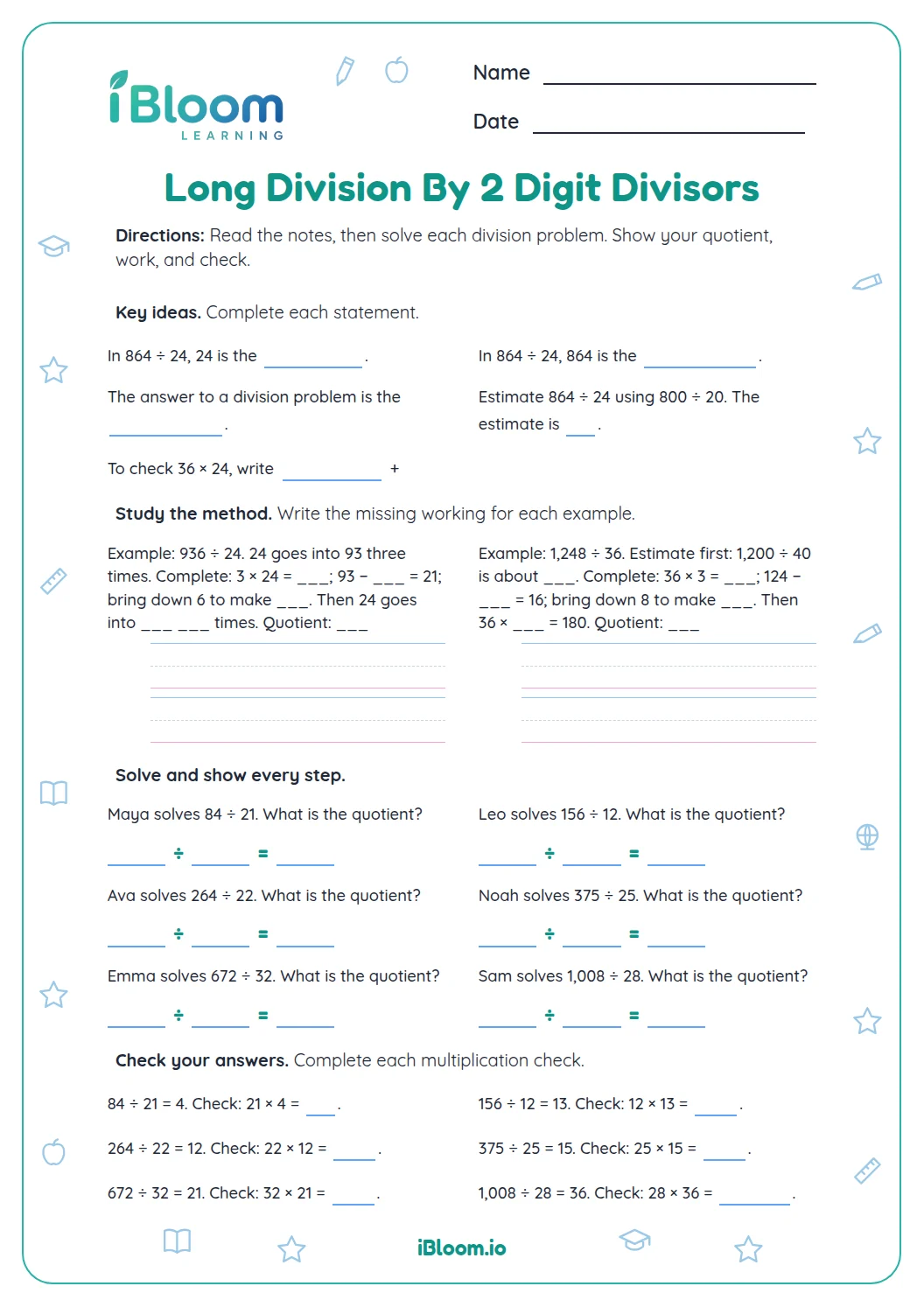
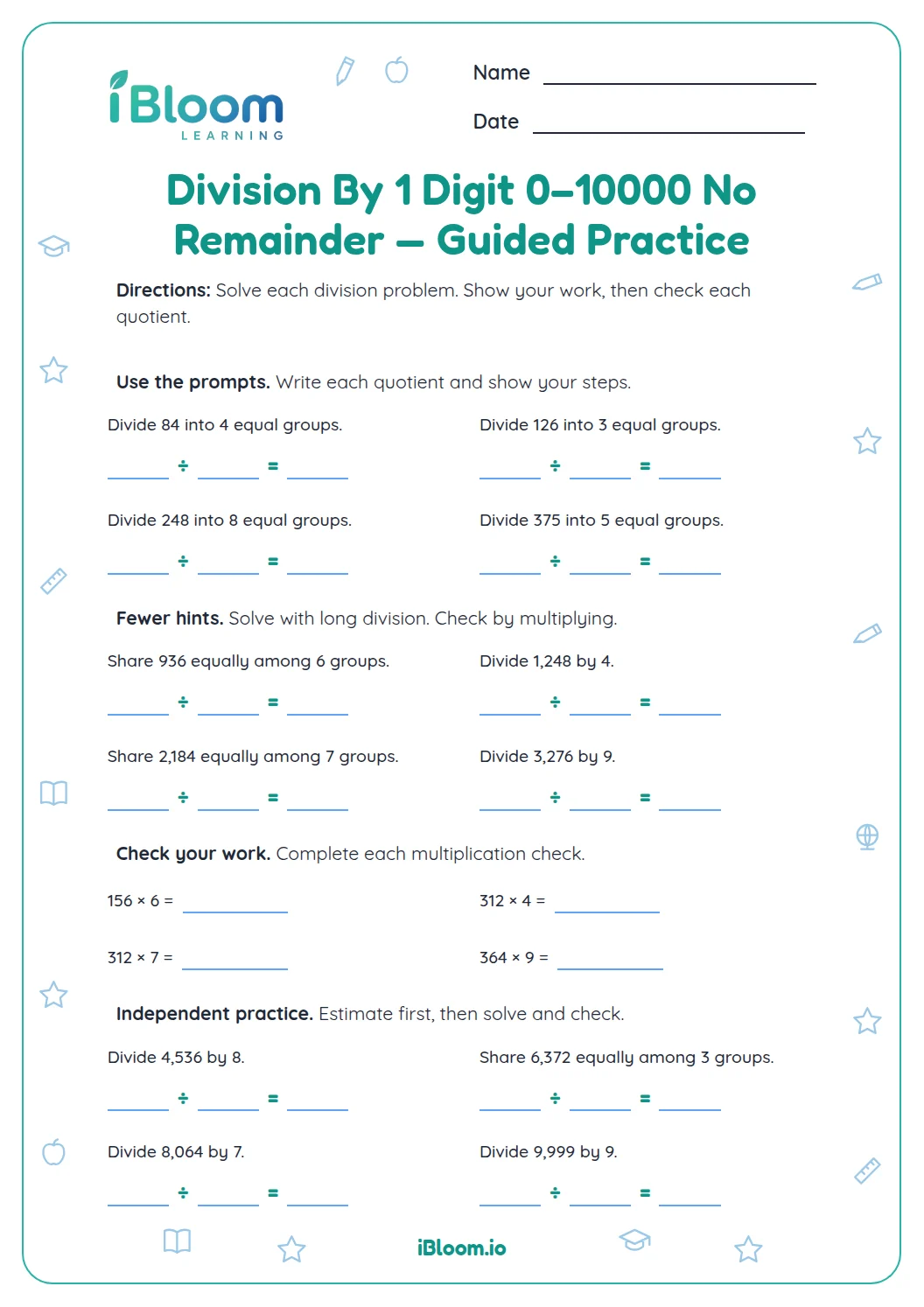
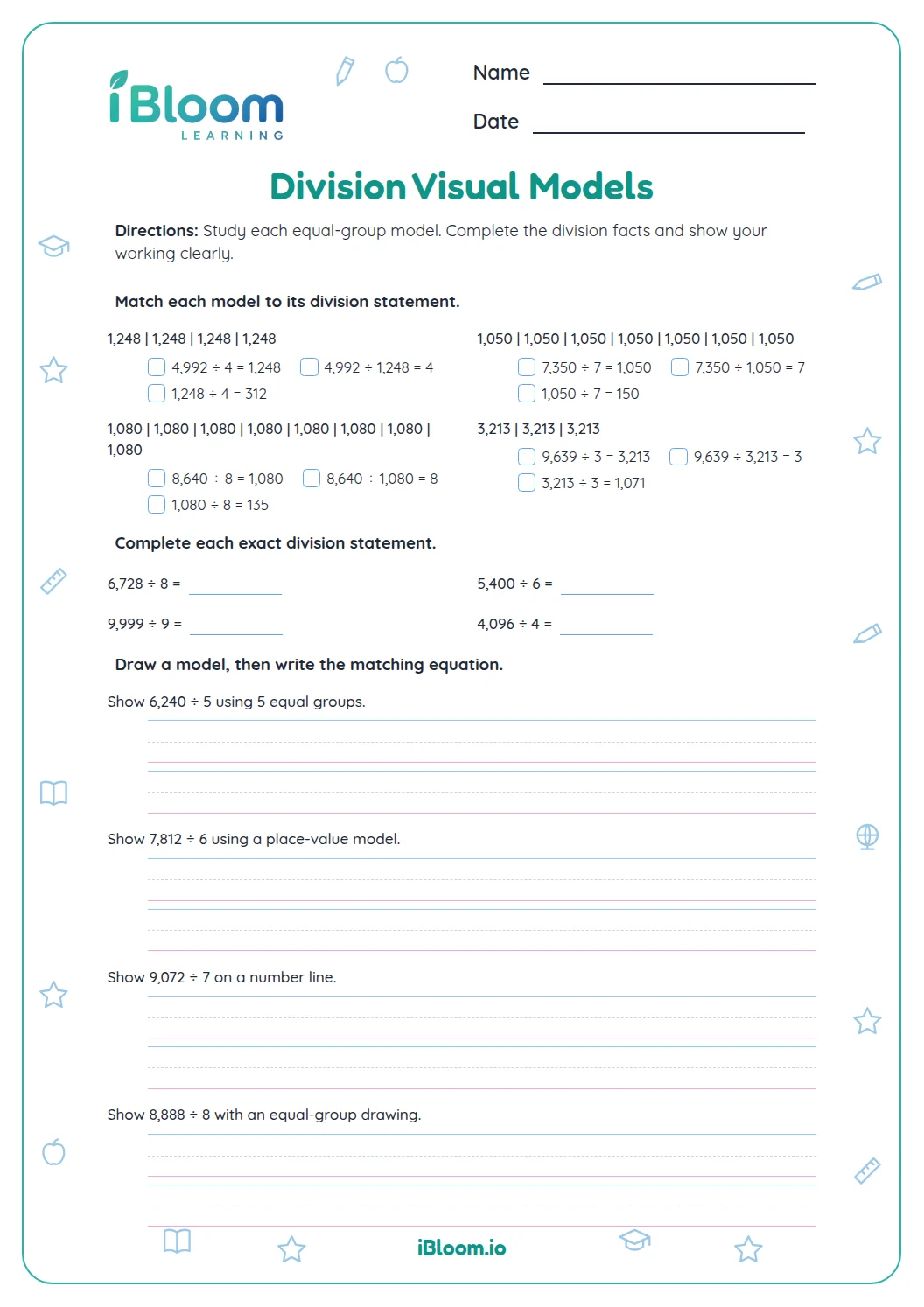
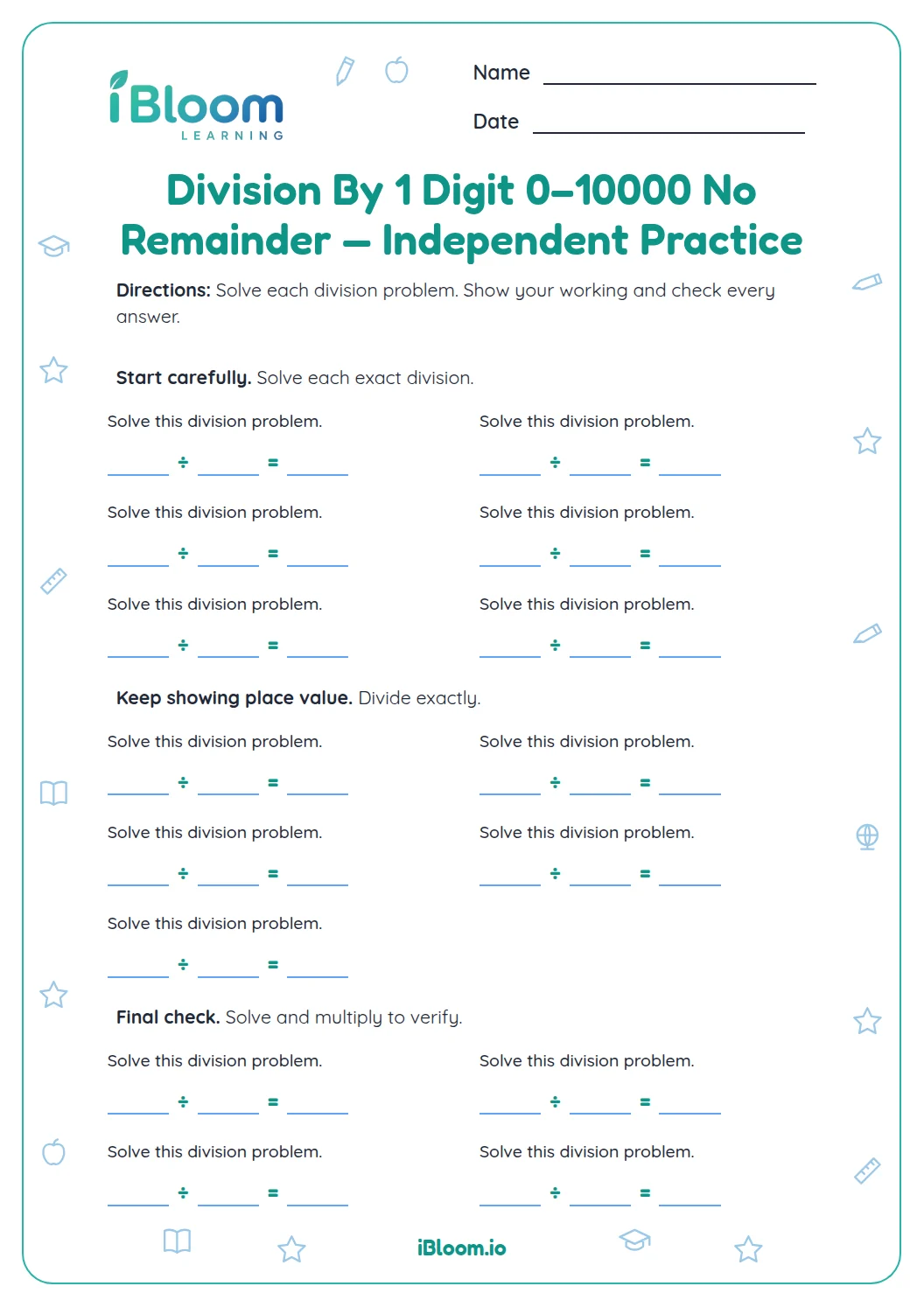
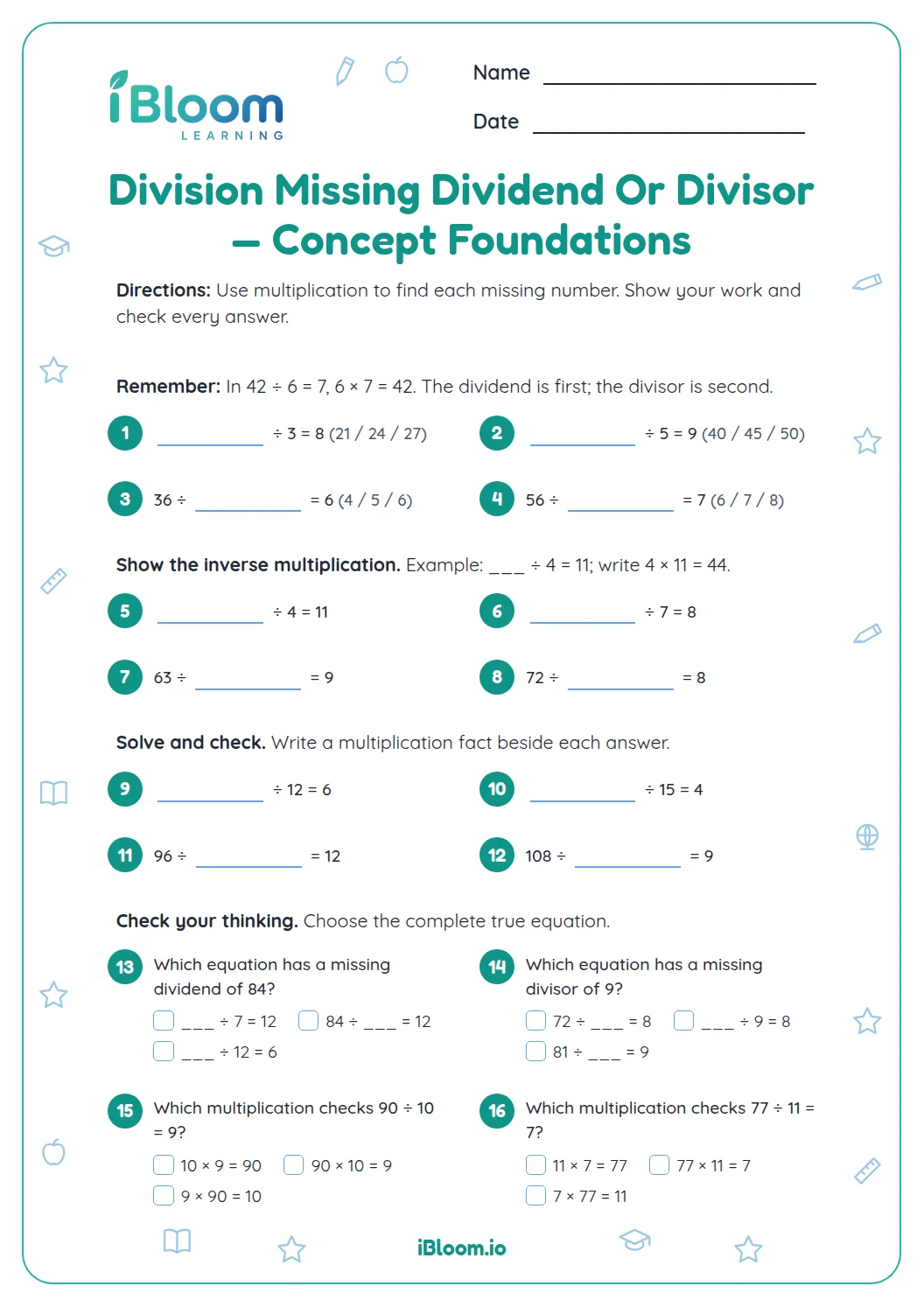
This free printable Grade 6 worksheet applies long division with two-digit divisors to practical situations. Students write division equations, estimate, solve, and check by multiplication. The first two parts focus on exact quotients; the final part asks students to describe remainders in context. A separate answer key includes units and remainder wording.
Aligned to 6.NS.B.2
How do you solve a two-digit division story?
Identify the total and the size of each group, then divide. In 1,248 ÷ 24, 24 × 50 = 1,200 and 48 more makes two additional groups, so the quotient is 52.
- 11,248 ÷ 24
- 224 × 50 = 1,200
- 348 remains; 24 × 2 = 48
- 4Quotient: 52 books
- 5Check: 52 × 24 = 1,248
How can multiplication check division?
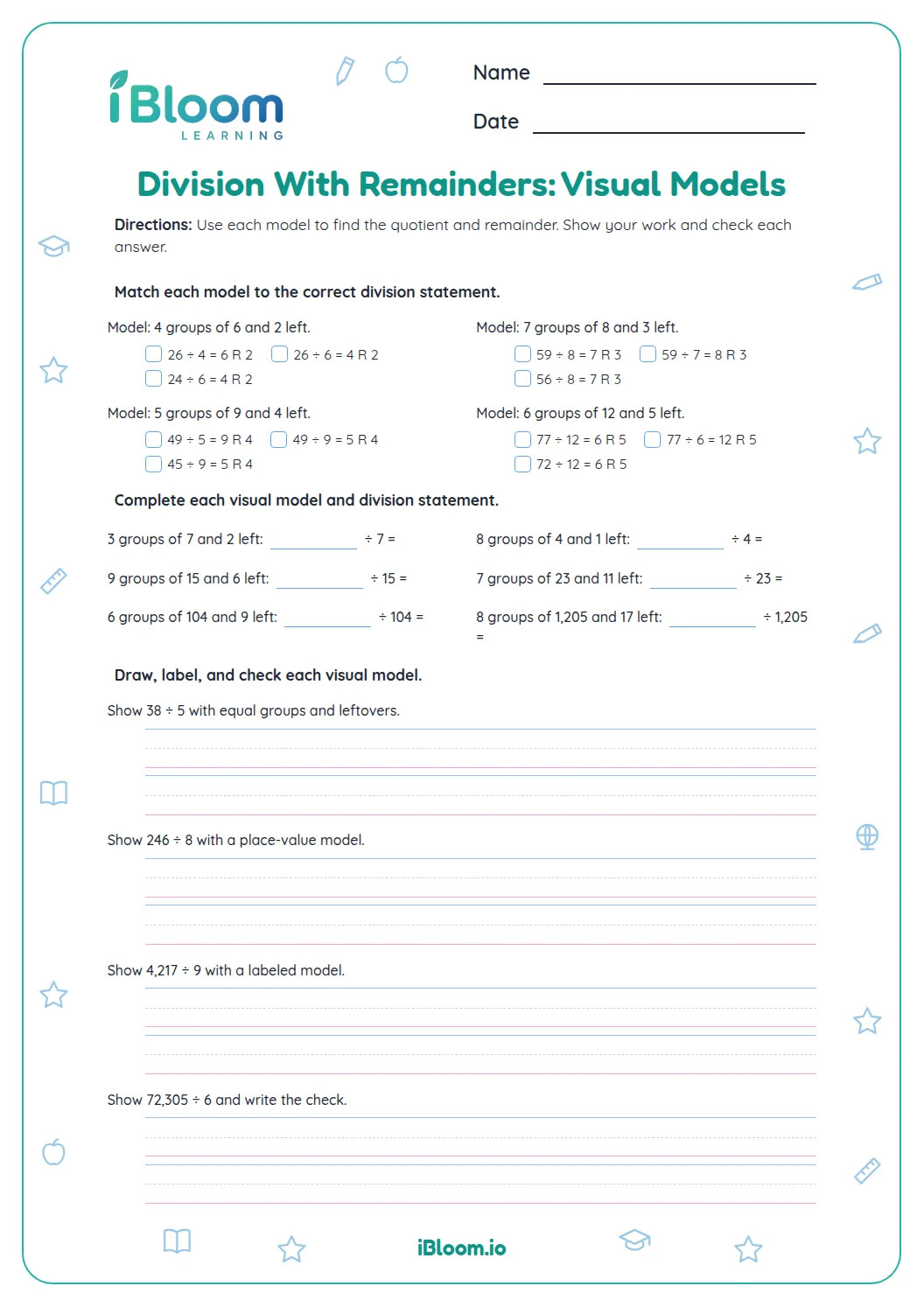
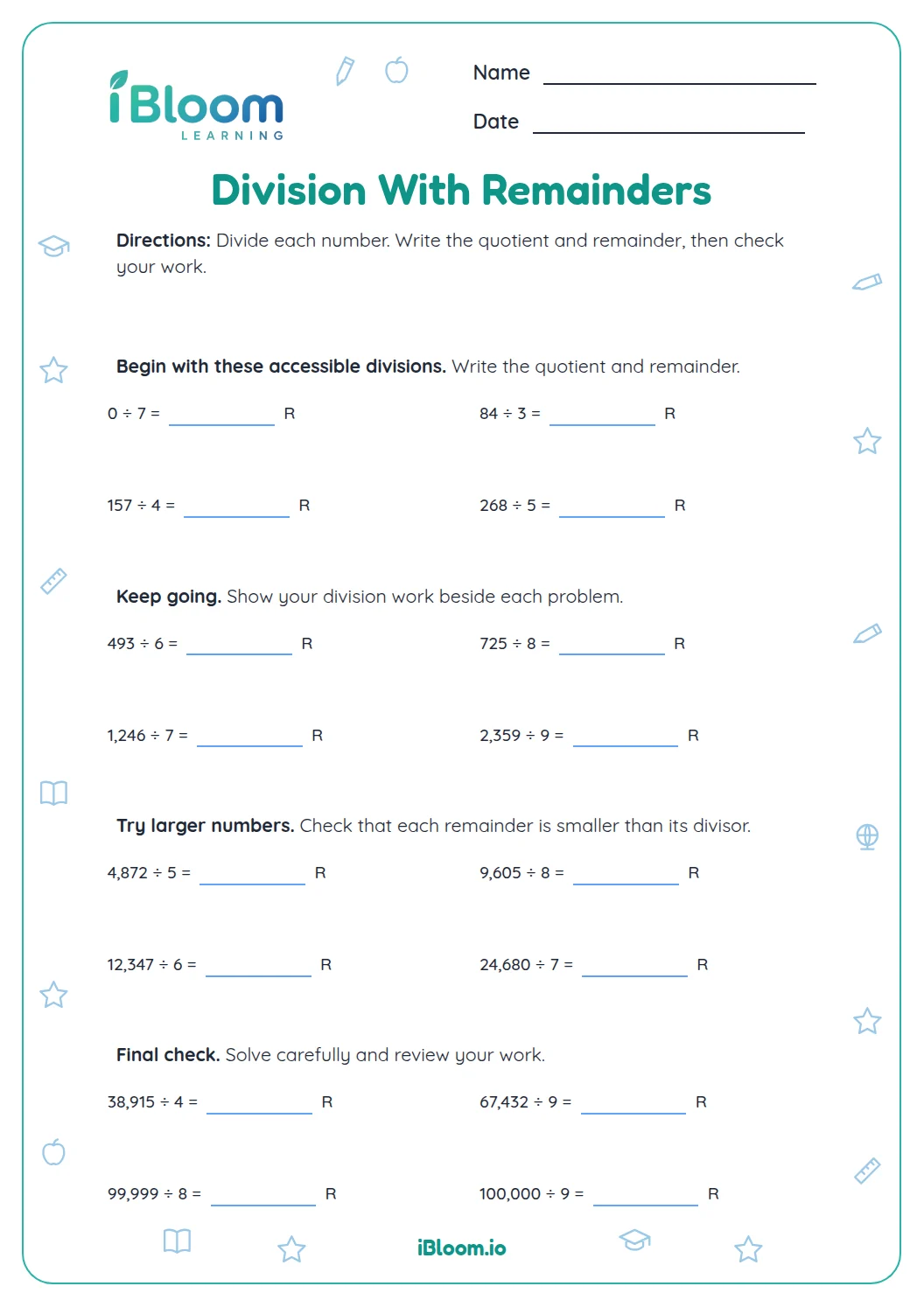
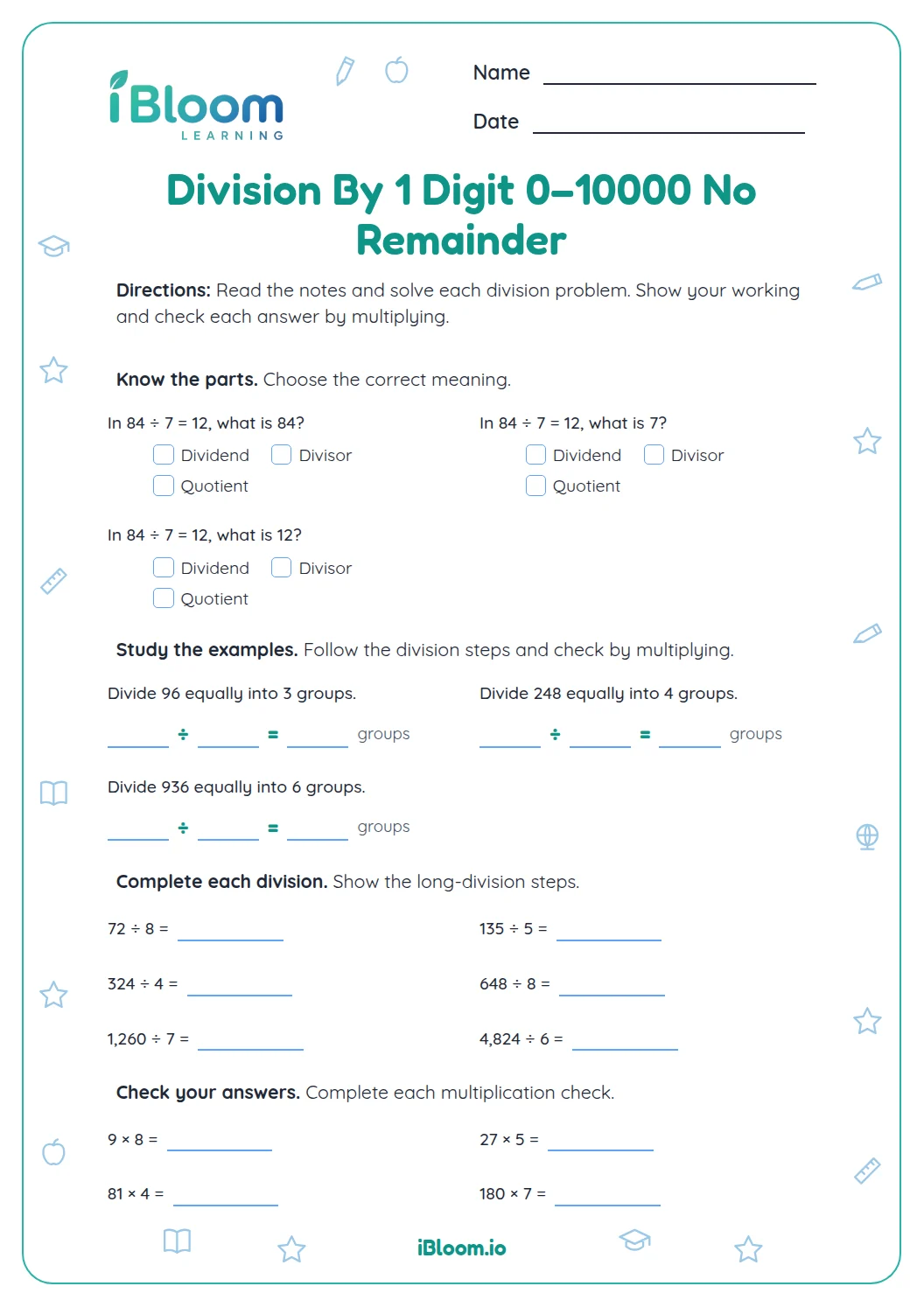
Check division with divisor × quotient. For an exact answer, the product should equal the dividend; with a remainder, add it to the product. In either case, the remainder must be smaller than the divisor.
How should a remainder be written in a story?
Use the story to label a quotient and remainder. For 2,345 flyers in packets of 32, 73 full packets use 2,336 flyers and 9 remain. A remainder does not always mean round up; answer the question asked.
How to work through the sheet
- 1Find the total and group size.
- 2Write a division equation.
- 3Estimate a quotient.
- 4Divide with the standard algorithm.
- 5Check divisor × quotient + remainder.
- 6Label the result with units.
Common slips and fixes
The mistake
Starting where the divisor does not fit.
The fix
Begin at the first place with enough value.
The mistake
Forgetting a zero in the quotient.
The fix
Use zero when a place has no groups.
The mistake
Leaving off context for a remainder.
The fix
State full groups and leftovers with units.
Common Core alignment
This page practices the listed skills through the worksheet activities.
Divide multi-digit whole numbers with the standard algorithm.
On this sheet: The problems require division by two-digit divisors and interpreting quotients or remainders.
Show the official wordingHide the official wording
Fluently divide multi-digit numbers using the standard algorithm.
What to practice next
Make more practice
Further reading
Questions parents and teachers ask
What is the first step in two-digit division?
Estimate how many groups fit, then multiply the divisor by that estimate. For 1,248 ÷ 24, 24 × 50 = 1,200, leaving 48; that is two more groups. The quotient is 52 books. The story units help distinguish the number of full groups from leftover items.
How can I check a long-division answer?
Multiply the quotient by the divisor and add the remainder, if there is one. For question 1, 52 × 24 = 1,248. In a remainder problem, the remainder must also be smaller than the divisor. The story units help distinguish the number of full groups from leftover items.
When does a word problem have a remainder?
A remainder occurs when the total is not an exact multiple of the group size. Question 12 divides 2,345 flyers into packets of 32: 73 full packets use 2,336 flyers, leaving 9. The story units help distinguish the number of full groups from leftover items.
How many problems are included?
There are 16 division stories: 11 exact quotients and 5 with remainders. The worksheet is two pages, and a separate two-page key lists each quotient and remainder with its context. The story units help distinguish the number of full groups from leftover items.
Should a remainder be rounded up?
Read what the question asks. These problems ask for equal groups, full packets, cartons, or whole units, so the answers name the full groups and leftover amount. Rounding up would describe a different question, such as how many containers are needed.
What is an estimate useful for?
An estimate helps catch a quotient that is far too large or small. For 1,248 ÷ 24, knowing that 24 × 50 is 1,200 shows the quotient should be near 50; multiplication then confirms 52. The story units help distinguish the number of full groups from leftover items.