

About this worksheet
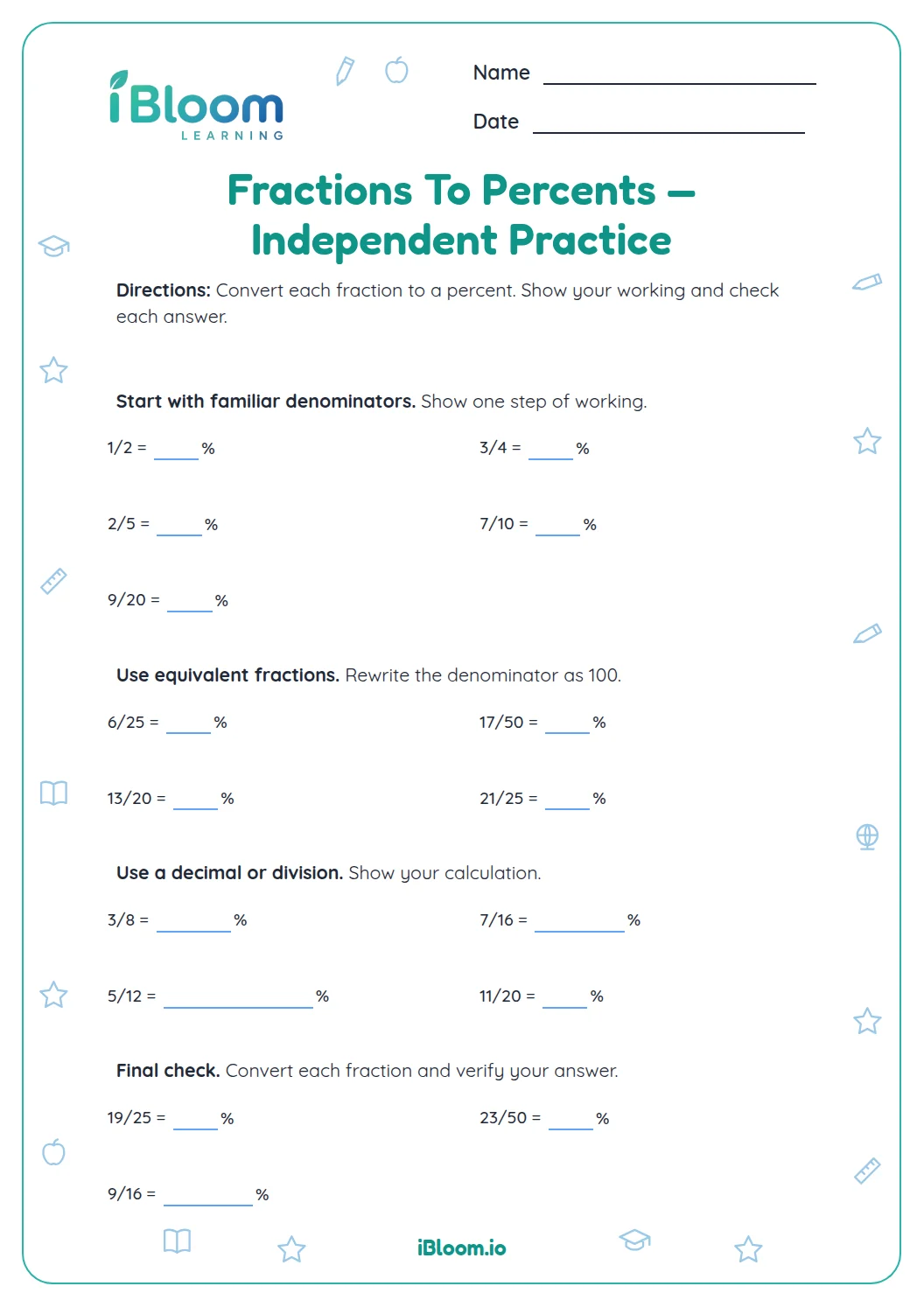
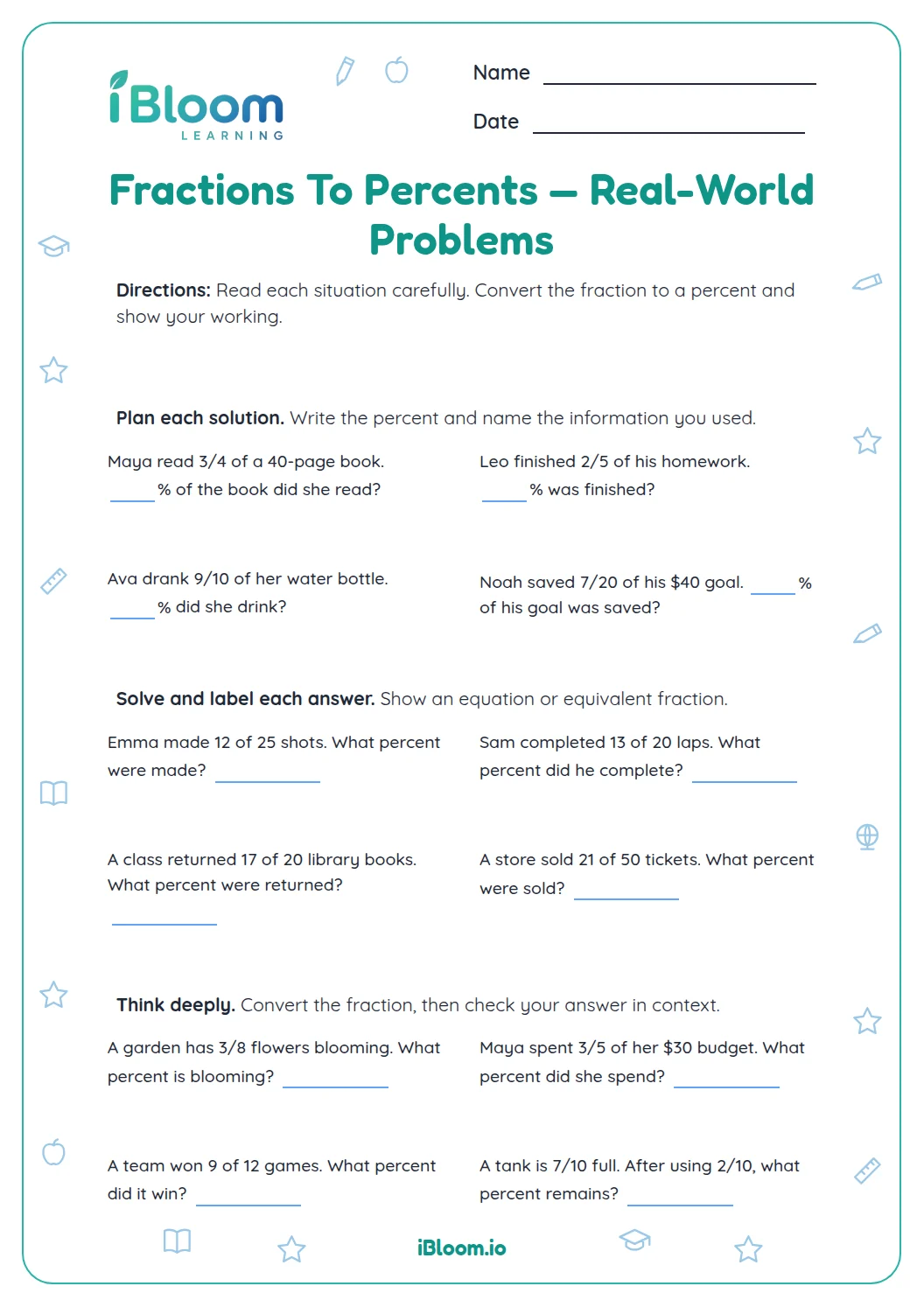
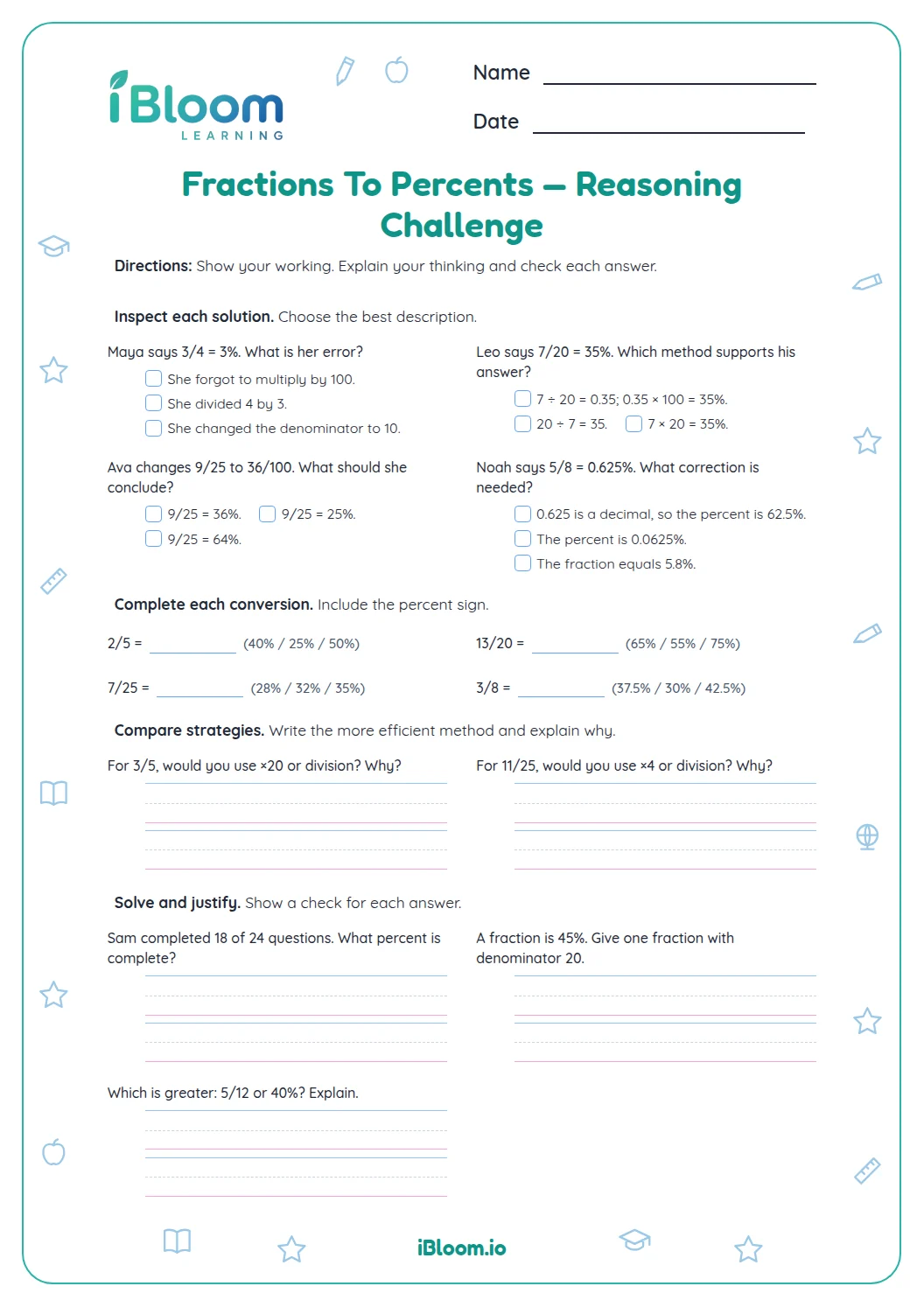
This free printable Grade 6 worksheet gives students focused practice with fractions to percents. It includes 18 questions that move from recognition to application, with clear directions and a separate answer key. The page aligns with 6.RP.A.3.c: Convert fractions to equivalent rates per 100 and express them as percents.
Aligned to 6.RP.A.3.c
What will learners practice?
The worksheet has 18 questions arranged in increasingly demanding parts. Each part focuses on a distinct way to use fractions to percents.
For example, question 1 asks: “{qs[0]["prompt"]}” The answer key gives a concise check for every item.
- Part A builds recognition of fractions to percents.
- Later parts ask learners to apply the idea and explain a choice.
How can students work through fractions to percents?
Read the complete prompt first, then look for the detail that signals fractions to percents. Reread the sentence or model before choosing an answer.
How should families review the answers?
Compare each response with the key, then revisit the words or details that support it. Ask the learner to explain one answer in their own words.
How to use this worksheet
- 1Read the directions and name the skill in your own words.
- 2Complete Part A carefully, checking each prompt before answering.
- 3Move through the later parts in order and use evidence from the item.
- 4Compare answers with the key and correct any missed items.
- 5Choose one response and explain how you reached it.
Common mistakes and quick fixes
The mistake
Answering before rereading the full item.
The fix
Read the whole sentence or model again, then point to the clue that supports the answer.
The mistake
Choosing an answer because it looks familiar.
The fix
Check that the choice fits the exact meaning and wording in the prompt.
The mistake
Skipping a check after finishing.
The fix
Use the key to review every response and explain any correction.
Curriculum alignment
This worksheet practices skills described in 6.RP.A.3.c.
Convert fractions to equivalent rates per 100 and express them as percents.
On this sheet: Every item converts a fraction or hundredths model to a percent, or compares those equivalent forms.
Show the official wordingHide the official wording
Find a percent of a quantity as a rate per 100 (e.g., 30% of a quantity means 30/100 times the quantity); solve problems involving finding the whole, given a part and the percent.
What to practice next
Make more practice
Questions parents and teachers ask
What does each small grid square represent?
A hundredths grid has 100 equal small squares. One shaded square is 1/100, or 1%, so the number of shaded squares gives the percent. For example, 25 shaded squares represent 25%. Have the learner point to the clue in the worksheet and explain the choice.
How do you convert 3/4 to a percent?
Write an equivalent fraction with denominator 100: 3/4 = 75/100. Therefore, 3/4 is 75%. Multiplying the numerator and denominator by 25 keeps the fraction’s value the same. Have the learner point to the clue in the worksheet and explain the choice.
Why multiply both parts of a fraction?
Multiplying the numerator and denominator by the same number creates an equivalent fraction. For 7/20, multiplying both by 5 gives 35/100, which is easy to read as 35%. Have the learner point to the clue in the worksheet and explain the choice.
How many questions are included?
There are 14 questions in three parts: six hundredths-grid readings, six fraction conversions, and two worked conversions. A separate two-page answer key follows the worksheet. Have the learner point to the clue in the worksheet and explain the choice. Review one missed response together.
Should students show their work?
The directions invite students to show an equivalent fraction when useful, and the final part provides room for working. Showing the scale factor makes it easier to check the conversion and spot an arithmetic slip. Have the learner point to the clue in the worksheet and explain the choice.