



About this worksheet
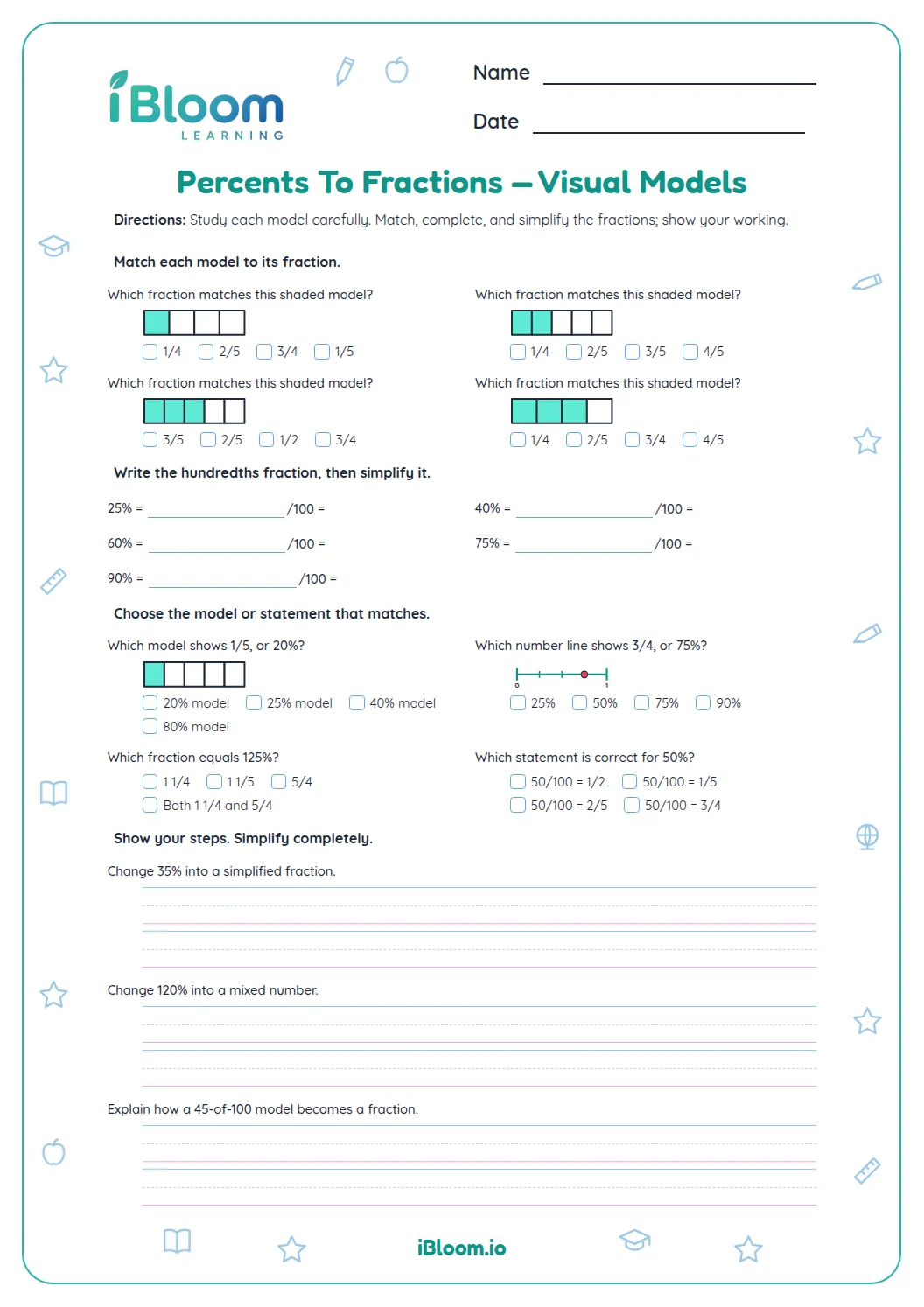
This Grade 6 worksheet guides students from shaded fraction models to fraction-to-percent conversions and short applications. It includes 16 questions in three parts and a separate answer key. Students use equivalent fractions and the relationship between a fraction and a rate per 100, practicing CCSS 6.RP.A.3c.
Aligned to 6.RP.A.3c
How can a shaded fraction show a percent?
A percent tells how many parts there would be out of 100. A fraction model makes the part-to-whole relationship visible before students calculate.
- 1Two of five equal parts are shaded.
- 22/5 = 40/100
- 3So 2/5 is 40%.
How do you convert a fraction to a percent?
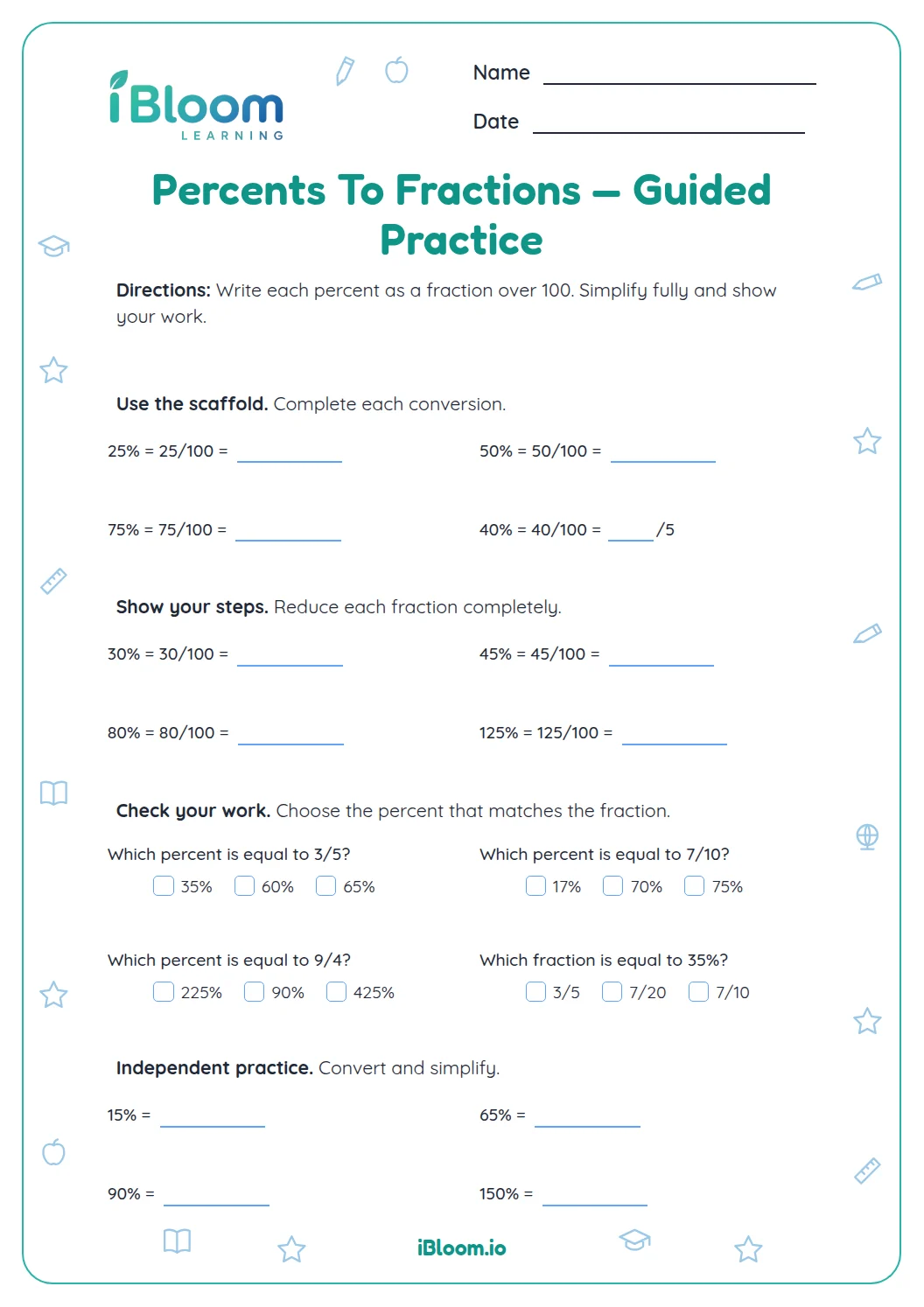
Find an equivalent fraction with denominator 100 when possible. For other denominators, divide the numerator by the denominator and multiply by 100. Keep the percent sign with the result.
- 13/4 = 75/100
- 275/100 = 75%
What does this guided practice include?
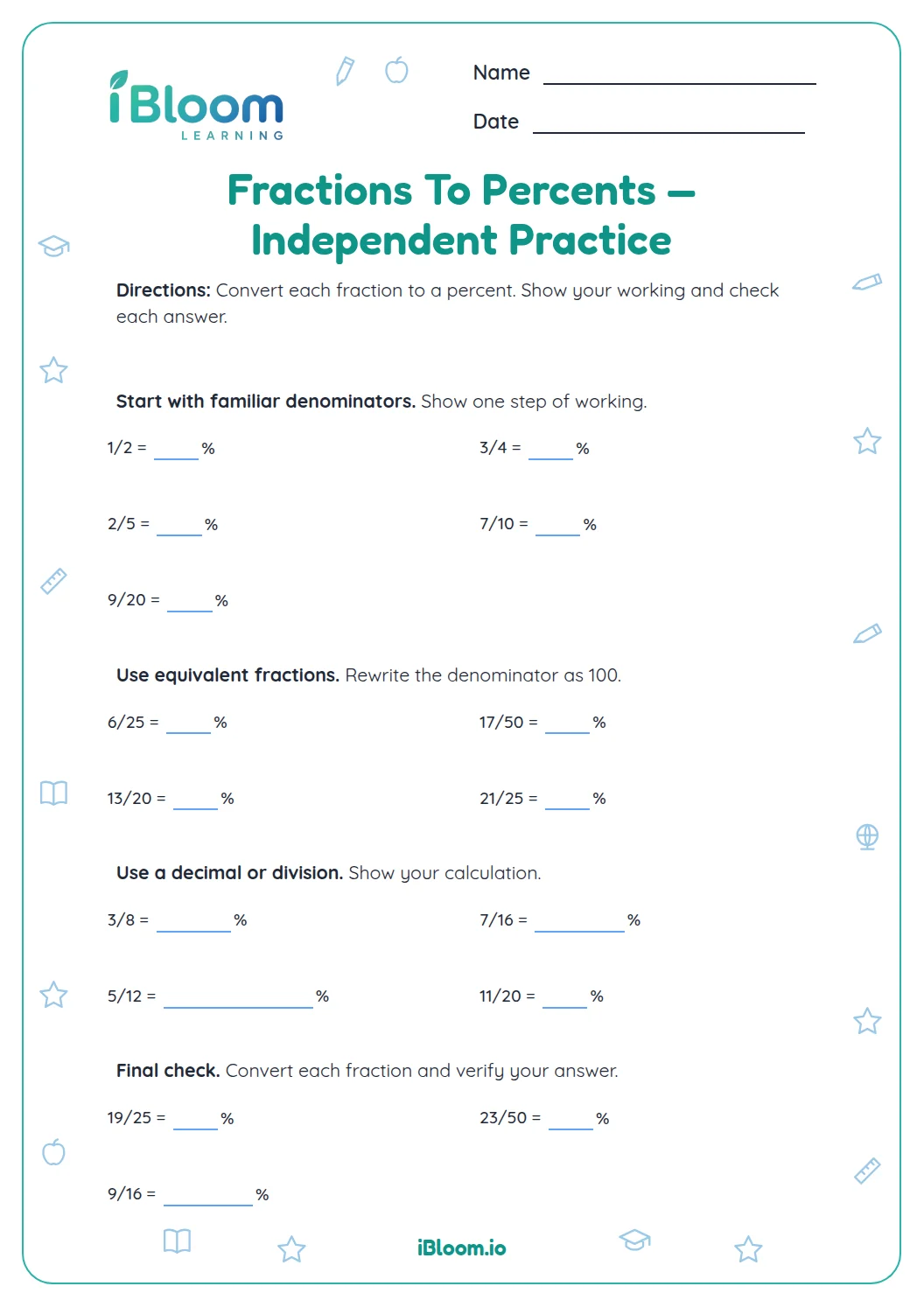
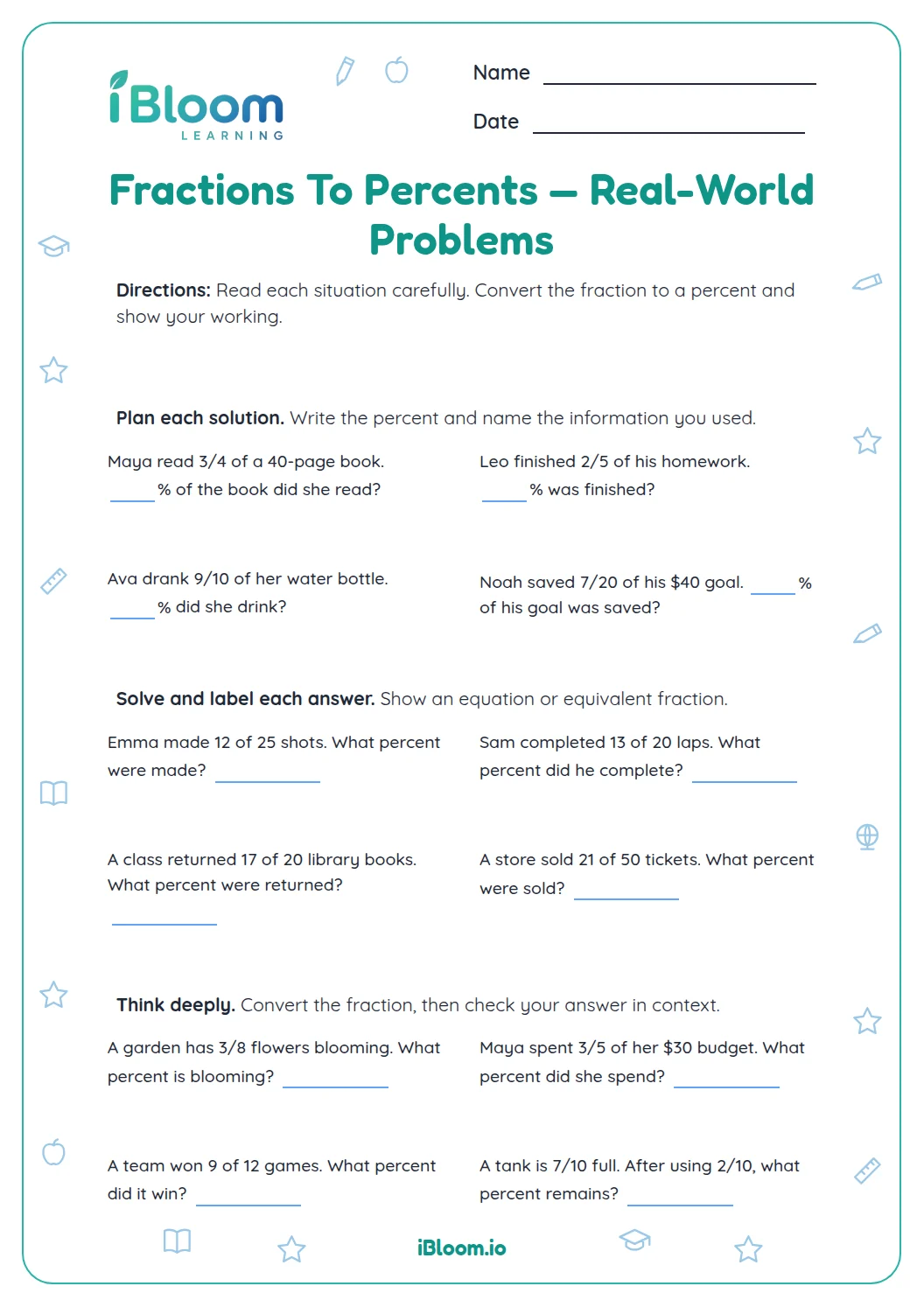
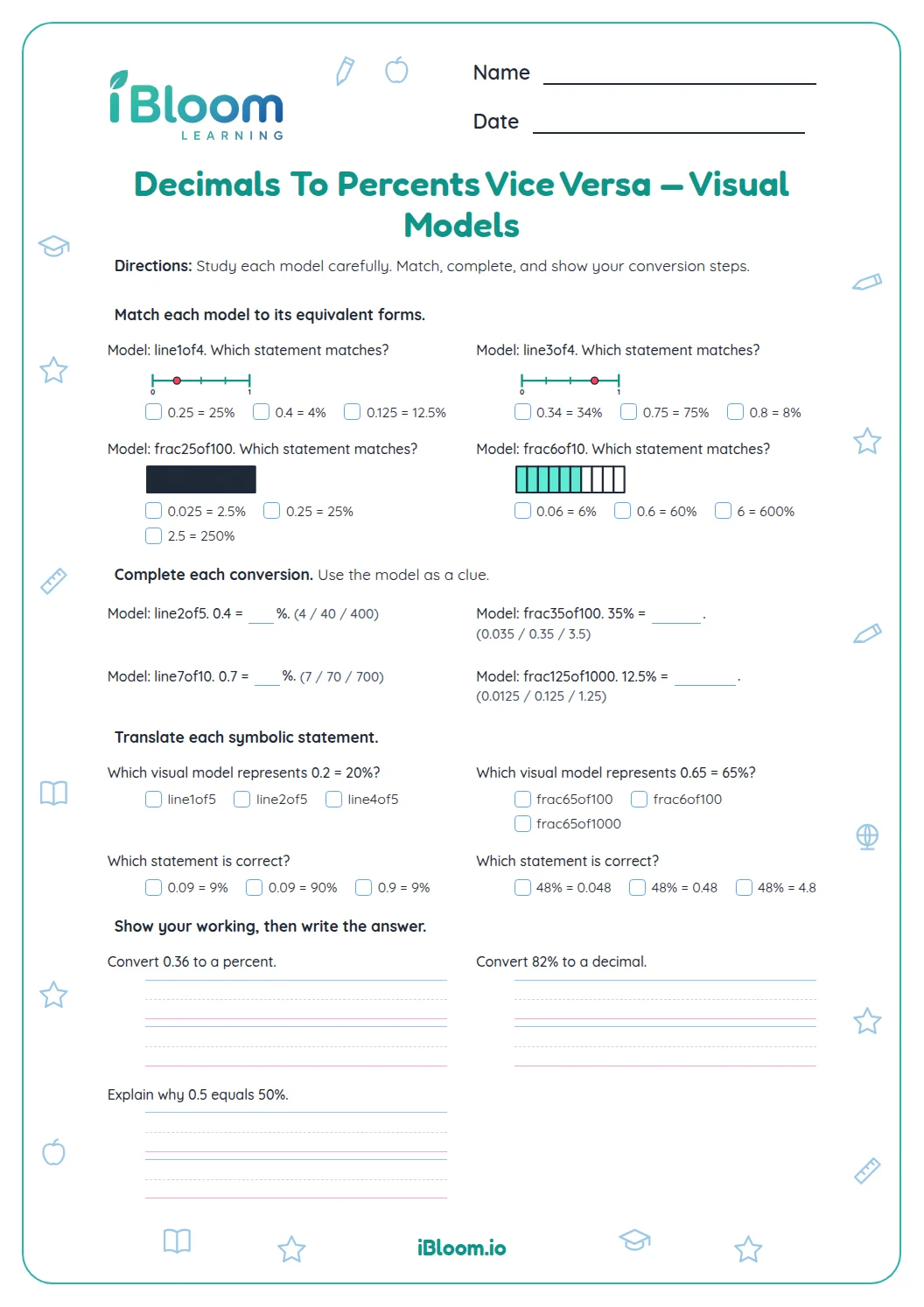
Part A connects four shaded models to percents. Part B gives six fraction conversions, including tenths, fifths, eighths, twentieths, twenty-fifths, fortieths, and fiftieths. Part C uses the same relationship in six brief situations.
- Part A: read four fraction models
- Part B: convert six fractions
- Part C: apply the conversions in context
- The answer key has a worked answer for each item
How to use this worksheet
- 1Begin with a shaded model and name the shaded fraction.
- 2For each model, think of an equivalent fraction out of 100.
- 3In Part B, multiply or divide the numerator and denominator by the same number when that makes 100.
- 4For other denominators, divide to find the decimal, then multiply by 100.
- 5In Part C, identify the part and the whole before converting.
- 6Use the key to check both the number and the percent sign.
Common mistakes and quick fixes
The mistake
Changing the denominator but not the numerator.
The fix
Multiply or divide both parts of the fraction by the same factor.
The mistake
Writing 0.45 as 0.45% when the fraction is 9/20.
The fix
Convert the decimal to a percent by multiplying by 100: 0.45 is 45%.
The mistake
Leaving off the percent sign.
The fix
Read the answer with the word percent and add % to the number.
Common Core alignment
This practice connects fraction equivalence with percent reasoning.
Use a percent as a rate per 100 to solve percent problems.
On this sheet: Students express fractions as percents and interpret part-to-whole situations.
Show the official wordingHide the official wording
Find a percent of a quantity as a rate per 100 (e.g., 30% of a quantity means 30/100 times the quantity); solve problems involving finding the whole, given a part and the percent.
What to practice next
Make more practice
Further reading
Questions parents and teachers ask
How do students change a fraction to a percent?
First identify the fraction’s whole and part. Then find an equivalent fraction out of 100 or divide the numerator by the denominator and multiply by 100. This sheet starts with shaded models and moves into conversions and short situations.
What is the answer to question 5?
Question 5 asks for 3/4 as a percent. Since 3/4 is equivalent to 75/100, the answer is 75%. The answer key shows this conversion and each other direct conversion so students can compare their result and review the relationship.
Why are there shaded fraction models?
The four models make equal parts and the shaded amount visible. Students can count the shaded parts, write the fraction, and connect that amount to a percent. The remaining questions then ask them to use the relationship without a model.
Does the worksheet include an answer key?
Yes. The answer key is provided separately and includes answers for all 16 questions. For the short application problems, the key gives the equivalent percent so an adult can check the result quickly and talk through how the fraction represents part of a whole.
How long should this practice take?
Plan for about 20 minutes, depending on whether students write out equivalent fractions. A useful routine is to complete the four models first, pause to review the relationship to 100, and then work through the conversions and situations at a comfortable pace.