




About this worksheet
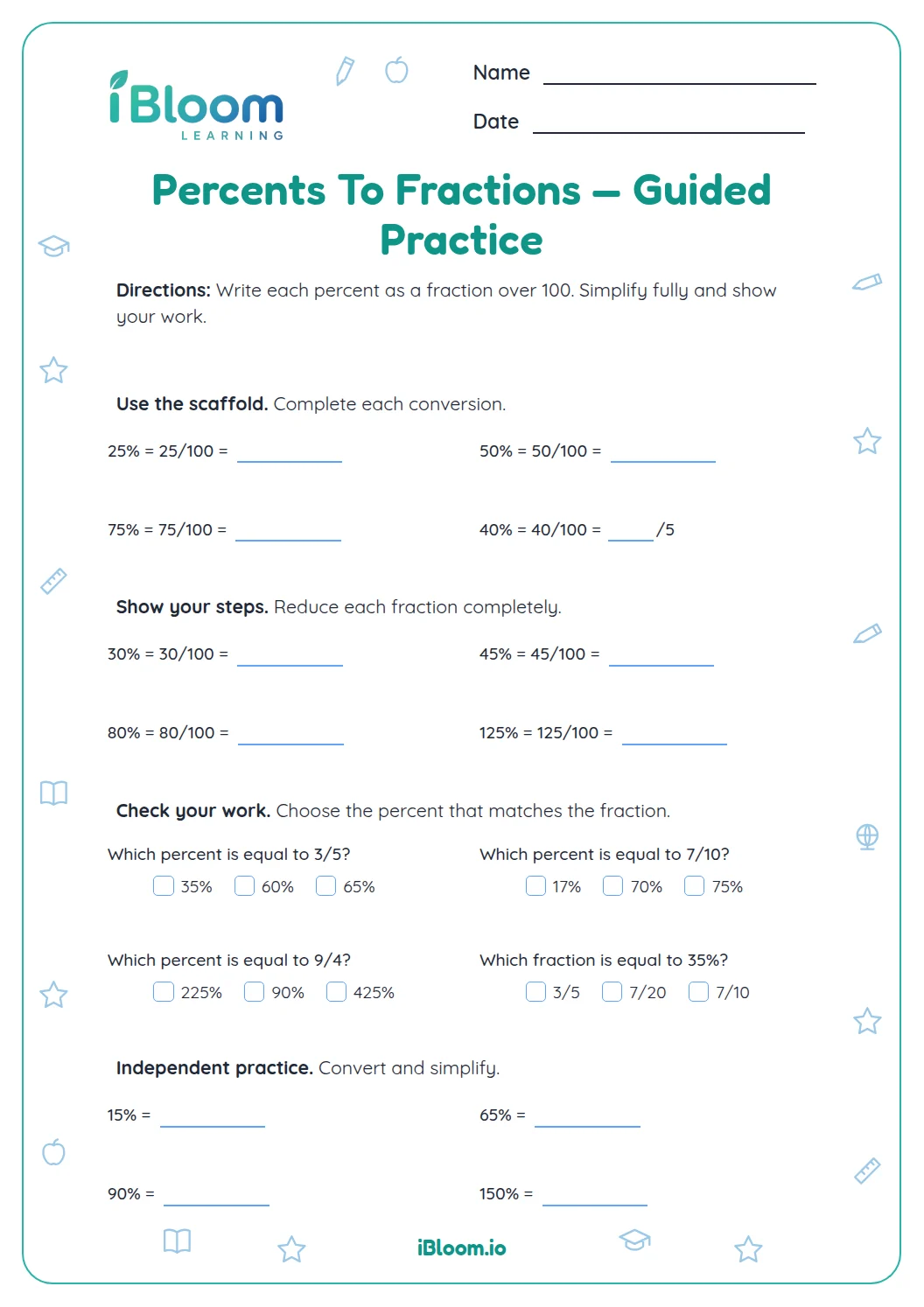
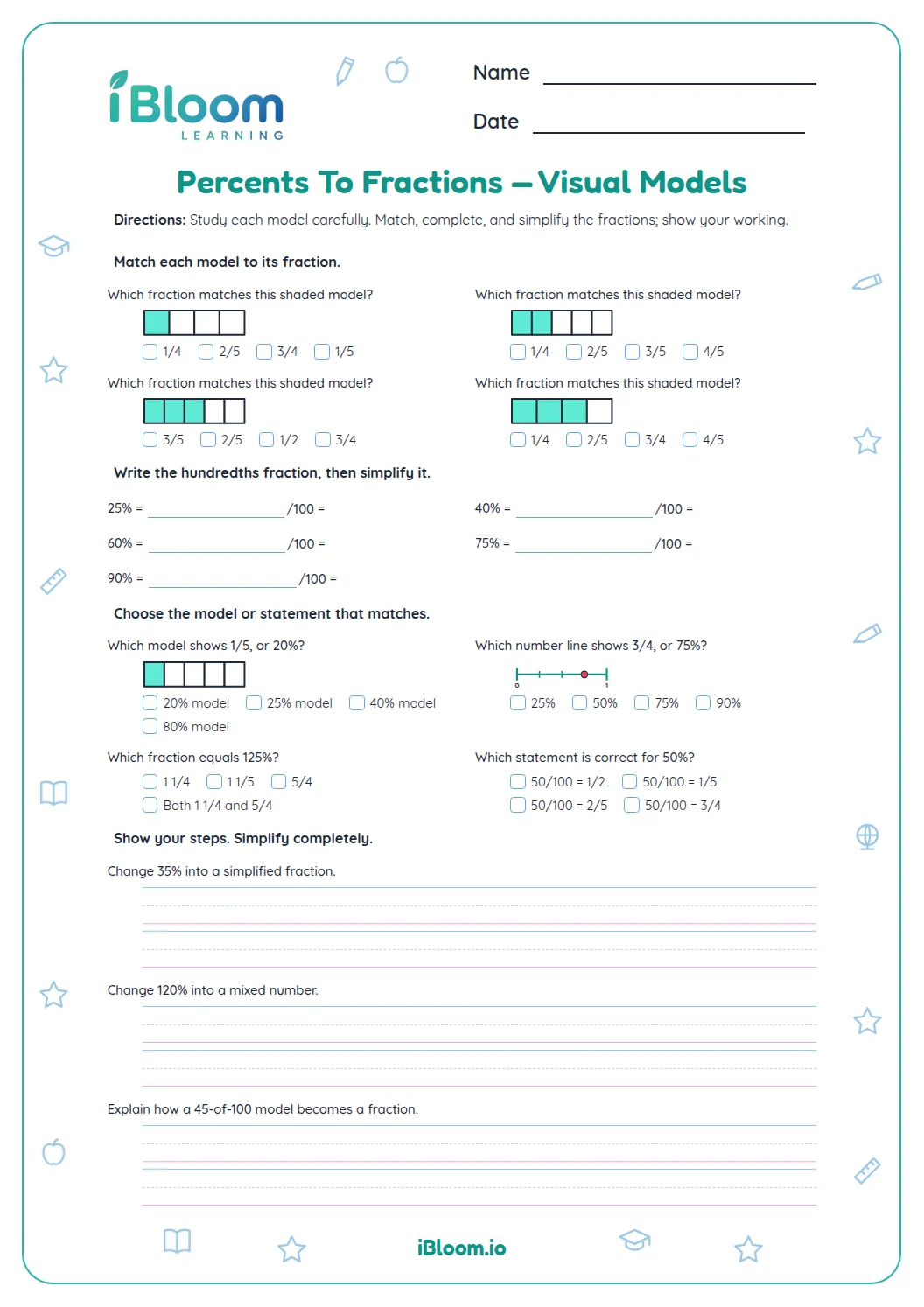
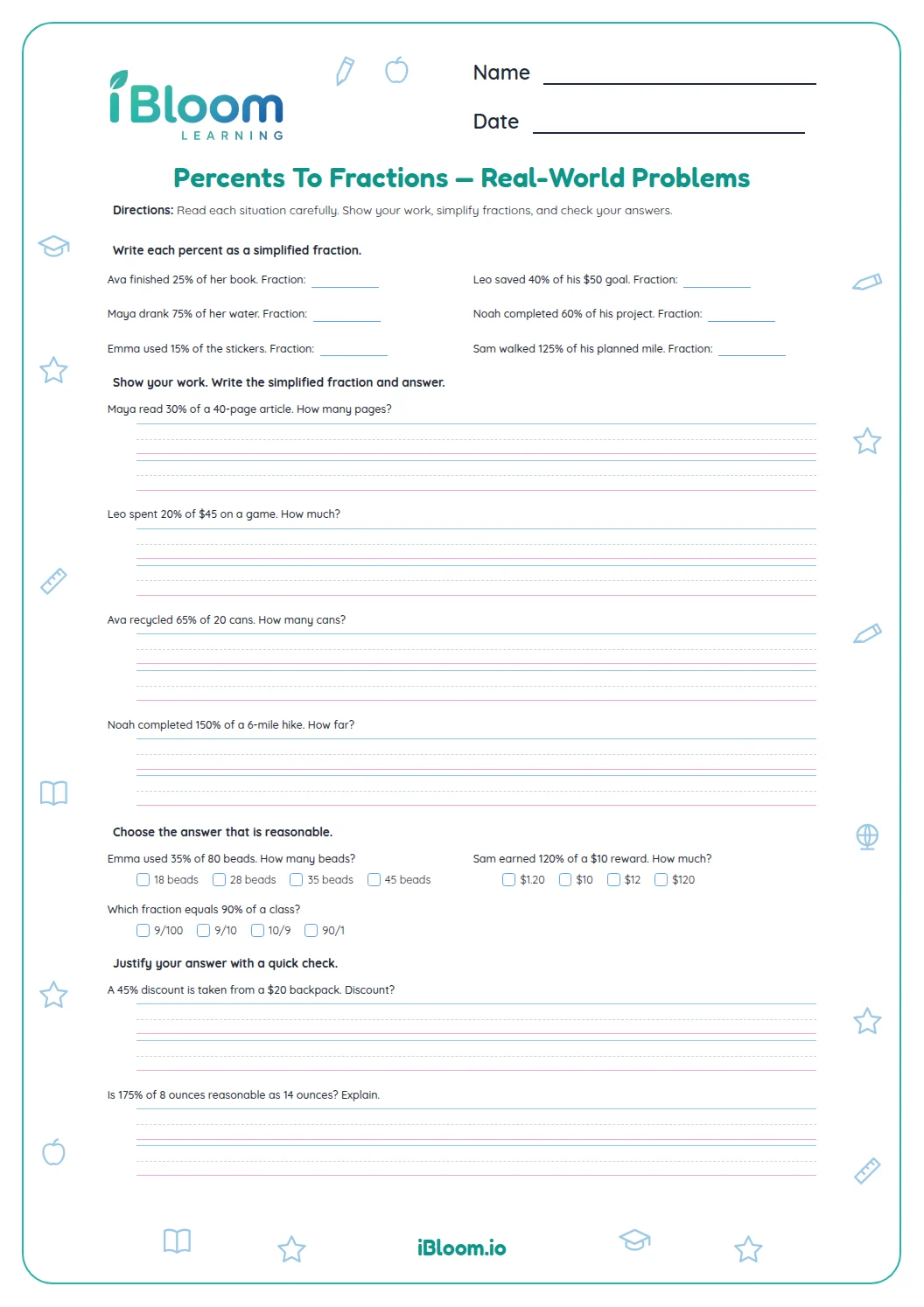
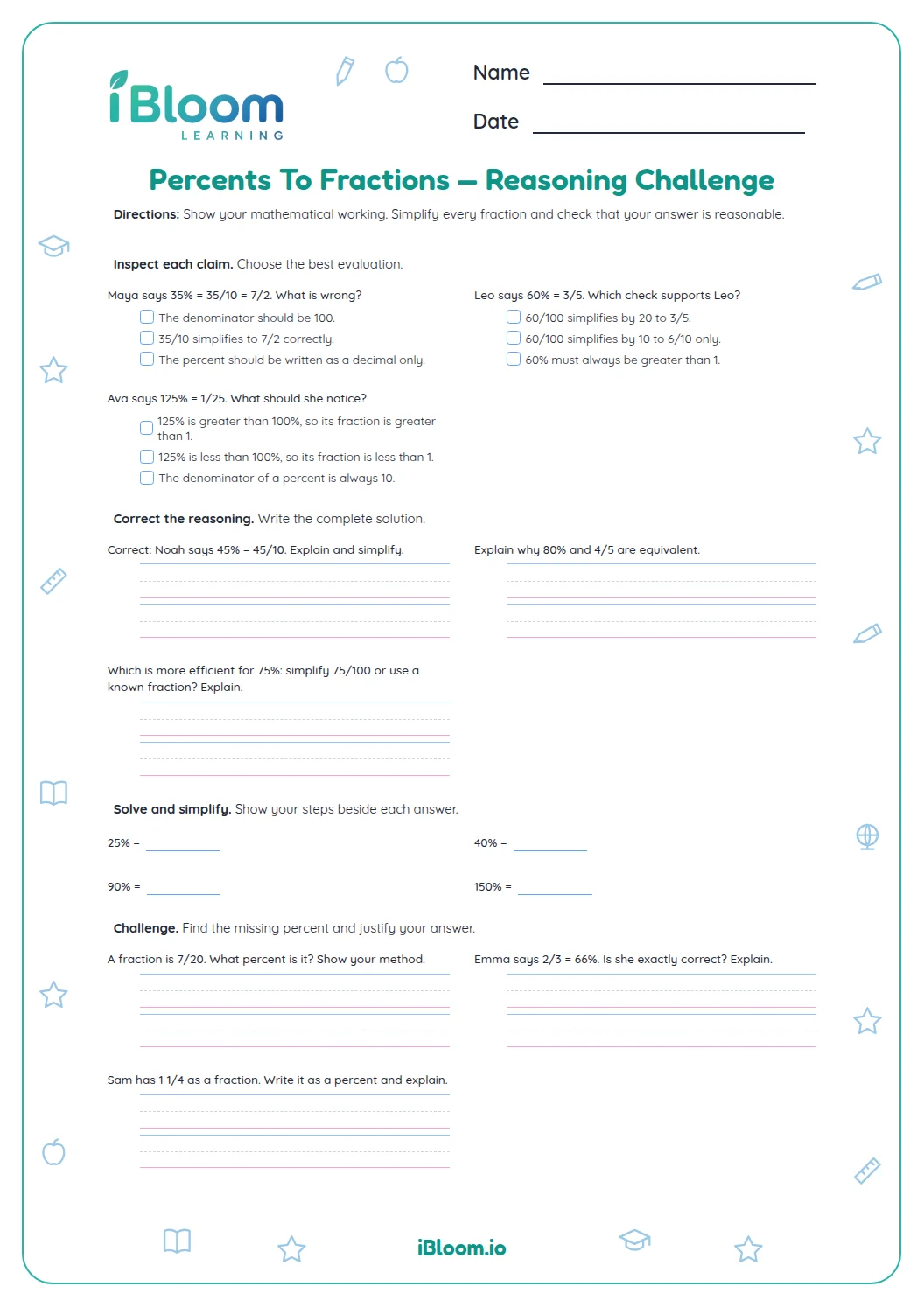
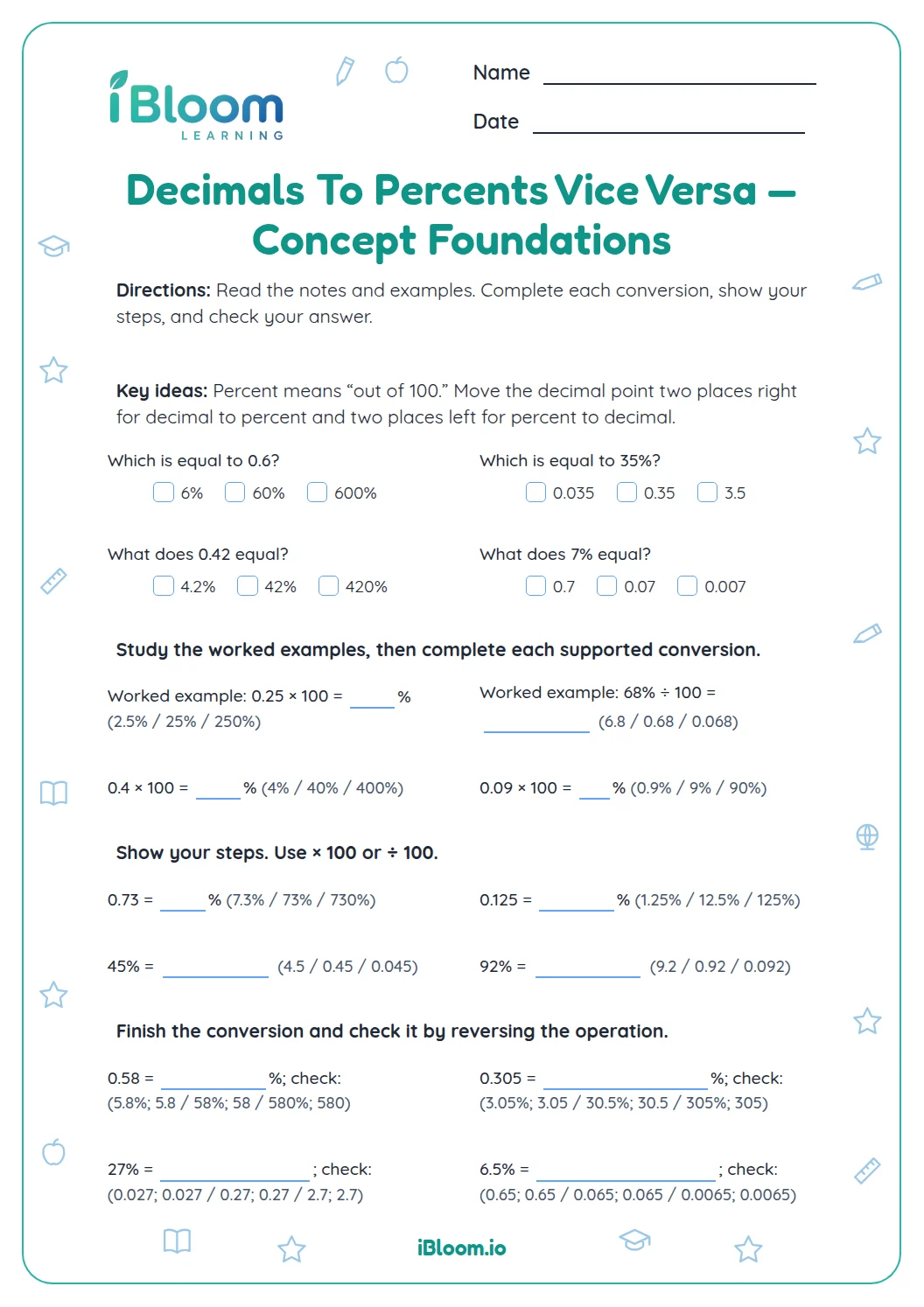
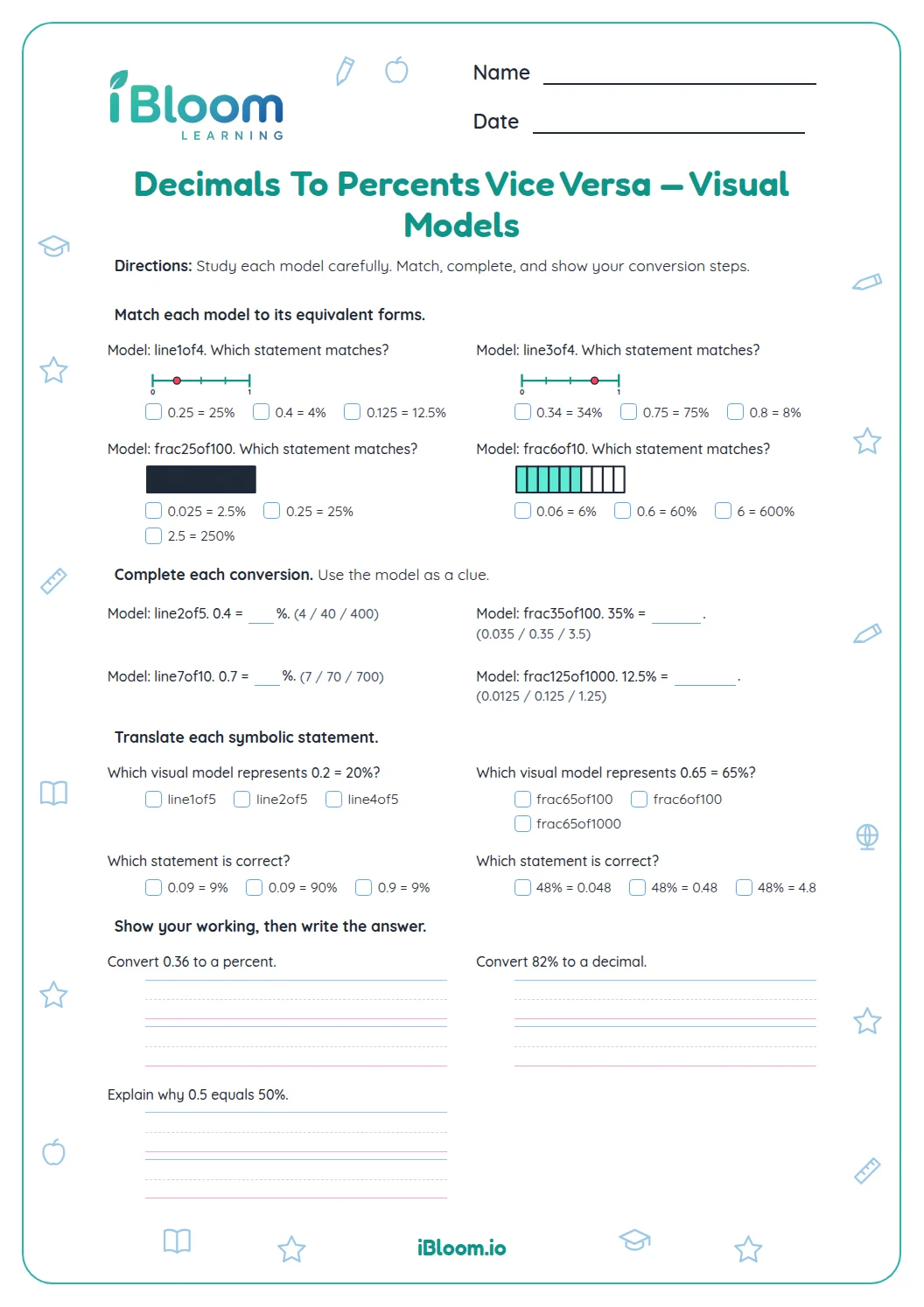
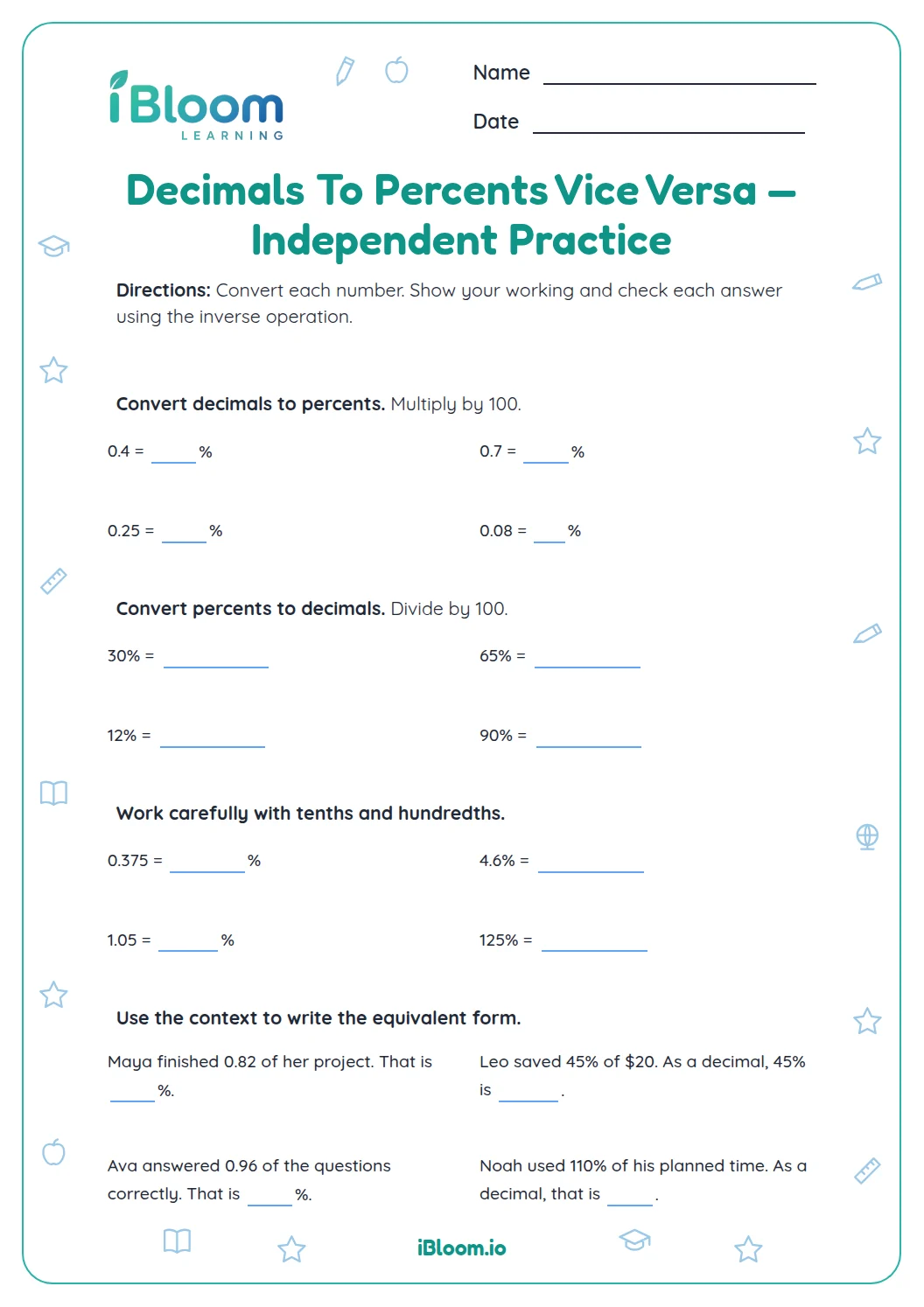
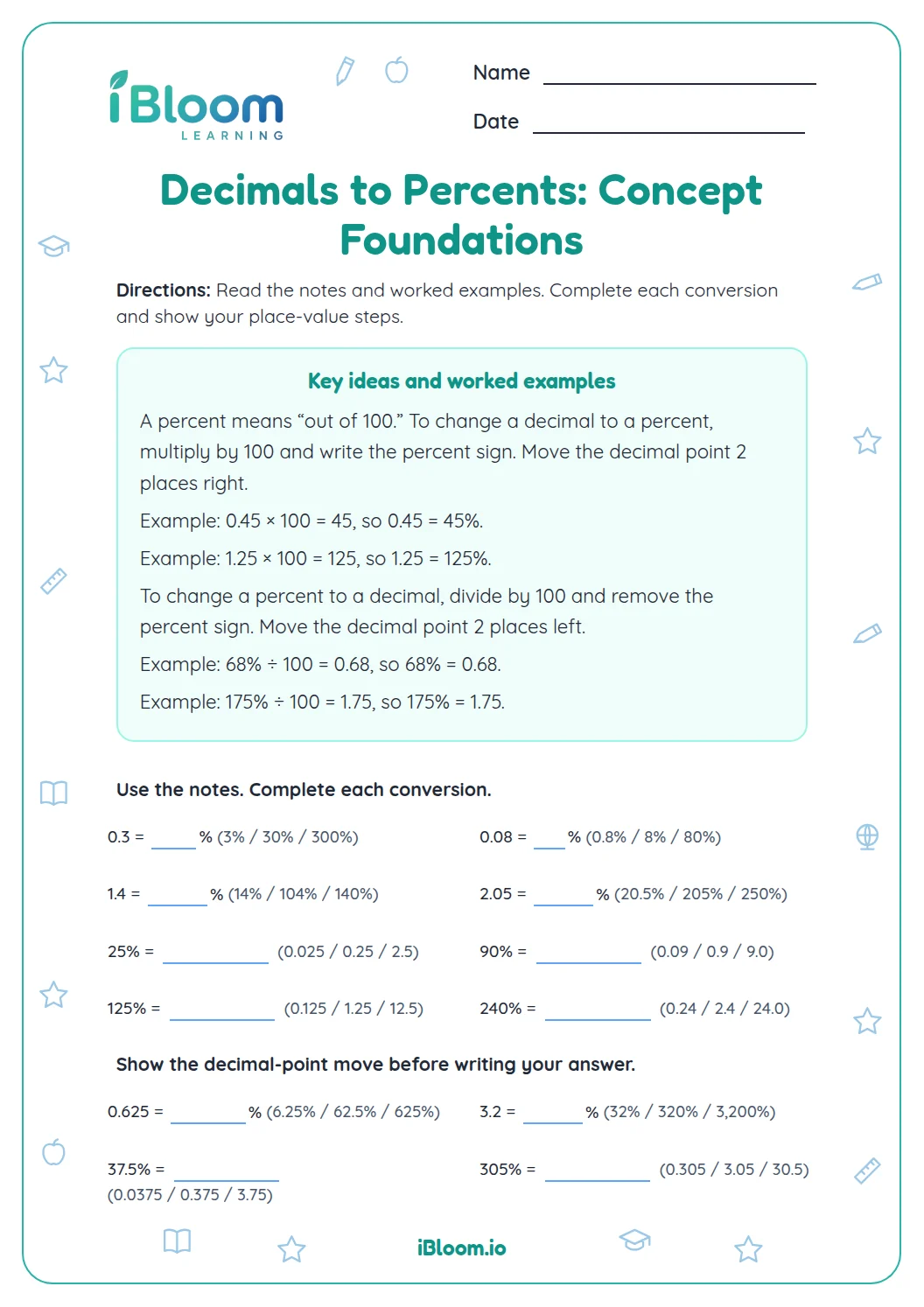
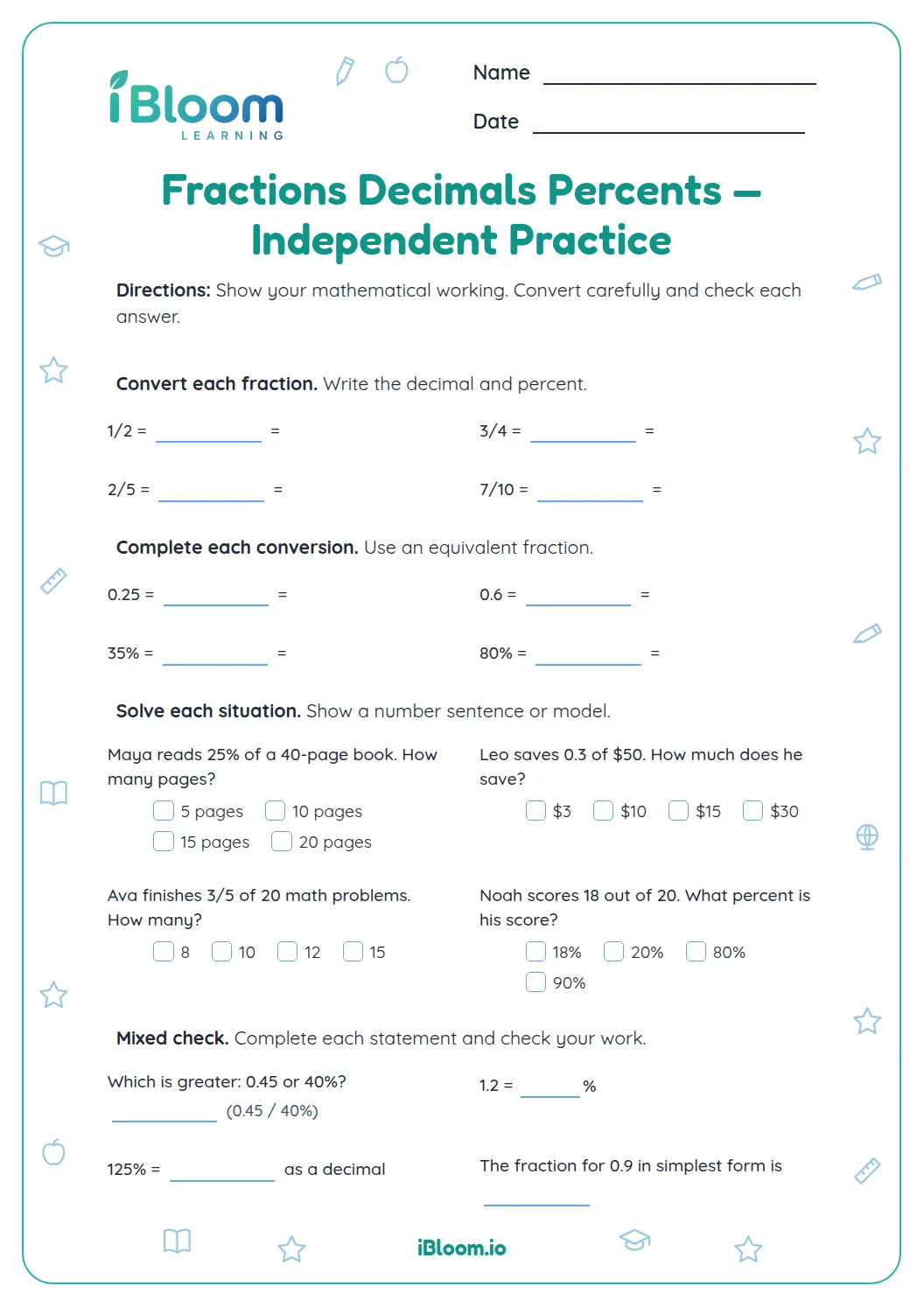
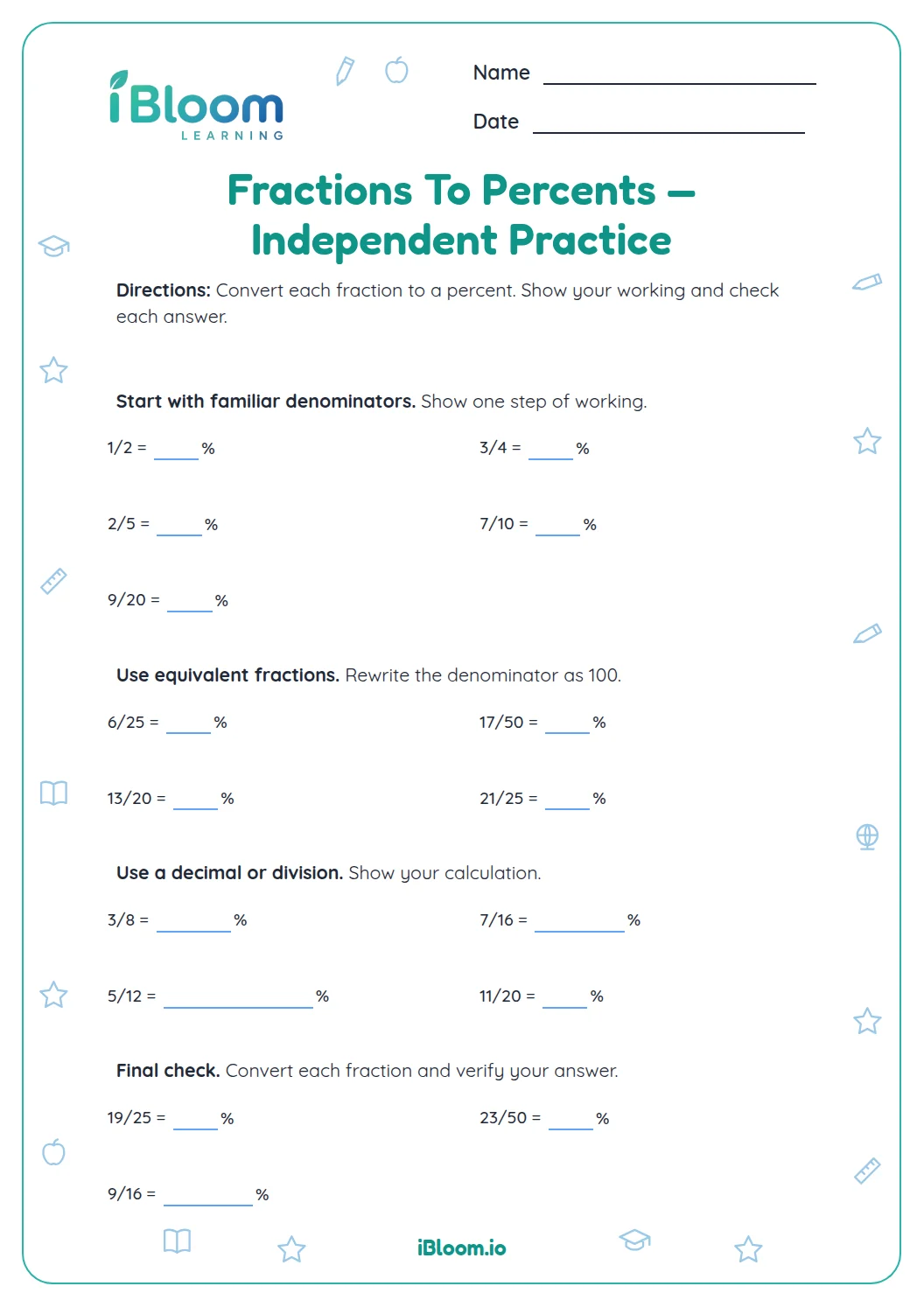
This Grade 6 printable has 16 percent-to-fraction conversions in three parts. Students write each percent as a fraction per 100, simplify familiar and less familiar values, and express values above 100% as improper fractions or mixed numbers. It connects percent notation with rates per 100 in CCSS 6.RP.A.3.c. A separate answer key includes simplified forms.
Aligned to 6.RP.A.3.c
How do you turn a percent into a fraction?
Write the percent number as the numerator and 100 as the denominator. Then simplify by dividing top and bottom by a shared factor.
- 135% = 35/100 = 7/20
How do you simplify the fraction?
Find a number that divides both the numerator and denominator evenly. Divide both by the same number, and repeat if another common factor remains.
- 112% = 12/100 = 3/25
What happens when a percent is over 100?
The fraction is greater than one whole. Simplify the fraction, then write it as an improper fraction or mixed number as requested.
- 1125% = 125/100 = 5/4 = 1 1/4
How to use this worksheet
- 1Write the percent value over 100.
- 2Find a common factor in the numerator and denominator.
- 3Divide both terms by the same factor to simplify.
- 4For values above 100%, use an improper fraction or mixed number.
- 5Check equivalent value and simplest form with the key.
Percent conversion checks
The mistake
Using 10 as the denominator.
The fix
Percent means per 100, so start with a denominator of 100.
The mistake
Reducing only the numerator.
The fix
Divide numerator and denominator by the same common factor.
The mistake
Writing a percent above 100 as less than one whole.
The fix
Check that its fraction is greater than 1; 125% is 5/4, or 1 1/4.
Common Core alignment
Express a percent as an equivalent fraction with denominator 100, then simplify.
On this sheet:
Show the official wordingHide the official wording
Find a percent of a quantity as a rate per 100 (e.g., 30% of a quantity means 30/100 times the quantity); solve problems involving finding the whole, given a part and the percent.
What to practice next
Make more practice
Further reading
Questions parents and teachers ask
What does percent mean when writing a fraction?
Percent means per hundred, so begin by writing the percent number over 100. For example, 35% becomes 35/100, which simplifies to 7/20. The first part practices familiar values before the later sets add less familiar percents. Students can confirm the result by checking that the simplified fraction still represents the original percent.
Should every answer be simplified?
Yes. The first two parts ask for fractions in simplest form, and the answer key gives reduced results. Check whether the numerator and denominator share a factor after writing the percent over 100. Students can confirm the result by checking that the simplified fraction still represents the original percent.
How are percents greater than 100 shown?
A percent above 100 represents more than one whole. Part C asks students to write these as improper fractions or mixed numbers; for example, 125% is 5/4, or 1 1/4. Students can confirm the result by checking that the simplified fraction still represents the original percent.
Can equivalent fraction forms be accepted?
Yes, an equivalent fraction has the same value, though the worksheet asks for simplest form in Parts A and B. For values above 100%, the key uses mixed numbers; an equivalent improper fraction is also mathematically correct. Students can confirm the result by checking that the simplified fraction still represents the original percent.
How many pages are in the worksheet and key?
There are two worksheet pages and a separate two-page answer key. Students can work through the three parts, then use the key to check conversions and simplify any answer that still has a common factor. Students can confirm the result by checking that the simplified fraction still represents the original percent.