


About this worksheet
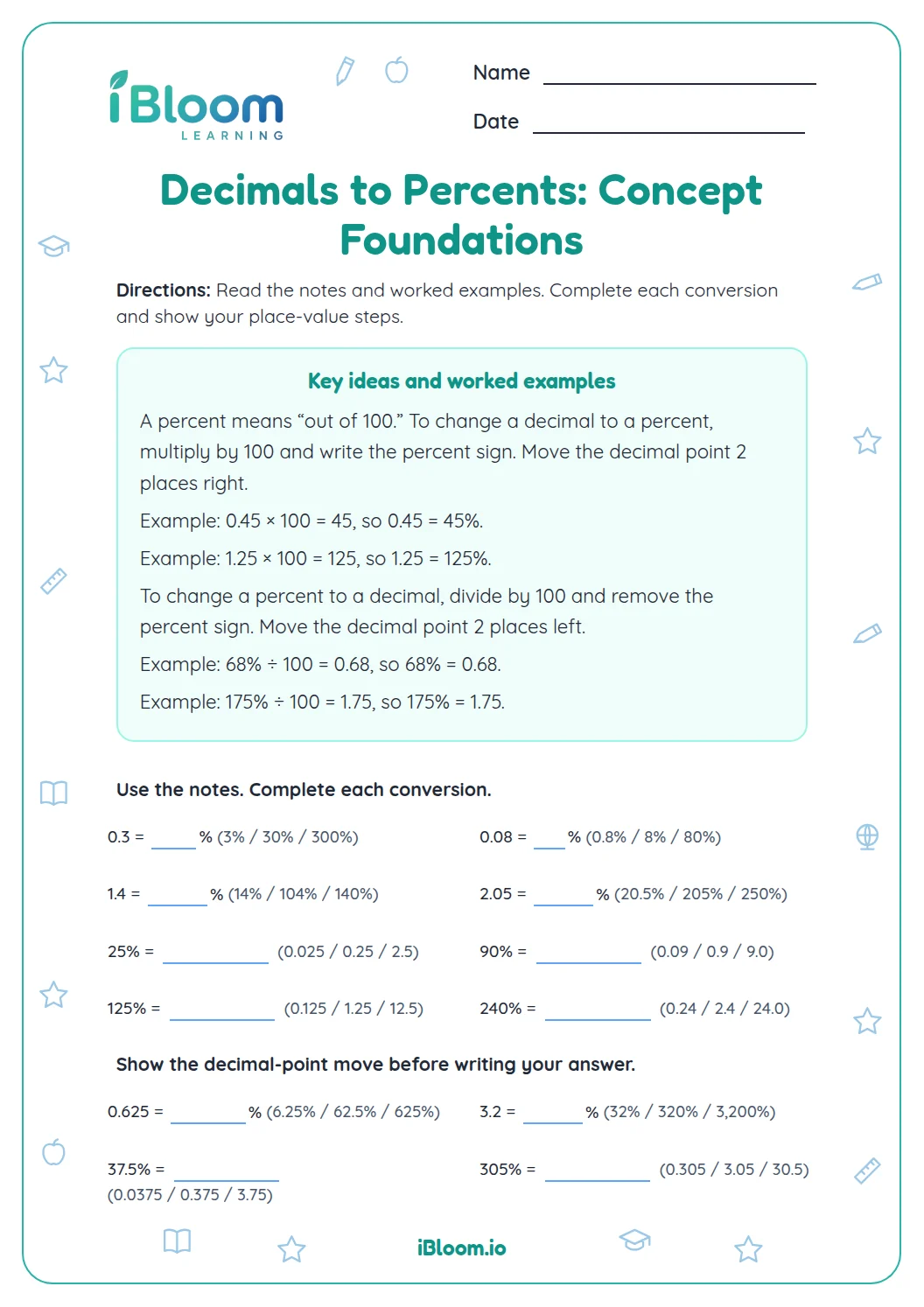
This Grade 6 worksheet practices converting in both directions: multiply a decimal by 100 to write a percent, or divide a percent by 100 to write a decimal. It includes values below and above one, plus short contexts about a battery, recipe, sale, and distance. A separate answer key supports checking.
How does the first part work?
Multiply a decimal by 100 and write the percent sign. For example, 1.35 becomes 135%, so values greater than 1 can produce percents greater than 100%.
How can you check each answer?
Divide a percent by 100, or move the decimal point two places left. For example, 64% is 0.64.
What should learners do next?
Each situation gives a decimal amount or multiplier. Express that amount as a percent of the stated whole or starting amount.
A simple practice routine
- 1Read the whole prompt before writing.
- 2Name the unknown value.
- 3Choose a strategy that fits the question.
- 4Work carefully and record one answer.
- 5Check by putting the answer back into the prompt.
Watch for these slips
The mistake
Changing the order of the values
The fix
Keep the original order when checking.
The mistake
Stopping after one operation
The fix
Read the full question and check the result.
The mistake
Copying a value inaccurately
The fix
Compare each digit or word with the prompt.
What to practice next
Make more practice
Questions parents and teachers ask
Can a percent be greater than 100%?
Yes. A percent compares an amount with one whole. A decimal of 1.24 is 124% of a whole, so this worksheet includes conversions above 100% as well as values below one whole. Convert the result back in the opposite direction to confirm the equivalent decimal or percent.
How do I convert 0.075 to a percent?
Multiply 0.075 by 100. The result is 7.5%, because moving the decimal point two places to the right changes the decimal into a rate per hundred. Keep the percent sign in the answer. Convert the result back in the opposite direction to confirm the equivalent decimal or percent.
How do I convert 125% to a decimal?
Divide 125 by 100 to get 1.25. The decimal is greater than one because 125% means 125 out of 100, which is more than one complete whole. Convert the result back in the opposite direction to confirm the equivalent decimal or percent.
What do the word problems ask learners to do?
Each situation gives a decimal amount or multiplier and asks learners to express it as a percent. For instance, 1.6 cups is 160% of one cup. The questions reinforce conversion in everyday contexts. Convert the result back in the opposite direction to confirm the equivalent decimal or percent.
Is an answer key included?
Yes. The separate key lists the equivalent decimal or percent for all 14 questions. Learners can check both the number and the direction of conversion, then convert the answer back to verify it. Convert the result back in the opposite direction to confirm the equivalent decimal or percent.