




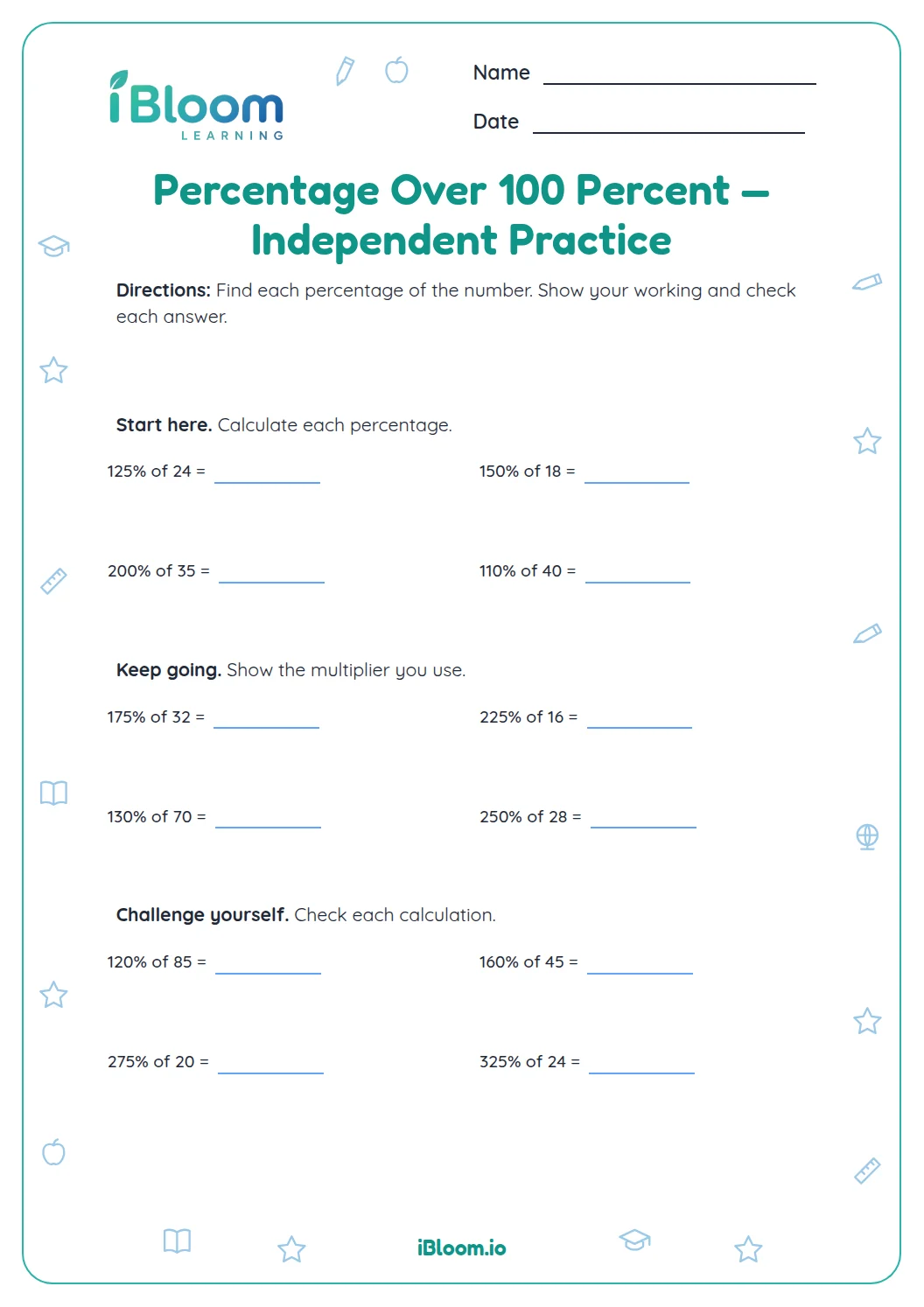

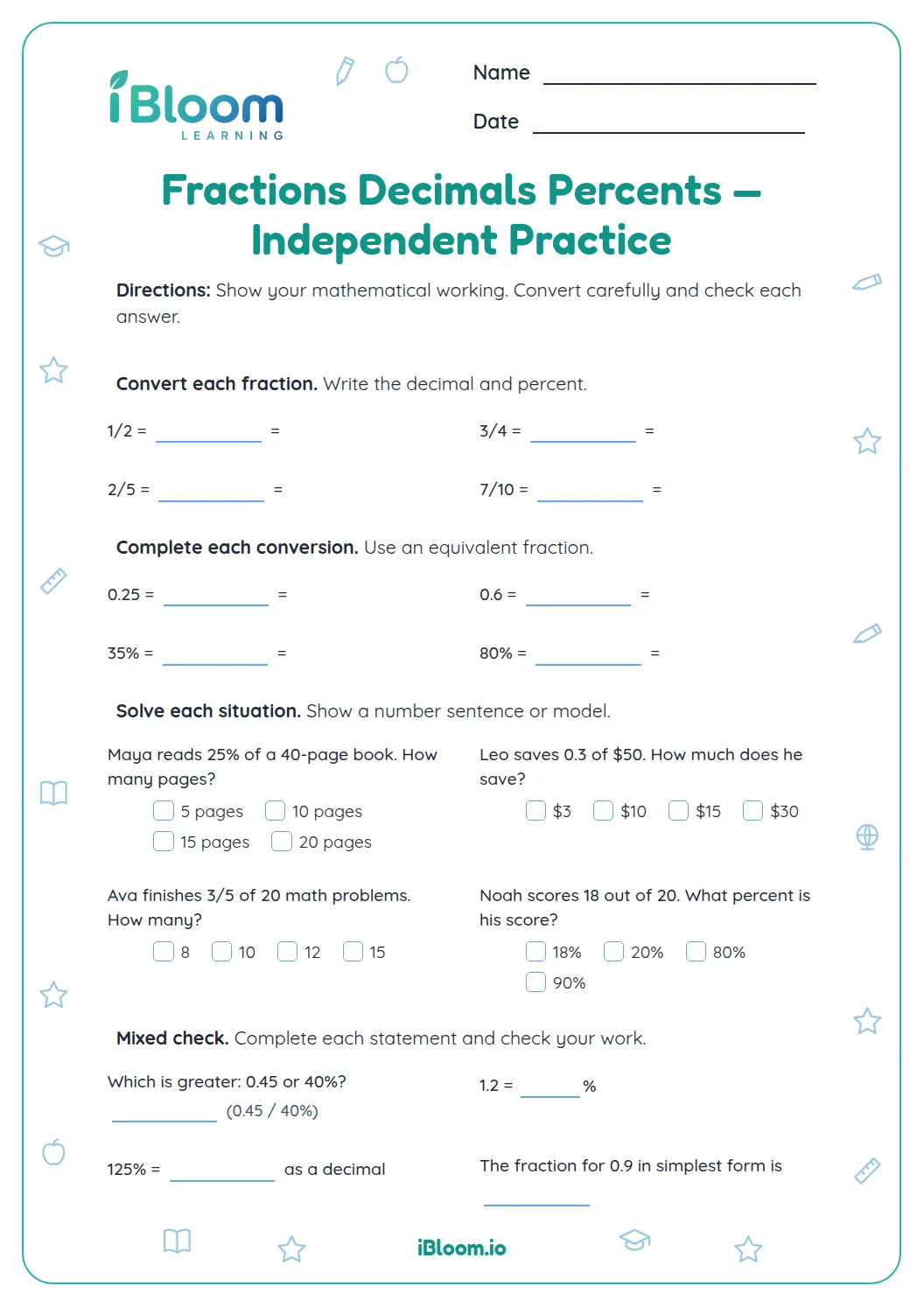
About this worksheet
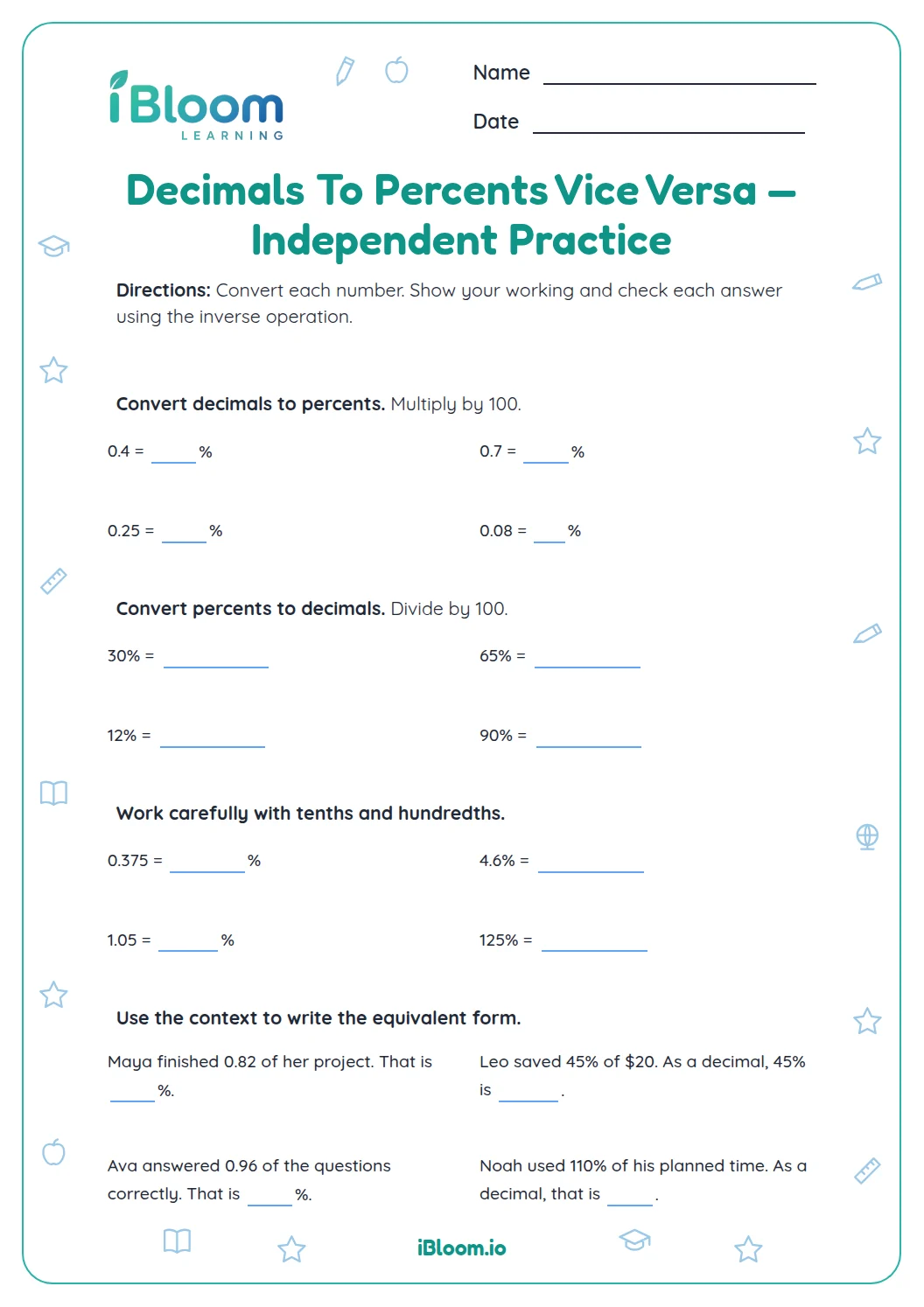
This independent practice page covers decimal-to-percent and percent-to-decimal conversions from hundredths through values above 300%. Children answer 16 questions, then use the conversions in two short situations. Each conversion uses the relationship that 1 whole equals 100%.
Aligned to 6.RP.A.3c
How do you convert a decimal to a percent?
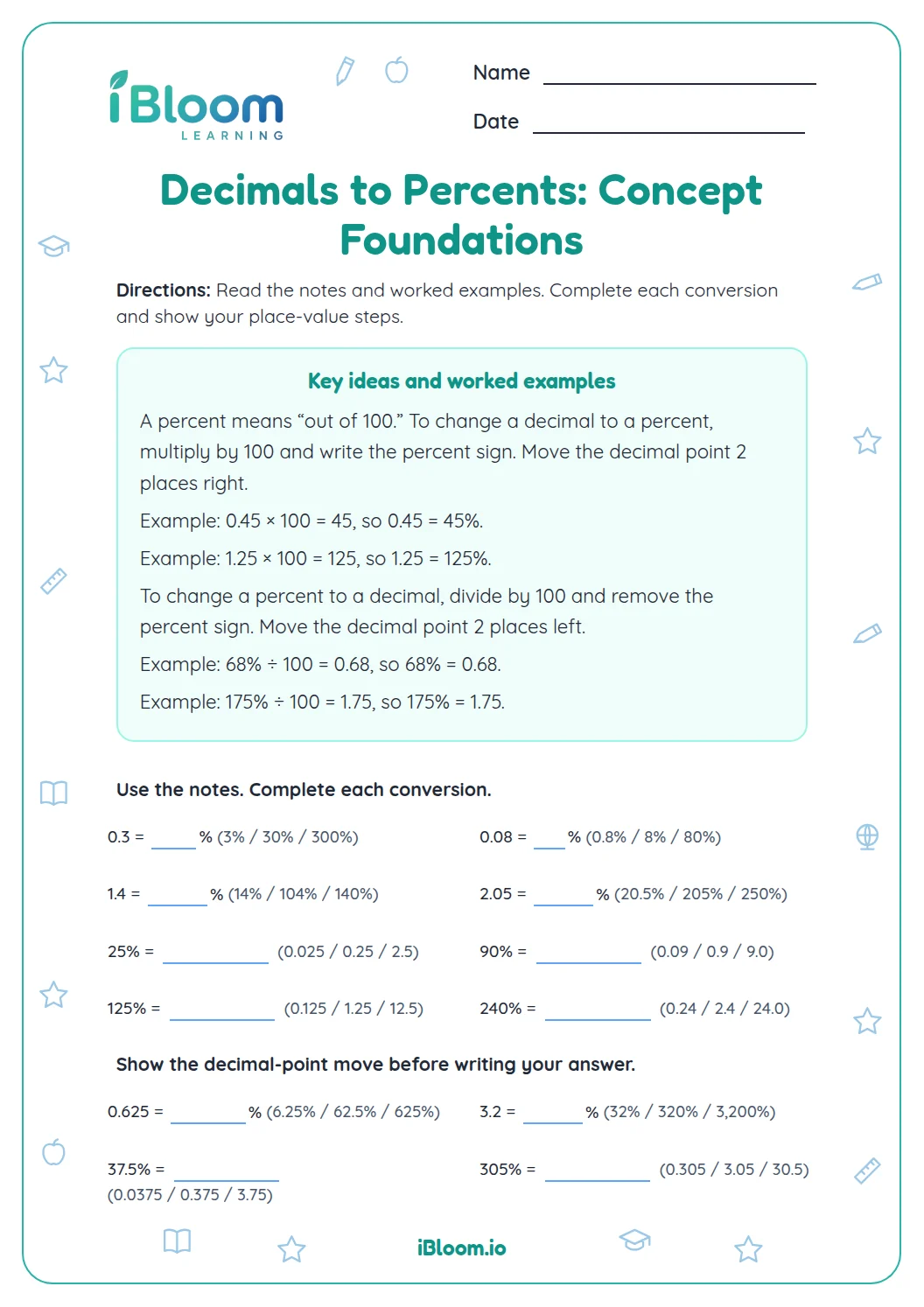
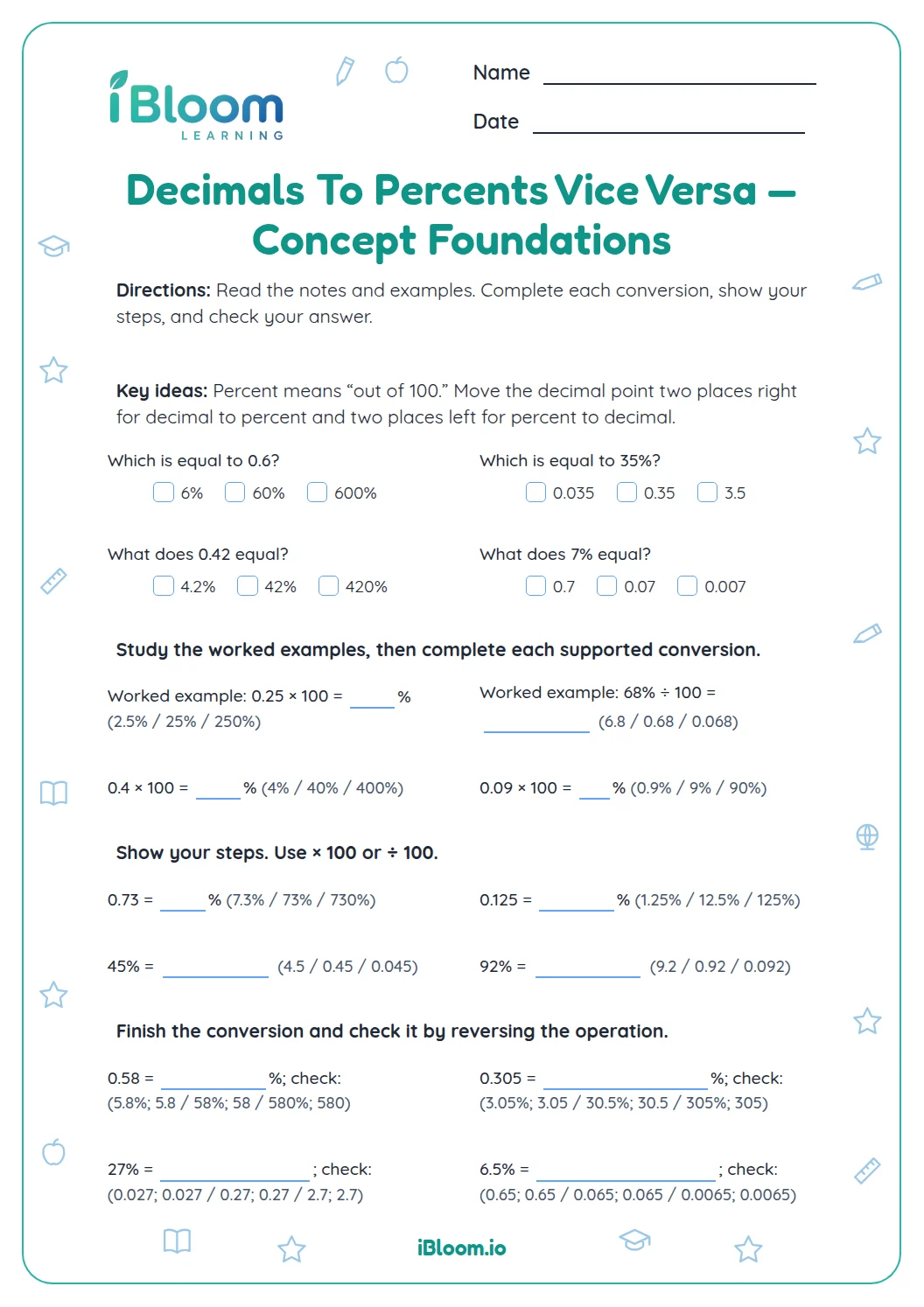
A percent tells how many hundredths. Multiply a decimal by 100 and write the percent sign: 0.37 becomes 37%. For a number greater than 1, the percent is greater than 100%; for example, 2.4 is 240%.
To convert the other way, divide the percent number by 100. Move the decimal point two places left: 125% becomes 1.25. Keep the zero when it holds a place, as in 5% = 0.05.
What does a percent over 100% mean?
One whole is 100%. A percent above 100% describes more than one whole. So 135% of one liter is 1.35 liters. The percent and decimal name the same amount in different forms.
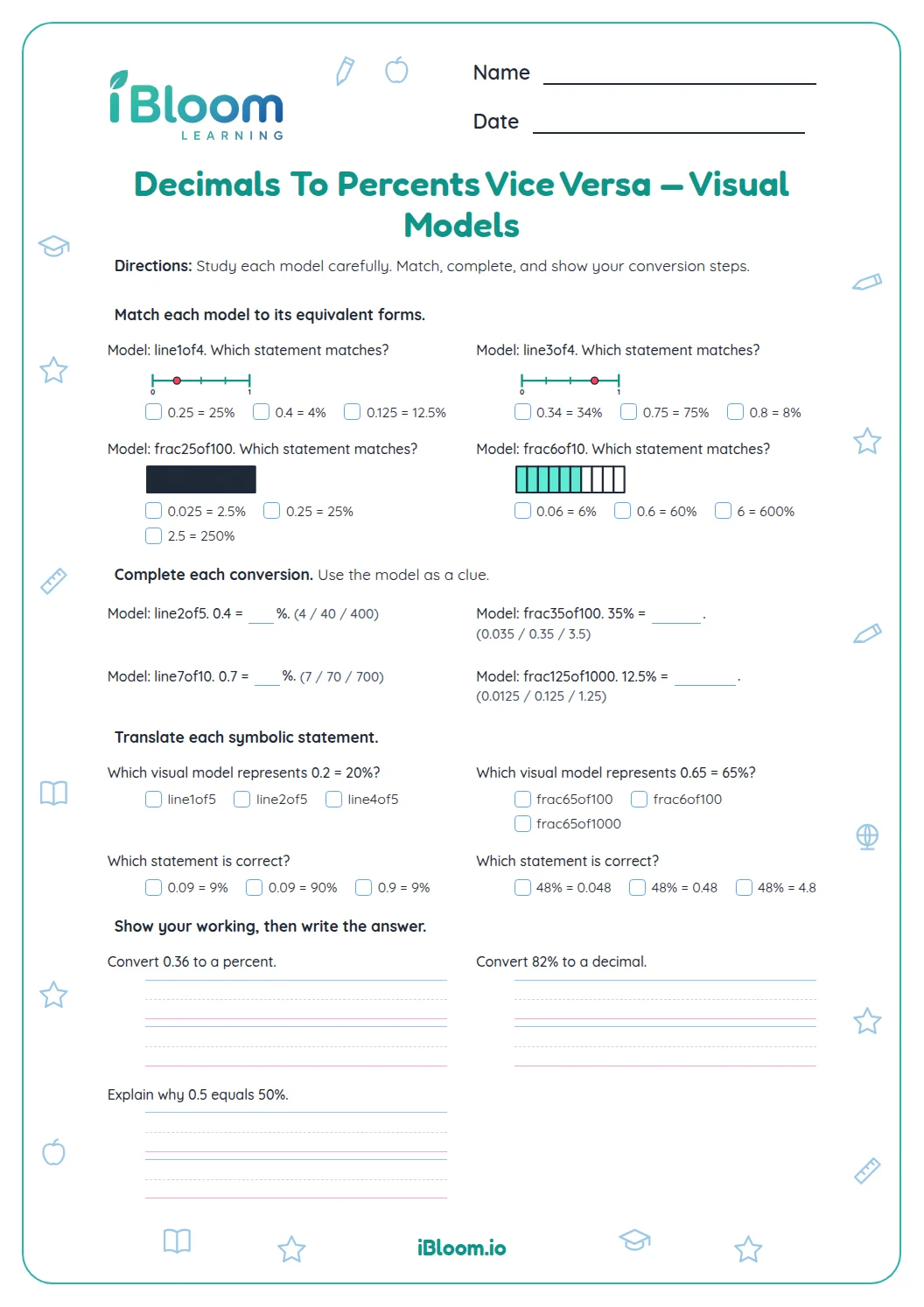
Parts A and B practice conversions in both directions. Part C checks equivalent forms with choices, and Part D applies the relationship to a jug and a ribbon.
How to use this worksheet
- 1Review the fact 1 = 100% before starting.
- 2In Part A, shift the decimal two places right and attach the percent sign.
- 3In Part B, shift two places left; add a leading zero when needed.
- 4For values above 100%, say how many wholes the decimal represents.
- 5Check each answer by converting it back to its starting form.
Common conversion errors
The mistake
Moving the decimal only one place, such as writing 0.37 = 3.7%.
The fix
Use 100 hundredths in one whole, so shift two places: 0.37 = 37%.
The mistake
Treating 125% as 12.5 or 0.125.
The fix
Divide by 100. Since 100% = 1, 125% is 1.25.
The mistake
Dropping the zero in 5% and writing 0.5.
The fix
Write 5/100 as a decimal: 0.05.
Common Core alignment
This practice focuses on expressing a quantity as a percent and converting between percent and decimal forms.
Find a percent of a quantity and solve problems involving percents.
On this sheet: The conversion practice uses the percent-as-rate-per-100 relationship, including amounts above 100%.
Show the official wordingHide the official wording
Find a percent of a quantity as a rate per 100 (e.g., 30% of a quantity means 30/100 times the quantity); solve problems involving finding the whole, given a part and the percent.
What to practice next
Make more practice
Further reading
Questions parents and teachers ask
Why can a percent be greater than 100%?
One whole is 100%, so a percent above 100% names more than one whole. For example, 240% is 2.4 as a decimal. The worksheet practices this relationship with values including 125%, 306%, and 415%. The 16-question set includes several examples above 100%, so children can compare a percent with one whole.
How do I convert 0.84 to a percent?
Multiply 0.84 by 100, or move the decimal two places to the right, then add the percent sign. The result is 84%. Part A uses the same step with decimals below and above one whole. You can check the result by converting 84% back to a decimal: 0.84.
How do I convert 125% to a decimal?
Divide 125 by 100, or move the decimal two places to the left. The decimal is 1.25. Since 125% is greater than 100%, its decimal form is greater than one. The reverse check is 1.25 × 100 = 125%, which confirms the decimal and percent name the same amount.
Why is 5% written as 0.05?
Five percent means 5 out of 100, or 5/100. In decimal form, that is 0.05; the zero keeps the 5 in the hundredths place. One question on the practice page checks this conversion. The answer key lists 0.05, not 0.5, for that item.
What is included on the worksheet?
The sheet has 16 questions in four parts: decimal-to-percent conversions, percent-to-decimal conversions, two multiple-choice checks, and two applications about measures. It includes values above 100% and a separate answer key for checking each conversion and comparing the decimal and percent forms.