




About this worksheet
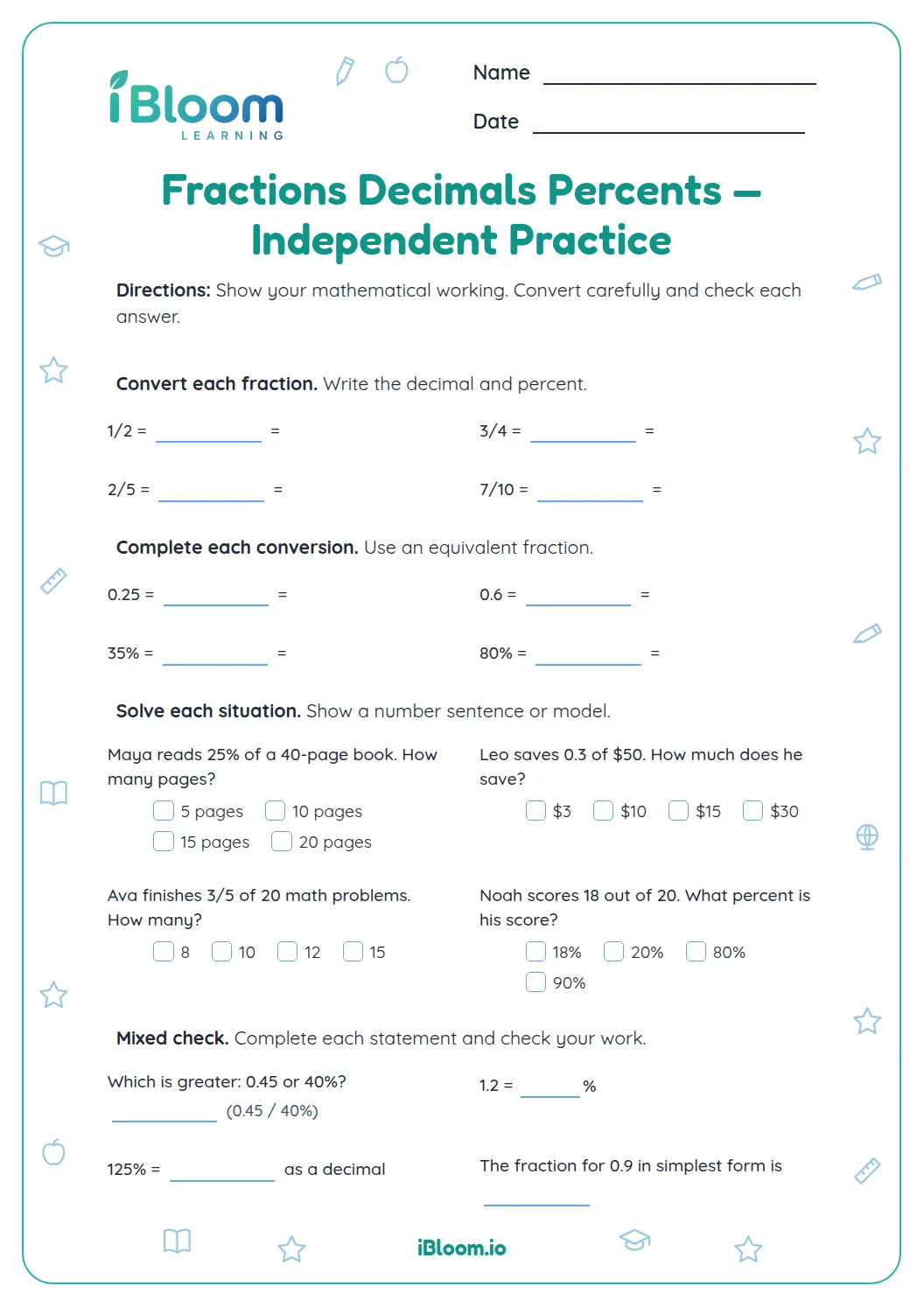
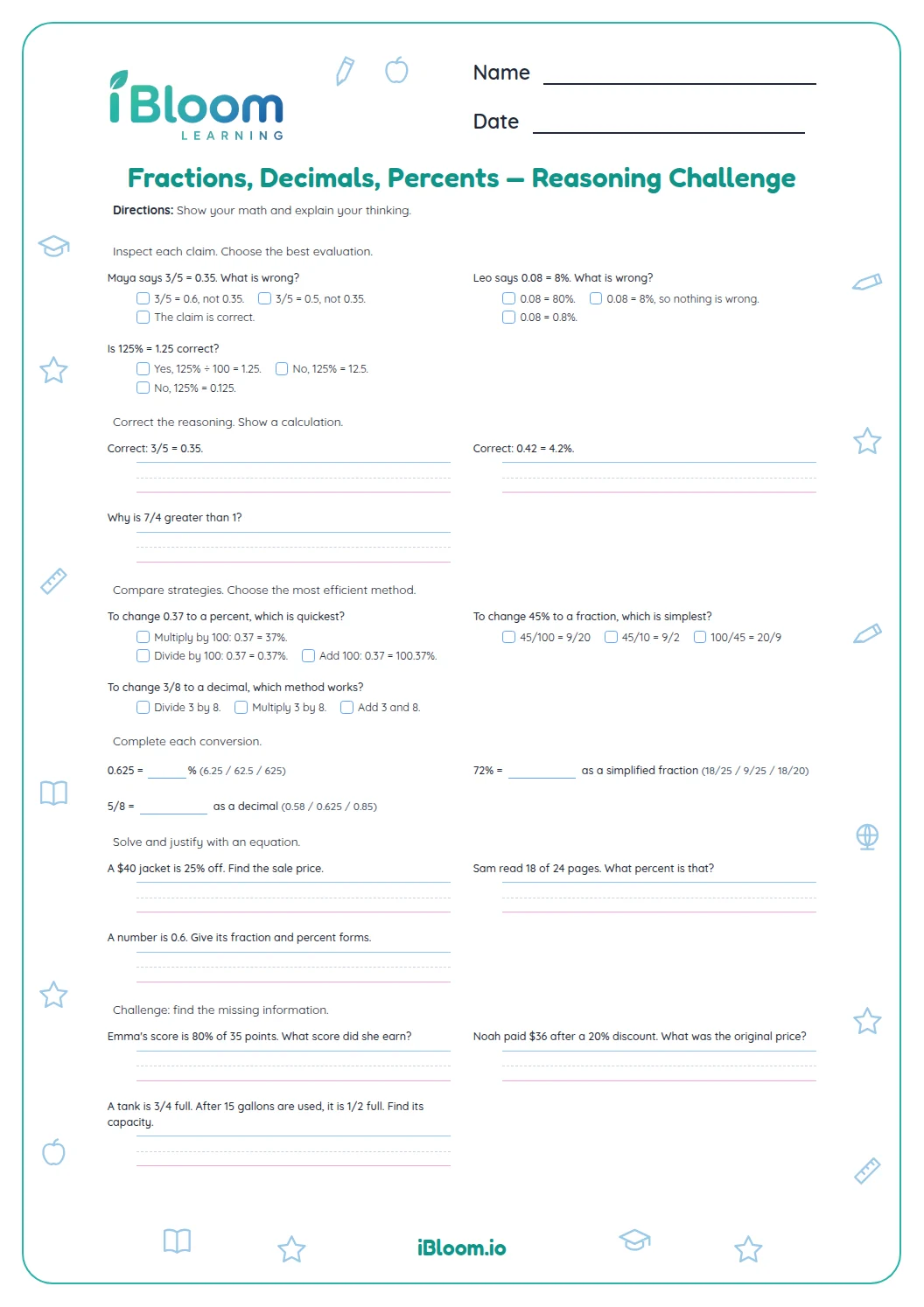
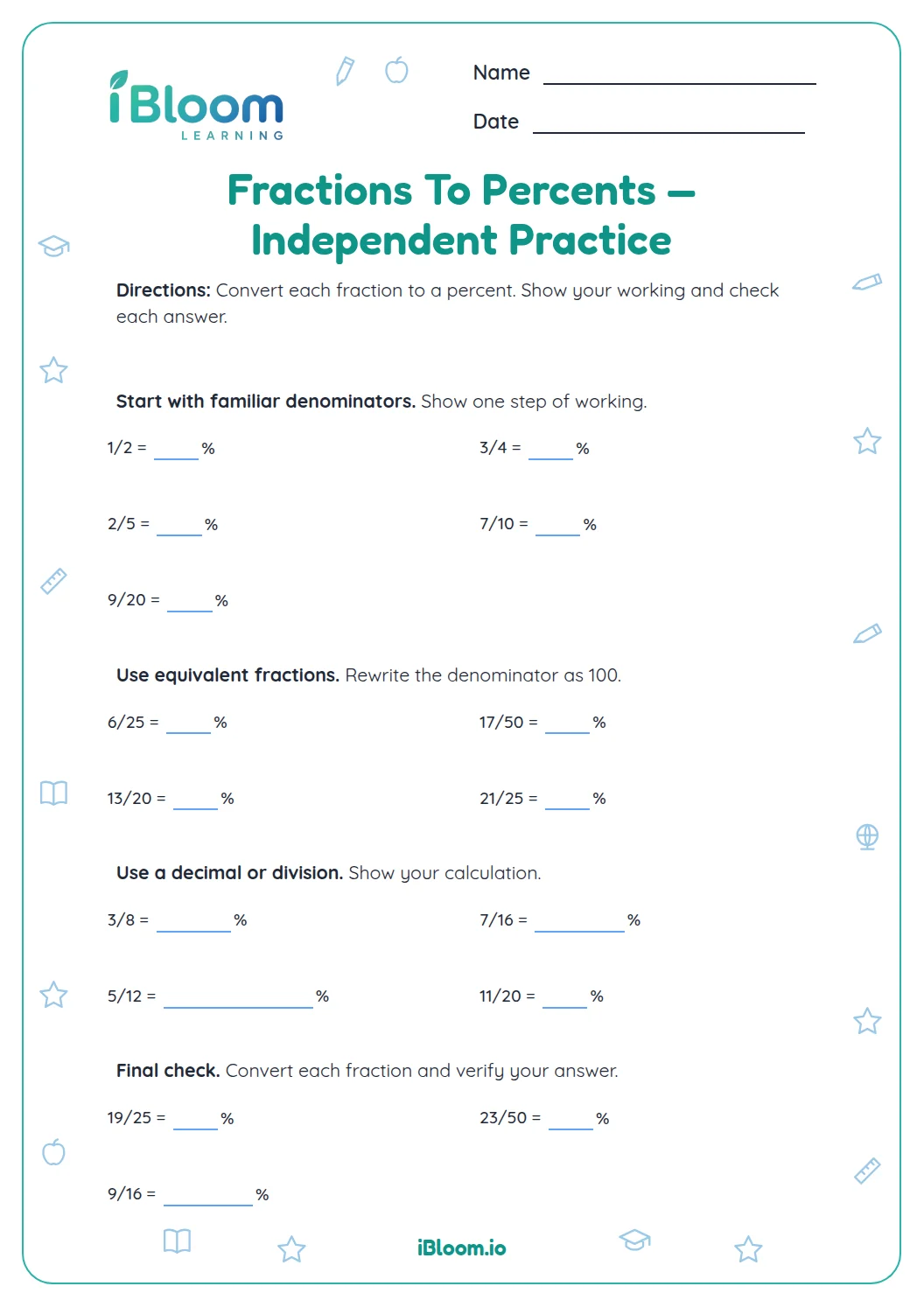
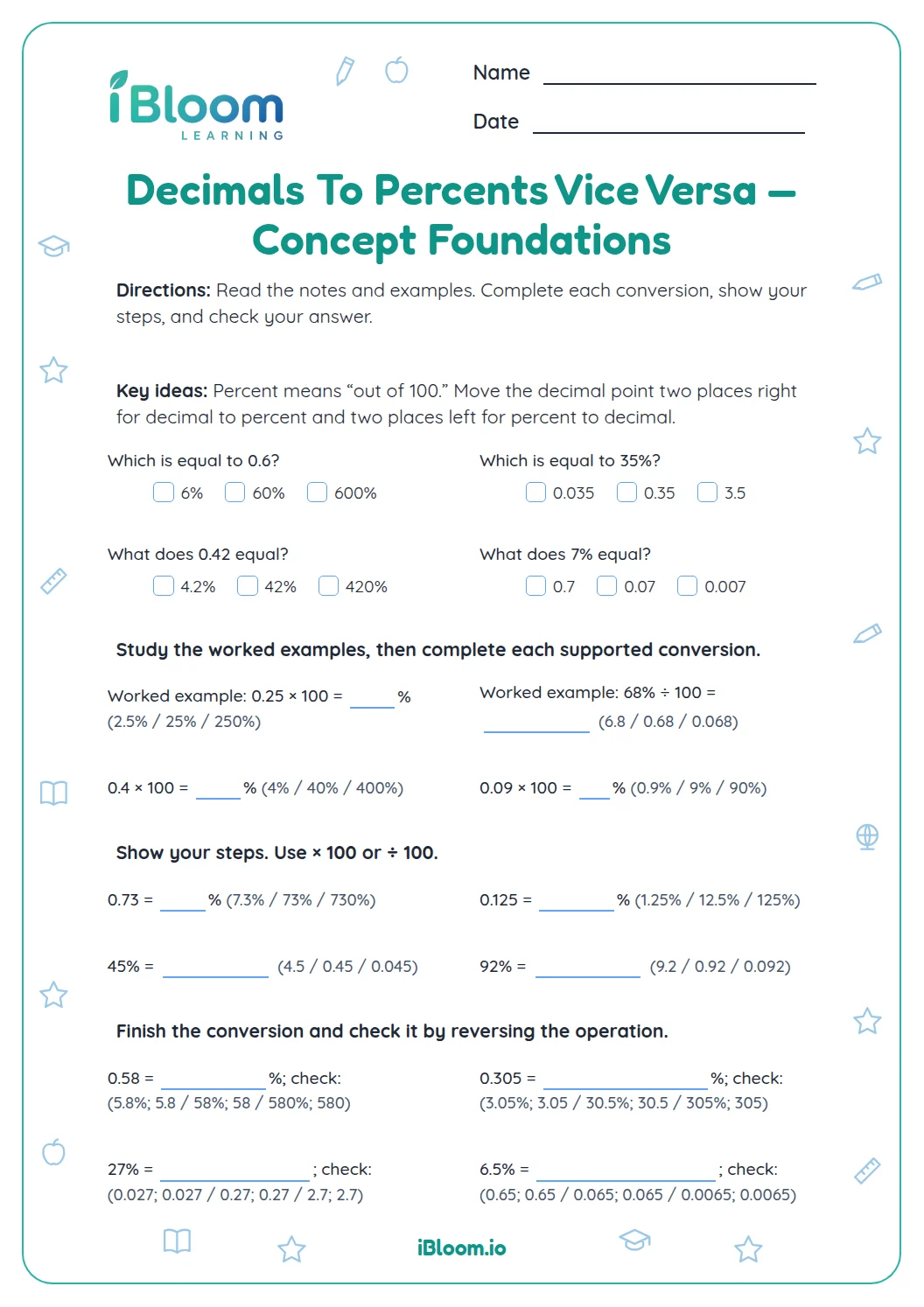
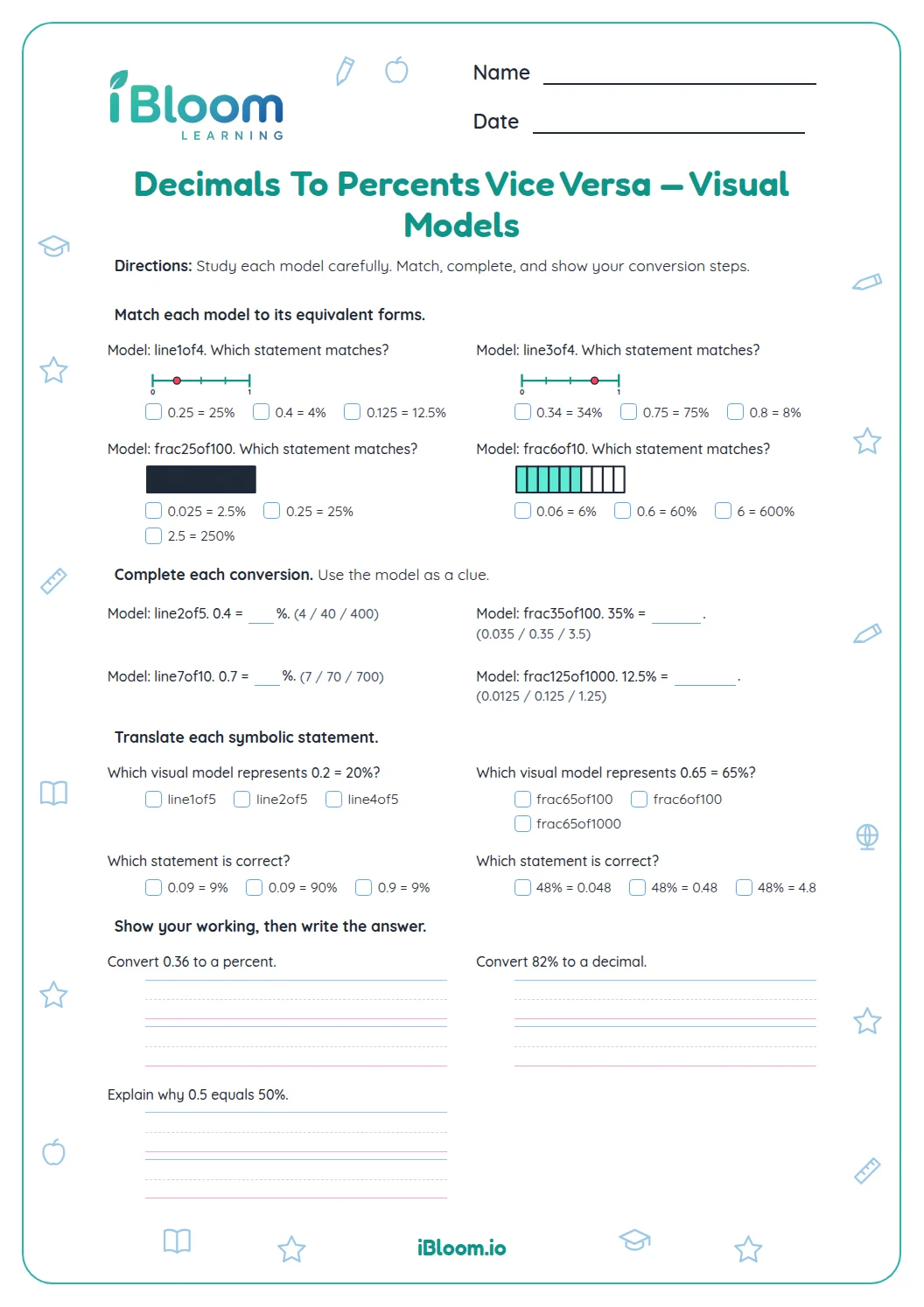
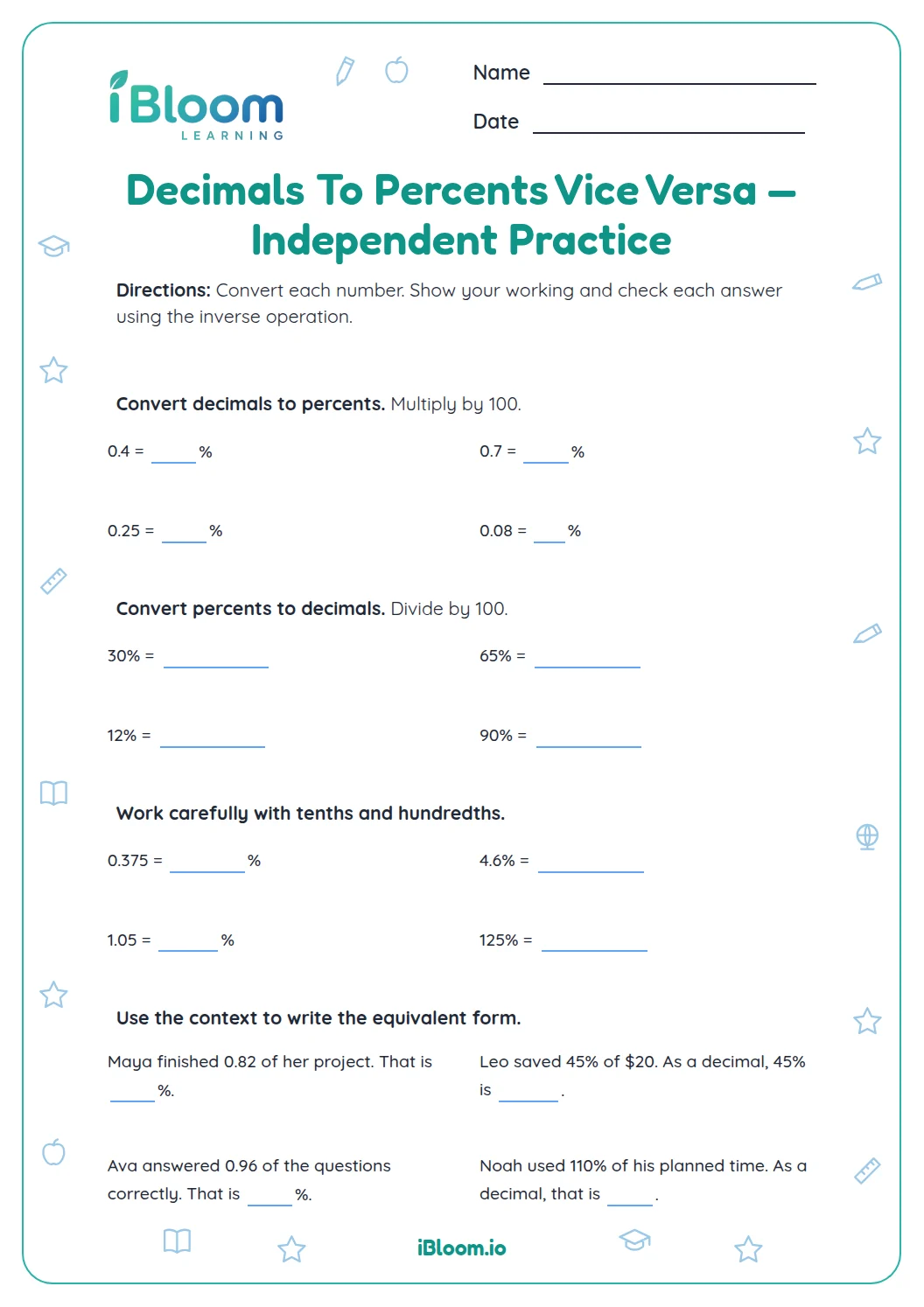
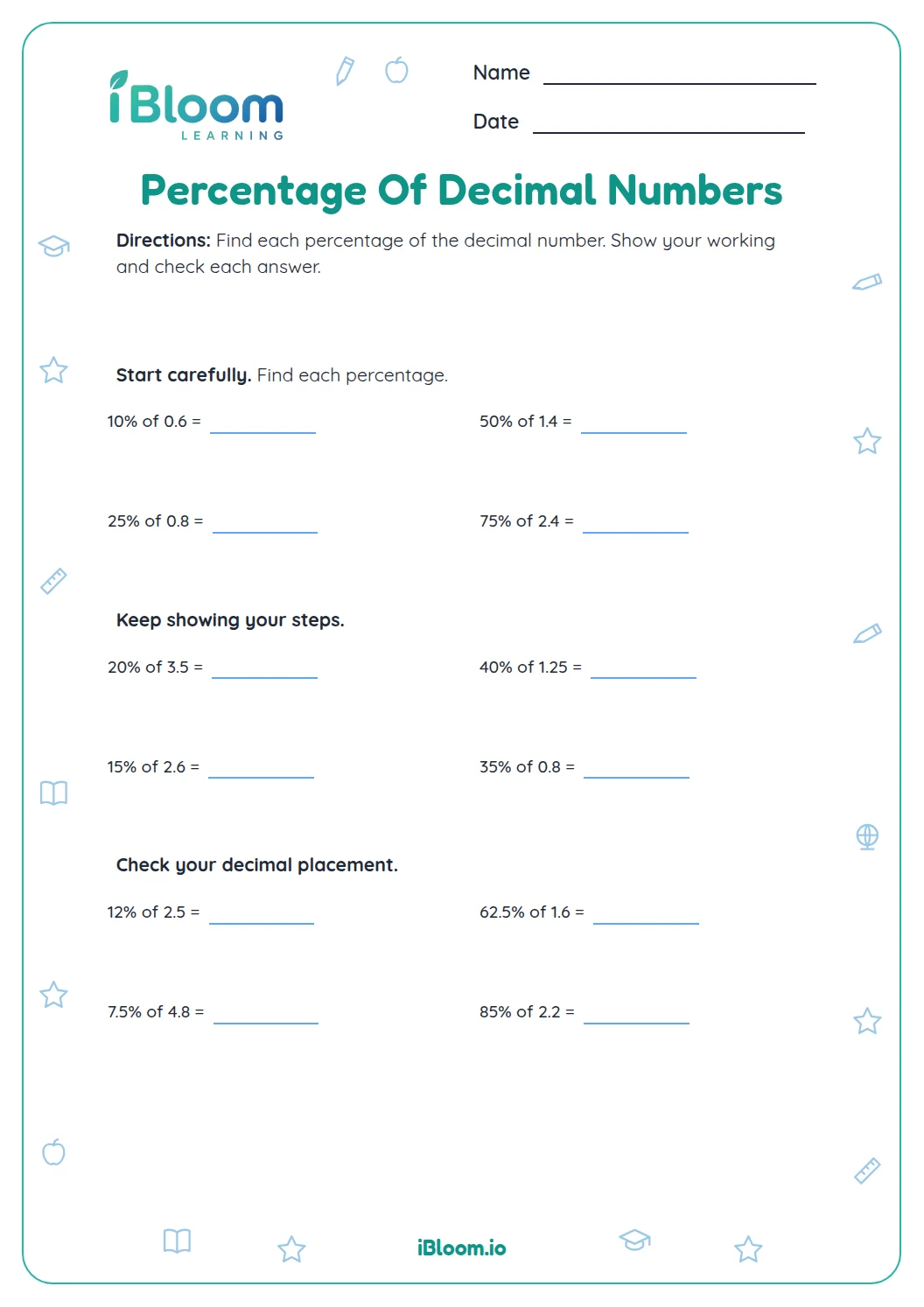
This Grade 6 worksheet uses eight shaded grids and fraction bars to connect fractions, decimals, and percents, followed by six independent conversions. The practice connects percent with a rate per 100, as described in CCSS 6.RP.A.3.c; the separate answer key lists each answer.
Aligned to 6.RP.A.3.c
What does each visual model tell me?
Eight questions use hundredths grids or fraction bars to make amounts visible. Six more questions ask students to convert without a drawing.
- 1Two of the five equal bar sections are shaded.
- 22/5 = 0.4 = 40%.
How do I convert a fraction or decimal to a percent?
A percent is a rate per 100. For fractions, make an equivalent fraction with denominator 100 when possible. For decimals, multiply by 100 to count hundredths, then write the percent sign.
How can I check that three forms are equivalent?
Convert each form to hundredths or a decimal and compare. For instance, 3/8 = 0.375, and 0.375 × 100 = 37.5%.
How to use this fractions, decimals, and percents worksheet
- 1For Question 1, count the shaded squares out of 100.
- 2Write the matching fraction or decimal when a number sentence asks for it.
- 3Convert a decimal to a percent by multiplying by 100.
- 4Convert a percent to hundredths by placing its number over 100.
- 5Check that the fraction, decimal, and percent name the same amount.
Common mistakes and quick fixes
The mistake
Writing 4% for 0.4
The fix
0.4 is four tenths, or 40 hundredths, so it is 40%.
The mistake
Moving a decimal the wrong direction
The fix
A decimal becomes a percent by multiplying its value by 100.
The mistake
Changing only one part of a fraction
The fix
Use an equivalent fraction so numerator and denominator are scaled by the same factor.
This worksheet gives students a concrete way to practice the skill.
Connect fraction, decimal, and percent models to rates per 100.
On this sheet:
Show the official wordingHide the official wording
Find a percent of a quantity as a rate per 100 (e.g., 30% of a quantity means 30/100 times the quantity); solve problems involving finding the whole, given a part and the percent.
What to practice next
Make more practice
Further reading
Questions parents and teachers ask
What does percent mean?
Percent means “per hundred.” Question 1 shows two of five equal parts shaded; 2/5 is 40/100, or 40%. The hundredths grid in Question 7 makes that per-hundred amount visible. This connects the percent sign with the phrase per hundred.
How do I turn a decimal into a percent?
Multiply the decimal by 100 and attach a percent sign. For example, 0.6 × 100 = 60, so 0.6 is 60%. Check by converting 60% back to 0.60; both forms name the same value and can be checked against each other.
Can a fraction have a denominator other than 100 and still be a percent?
Yes. A fraction can be converted to an equivalent fraction with denominator 100 when useful. For 2/5, multiply numerator and denominator by 20 to get 40/100, or 40%. That names 40 parts per hundred, the meaning of percent. The bar model on the sheet shows the same amount.
Why does 3/8 equal 37.5%?
Divide 3 by 8 to get 0.375, then multiply by 100 to express the amount per hundred. The result is 37.5%. The fraction and decimal forms give a reliable way to check the percent conversion in Question 11. It is also the value shown by 3/8.
What is a good way to check my conversions?
Translate each answer back to a familiar form. If 0.25 is written as 25%, divide 25 by 100 to return to 0.25. A matching fraction such as 1/4 gives another check that the value stayed the same after conversion. Try this check on one answer from the practice.