




About this worksheet
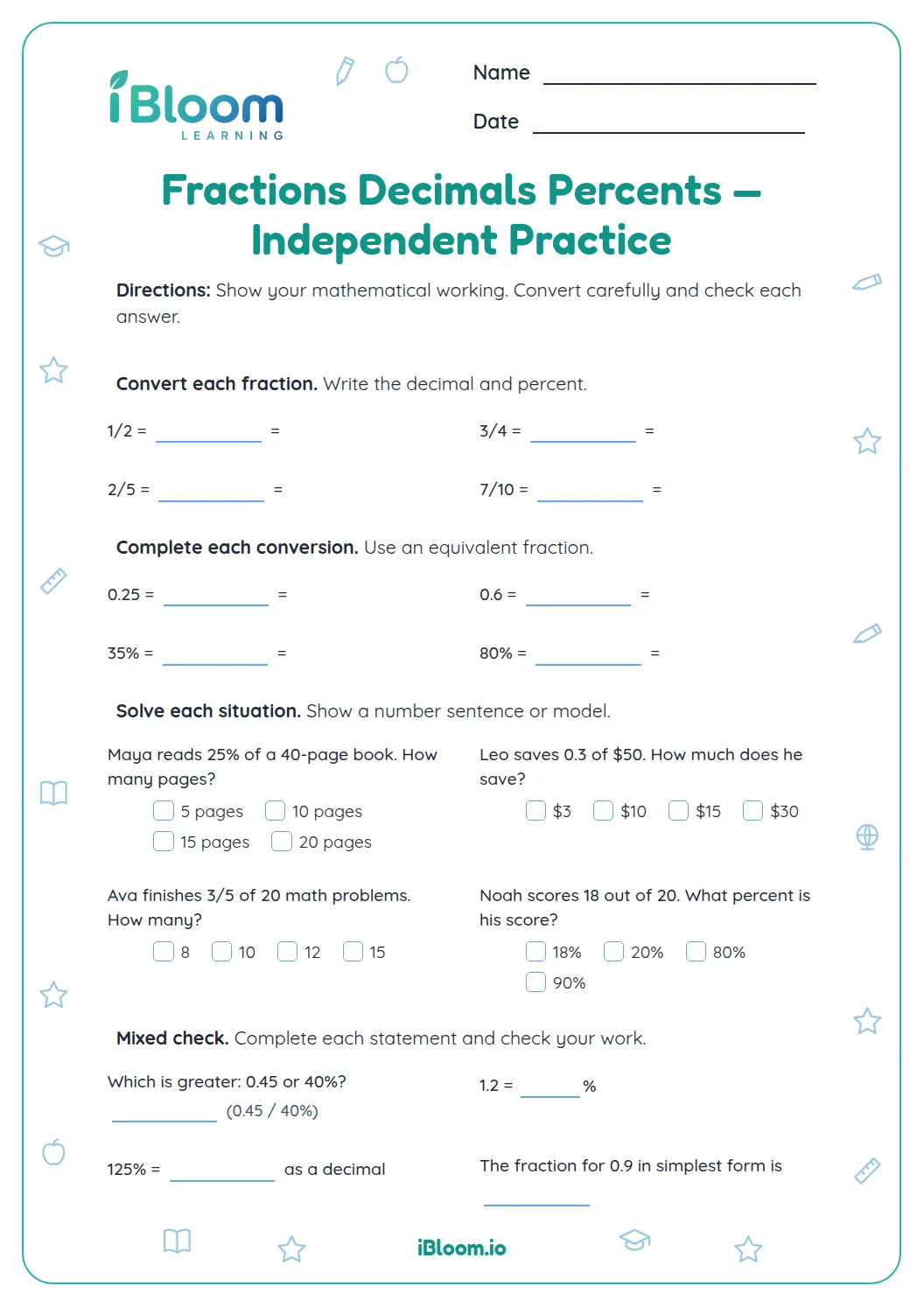
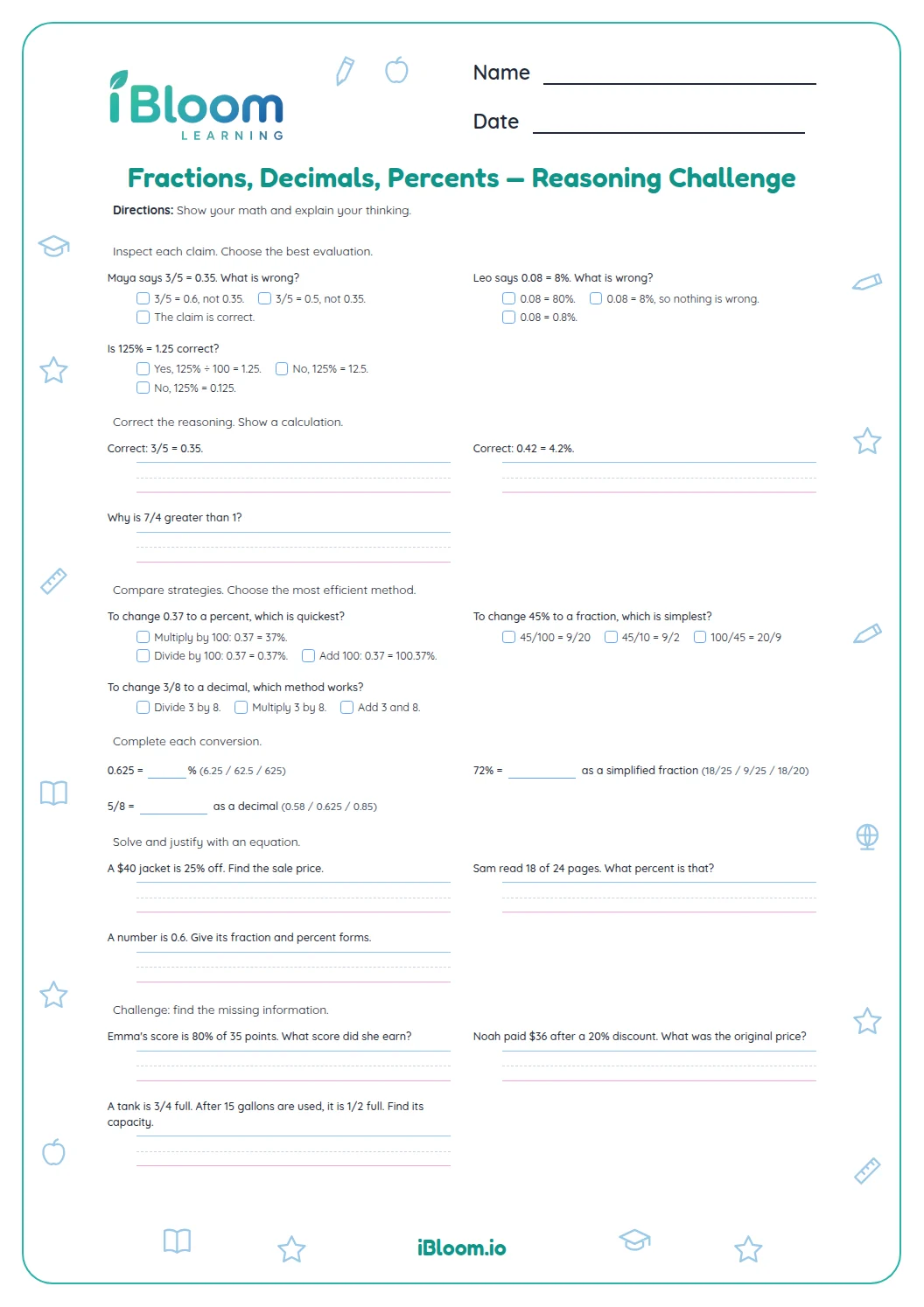
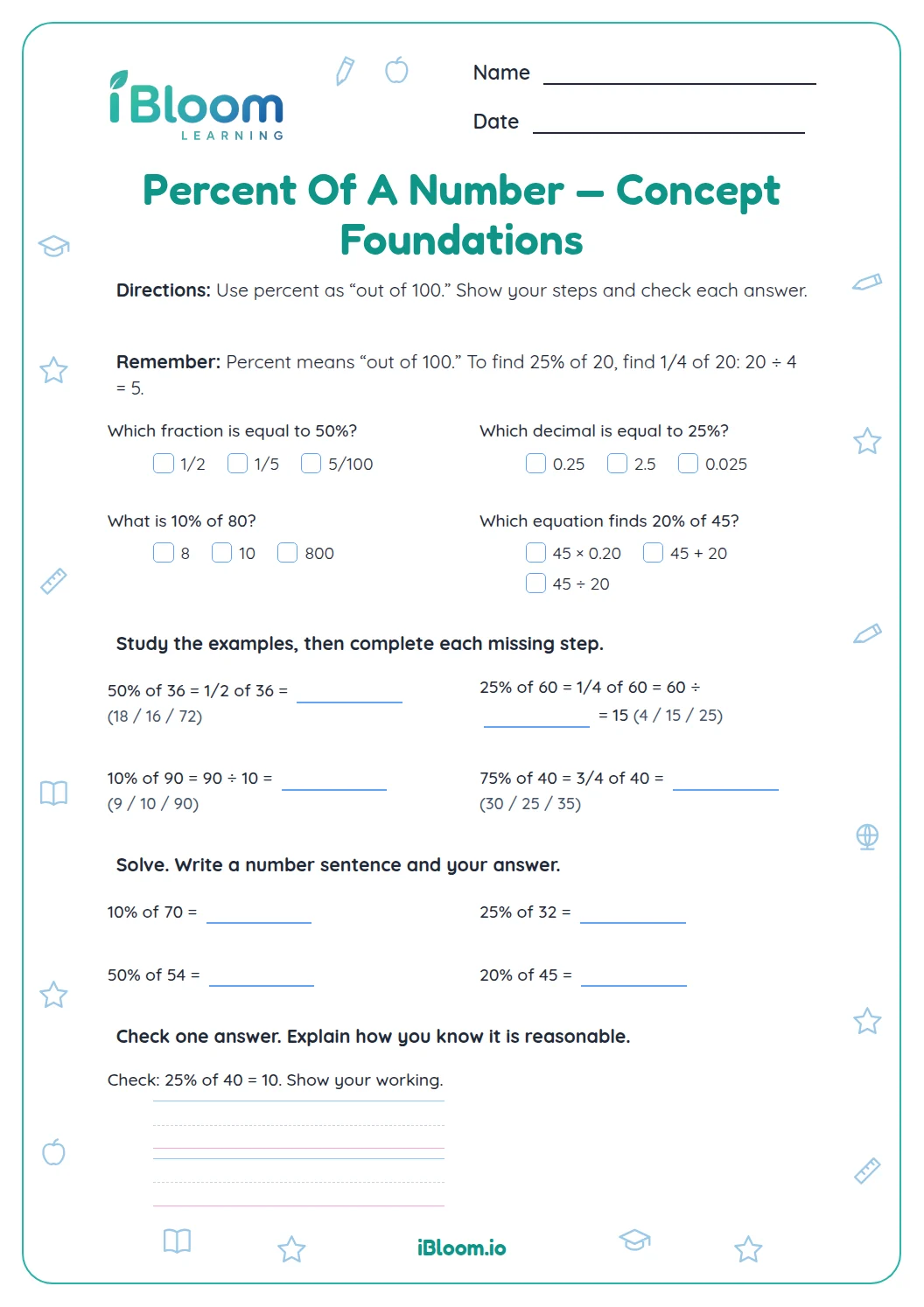
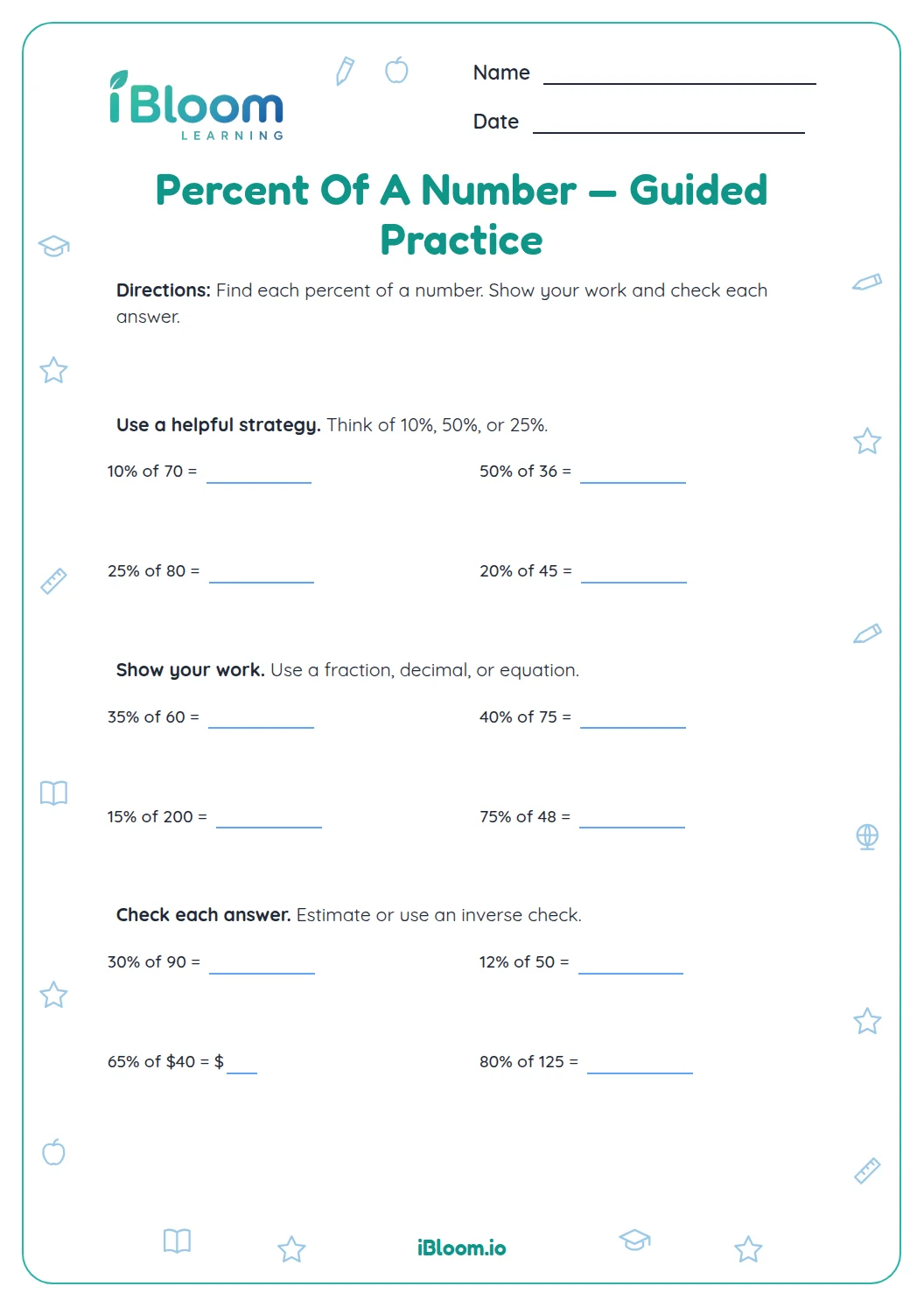
This Grade 6 worksheet puts fractions, decimals and percents into practical situations: discounts, portions, attendance, distances and survey counts. Students write an equation and solve each of 16 problems, including percent-of-a-quantity calculations and conversions among common representations. The separate answer key includes units and currency. The work practices CCSS 6.RP.A.3.c by finding a percent of a quantity and solving percent problems.
Aligned to 6.RP.A.3.c
How do you find a percent of a quantity?
A percent is a rate per 100. To find 25% of $48, multiply 48 by 25/100, or 0.25: the discount is $12. Keep the original unit in the answer, especially for money, distance and volume.
Question 2 uses this method for a $48 jacket. An estimate helps: 25% is one fourth, and one fourth of 48 is 12.
- 125% of $48
- 20.25 × 48 = 12
- 3The discount is $12.
How do fractions and decimals connect to percents?
A fraction such as 3/5 represents 0.6, or 60%, because 3 ÷ 5 = 0.6 and 0.6 × 100 = 60. In a story problem, identify the whole and the part before choosing the operation.
When the problem gives a portion of a whole, multiply the whole by that portion. When it gives the part and whole, divide to find the rate, then write it as a percent.
What situations are in the practice?
The 16 questions use school, shopping, recipes, distances and outdoor examples. They print across the worksheet with working space for equations; the answer key checks each number and unit.
How to use this worksheet
- 1Underline the whole amount and the percent or fraction in the story.
- 2Decide whether the question asks for a part, a whole or a rate.
- 3Write the percent as a decimal or fraction before calculating.
- 4Estimate the answer to check that its size makes sense.
- 5Label the answer with dollars, students, miles, ounces or another requested unit.
Common mistakes and quick fixes
The mistake
Multiplying by 25 instead of 0.25 to find 25%.
The fix
Write 25% as 25/100 or 0.25 before multiplying.
The mistake
Reporting 12 for a $48 discount without the money unit.
The fix
Reread the question and label the result in dollars.
The mistake
Treating the part as the whole in a percent question.
The fix
Name the total first; the percent is the part compared with that total.
Common Core alignment
This page connects the worksheet practice to the grade-level skills below.
Find a percent of a quantity as a rate per 100.
On this sheet: Discount, portion and percent-of-quantity situations require multiplying by a percent.
Show the official wordingHide the official wording
Find a percent of a quantity as a rate per 100 (e.g., 30% of a quantity means 30/100 times the quantity); solve problems involving finding the whole, given a part and the percent.
What to practice next
Make more practice
Further reading
Questions parents and teachers ask
How do I find 25% of $48?
Write 25% as 0.25 or 1/4, then multiply by $48. One fourth of 48 is 12, so the discount is $12. This method works for the other percent-of-a-quantity questions too. Each amount is tied to a real situation, so keep its unit in your answer.
Should students show their work?
Yes. Each problem has a blank for the answer, and students can write an equation beside it. Showing the percent as a decimal or fraction makes it easier to check the operation and catch a misplaced decimal point.
Why are units included in the answer key?
Units connect a calculation to its situation. A result of 18 is clearer as 18 students, and 1.5 is clearer as 1.5 liters. Currency answers keep the dollar sign so the amount remains clear. Always use the unit named in the question.
What is the difference between a part and a percent?
The part is an amount, such as 18 students; the percent compares it with the whole. If 18 of 30 students did something, divide 18 by 30 to get 0.6, or 60% of the class. The total count is the whole.
How many questions and pages are included?
The printable has 16 real-world problems across two worksheet pages, plus a separate answer key. The situations ask students to find parts, discounts, rates and portions using fractions, decimals and percents. Each key answer includes the unit or currency requested.