




About this worksheet
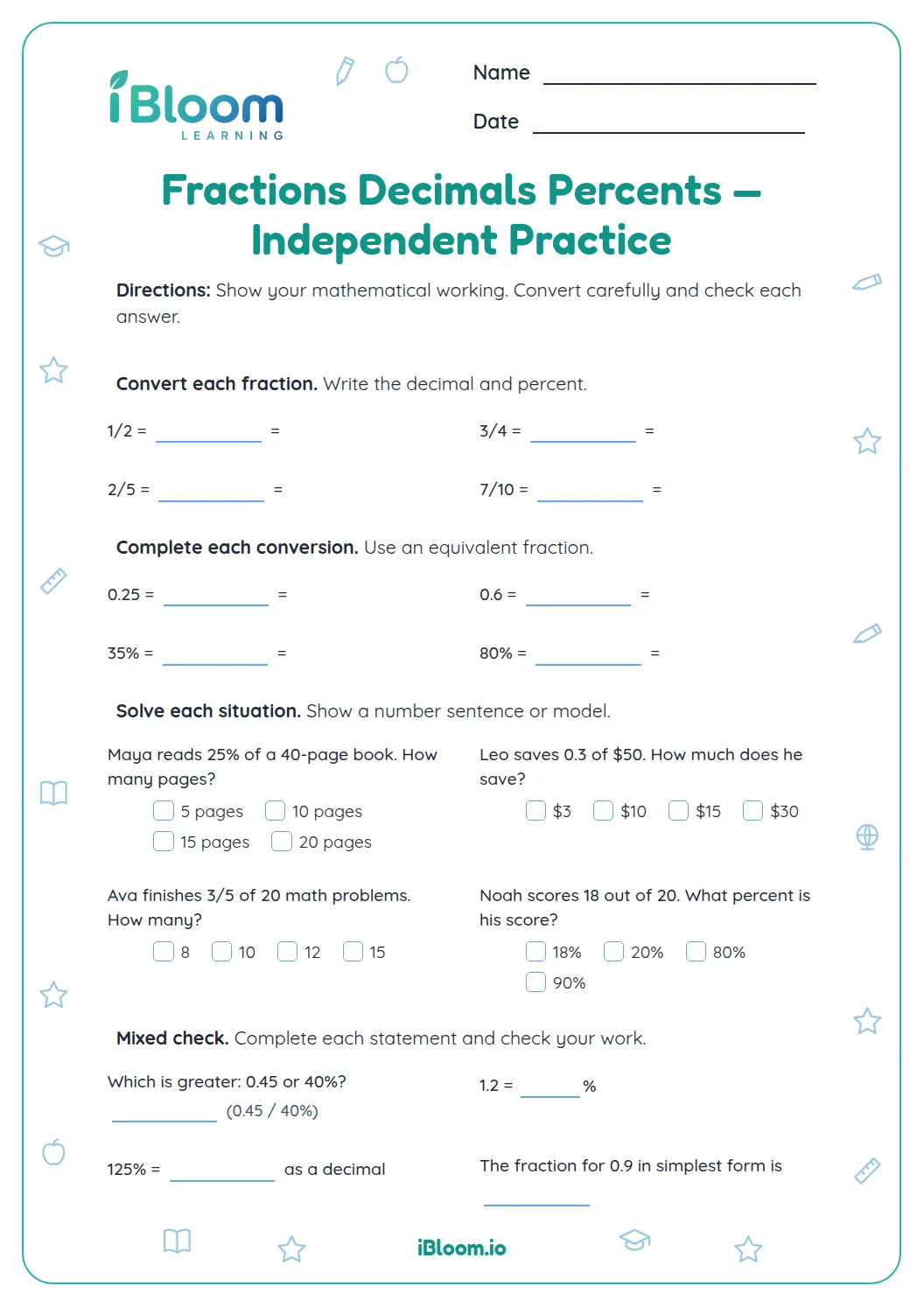
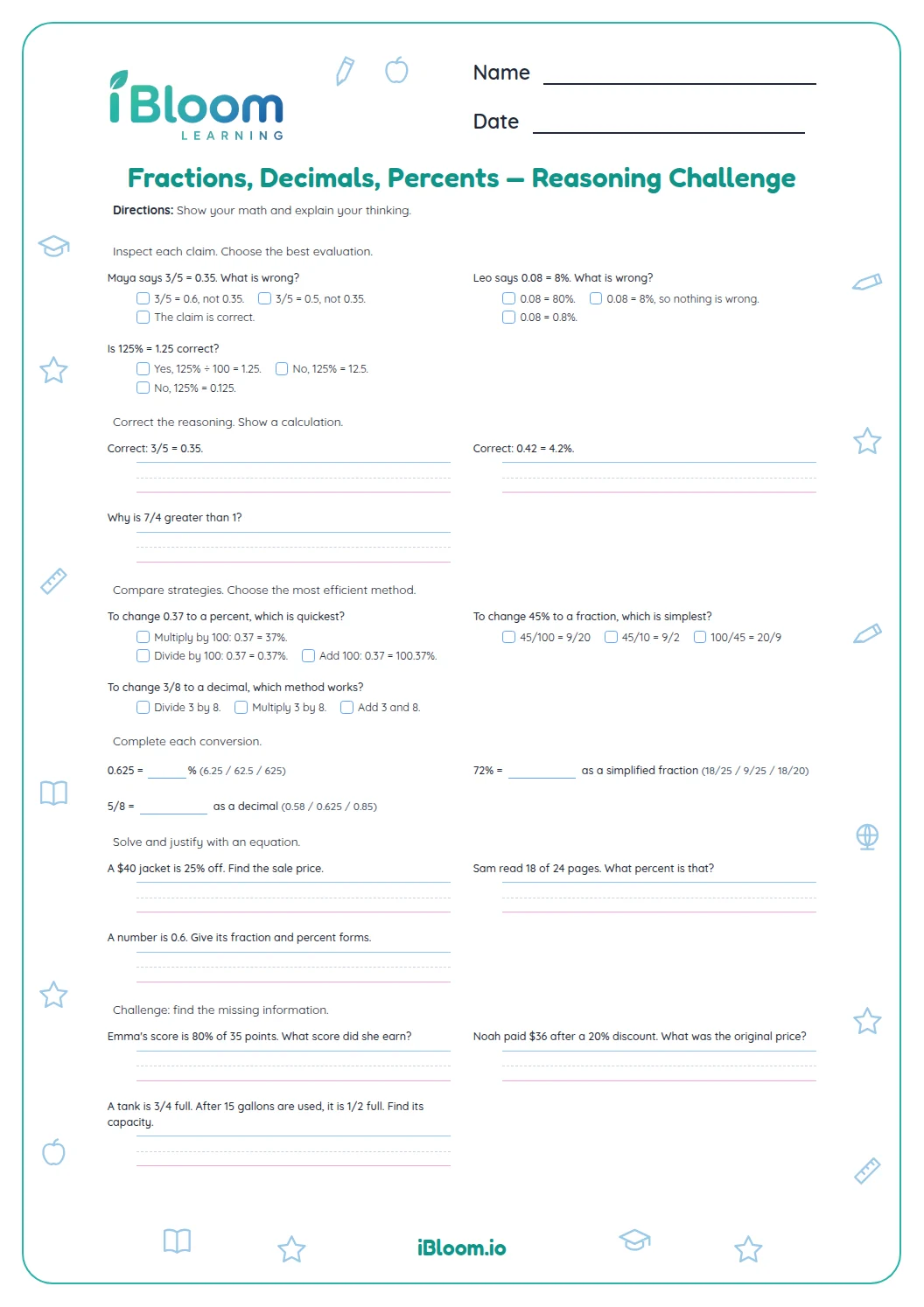
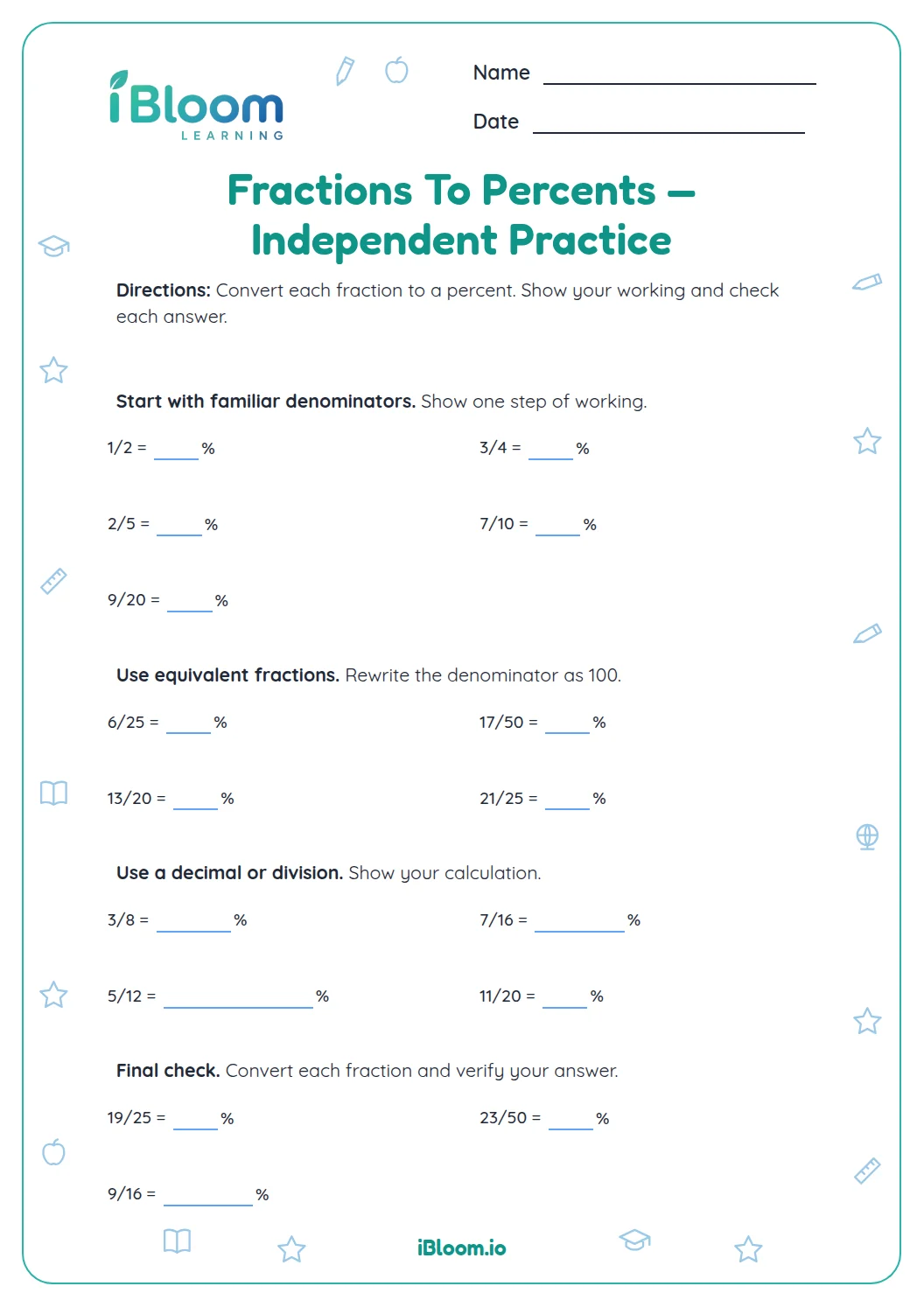
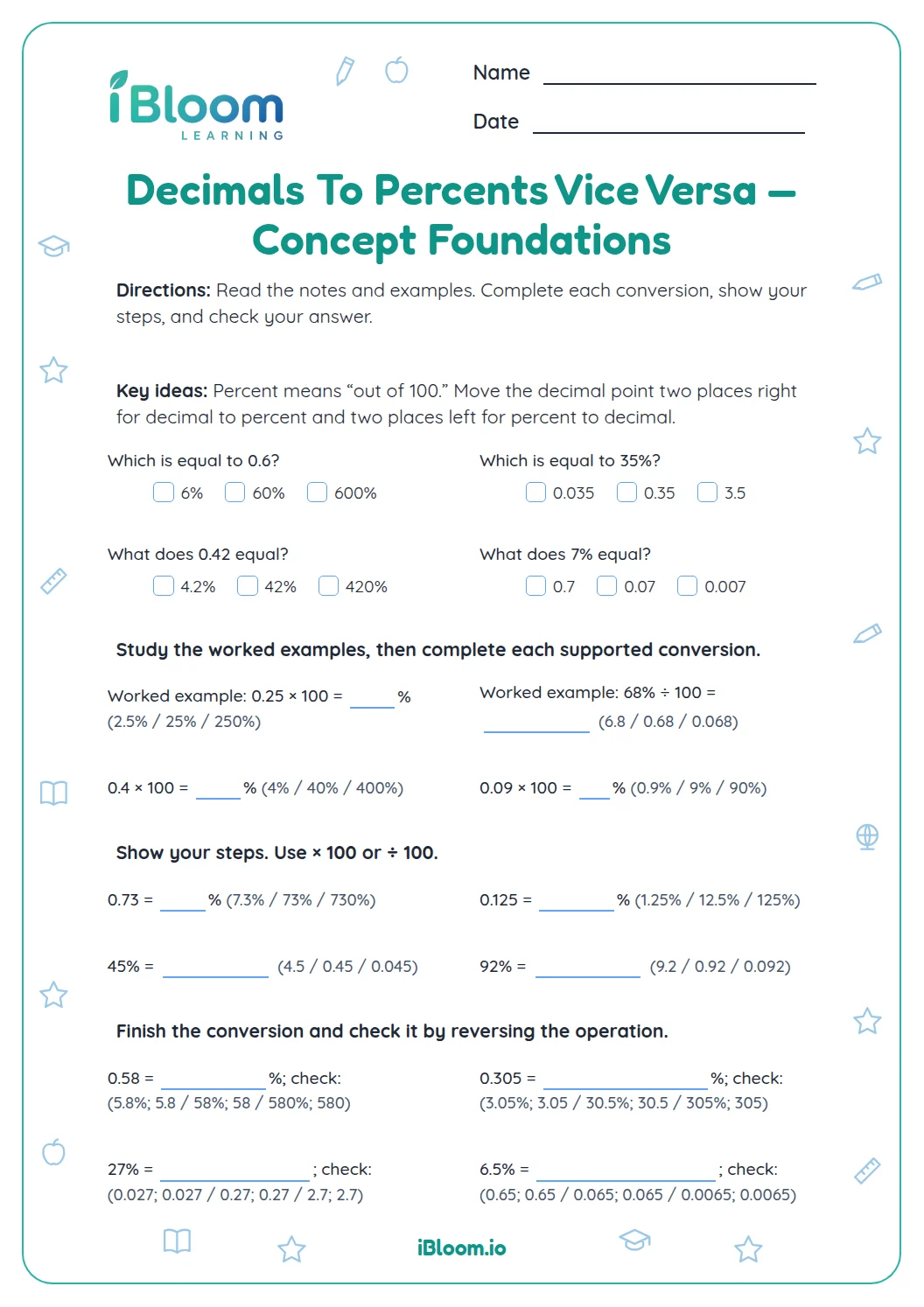
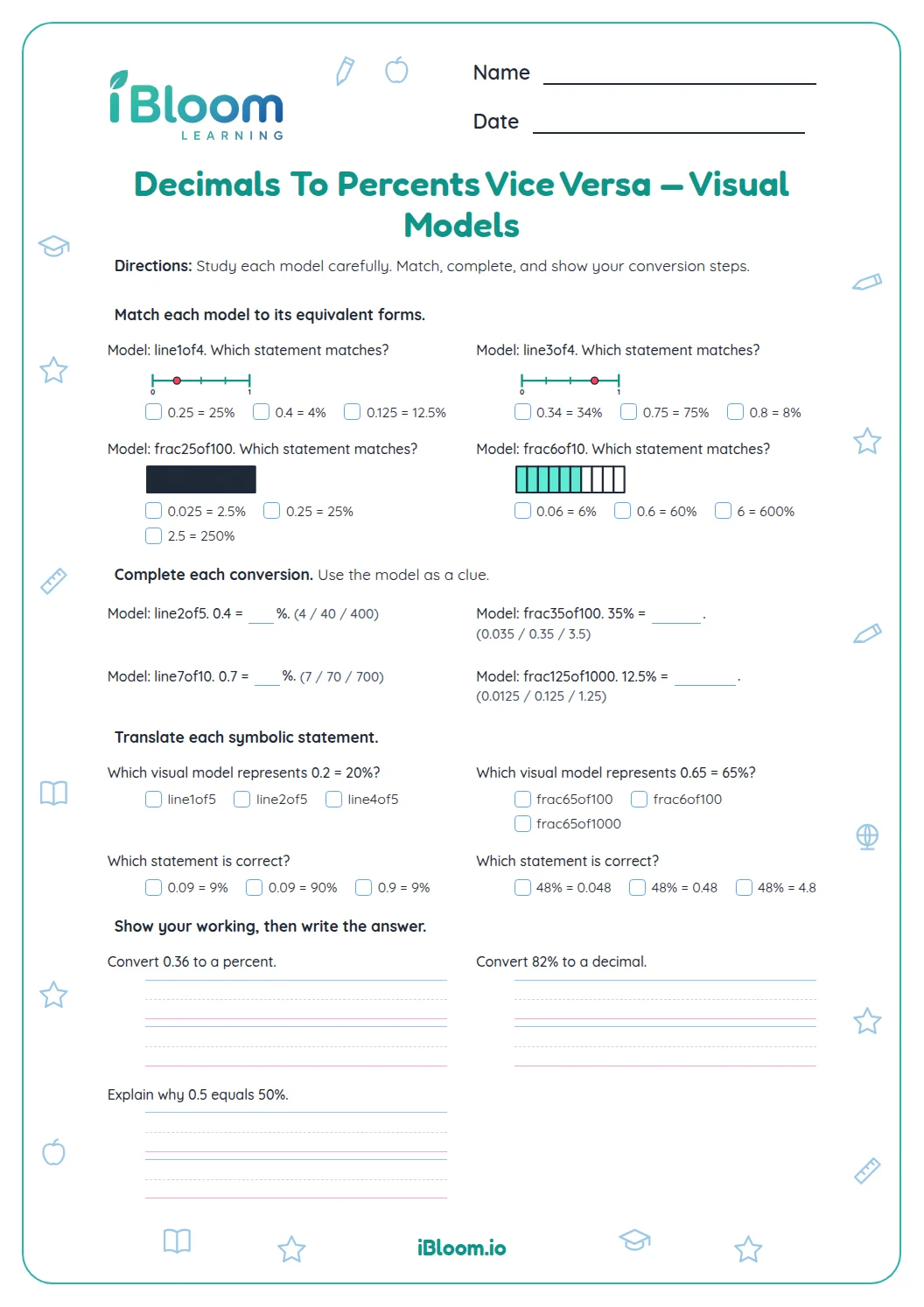
This Grade 6 worksheet connects fractions, decimals and percents in 14 questions. Students begin with three shaded models, complete six conversion items, and apply the relationships to five short percent situations. The answer key lists equivalent values and results. The practice supports CCSS 6.RP.A.3.
Aligned to 6.RP.A.3
How are fractions, decimals and percents connected?
Fourteen questions connect shaded models with equivalent fraction, decimal and percent forms. Students begin by reading three shaded models, then complete conversions and solve percent situations.
The first five questions use shaded models. The next five ask for a missing equivalent value, and the final five use the relationships in situations.
- Part A: read shaded hundredths and tenths
- Part B: convert among fraction, decimal and percent forms
How can a hundredths grid show a percent?
Each small square is one hundredth of the whole. If 38 of 100 squares are shaded, the shaded amount is 38/100, 0.38 or 38%.
- 138 shaded squares out of 100 → 38/100
- 238/100 = 0.38 = 38%
How do you find a percent of a quantity?
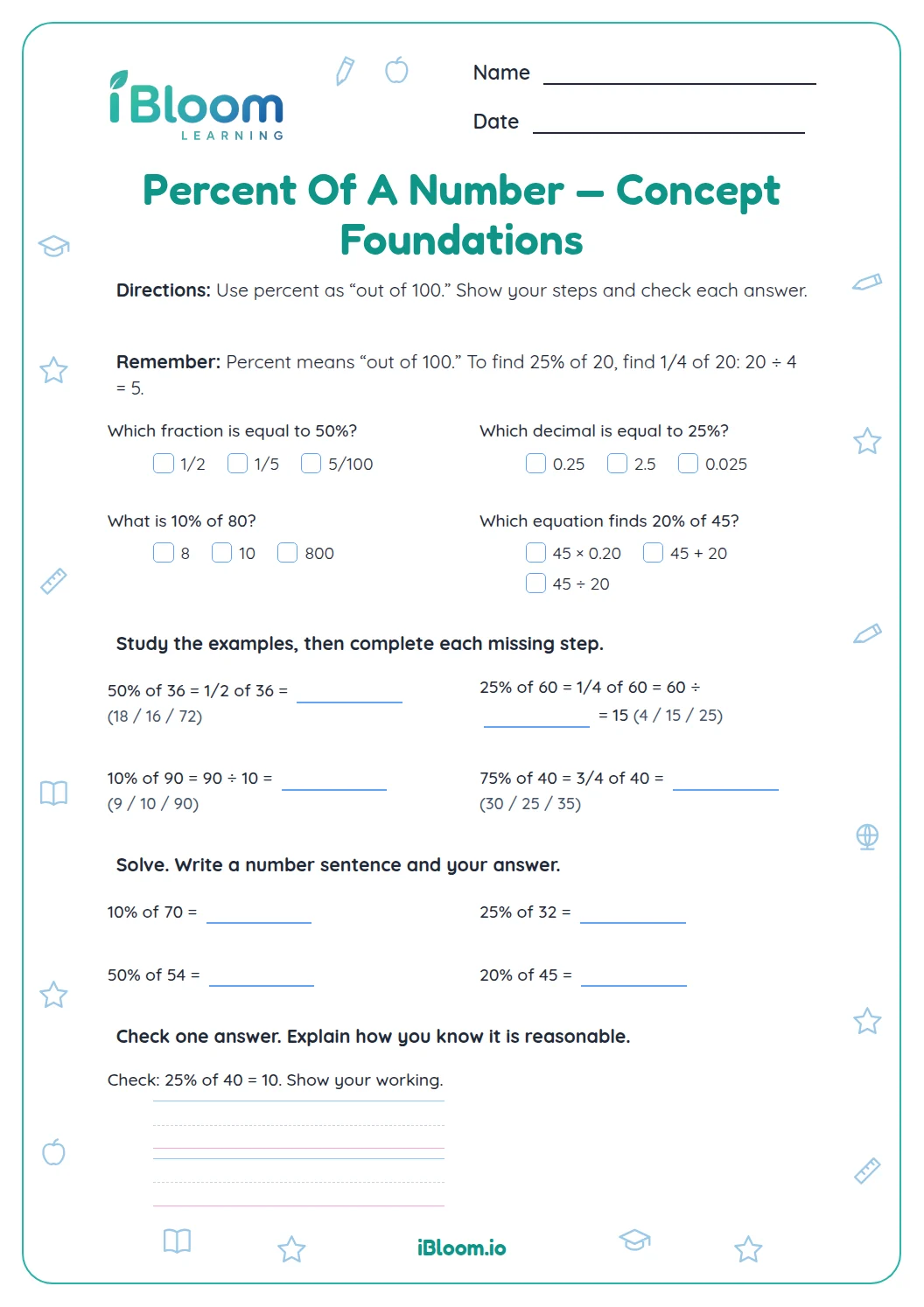
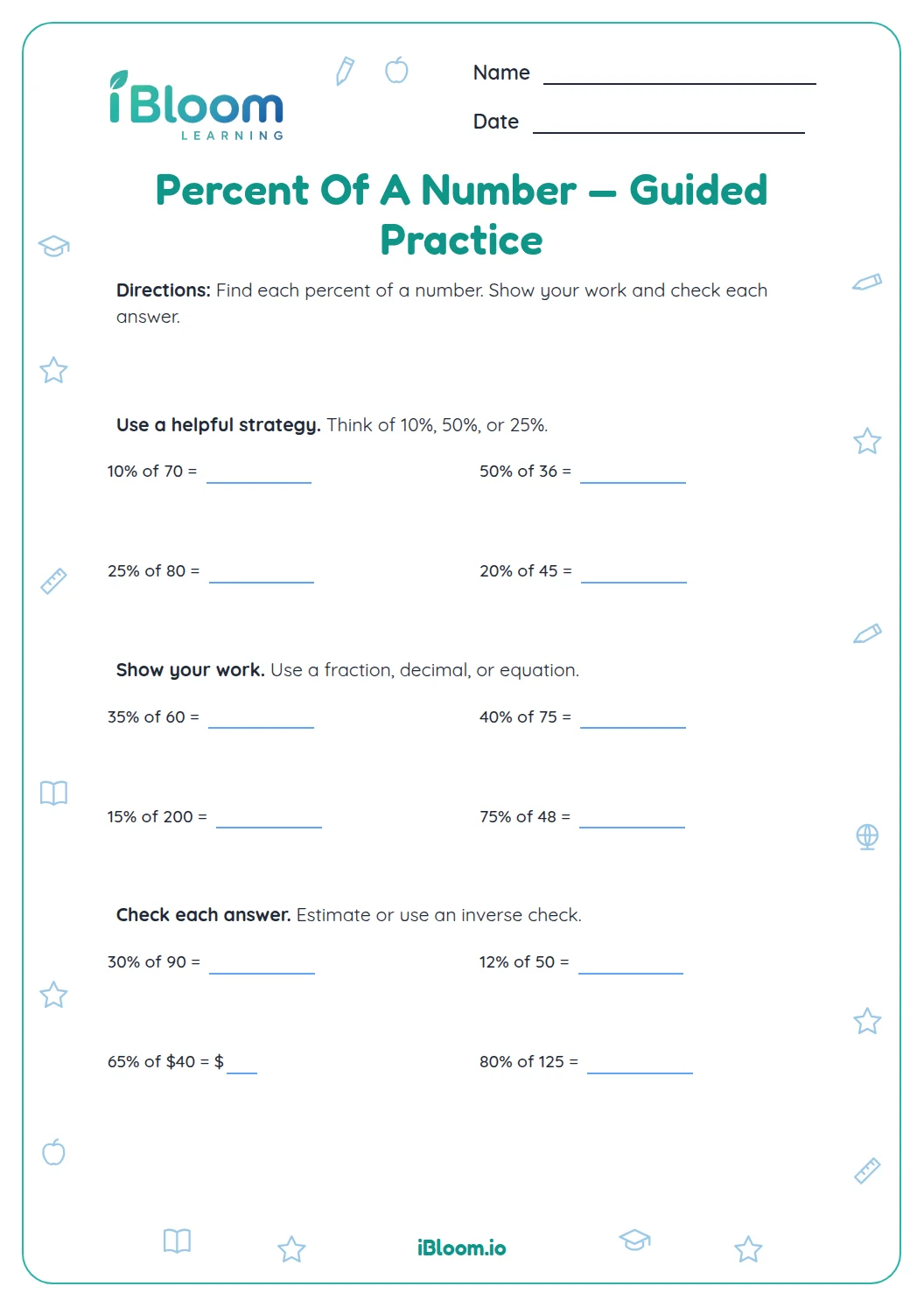
Write the percent as a fraction with denominator 100, then multiply by the quantity. For 25% of 80, compute 25/100 × 80 = 20. A quick estimate helps check the result: one quarter of 80 is 20.
How to use this worksheet
- 1Read the model or the full situation.
- 2Write a percent as a fraction out of 100.
- 3Use equivalent fractions to simplify when useful.
- 4Move between decimal and percent by comparing hundredths.
- 5For a percent of a quantity, multiply by the percent as a decimal or fraction.
- 6Check whether the answer size makes sense.
Common mistakes and quick fixes
The mistake
Writing 0.4 as 4%.
The fix
Remember that 0.4 is four tenths, or 40 hundredths, so it is 40%.
The mistake
Reading 25 shaded squares as 2.5%.
The fix
A hundredths grid has 100 equal squares; 25 shaded squares represent 25%.
The mistake
Finding 25% of 80 by adding 25 and 80.
The fix
“Of” means multiply: 25/100 × 80 = 20.
Common Core alignment
This worksheet practices the math described by this standard.
Use ratio and rate reasoning to solve real-world and mathematical problems.
On this sheet: Students connect equivalent percent, fraction and decimal values, then solve percent situations.
Show the official wordingHide the official wording
Use ratio and rate reasoning to solve real-world and mathematical problems, e.g., by reasoning about tables of equivalent ratios, tape diagrams, double number line diagrams, or equations.
What to practice next
Make more practice
Further reading
Questions parents and teachers ask
Why does a percent have a denominator of 100?
Percent means “per hundred.” So 38% means 38 out of 100, or 38/100. The decimal form is 0.38 because 38 hundredths is written in the hundredths place. The shaded grid in Part A helps connect these notations. This is why percent, decimal and fraction notation can all name the same amount, even though the symbols look different.
How do I change a decimal to a percent?
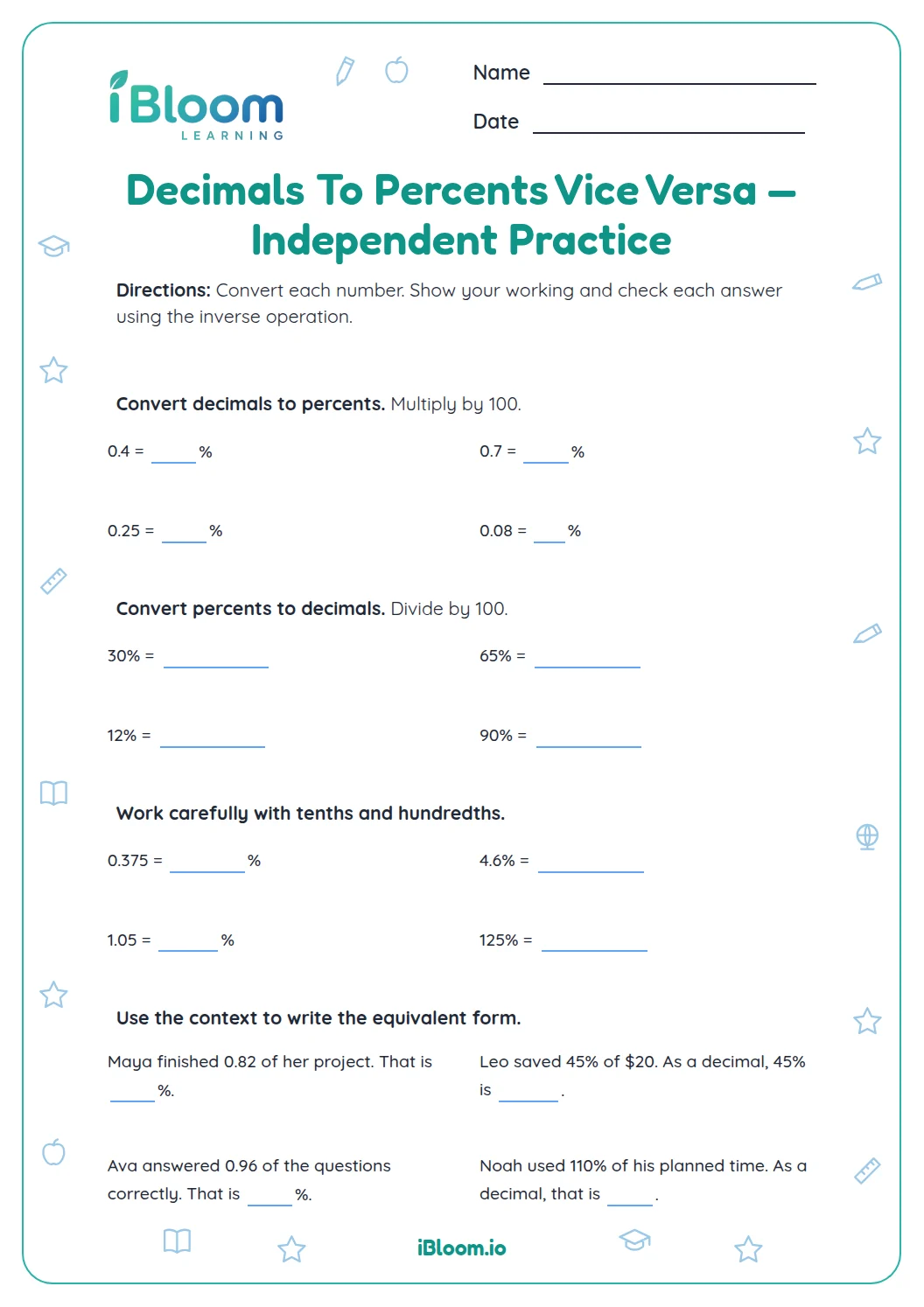
Think of the decimal as a number of hundredths, then name that many percent. For example, 0.62 is 62 hundredths, so it equals 62%. The missing-value questions in Part B give practice with this relationship. For values above one whole, the same place-value idea still applies: 125% is 1.25 as a decimal.
How does the worksheet use visual models?
Part A includes shaded tenths strips and hundredths grids. Students identify the decimal, fraction or percent represented by each model before moving to number conversions and real-world questions. Point out the number of shaded parts and the total equal parts before naming the model in another form.
How can I find 25% of a number?
Twenty-five percent is one fourth because 25/100 simplifies to 1/4. Divide the number by 4, or multiply it by 0.25. For example, 25% of 80 is 20. For a quick check, find one fourth of the quantity and compare it with the computed result.
What is included with the printable?
The worksheet has 15 questions in two parts and a separate answer key. Students first read visual models, then convert forms and finish with percent situations. Students may use the key after attempting each part, then redo a missed conversion without looking at the answer.