



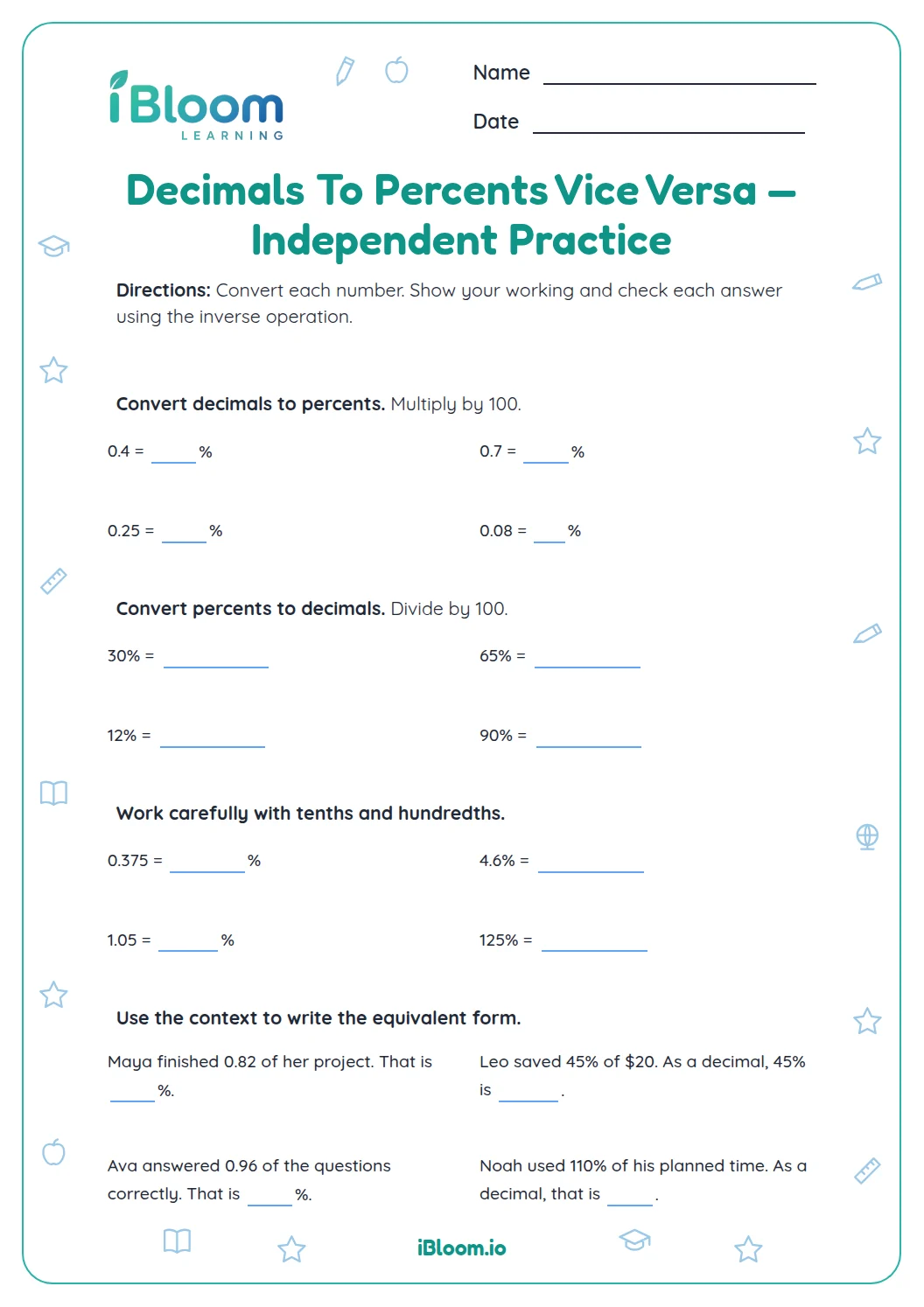
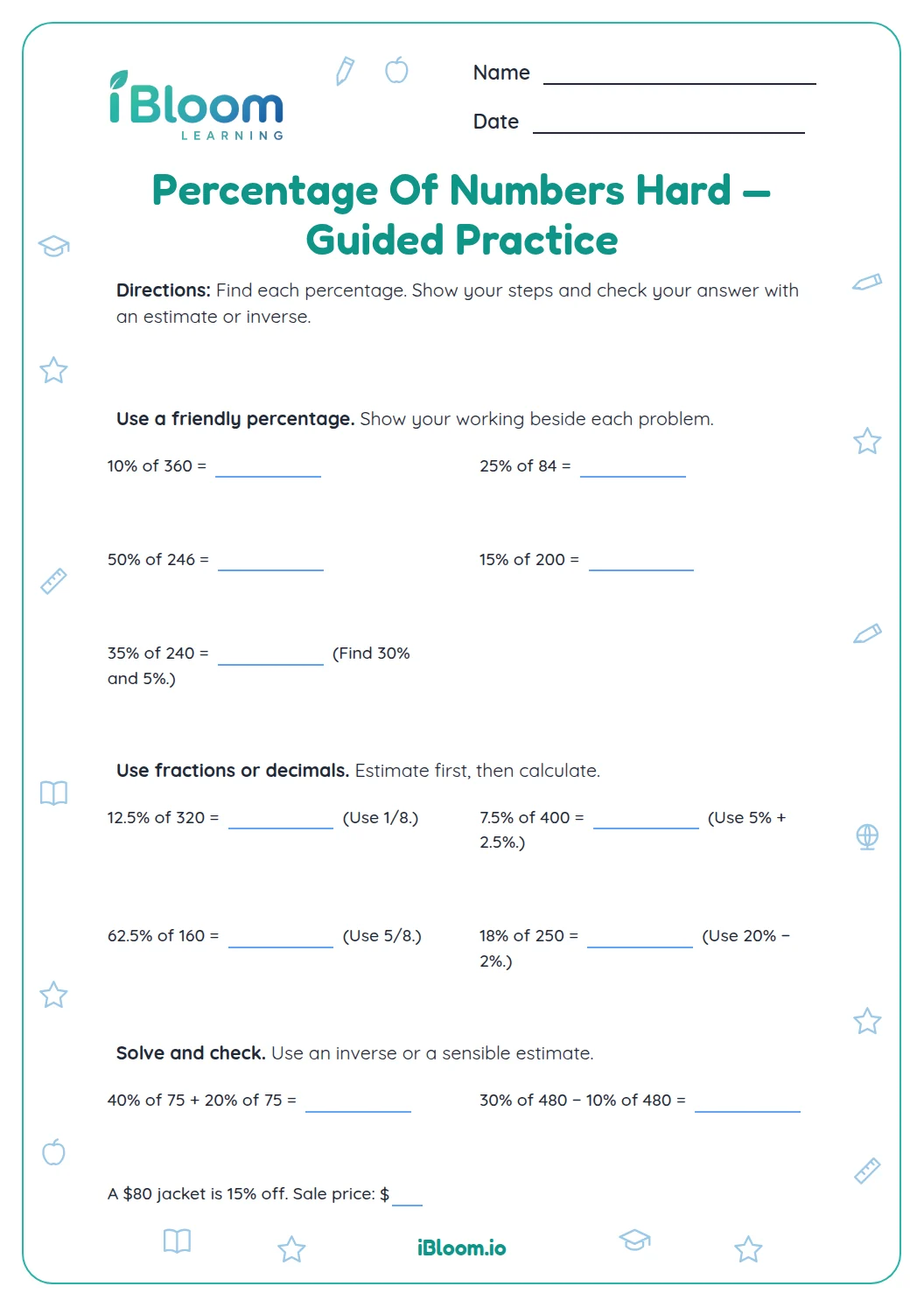

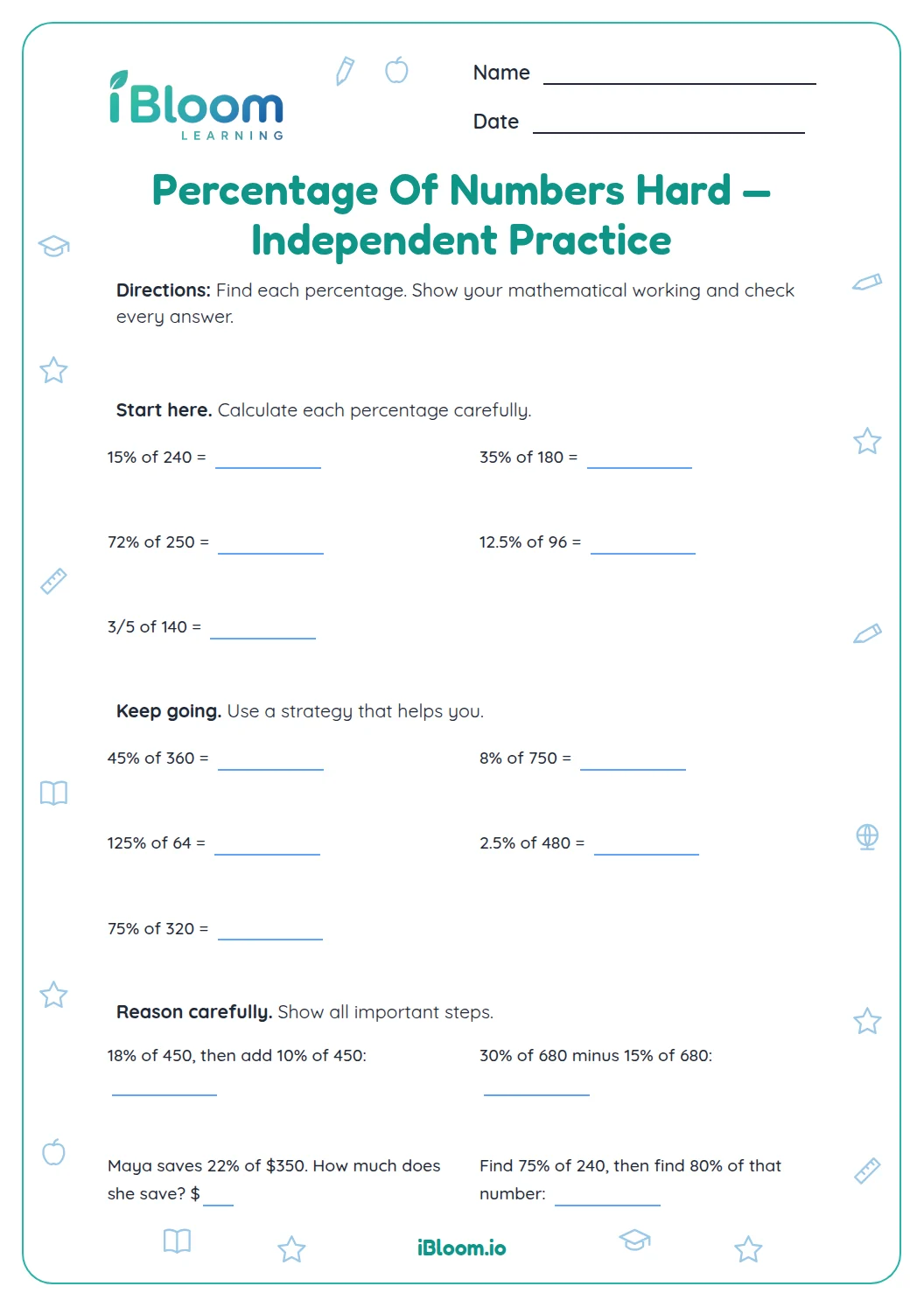
About this worksheet
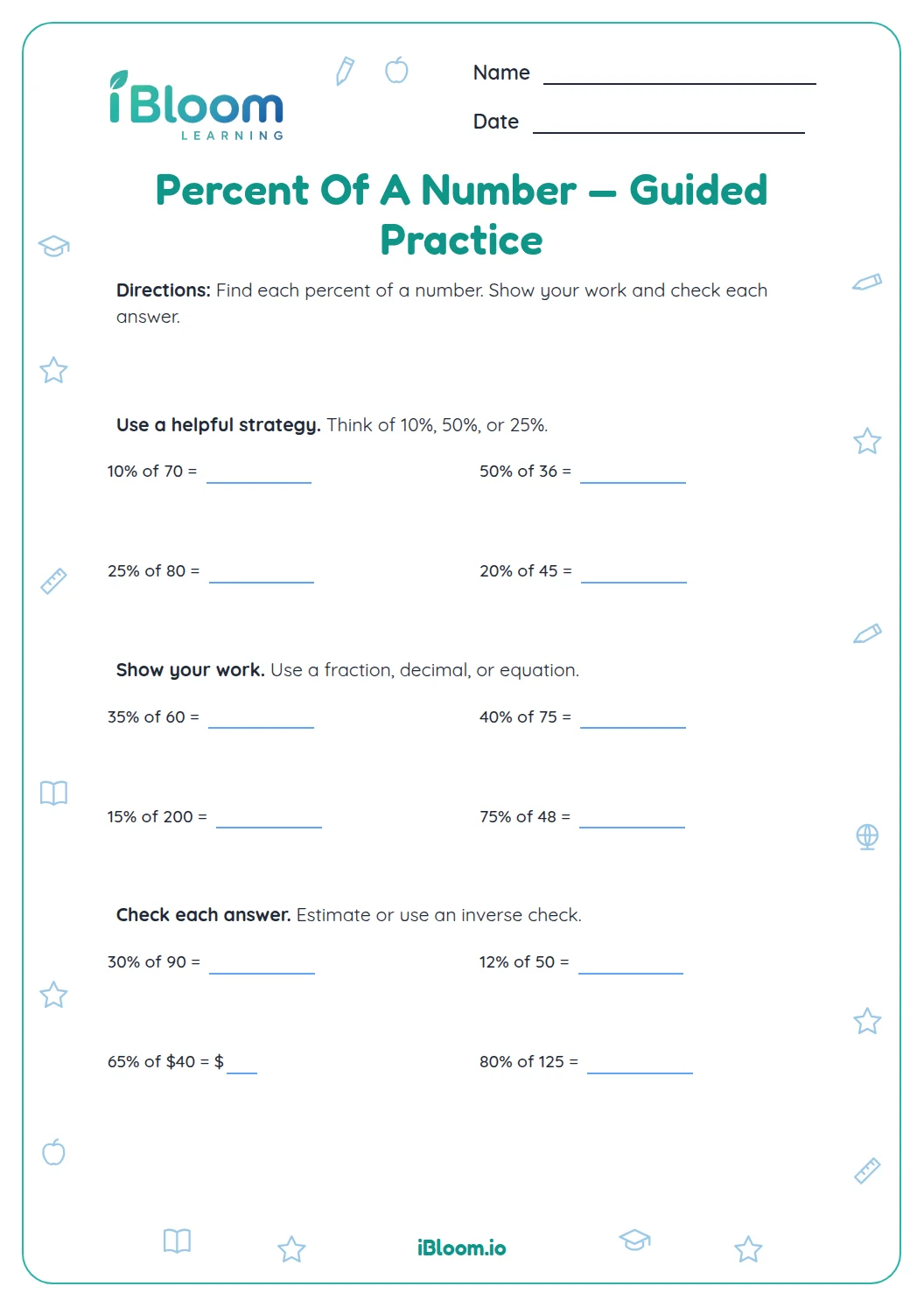
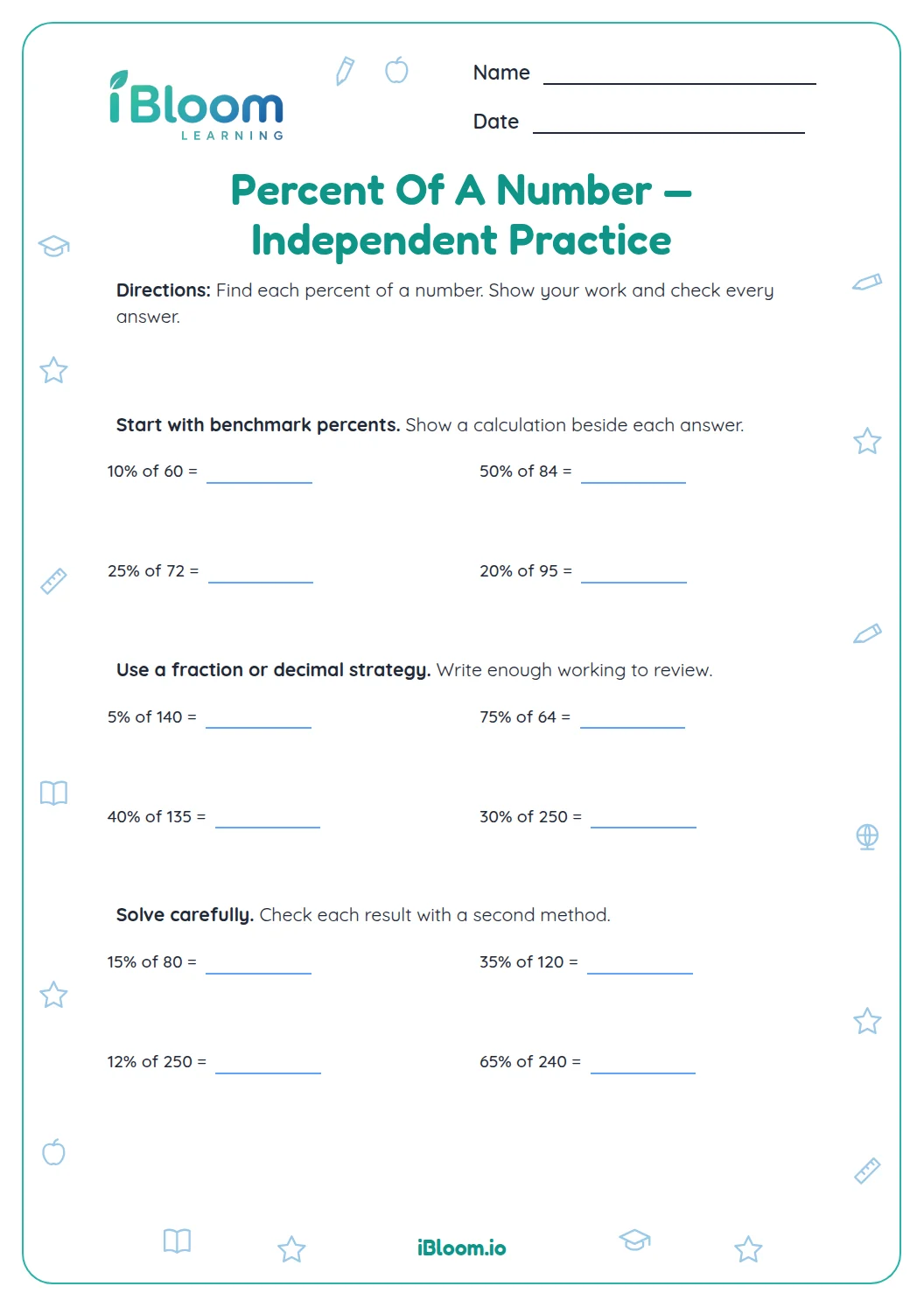
This Grade 6 worksheet introduces finding a percent of a decimal amount. Students translate percents such as 25% or 10% into decimals, multiply, and then apply the same method to a discount or growth situation. The practice supports Common Core 6.RP.A.3.c: interpreting a percent as a rate per 100 when finding a percent of a quantity. A separate answer key includes the calculations and a model explanation.
Aligned to 6.RP.A.3.c
What is on the worksheet?
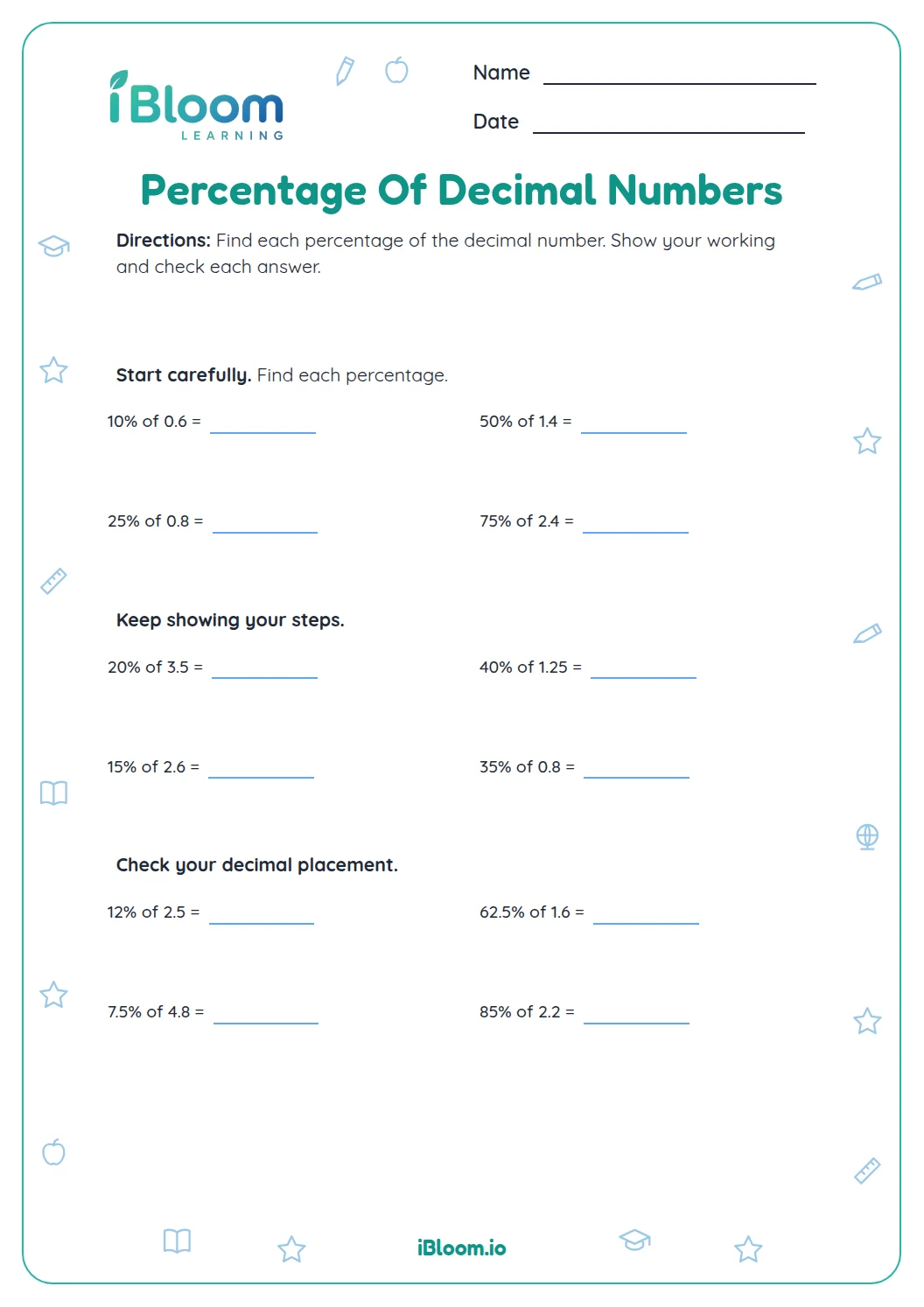
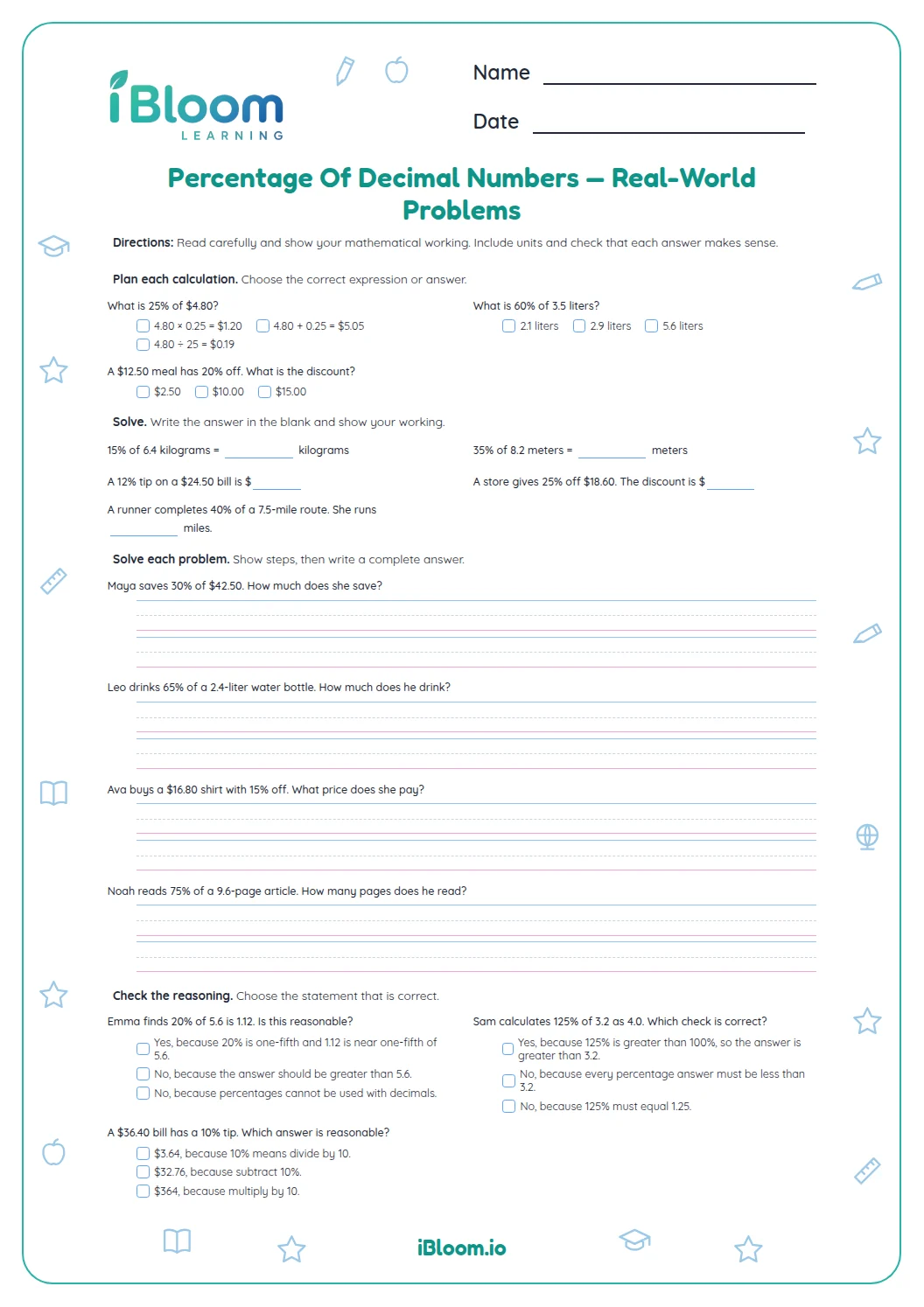
Students begin with direct percent-of-decimal calculations, then solve examples with less familiar percent values. The final items connect the operation to discounts and growth.
- Write a percent as a decimal.
- Multiply by the decimal amount.
- Use the context to label the result.
How do you find 25% of 1.6?
25% means 25 per 100, or 0.25. Multiply 0.25 by 1.6 to find the part.
- 125% of 1.6
- 20.25 × 1.6 = 0.40
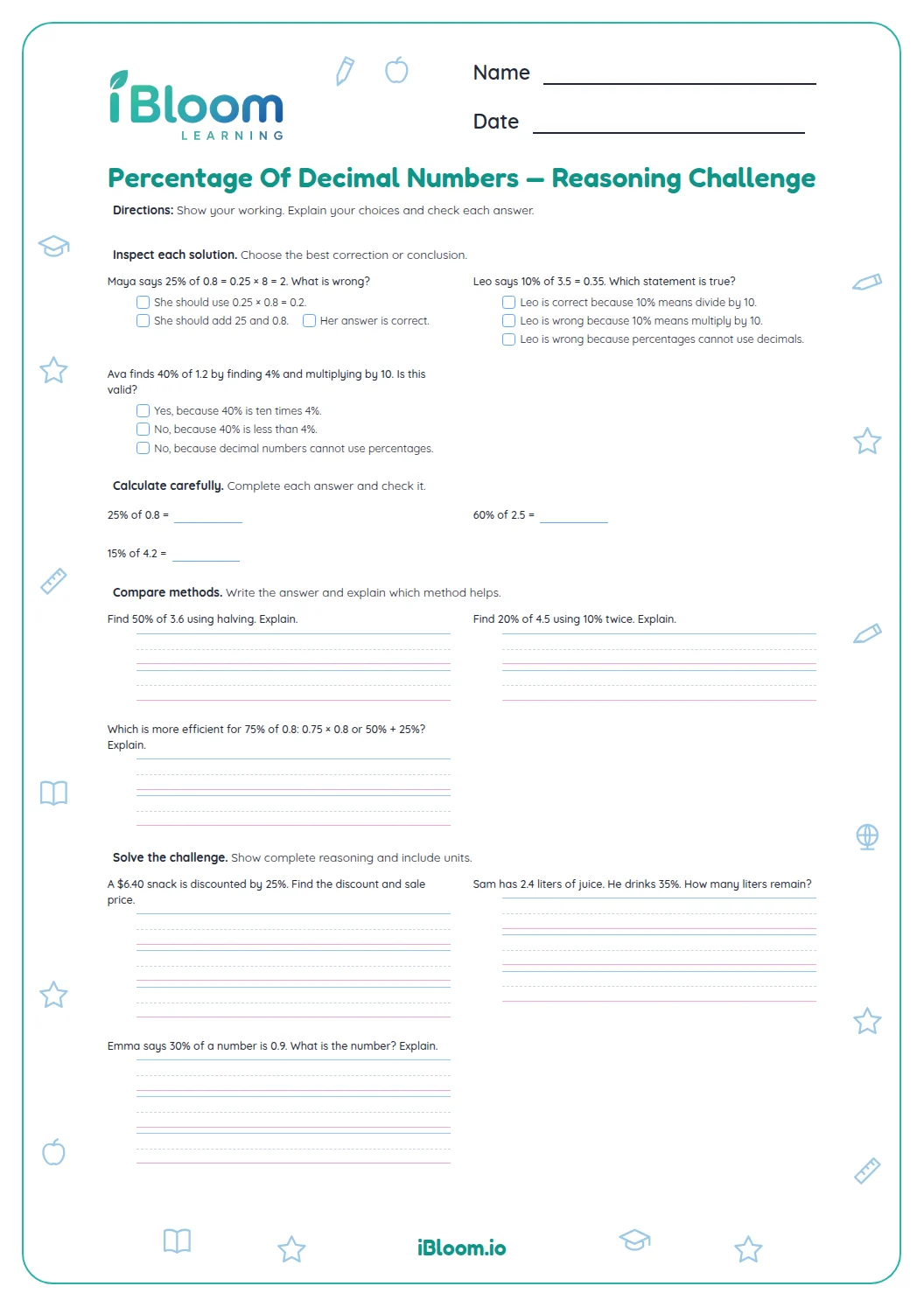
How can you check the result?
For a percent below 100%, the part should be smaller than the whole. Estimate with a familiar percent, such as 50% or 10%, before accepting a product.
How to use this worksheet
- 1Move the percent sign two places left to write the percent as a decimal.
- 2Keep the decimal amount as the second factor.
- 3Multiply as with whole numbers, then place the decimal point.
- 4Estimate whether the result is reasonable for the percent.
- 5In a story problem, name what the amount represents.
Common mistakes and quick fixes
The mistake
Writing 25% as 2.5.
The fix
A percent is per 100, so 25% is 0.25.
The mistake
Finding 25% of 1.6 by multiplying by 25.
The fix
Use 0.25 as the factor, not 25.
The mistake
Giving a result larger than the whole for a percent below 100%.
The fix
Compare your product with the original amount and estimate first.
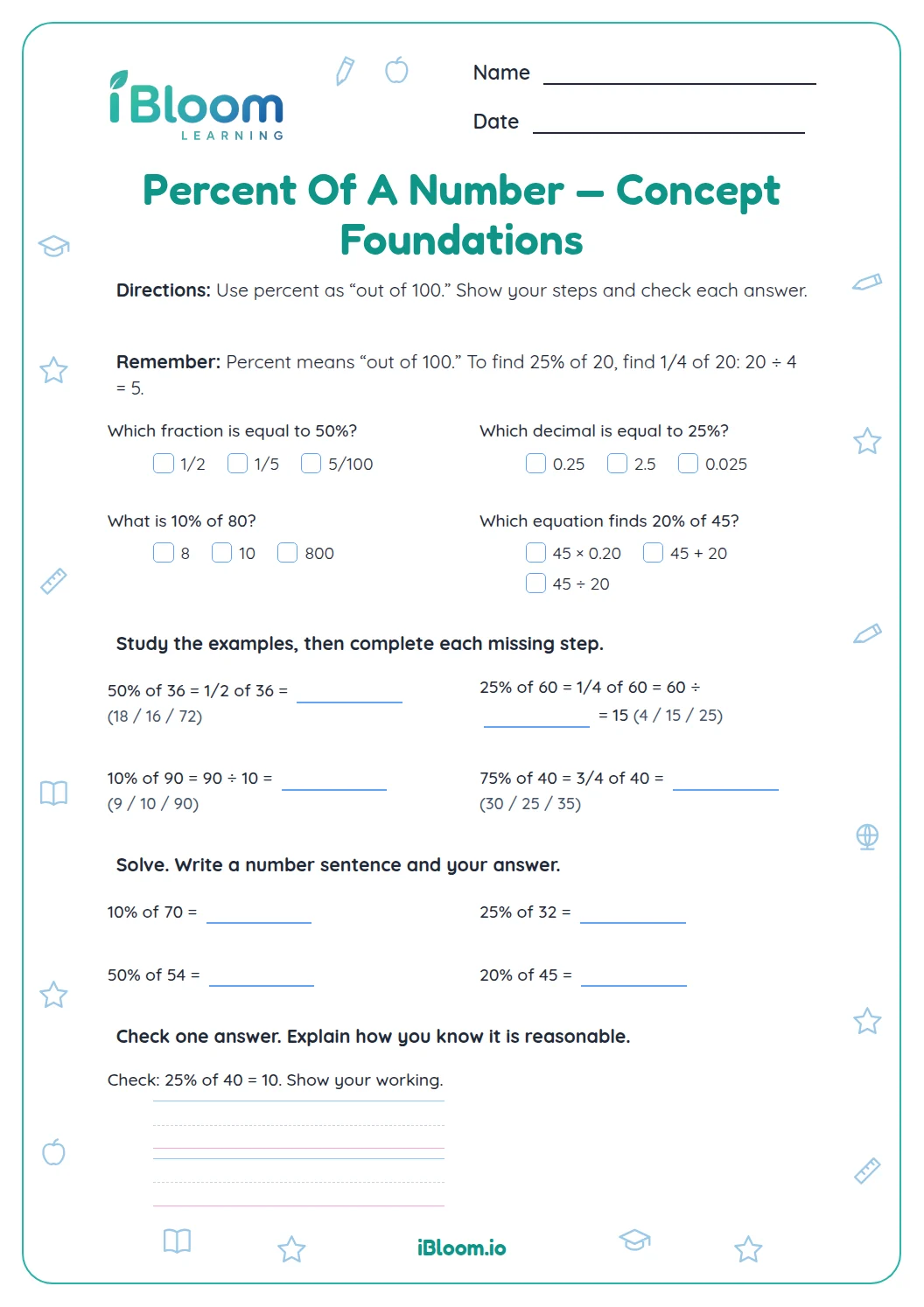
Interpret each percent as a rate per 100 when finding part of a decimal amount.
On this sheet:
Show the official wordingHide the official wording
Find a percent of a quantity as a rate per 100 (e.g., 30% of a quantity means 30/100 times the quantity); solve problems involving finding the whole, given a part and the percent.
What to practice next
Make more practice
Questions parents and teachers ask
What does 25% mean as a decimal?
Twenty-five percent means 25 out of 100. Divide 25 by 100 to write it as 0.25. Then multiply 0.25 by the decimal amount; for example, 25% of 1.6 is 0.25 × 1.6, or 0.4. This converts the rate before finding the part.
Why multiply instead of divide by the percent?
The percent is a rate per 100. Writing it as a decimal makes the operation clear: 30% of 5.4 is 0.30 times 5.4. Multiplying finds the part named by the rate, so the result can be compared with the original amount.
Should an answer be smaller than the original amount?
When the percent is less than 100%, the part should be less than the whole amount. For instance, 15% of 6.2 is smaller than 6.2. Estimating with 10% or 50% can help students check their product and catch a misplaced decimal point.
What does the answer key include?
The key gives the decimal amount for each calculation and a sample explanation for the final item. For story questions, it also names what the amount represents, such as the size of a discount or a plant’s growth, so students can check their interpretation.
How can estimation check a decimal percent product?
Compare the result with a familiar fraction of the starting amount. For example, 10% of 4.8 should be less than 1 because one tenth of 4.8 is 0.48. Estimation can catch a misplaced decimal point before you move to the next problem.