






About this worksheet
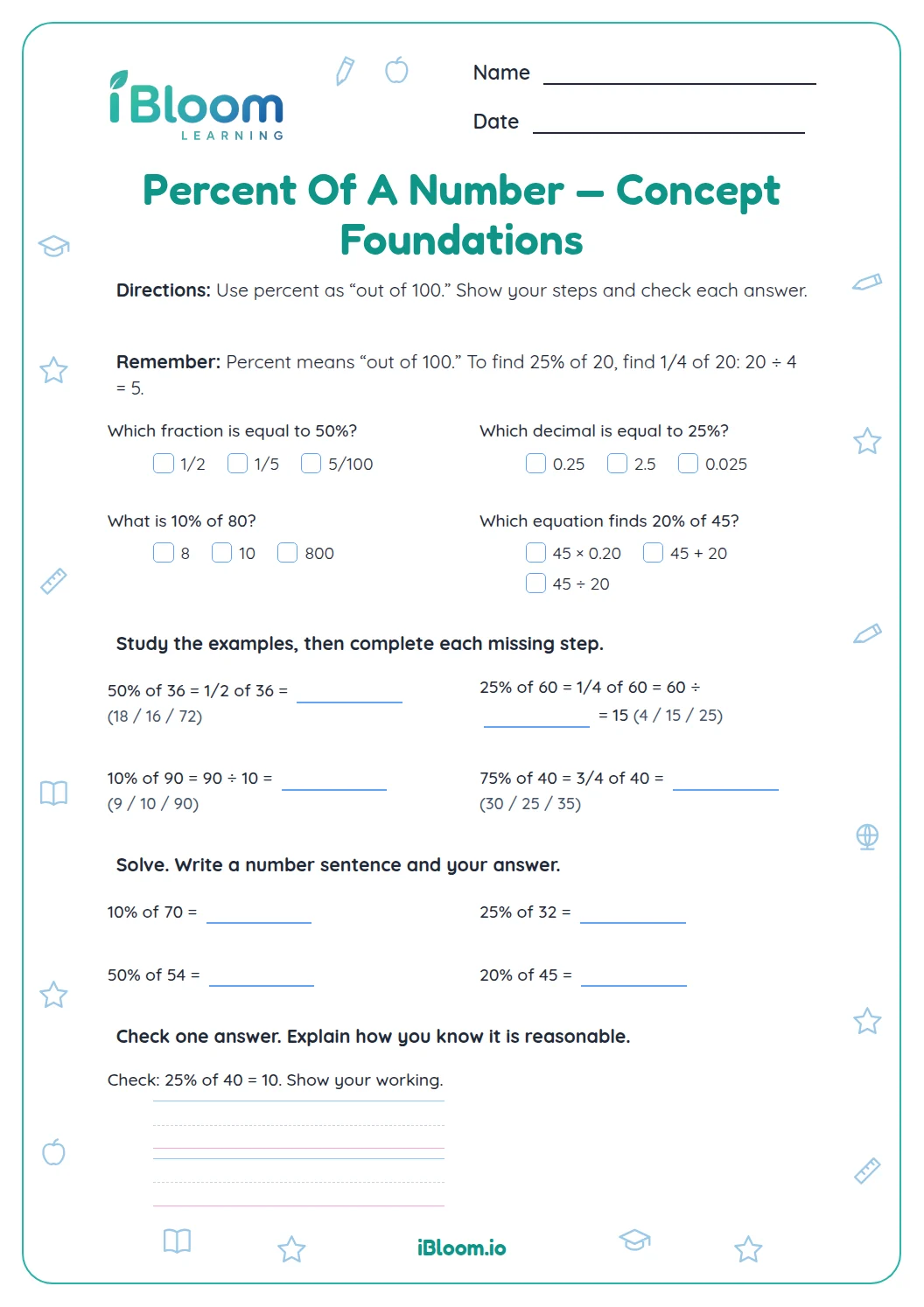
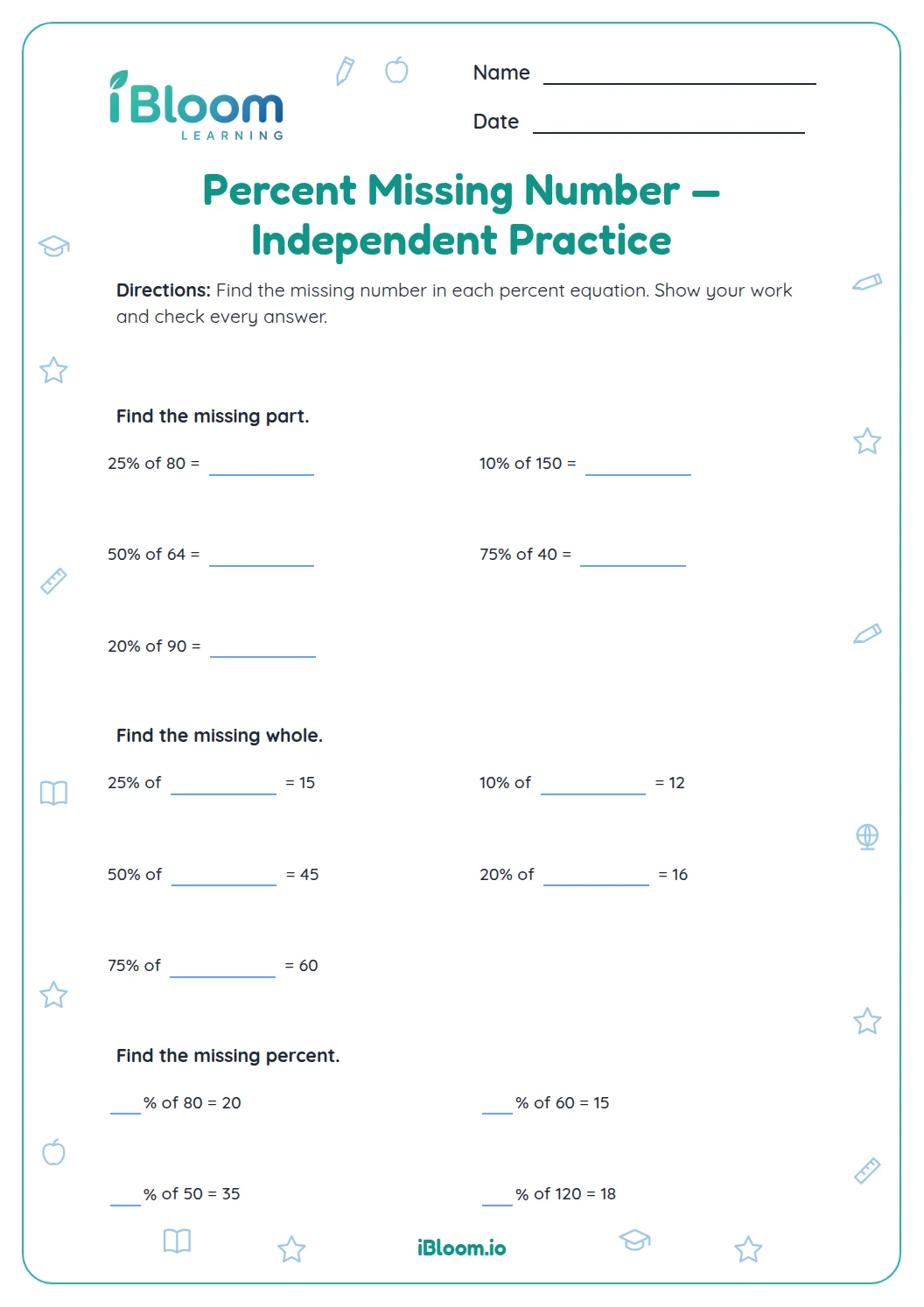
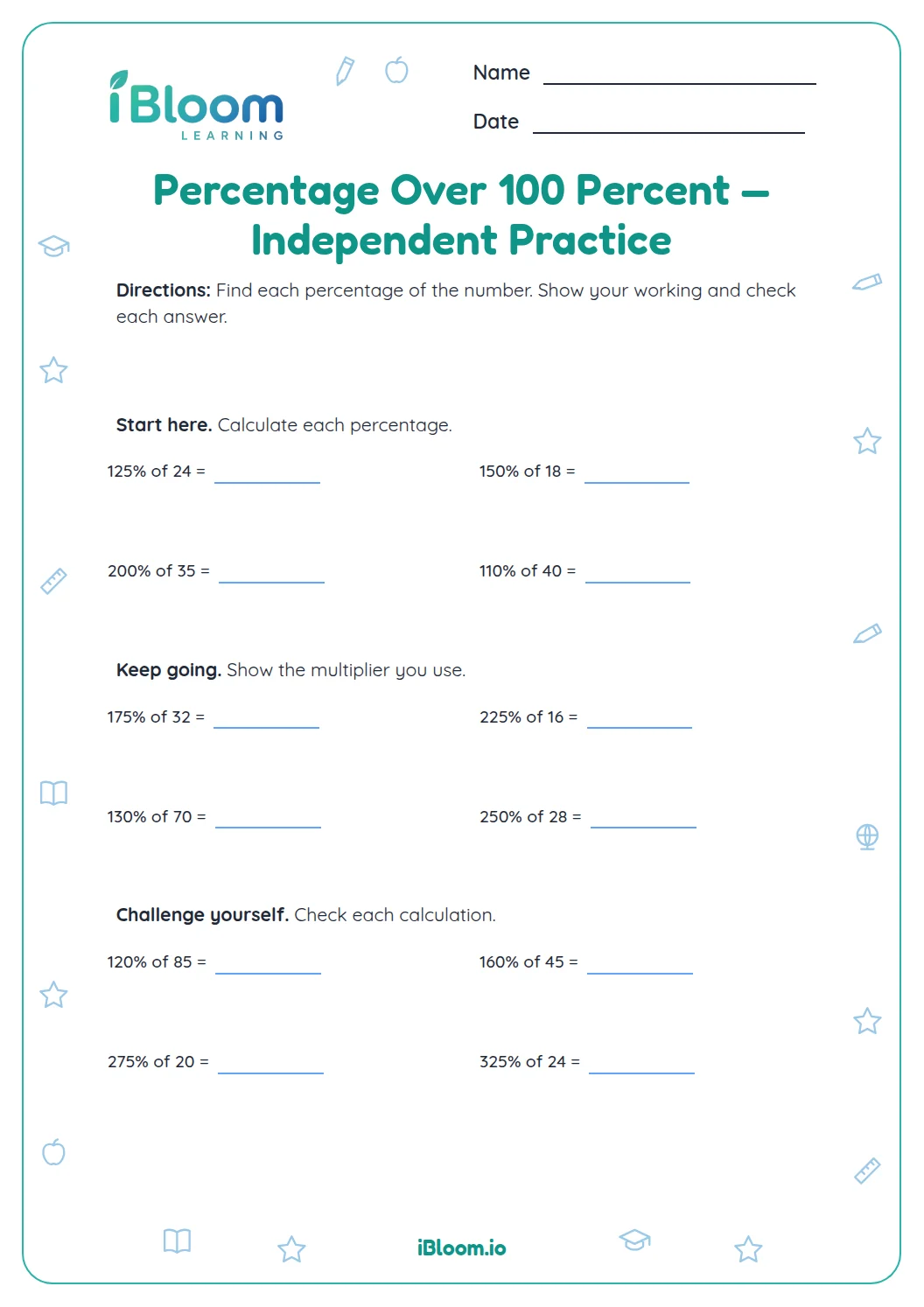
This free printable Grade 6 worksheet builds the idea behind finding a percent of a number. It starts with what percent means (out of 100) and shows that 10% is one tenth. Students then use 10% to find 5%, 15% and 30% of 240, work four mixed examples such as 35% of 80, and finish with three word problems about students, a discount and stickers. It practices Common Core 6.RP.A.3.c, and a separate answer key shows every answer.
Aligned to 6.RP.A.3.c
Why start with 10%?
Percent means out of 100, so 10% is 10 out of every 100, which is one tenth. That makes 10% of a number easy: divide by 10. Question 3 shows it with 10% of 80 = 80 ÷ 10, and question 4 does the same for 1%, which is one hundredth, 80 ÷ 100.
Once students know 10% and 1%, most other percents are built from them. 30% is three tens, 5% is half of 10%, and 15% is 10% plus 5%.
- 110% of 240 = 240 ÷ 10 = 24
- 230% of 240 = 3 × 24 = 72
- 35% of 240 = half of 24 = 12
- 415% of 240 = 24 + 12 = 36
How do you find a percent like 35% or 12%?
Split the percent into pieces you already know. 35% is 30% + 5%, so for 35% of 80 find 10% (8), triple it (24), add 5% (4) and get 28. Part C asks students to choose their own route, so 45% of 120 can be 10% four times plus 5%, or 50% minus 5%.
A small percent works the same way. For 12% of 50, 10% is 5 and 1% is 0.5, so 2% is 1 and the answer is 5 + 1 = 6.
- 135% of 80 = ___
- 210% of 80 = 8
- 330% of 80 = 3 × 8 = 24
- 45% of 80 = half of 8 = 4
- 524 + 4 = 28
How do the word problems use a percent of a number?
Each word problem names a whole and a percent, then asks for the part. In question 13, 35% of 480 students walk: 10% is 48, 30% is 144, 5% is 24, and 144 + 24 = 168. Question 14 finds the discount on a $60 jacket at 15% off: $6 + $3 = $9.
Question 15 asks for 24% of 250 stickers. 10% is 25, so 20% is 50, and 4% is 4 × 2.5 = 10. Then 50 + 10 = 60.
What is on this worksheet?
Fifteen questions in four parts, moving from the meaning of percent to the building method to word problems.
- Part A, What percent means: a 10 × 10 grid with 35 squares shaded, and a fraction match for 25%
- Part B, Build from 10%: six fill-ins, from 80 ÷ 10 to 15% of 240
- Part C, Percent of any number: 35% of 80, 60% of 450, 12% of 50 and 45% of 120
- Part D, Word problems: students walking, a jacket discount and star stickers
- Answer key on its own pages
How to use this worksheet at home or in class
- 1Look at the grid in question 1 together. There are 100 squares, so each square is 1%. Count the shaded squares aloud.
- 2Ask your student to explain why 10% of any number is that number divided by 10 (question 3), then find 1% (question 4).
- 3In questions 5 to 8, have your student write the 10% answer first and circle it, then build the others from it.
- 4In Part C, let your student choose a route, such as 12% as 10% + 1% + 1%. Different routes are fine when the answers match the key.
- 5In Part D, ask what the whole is and what the part is before any calculating.
- 6Estimate before checking: 35% of 480 should be a little more than a third of 480, which is 160.
Common mistakes and quick fixes
The mistake
Treating 10% as 10 and answering 10% of 240 with 10, or with 2,400.
The fix
10% means 10 out of every 100, one tenth. To find one tenth, divide by 10: 240 ÷ 10 = 24.
The mistake
Doubling instead of halving to get 5% of 240, so the answer is 48.
The fix
5% is smaller than 10%, so the answer must be smaller than 24. Half of 24 is 12.
The mistake
Adding the percent to the number: 15% of $60 as $75 or $60 + 15.
The fix
A percent of a number is a part of it, so the answer is less than $60. Find 10% ($6) and 5% ($3), then add: $9.
Common Core alignment
Most US states use the Common Core standards or a close state version. This sheet practices the Grade 6 standard on finding a percent of a quantity.
Find a percent of a quantity as that many hundredths of it.
On this sheet: Every question after Part A finds a percent of a number, from 10% of 240 to 35% of 480 students.
Show the official wordingHide the official wording
Find a percent of a quantity as a rate per 100 (e.g., 30% of a quantity means 30/100 times the quantity); solve problems involving finding the whole, given a part and the percent.
What to practice next
Make more practice
Further reading
Questions parents and teachers ask
Why does this worksheet start from 10%?
Because 10% is one tenth, it is the easiest percent to find: divide by 10. Many other percents are sums, halves or multiples of it. 15% is 10% plus half of 10%, and 30% is three times 10%. Students who build from 10% and 1% can find percents like these without a calculator.
How do I find 15% of 240 without a calculator?
Find 10% by dividing by 10, which gives 24. Then find 5% by halving 10%, which gives 12. Add the two: 24 + 12 = 36. Question 8 on the sheet uses exactly this method, and question 14 uses it again for 15% of a $60 jacket.
Why does question 1 use a grid?
A 10 × 10 grid has 100 squares, so each square is 1% of the whole. Counting the 35 shaded squares gives 35%, which makes the meaning of percent, out of 100, visible before any calculating. It also shows why 10% is one column of ten squares, one tenth of the grid.
Can my student use decimals or fractions instead?
Yes. 35% of 80 can also be 0.35 × 80, or 35/100 × 80, and both give 28. The 10% building method is a way to get there by thinking, and it works well for checking a calculator answer. Part C leaves the route open for exactly that reason.
How can my student check a percent answer?
Compare it with a benchmark. 50% of a number is half, 25% is a quarter and 10% is a tenth. 35% of 480 should be a little more than a third of 480, which is 160, so 168 is reasonable. A percent below 100% must give an answer smaller than the number.
Is there an answer key for this worksheet?
Yes. A separate two-page answer key shows the correct choice for the grid and the fraction, every fill-in answer and the answers to all three word problems. Print the two worksheet pages on their own and keep the key for checking afterward, or use it to talk through any route that went wrong.