




About this worksheet
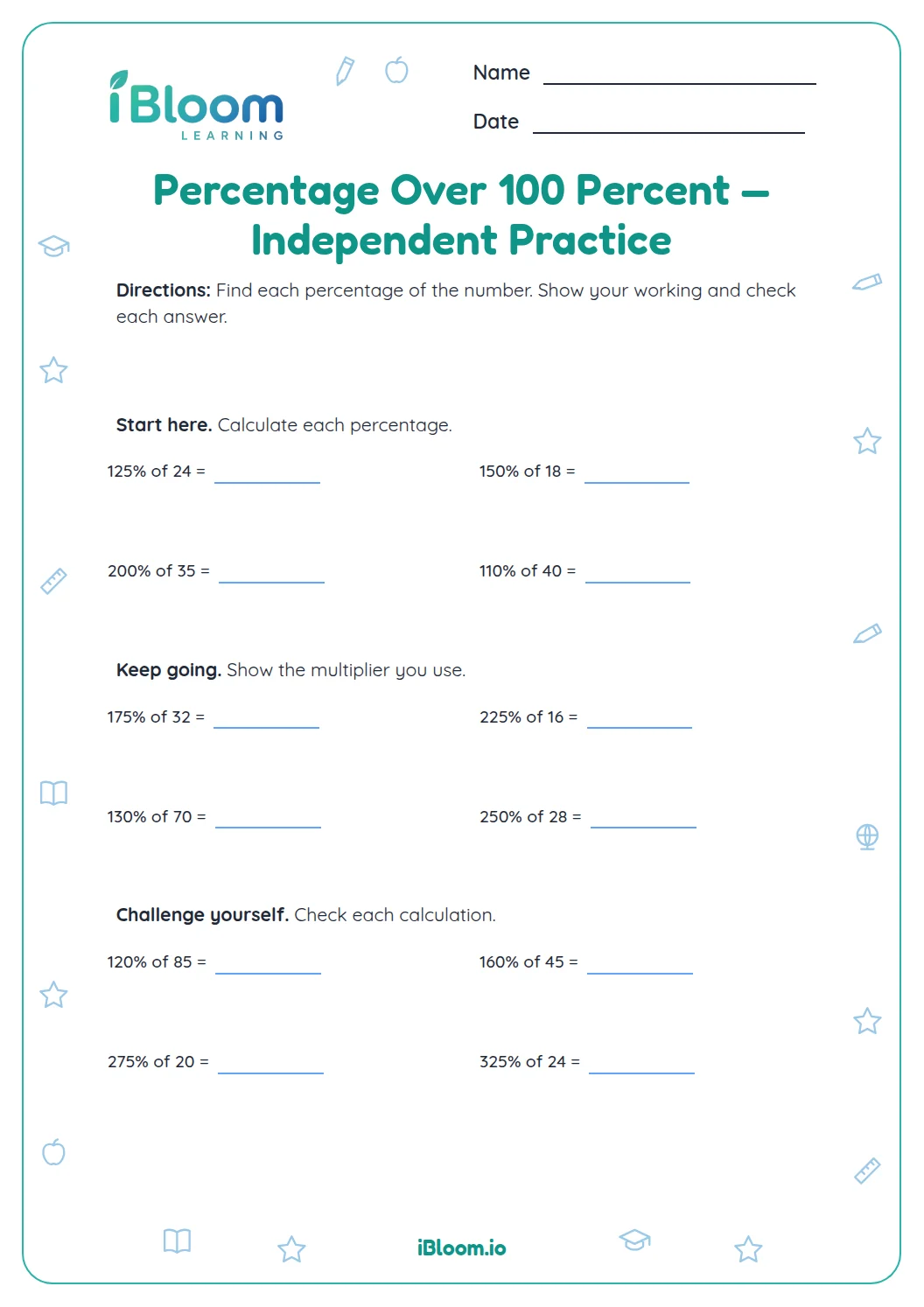
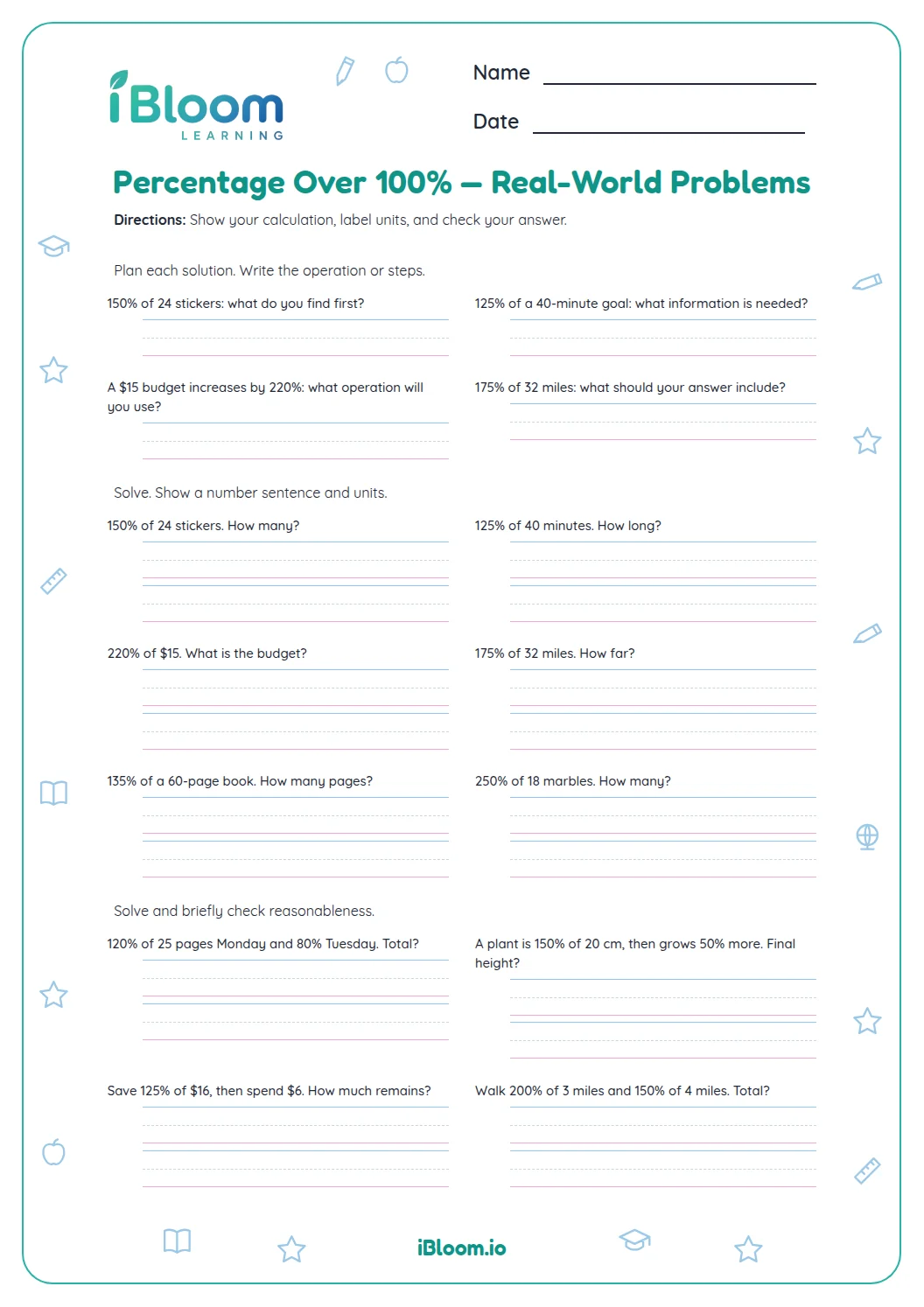
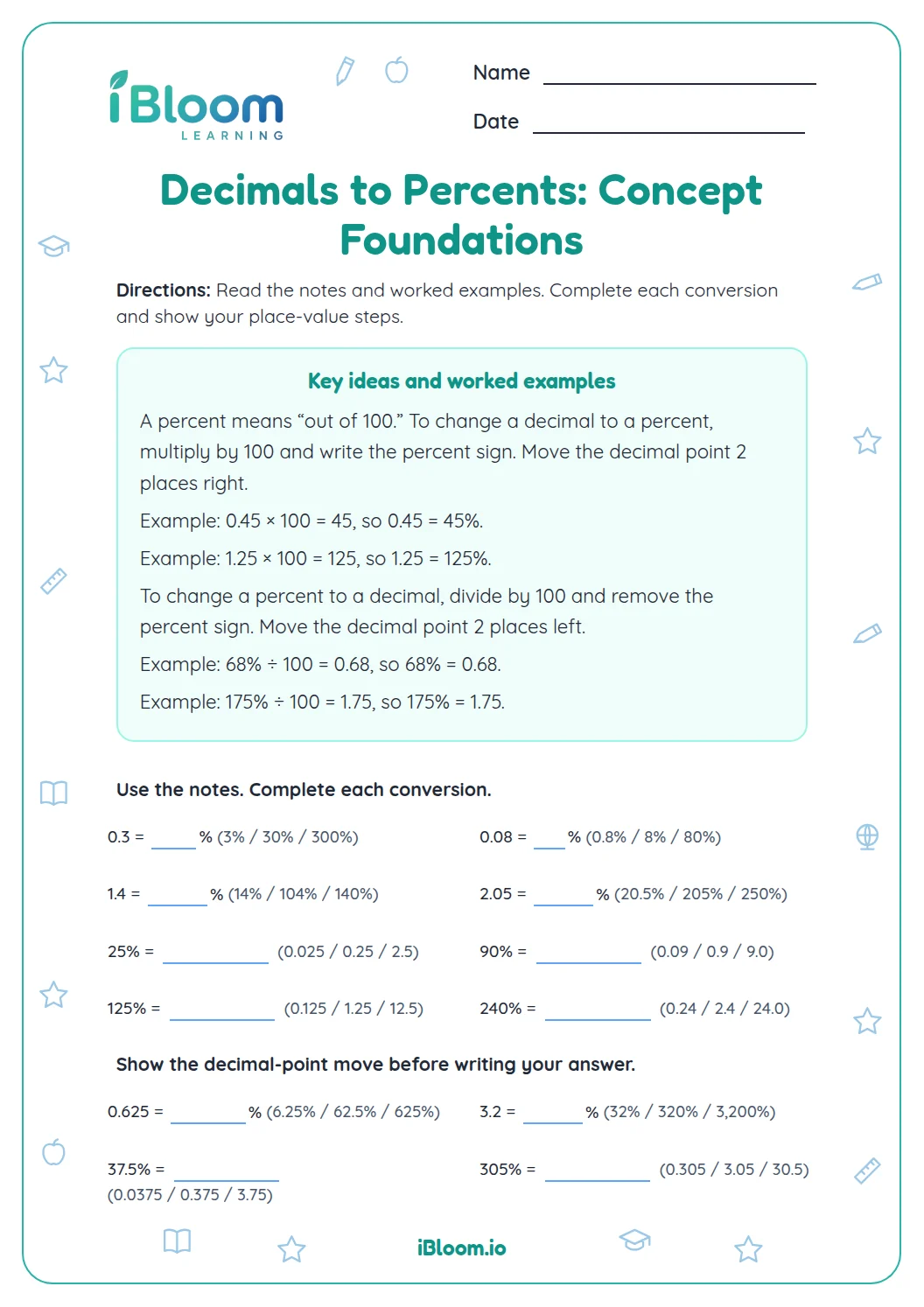
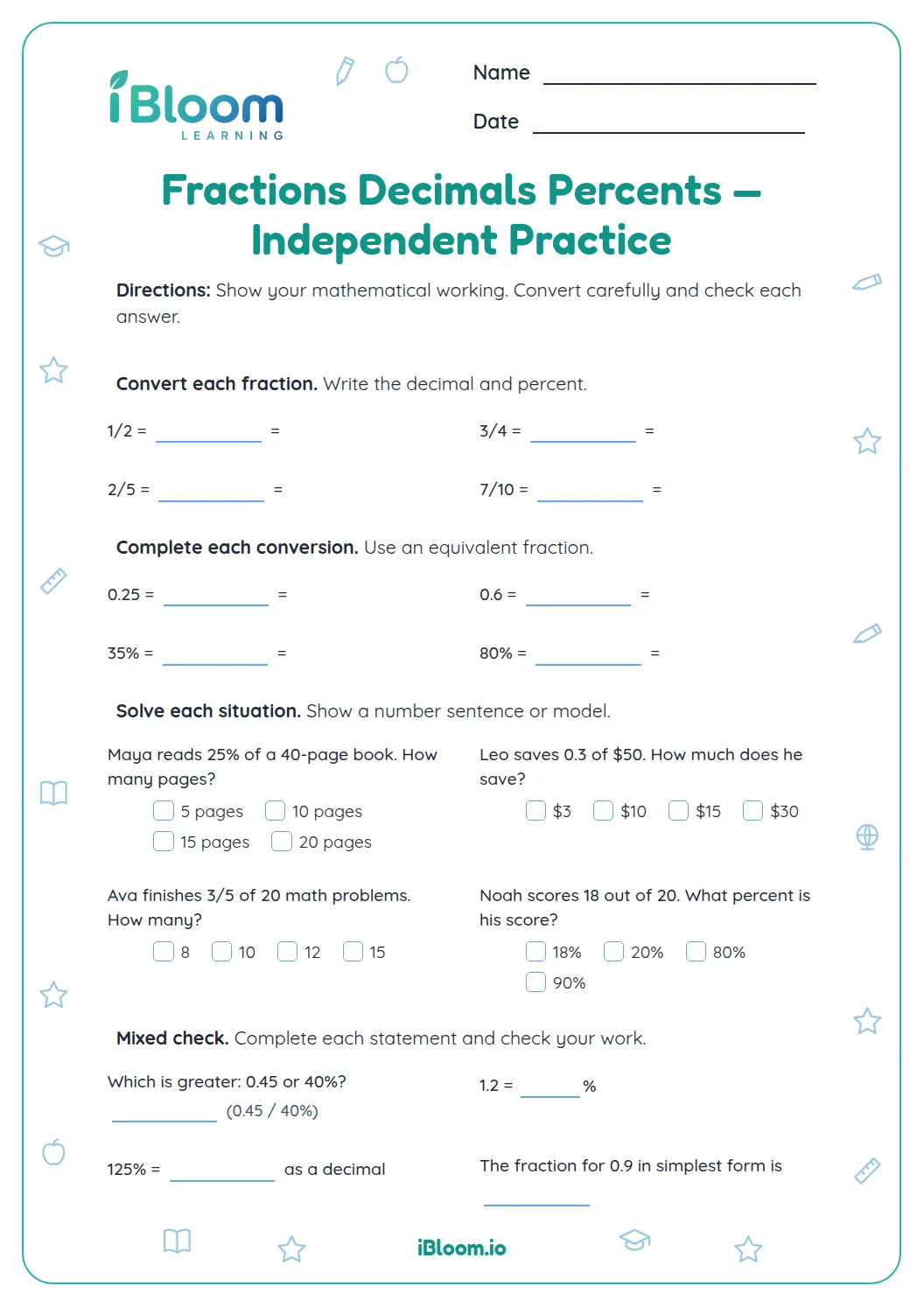
This Grade 6 worksheet uses two shaded hundredths-grid models and 12 short conversions to practice values above 100%. Students count complete wholes and remaining hundredths, then write equivalent decimal, percent, or fraction forms. The printable answer key supports checking each representation. The work connects to CCSS 6.RP.A.3.c on understanding percent as a rate per 100.
Aligned to 6.RP.A.3.c
What does 100% represent?
One complete hundredths grid represents 100%, or 1.00. A second complete grid adds another 100 percentage points. Values above 100% show at least one whole and some additional part.
- 1One full grid and 25 shaded hundredths = 100% + 25%.
- 2That is 125%, or 1.25.
How do you write a percent as a decimal?
A percent is an amount per 100. Divide the number of percent points by 100: 125% = 125/100 = 1.25. The complete shaded grid makes the 1 whole visible.
How can the model become a fraction?
Count every shaded hundredth, including the hundredths in each full grid. For example, 2 complete grids and 50 more hundredths make 250/100, which is 2.5.
How to use this worksheet
- 1Count the fully shaded grids; each is 100%.
- 2Count shaded squares in the final partial grid.
- 3Add the full hundreds and partial hundredths.
- 4For decimal form, divide the percent number by 100.
- 5For fraction form, place the total percent over 100.
Common mistakes and quick fixes
The mistake
Counting only the last grid
The fix
Add 100 percentage points for every complete grid.
The mistake
Writing 125% as 0.125
The fix
Divide by 100, moving the decimal two places: 125% = 1.25.
The mistake
Using 25/100 for 125%
The fix
Include the whole grid too: 125 shaded hundredths make 125/100.
Common Core alignment
The models make the “per 100” meaning of percent visible for amounts greater than one whole.
Use hundredths grids to connect percent to a rate per 100.
On this sheet: Students interpret each percent as a count of hundredths, including complete groups of 100.
Show the official wordingHide the official wording
Find a percent of a quantity as a rate per 100 (e.g., 30% of a quantity means 30/100 times the quantity); solve problems involving finding the whole, given a part and the percent.
What to practice next
Make more practice
Further reading
Questions parents and teachers ask
What does 125% look like?
One complete hundredths grid plus 25 shaded squares on a second grid represents 125%. The full grid is 100%, and the extra squares represent 25%, for 125% altogether. Students count the extra squares after naming the complete whole.
Why does a percent over 100% have more than one grid?
One hundred percent is one whole grid. Any amount above 100% needs that complete grid plus additional shaded hundredths to show the extra amount. Counting complete grids first keeps the amount above 100% visible. Counting complete and partial grids together prevents losing a whole.
How do I convert a percent above 100 to a decimal?
Divide the percent number by 100. For example, 125% becomes 125/100, which is 1.25. The decimal includes the whole grid and the extra part. Move the decimal two places left from the percent number. For instance, 150% equals 1.5 because it is one and one-half wholes.
What fraction represents 250%?
There are 250 shaded hundredths when two complete grids and 50 more squares are shaded, so the fraction is 250/100. It can also be simplified to 5/2. The fraction can be simplified after the model has been counted accurately.
How many models are on the page?
There are two visual models. Students interpret the shaded grids in questions 1 and 8, then complete 12 conversion questions using percentages, decimals, and fractions over 100. The worksheet has 14 questions total, with a separate answer key for checking.
What should come next?
Decimals to Percents, Including Over 100% gives more conversion practice, while Fractions, Decimals, and Percents connects all three forms. Percent of a Number applies the same rate-per-100 idea to quantities. Each follow-up page builds on the same relationship between percent and hundredths.