





About this worksheet
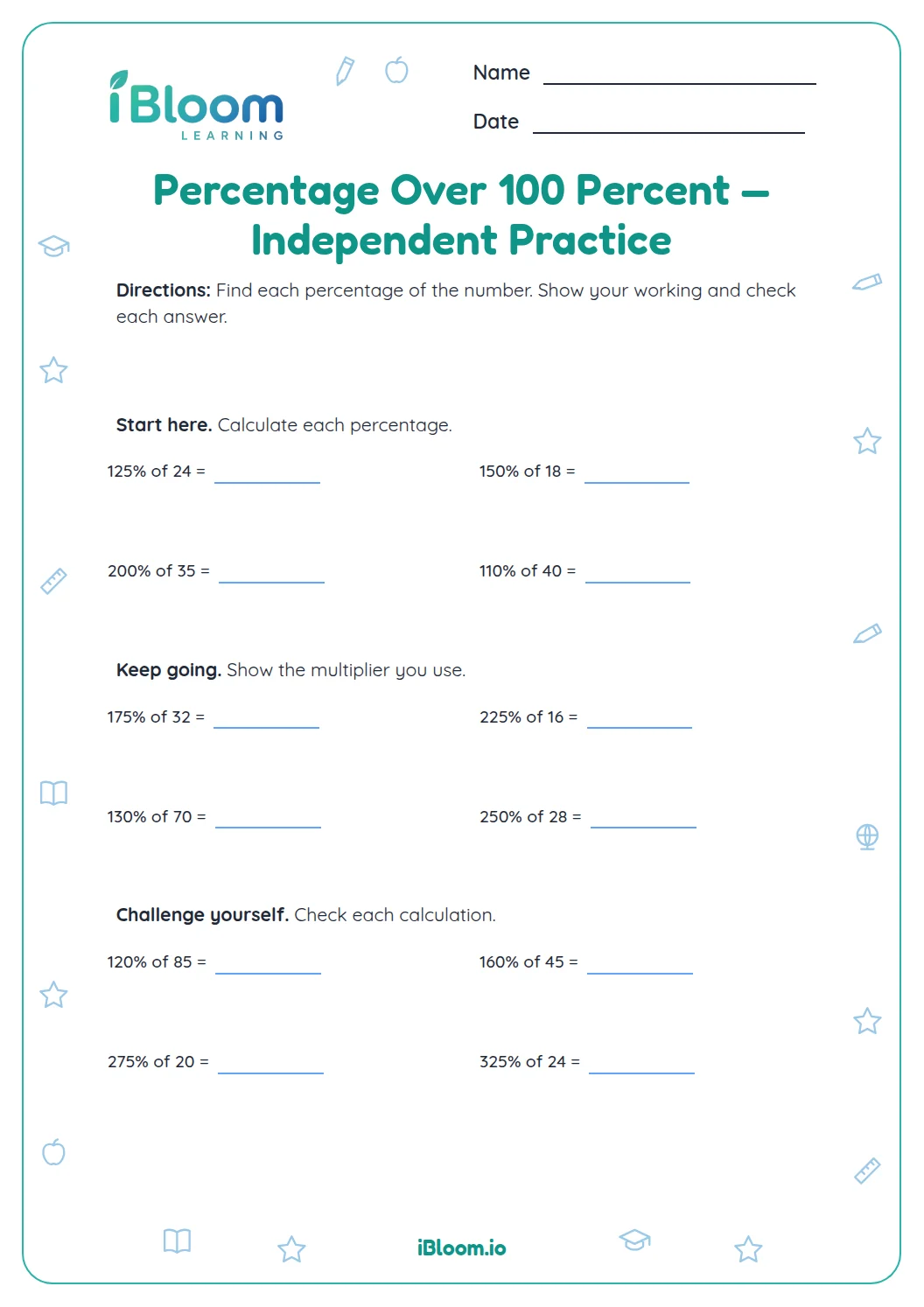
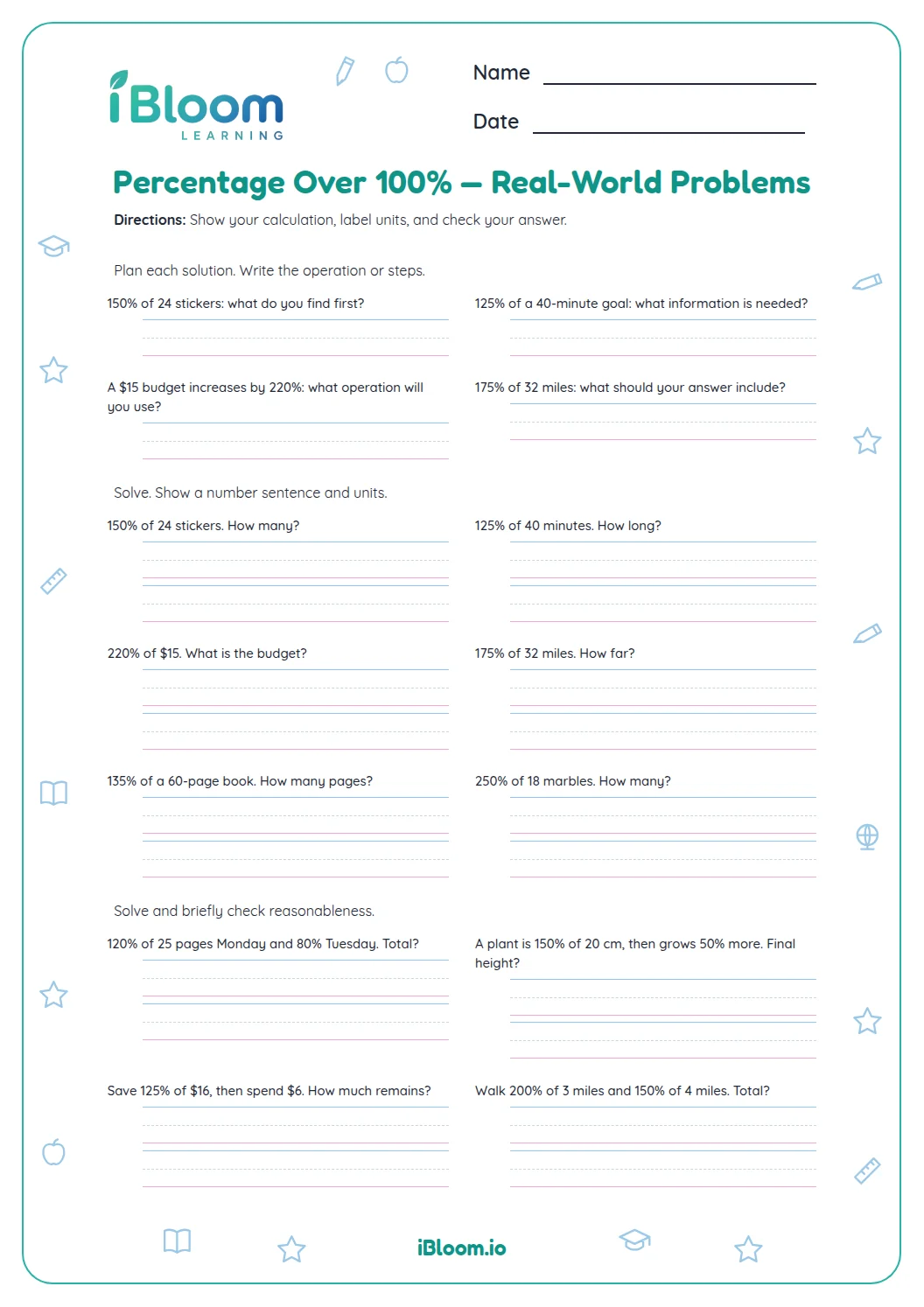
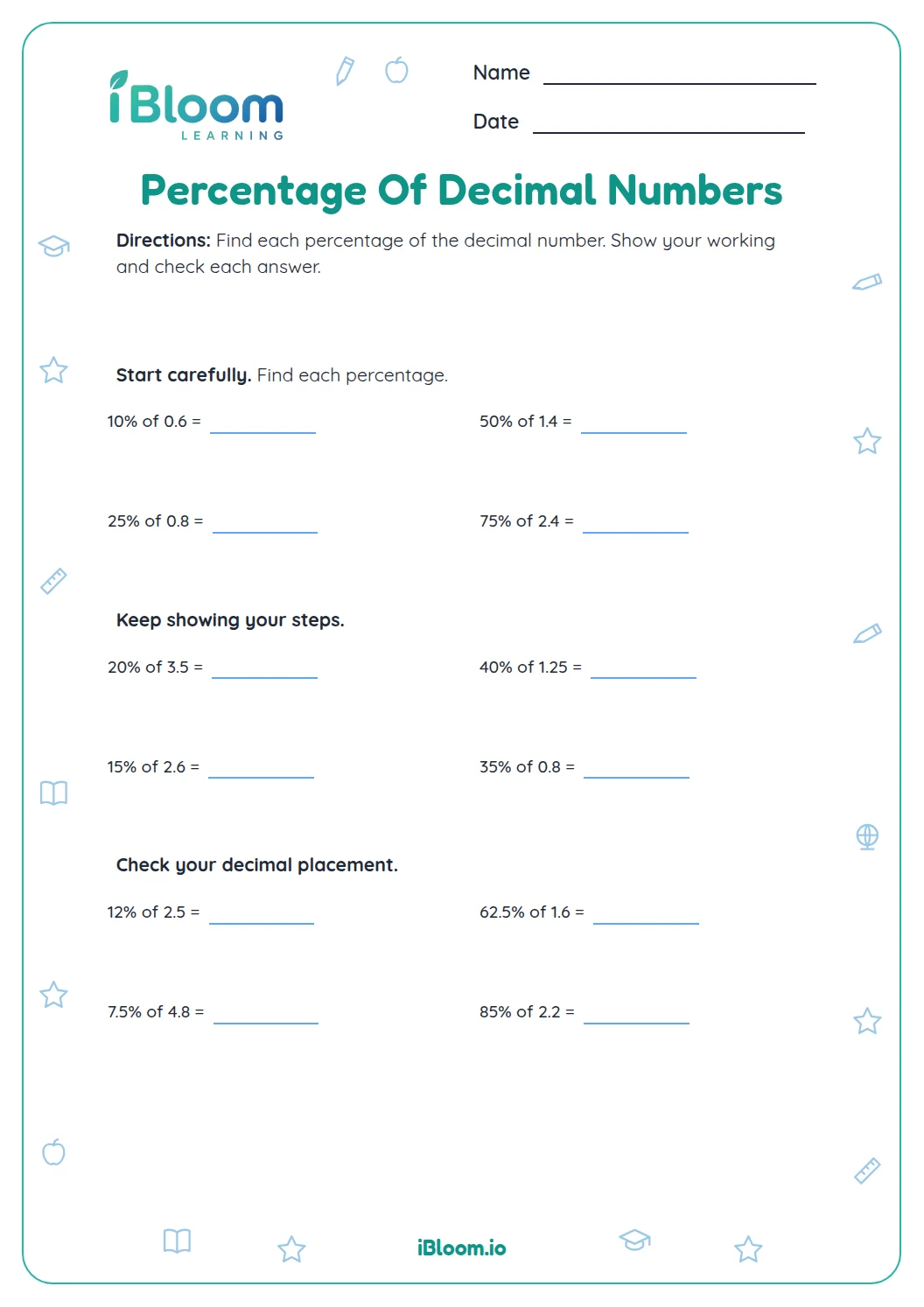
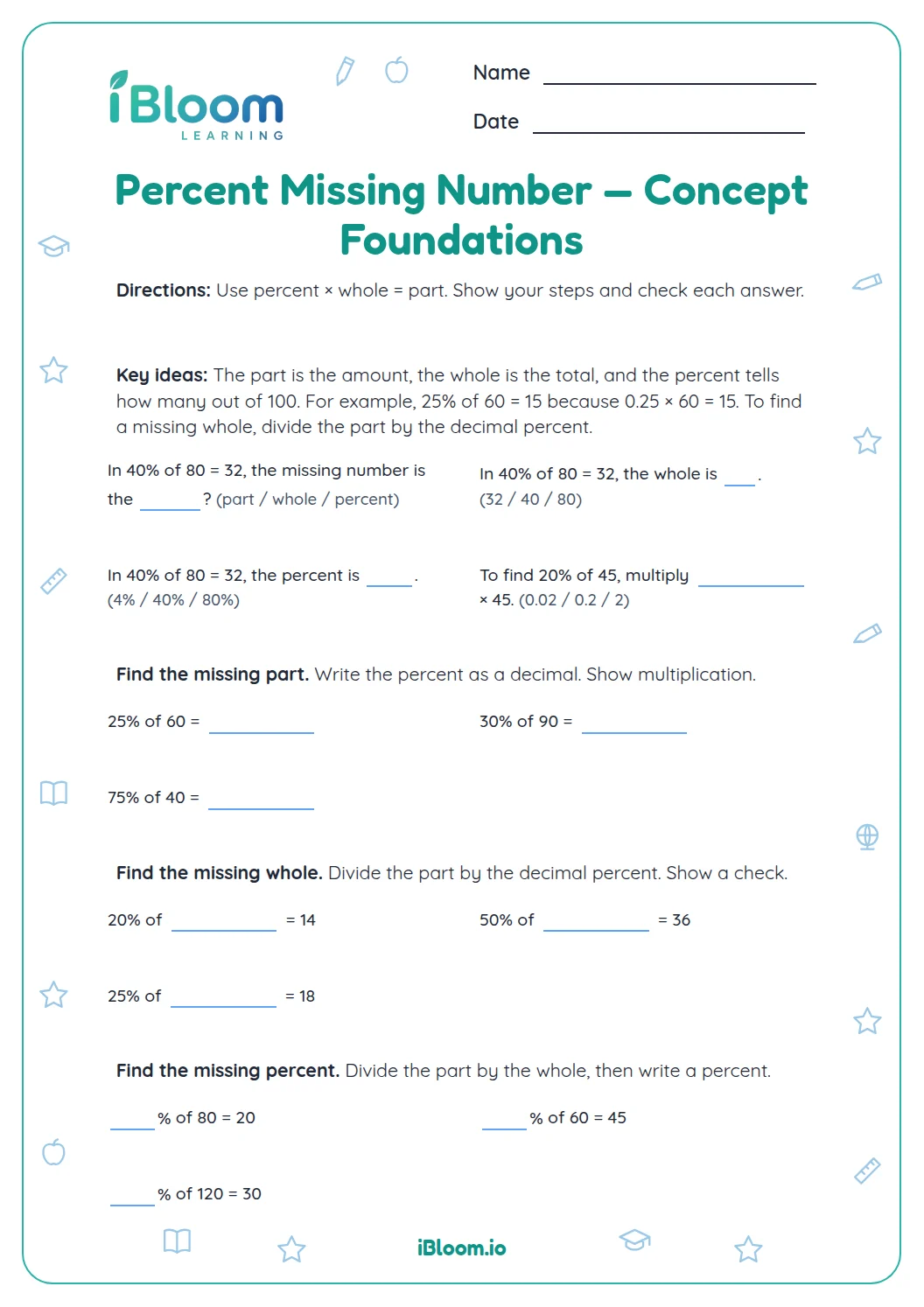
This Grade 6 printable helps students reason about percentages greater than 100%. It starts with fraction and decimal conversions, then moves to percent-of-quantity calculations and comparisons with one whole. The final questions use the 100% benchmark in short statements about height, distance, and number size. The practice aligns with CCSS 6.RP.A.3c, which includes finding a percent of a quantity as a rate per 100. A separate answer key is included.
Aligned to 6.RP.A.3c
What does a percent over 100% mean?
Percent means “per 100.” So 100% is one whole, 150% is one and a half wholes, and 220% is 2.2 wholes. A percent above 100 is a useful way to compare an amount with its starting or reference amount.
How can you rename a percent?
Write the percent over 100 and simplify, or move the decimal point two places left to get a decimal. Keeping the value above one intact prevents a common error: treating 125% as 0.125.
- 1Find 125% of 48.
- 2125% = 1.25 = 5/4.
- 348 × 5/4 = 12 × 5.
- 4Answer: 60.
How does 100% help compare amounts?
Use 100% as the one-whole benchmark. A percent below 100% is less than the reference amount; a percent above it is greater. For a growth question, divide the new amount by the original amount before converting to a percent.
How to work through the sheet
- 1Start with Part A and rewrite each percent carefully.
- 2Simplify fractions when the prompt asks for simplest form.
- 3In Part B, convert the percent to a multiplier before multiplying.
- 4For a comparison, use 100% or 1 as the benchmark.
- 5Check whether the answer should be larger than the original amount.
- 6Use the separate key to review calculations and explanations.
Common percent mistakes and fixes
The mistake
Writing 125% as 0.125.
The fix
Move the decimal two places left: 125% = 1.25.
The mistake
Adding the percent number to the quantity.
The fix
Convert the percent to a multiplier, then multiply the quantity.
The mistake
Assuming an answer above the starting amount is impossible.
The fix
Compare the percent with 100%; a greater percent represents more than one whole.
Common Core alignment
This practice uses percent reasoning to compare and calculate amounts.
Find a percent of a quantity as a rate per 100 and solve percent problems.
On this sheet: Questions convert percents to rates per 100 and use them to find amounts.
Show the official wordingHide the official wording
Find a percent of a quantity as a rate per 100 (e.g., 30% of a quantity means 30/100 times the quantity); solve problems involving finding the whole, given a part and the percent.
What to practice next
Make more practice
Further reading
Questions parents and teachers ask
Can a percent be more than 100%?
Yes. A percent compares an amount with a whole of 100%. For example, 150% means 150 per 100, or 1.5 wholes. The worksheet uses this idea in conversions, comparison questions, and everyday situations such as a route longer than a reference trail.
How do I find 125% of a number?
Change 125% to 1.25 or 5/4, then multiply by the number. On question 7, 125% of 48 is 48 × 5/4, which equals 60. Multiplying by a factor greater than one gives an answer greater than the starting number.
What does 220% mean?
It means 220 for every 100, which is 2.2 times the reference amount. That is more than two wholes because 200% is exactly two wholes and 220% is another 20% beyond that. The last question asks students to explain this comparison.
What is included in the answer key?
Yes. The separate answer key lists answers for all 16 questions, including the final comparison statement. Students can compare each result and revisit the percent-to-multiplier step if their answer differs. It is useful to check one step at a time.
How long should this worksheet take?
Plan for about 20 minutes, depending on how much written work a student shows. The first questions are short conversions; the later amount and reasoning problems take more time because students need to choose and check a strategy.