






About this worksheet
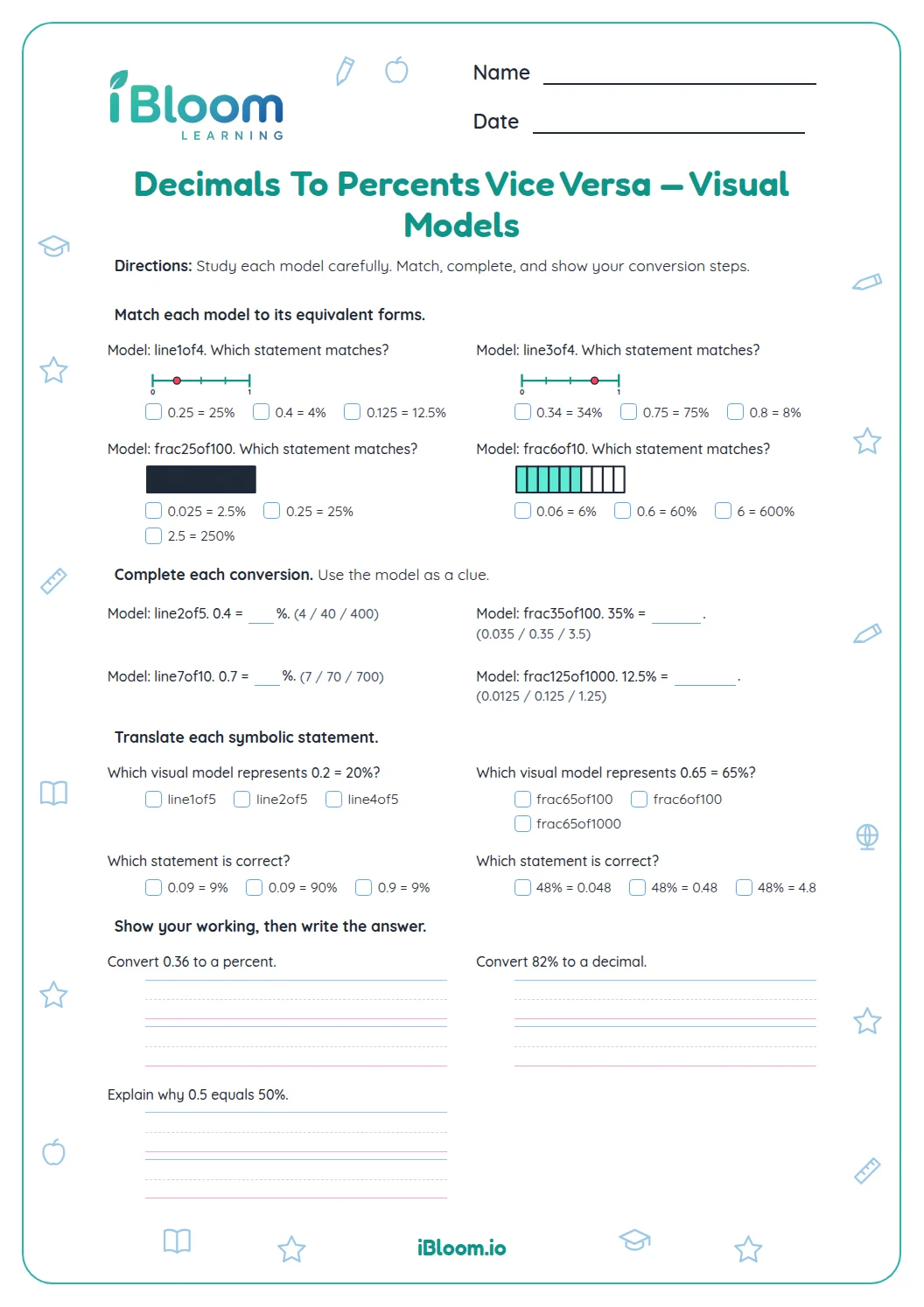
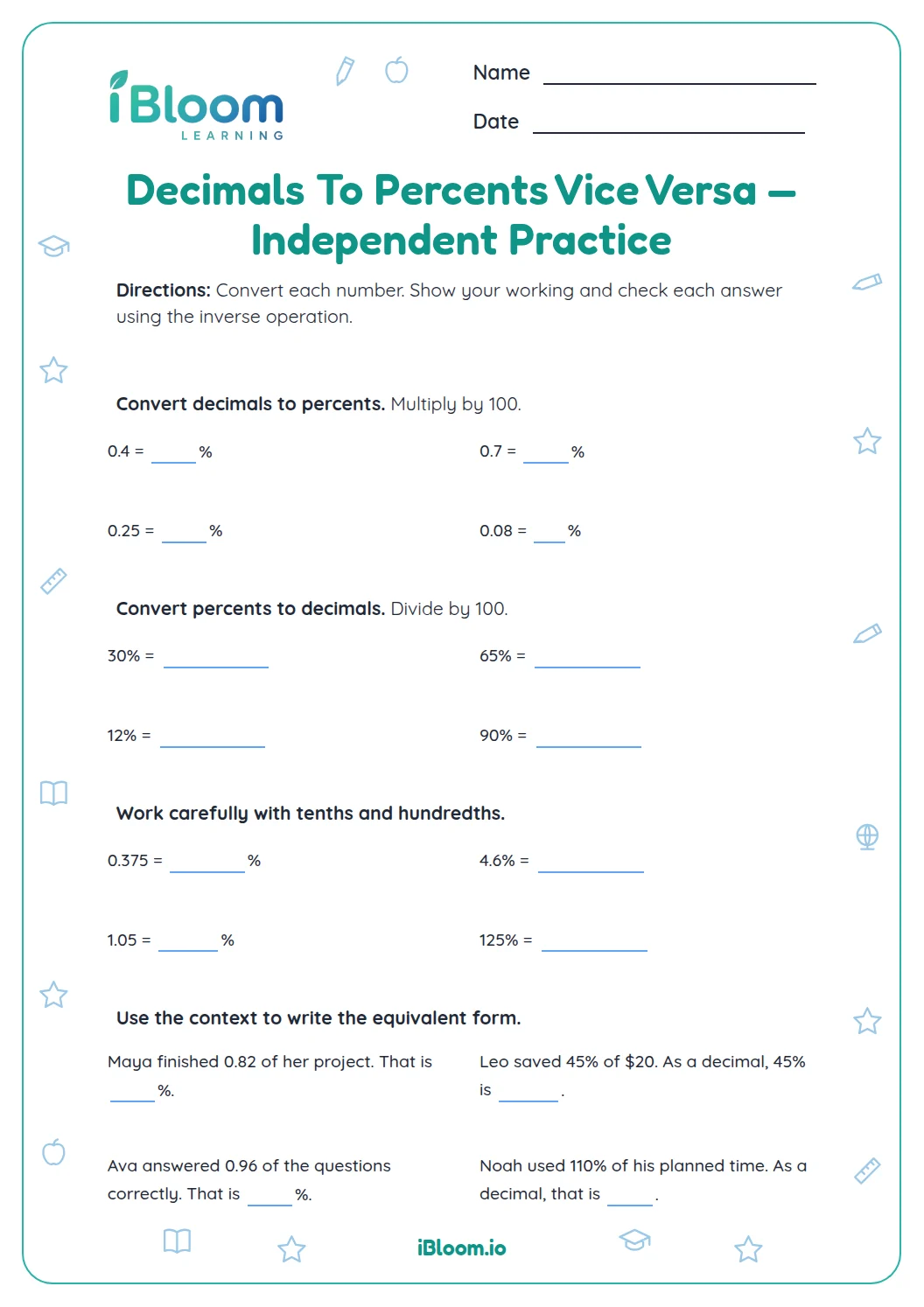
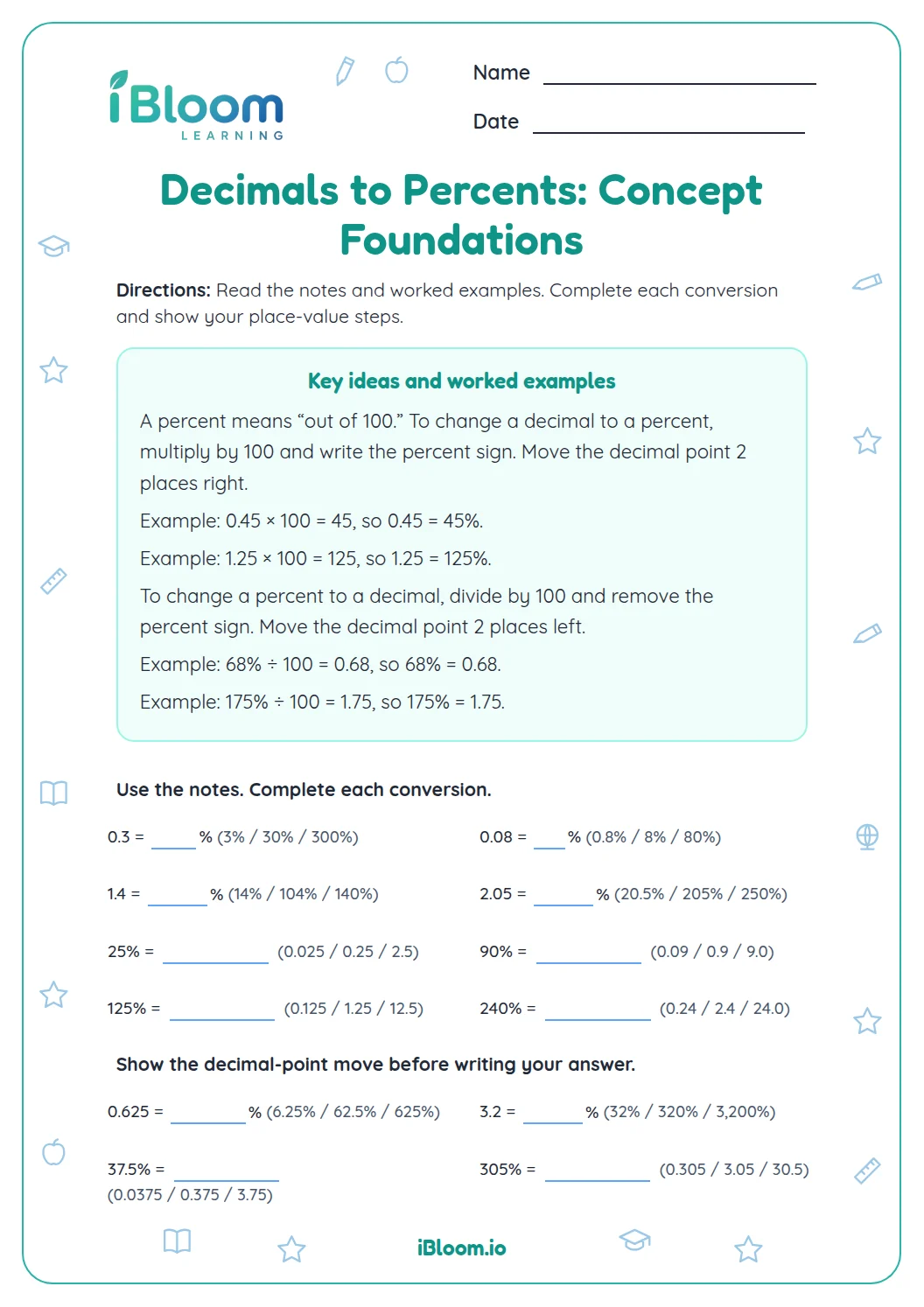
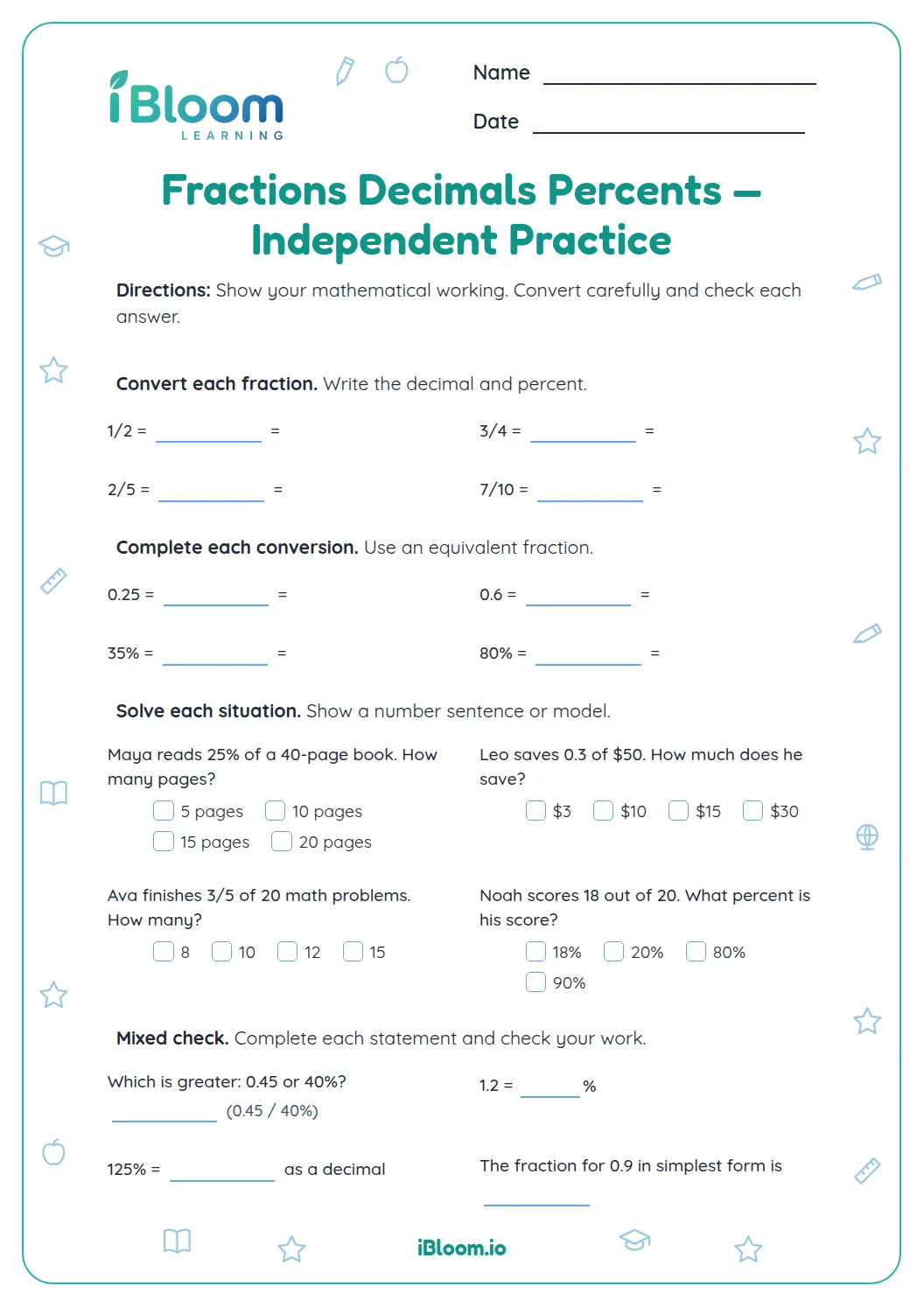
This Grade 6 worksheet connects decimal models to percent notation, then uses percents to find parts of decimal amounts. Its 14 questions move from shaded hundredths and tenths to calculations and measurement contexts, with an answer key. It practices CCSS 6.RP.A.3.c by finding a percent of a quantity.
Aligned to 6.RP.A.3.c
How do visual models connect decimals and percents?
This Grade 6 worksheet connects decimal models to percent notation, then uses percents to find parts of decimal amounts. Its 14 questions move from shaded hundredths and tenths to calculations and measurement contexts, with an answer key. It practices CCSS 6.RP.A.3.c by finding a percent of a quantity.
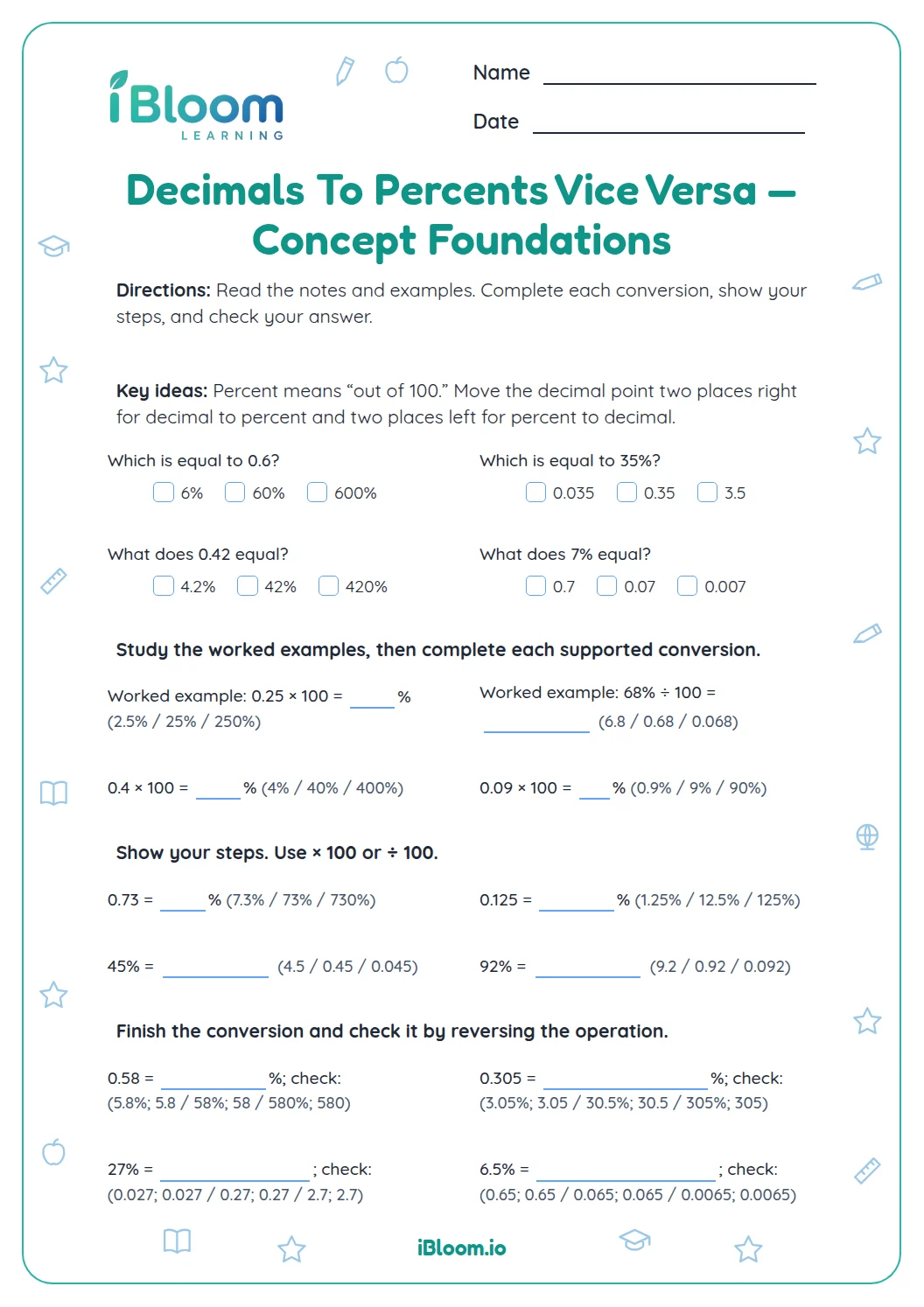
For example, 0.37 represents 37 hundredths, so it is 37%. The shaded hundredths grid reinforces the value of each digit.
What will students do in each part?
Part A reads two shaded models and converts two decimals to percents. Part B moves to percent-of-decimal calculations and missing percents; Part C applies the same reasoning to grids and measurements. Part D asks why 0.08 equals 8%, connecting hundredths to “per hundred.”
How can an adult support practice?
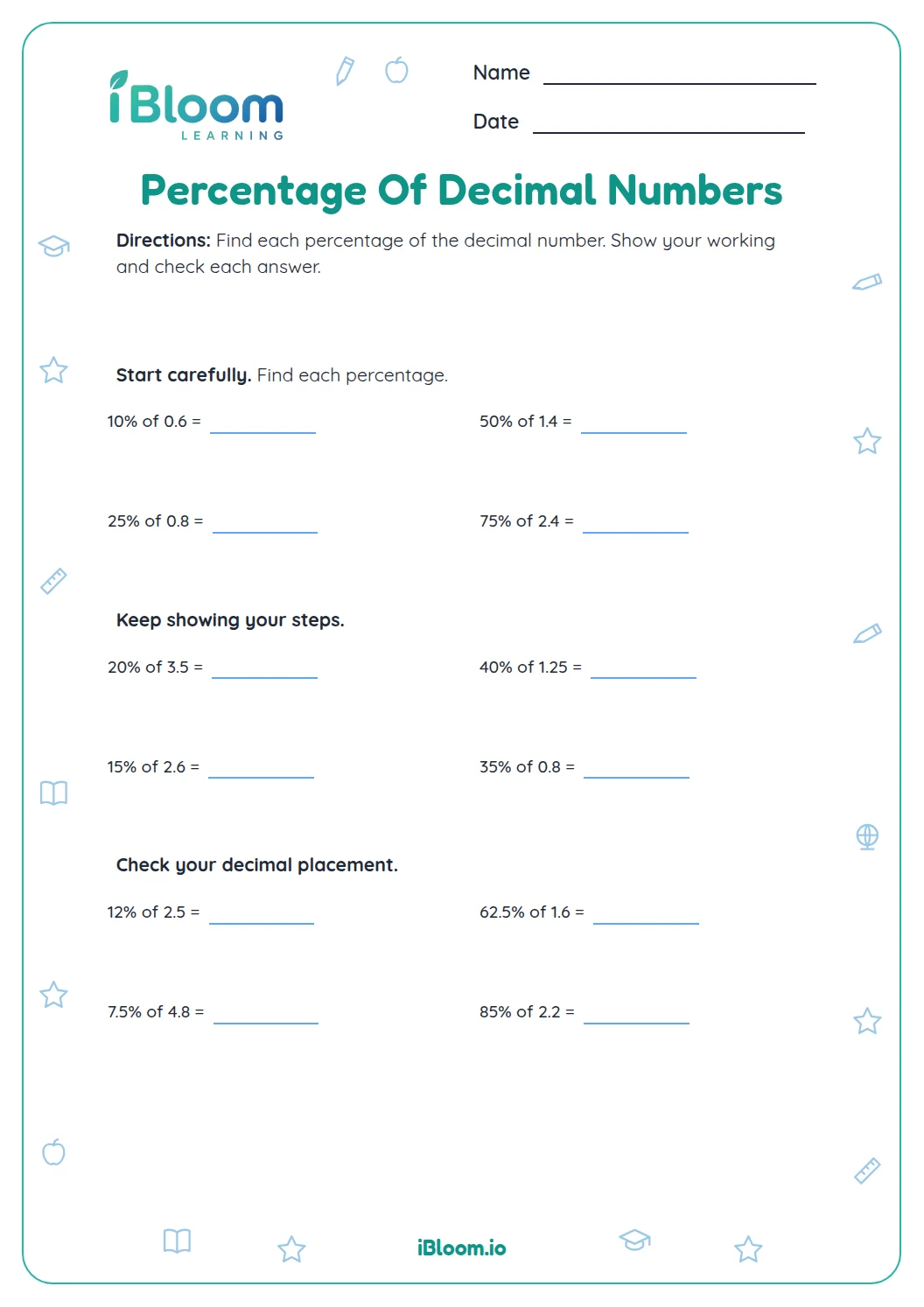
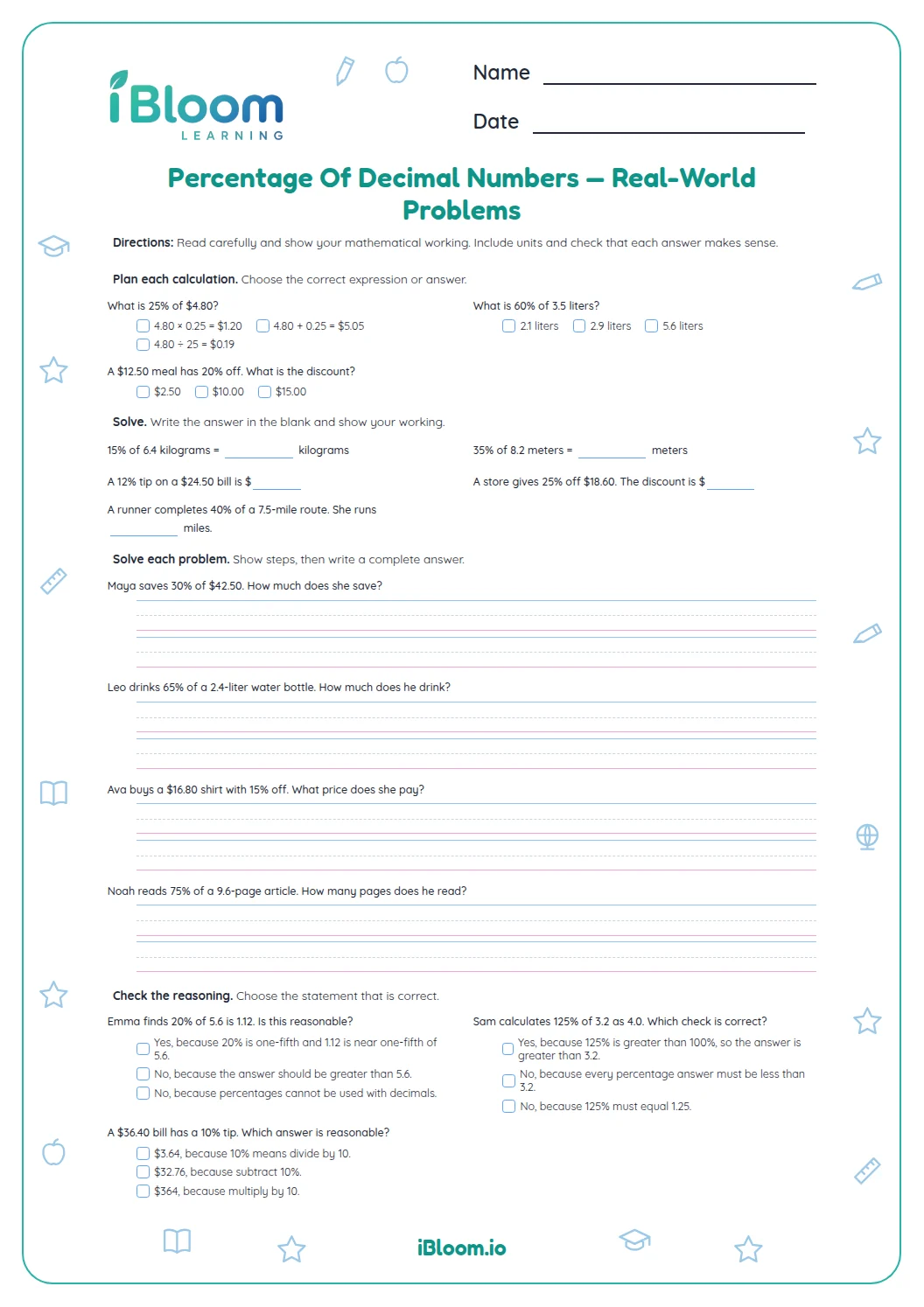
For a percent of a decimal, change the percent to a decimal multiplier. For example, 75% of 2.4 liters is 0.75 × 2.4 = 1.8 liters. Estimate first: because 75% is less than one whole, the result should be less than 2.4 liters.
How to use this worksheet
- 1Read the directions and scan the first model or example.
- 2Work through each part in order, writing clearly in the answer spaces.
- 3Pause to explain one strategy or shape clue aloud.
- 4Check every response with the separate answer key.
- 5Choose one missed question and solve or copy it again carefully.
Common mistakes and quick fixes
The mistake
Moving the decimal two places but forgetting the percent sign.
The fix
Use “per 100” to connect 0.37 with 37%, then check the unit in the answer.
The mistake
Choosing an answer without checking the amount or clue.
The fix
Use the visual model, place value, or stated attribute to verify the choice.
The mistake
Skipping the check after finishing.
The fix
Compare each response with the key and correct one item in a different color.
Common Core alignment
This worksheet practices the following Common Core skill.
Find a percent of a quantity by treating the percent as a rate per 100.
On this sheet: Find a percent of a quantity by treating the percent as a rate per 100.
Show the official wordingHide the official wording
Find a percent of a quantity as a rate per 100 (e.g., 30% of a quantity means 30/100 times the quantity); solve problems involving finding the whole, given a part and the percent.
What to practice next
Make more practice
Further reading
Questions parents and teachers ask
What does this worksheet practice?
The 14 items connect decimal models to percent notation and use percents to find parts of decimal amounts. Students read tenths and hundredths, convert decimals to percents, calculate percent amounts, and solve short measurement problems. The final prompt asks them to explain why 0.08 is 8%, using place value.
How do you read 0.37 as a percent?
Read 0.37 as 37 hundredths. Since percent means per hundred, 37 hundredths is 37%. The worksheet begins with a shaded hundredths model to make that relationship visible before students work with percent equations and measurement situations. Each small grid square represents one hundredth.
How can a child find 25% of 0.8?
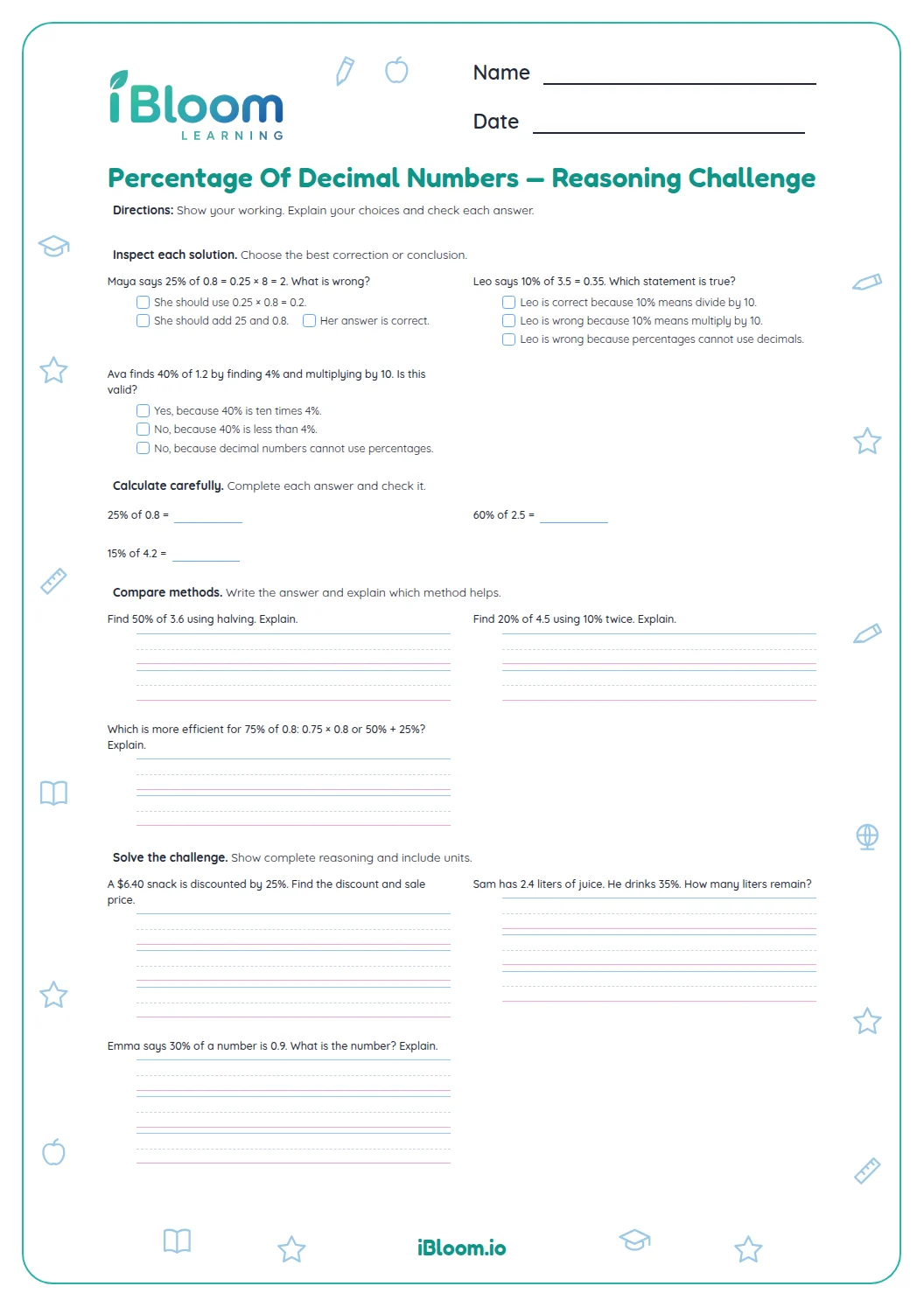
Since 25% is one fourth, divide 0.8 by 4: the result is 0.2. Multiplication gives the same calculation, 0.25 × 0.8 = 0.20. Check that 0.2 is smaller than 0.8, as a quarter of a positive amount should be.
Does the sheet include an answer key?
Yes. The answer key shows the correct percent or decimal for all 14 items and gives a sample explanation for the last question. For written work, compare the mathematical idea rather than requiring the exact sample wording: 0.08 is eight hundredths, or 8 per 100.
What should students check in percent problems?
Estimate the size before calculating. A percent under 100% of a positive amount gives a smaller result; for example, 75% of 2.4 liters must be below 2.4 liters. Then check the decimal multiplication and keep the unit from the question, such as liters or meters.