




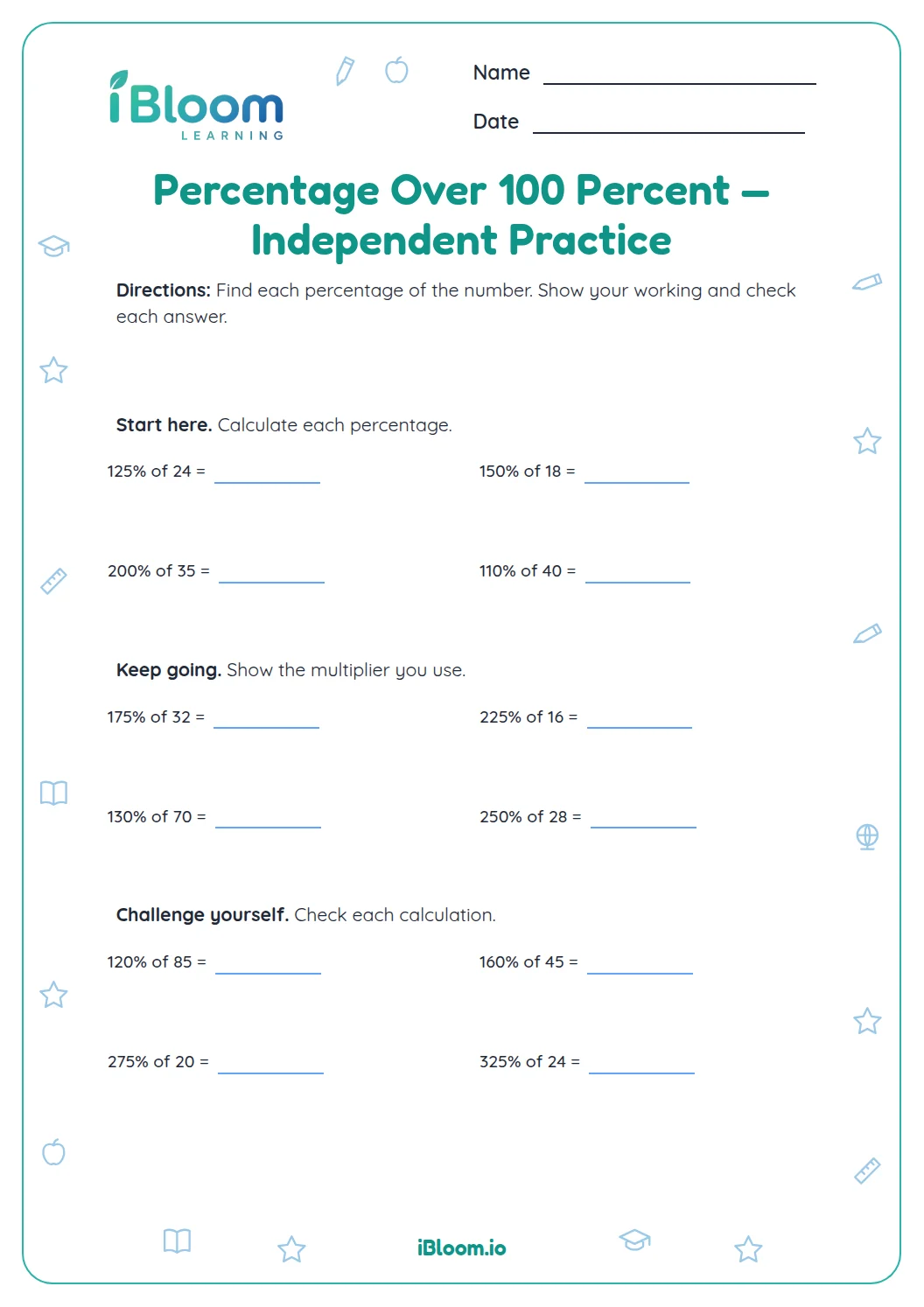

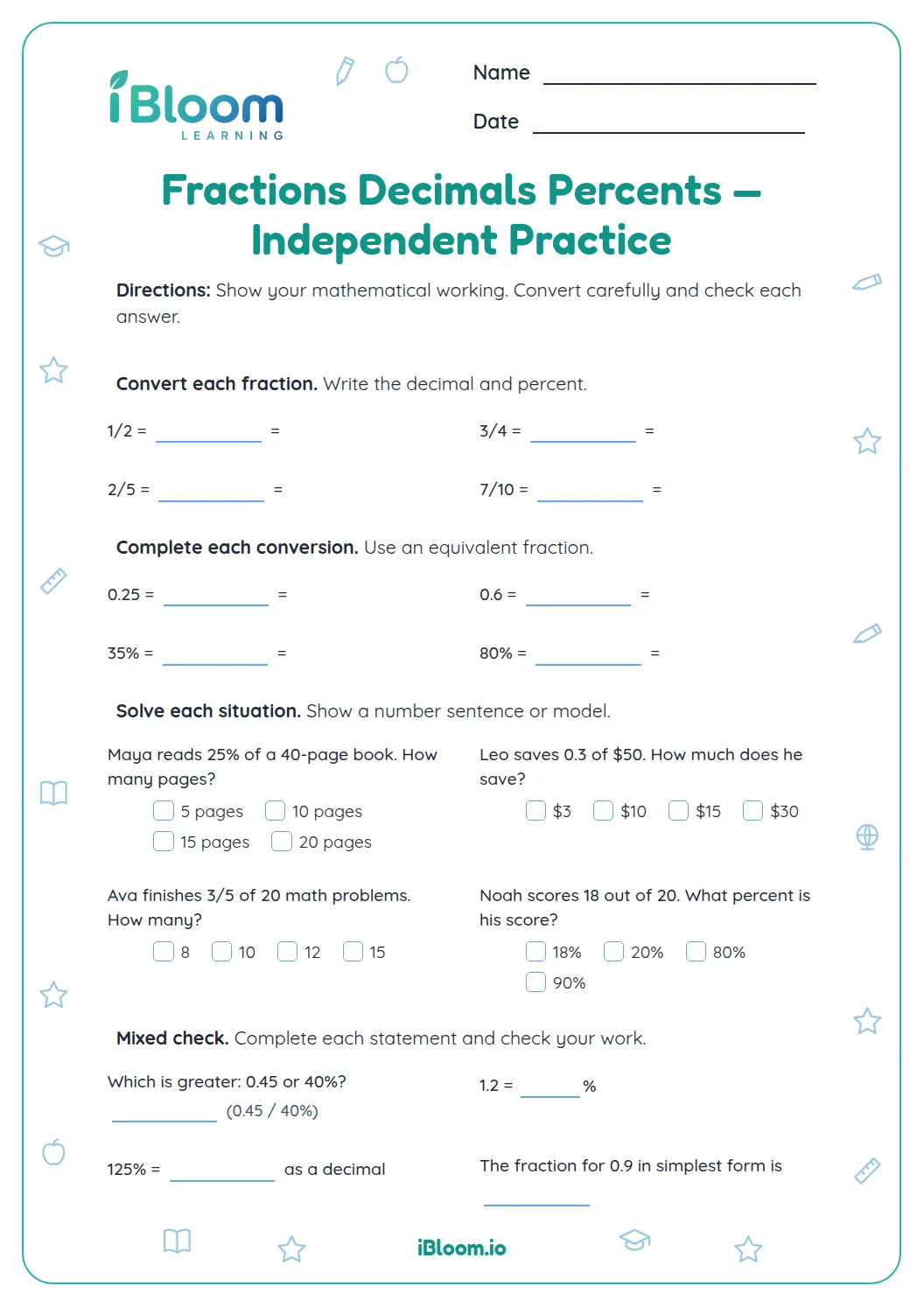

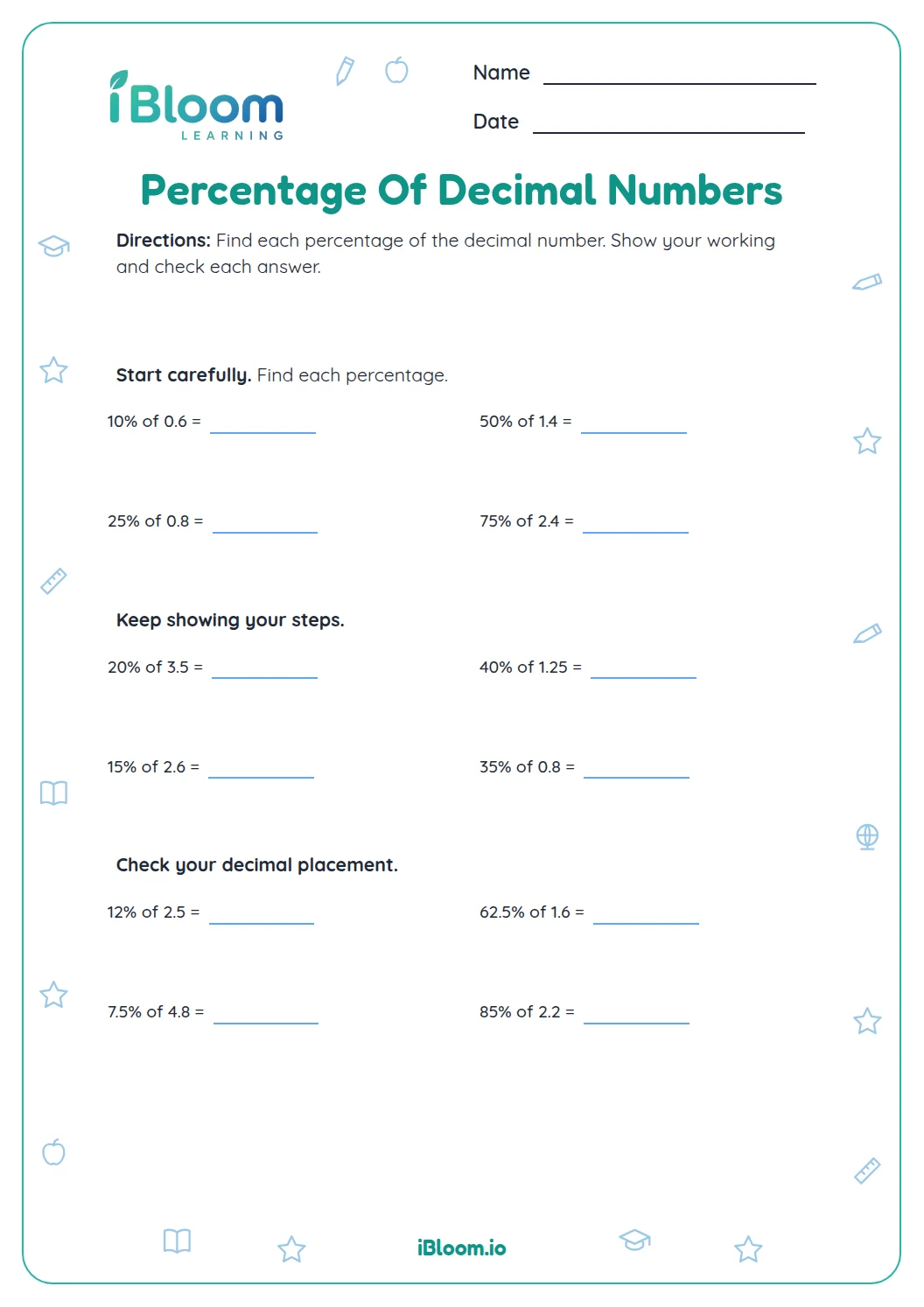
About this worksheet
This Grade 6 reasoning challenge practices converting decimals to percents and percents to decimals, including values greater than 100%. Learners complete eight decimal-to-percent conversions, four reverse conversions, and four short reasoning problems. They interpret percent as a rate per 100 and connect a percent greater than 100% to an amount greater than one whole. The work supports Common Core 6.RP.A.3.c.
Aligned to 6.RP.A.3.c
How do decimal and percent notation connect?
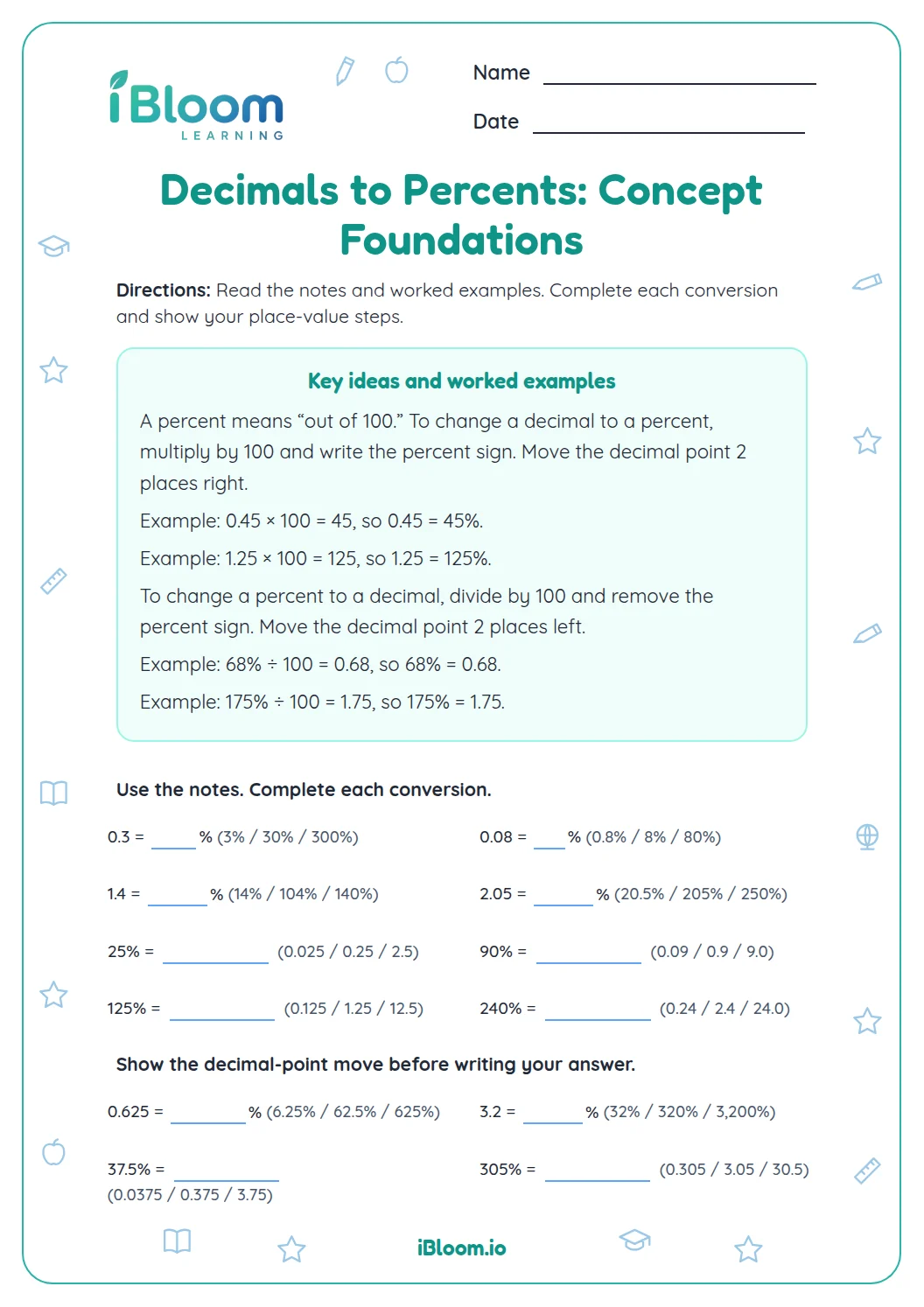
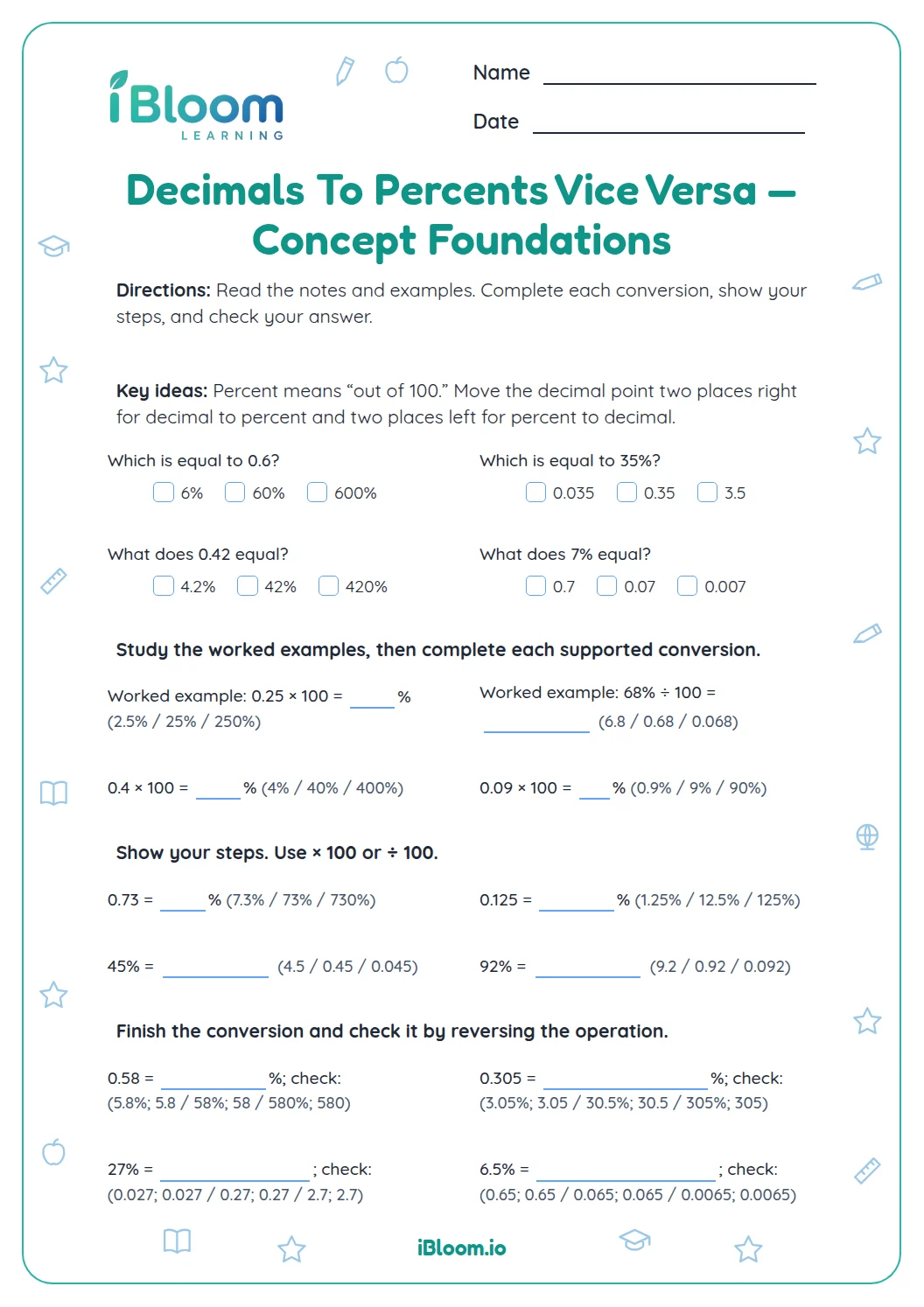
Percent means “per 100.” Multiplying a decimal by 100 gives the equivalent percent: 1.25 is 125%, and 0.37 is 37%. To change a percent to a decimal, divide by 100.
- 11.25 × 100 = 125
- 21.25 = 125%
What does a percent over 100% mean?
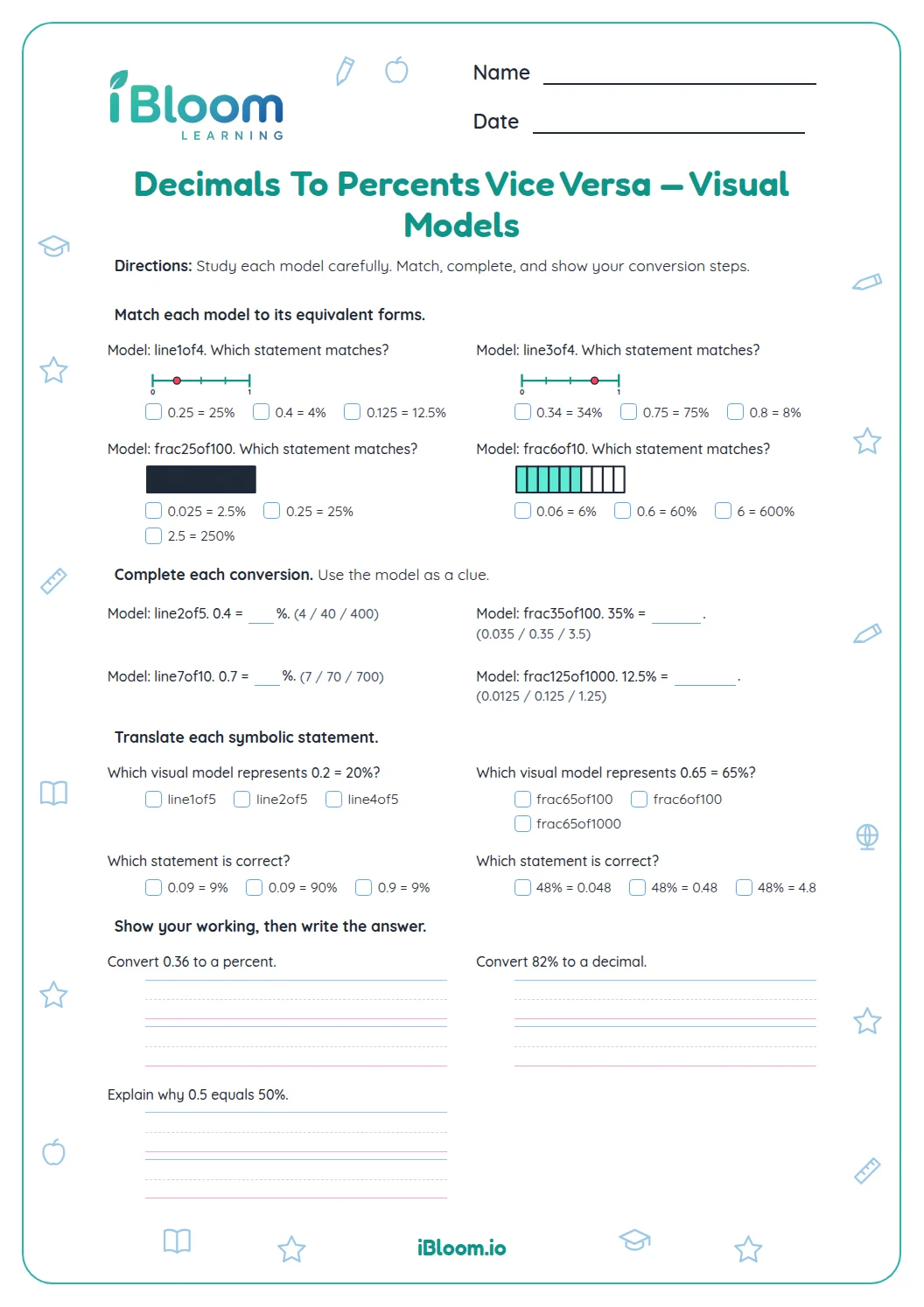
It represents more than one whole. For example, 225% means 2.25 times the whole. In a quantity situation, multiply the whole amount by 2.25 to find the represented amount.
How is the challenge organized?
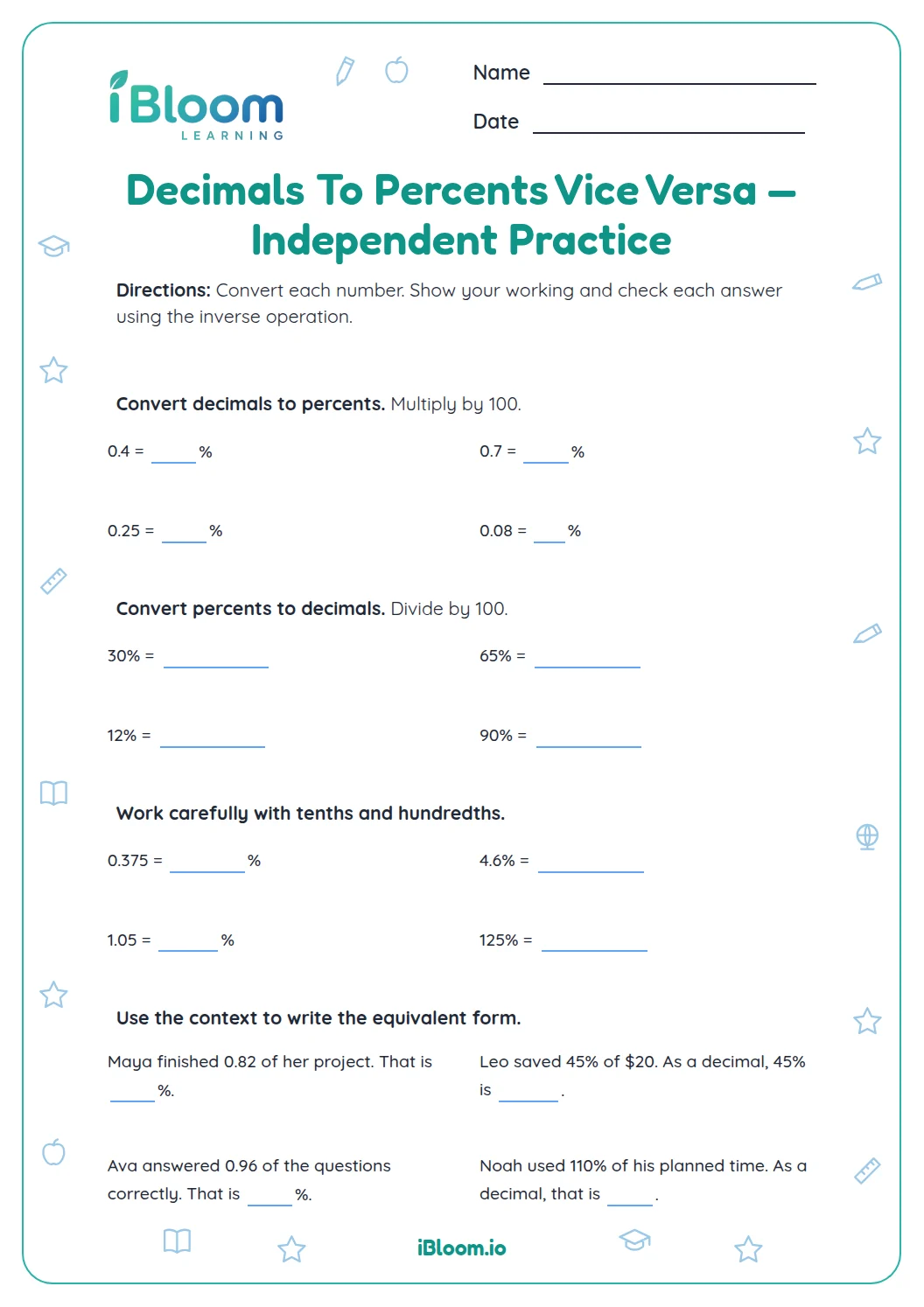
Part A converts decimals to percents, Part B converts percents to decimals, and Part C applies the relationship to comparisons and quantities.
- Part A: eight decimal-to-percent conversions
- Part B: four percent-to-decimal conversions
- Part C: four reasoning questions
How can I use this worksheet?
- 1Move the decimal point two places right when converting a decimal to a percent.
- 2Move it two places left when converting a percent to a decimal.
- 3Check that values above 1 become percents above 100%.
- 4For a percent-of-quantity question, rewrite the percent as a decimal multiplier.
- 5Use an equality check when comparing decimal and percent forms.
What should learners check?
The mistake
Moving the decimal in the same direction for both conversions.
The fix
Remember: decimal to percent moves right; percent to decimal moves left.
The mistake
Treating 125% as less than one whole.
The fix
Compare with 100%: anything above 100% is greater than one whole.
The mistake
Dropping the percent sign after a decimal-to-percent conversion.
The fix
Keep the percent sign to show the answer is a rate per 100.
Common Core alignment
The conversions help interpret percentages as rates per 100 in quantity situations.
Use percent as a rate per 100 to compare and solve quantity problems.
On this sheet: Use percent as a rate per 100 to compare and solve quantity problems.
Show the official wordingHide the official wording
Find a percent of a quantity as a rate per 100 (e.g., 30% of a quantity means 30/100 times the quantity); solve problems involving finding the whole, given a part and the percent.
What to practice next
Make more practice
Questions parents and teachers ask
What does a percent greater than 100% mean?
A percent greater than 100% represents more than one whole. For example, 160% is 1.6 times the whole, and 225% is 2.25 times the whole. Part C asks learners to connect that notation to quantities and equivalent decimals. The conversions reinforce that relationship.
How many conversion questions are included?
There are 12 direct conversions: eight decimals to percents and four percents to decimals. Four additional reasoning questions apply those conversions to comparisons and amounts. A separate answer key is included. The mix gives learners repeated conversion practice before they apply the relationship to equality and quantity reasoning.
How do I move between decimal and percent form?
To write a decimal as a percent, multiply by 100 and include the percent sign. To write a percent as a decimal, divide by 100 and remove the sign. The decimal point moves two places in opposite directions for the two conversions.
Why is 0.045 equal to 4.5%?
Multiplying 0.045 by 100 gives 4.5, so the percent form is 4.5%. The digits shift two places to the left in the written numeral, while the value is expressed in units per hundred. For example, 4.5% is 4.5 per 100, which is 0.045 as a decimal. The decimal and percent forms name the same amount.
How does the worksheet connect percent to an amount?
One problem asks learners to find 225% of 0.4 liter. Since 225% is 2.25, multiply 0.4 by 2.25 to get 0.9 liter. This shows that a percentage above 100% can describe more than the starting whole. Learners can write 225% as 2.25, then multiply by the given capacity. That calculation gives 0.9 liter, more than the original 0.4-liter capacity.
What should I check when reviewing the answers?
Check both the decimal-point movement and the notation. A decimal-to-percent answer needs a percent sign; a percent-to-decimal answer does not. Also check that results greater than one whole are greater than 100%. The two directions undo each other: multiplying a decimal by 100 produces a percent, and dividing that percent by 100 returns to the starting decimal.