

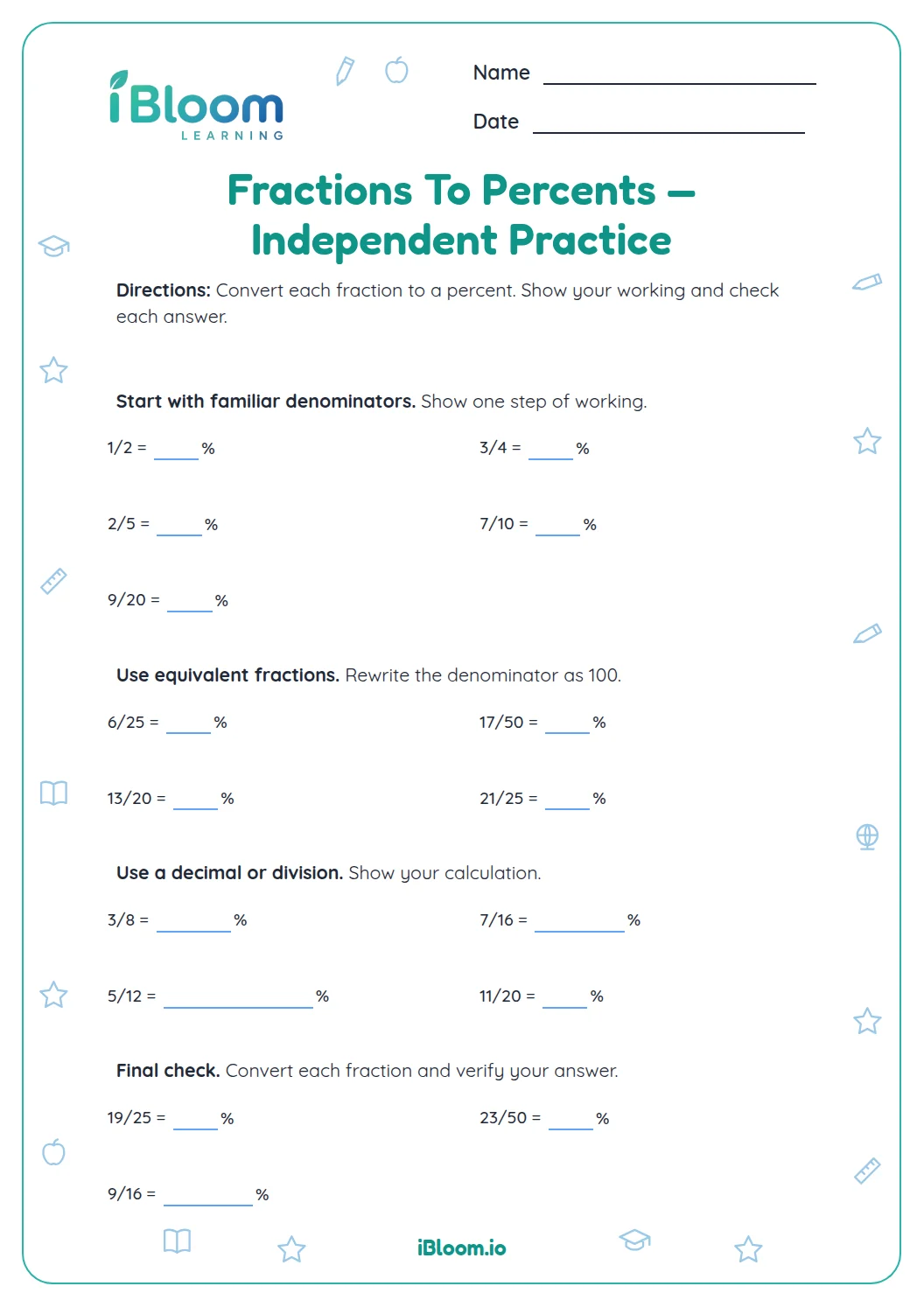

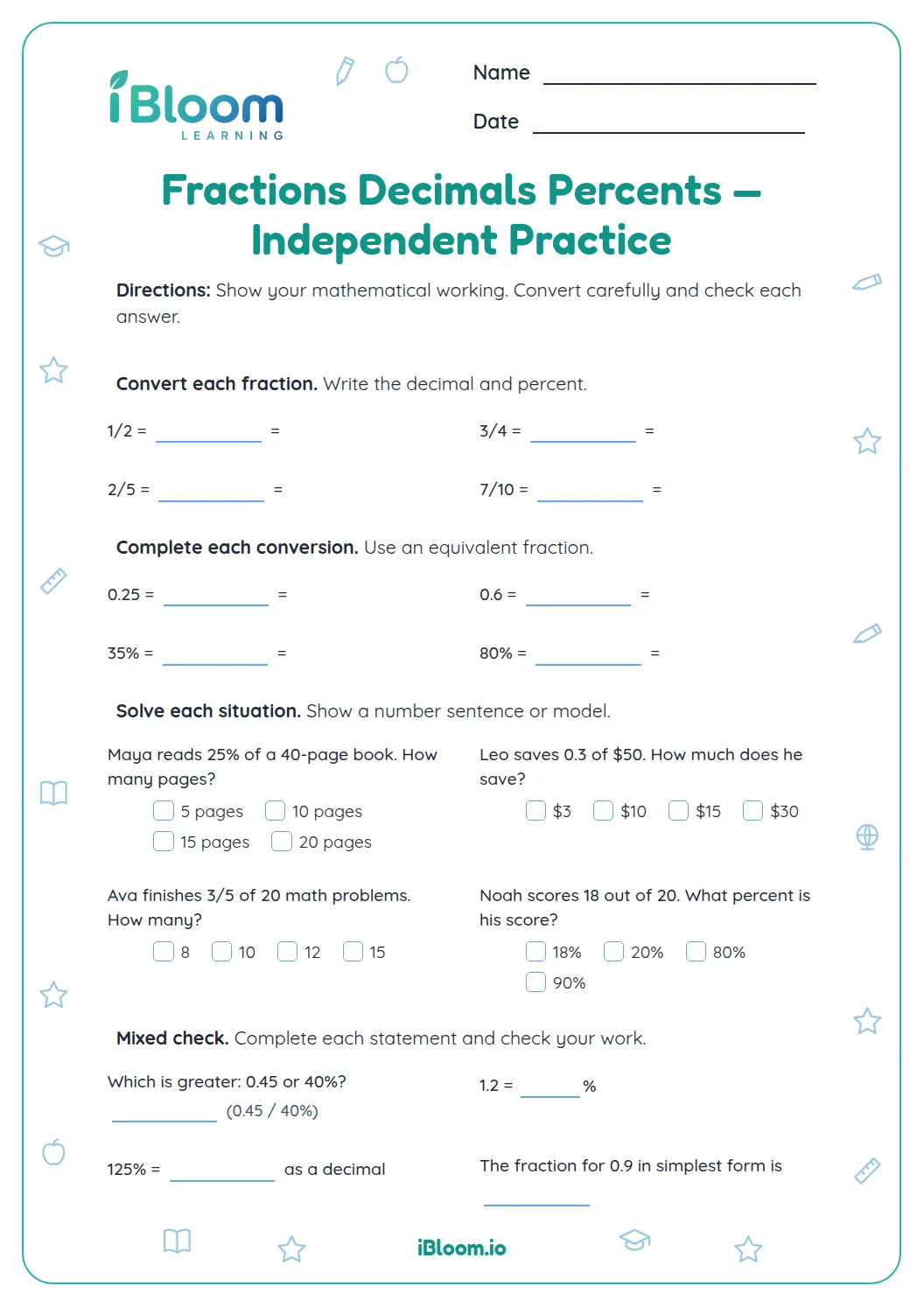
About this worksheet
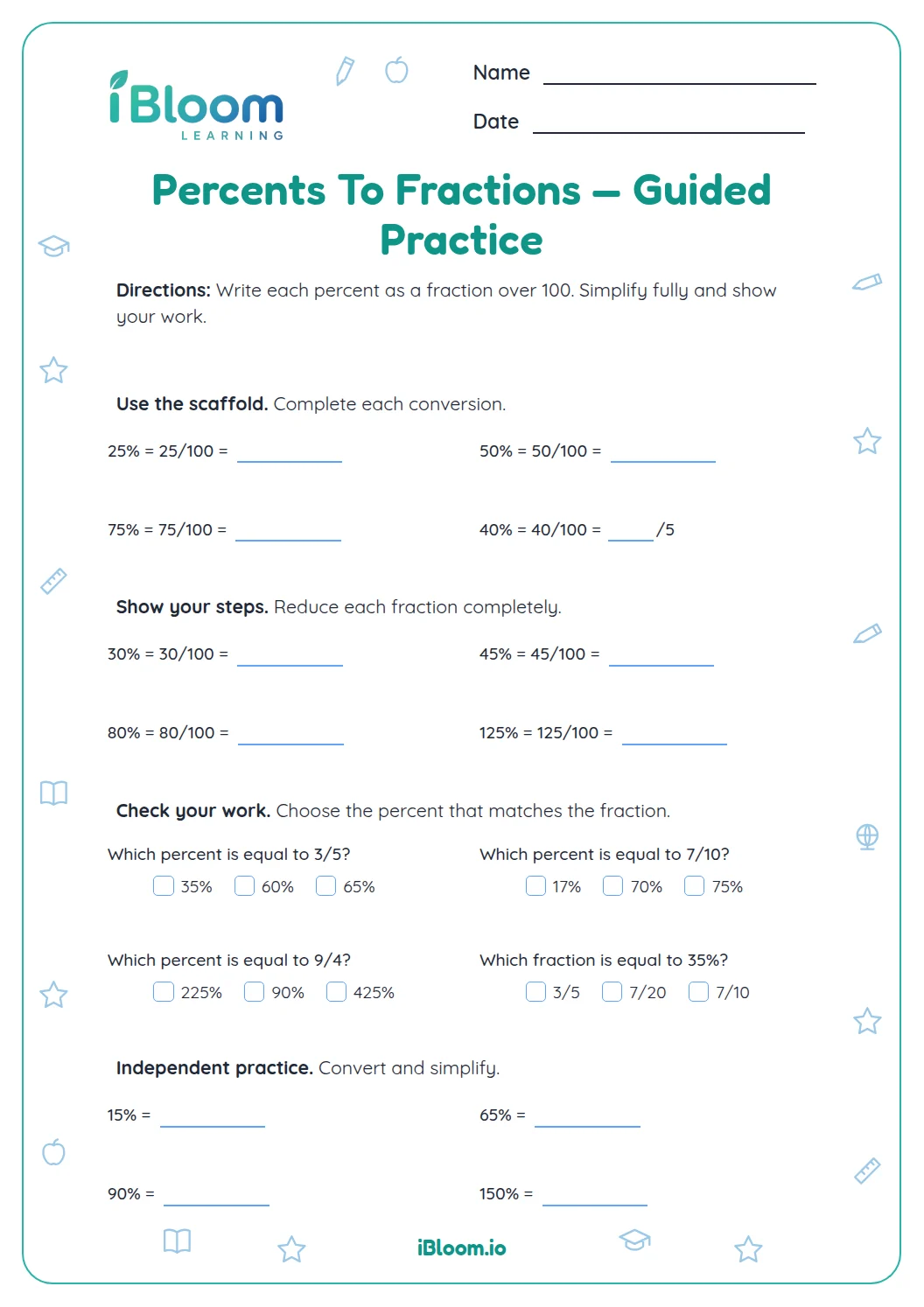
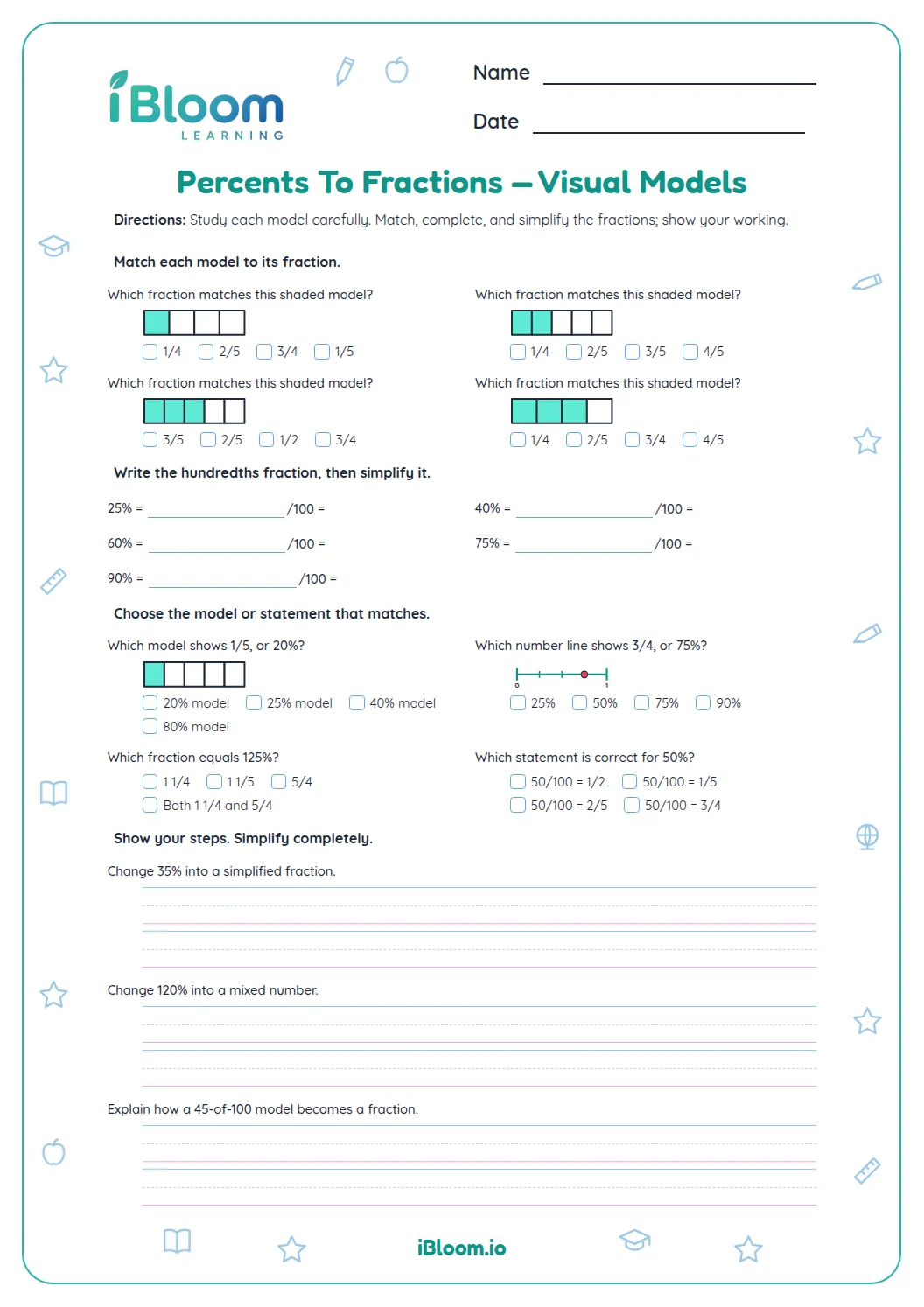
Percent means “out of 100.” Write the percent over 100, then reduce the fraction. For 40%, write 40/100 and divide both numbers by 20 to get 2/5. The sheet begins with direct conversions, then asks students to simplify, compare a fraction and a percent, and solve brief applications.
Aligned to 6.RP.A.3.c
Why does a percent become a fraction over 100?
The percent sign means “per hundred,” so 25% begins as 25/100. Reduce the fraction by dividing its numerator and denominator by the same factor.
- 125% = 25/100
- 2Divide both terms by 25.
- 325% = 1/4
How do students simplify the fraction?
Look for a common factor in the numerator and denominator. For question 6, 36% becomes 36/100; dividing both numbers by 4 gives 9/25. The simplified fraction keeps the same value as the starting percent.
- Write the percent over 100.
- Divide top and bottom by the same common factor.
Where do students use percents in context?
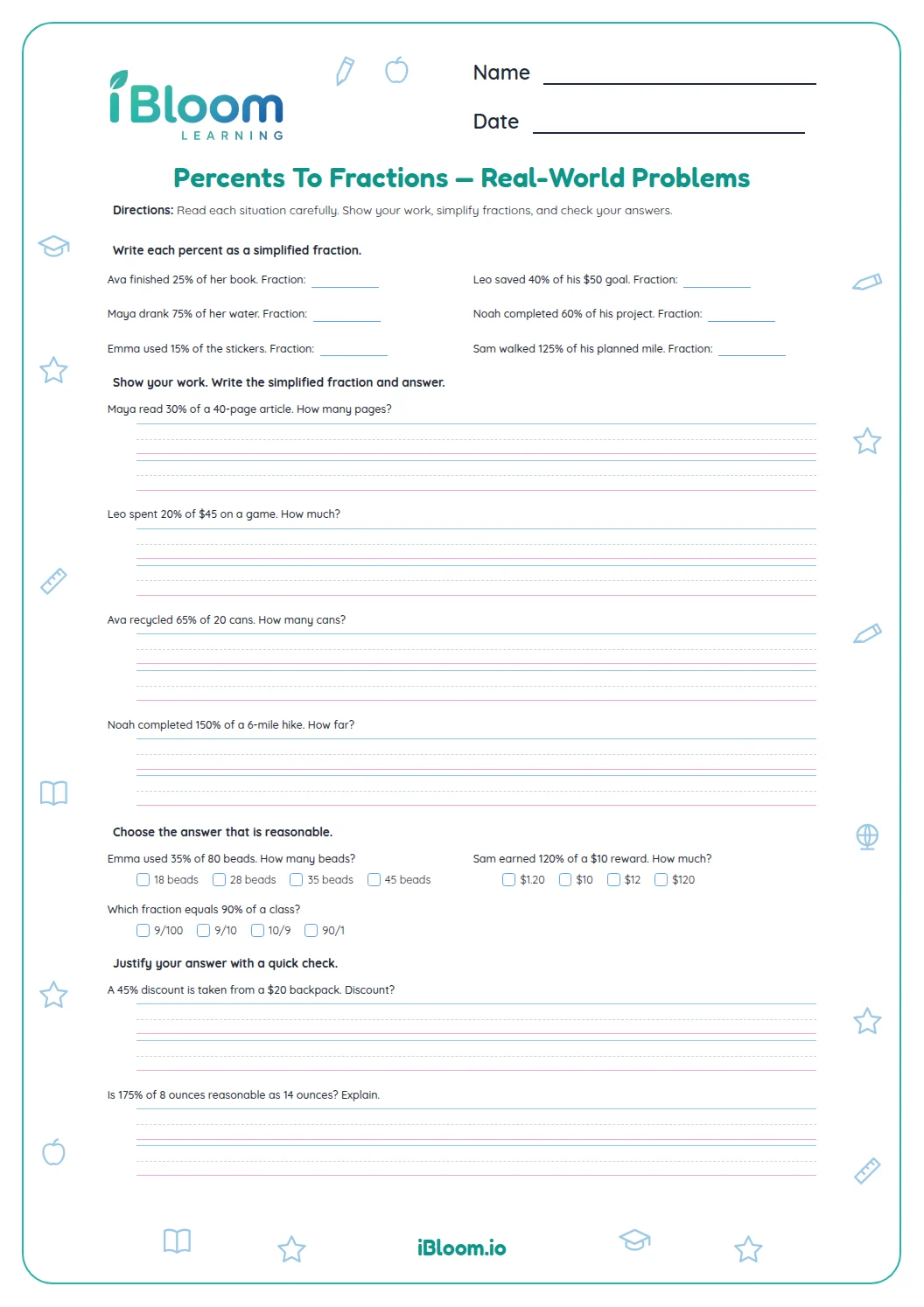
Part C connects the conversion idea to a group and a completed set of tasks. In question 15, 12 of 15 tasks are complete, so 12/15 simplifies to 4/5, or 80%.
How to use this worksheet
- 1Write the percent as a fraction with 100 as the denominator.
- 2Find a common factor shared by the numerator and 100.
- 3Divide the numerator and denominator by that same factor.
- 4For a percent of a group, multiply the group size by the percent written as a fraction.
- 5Check that the simplified fraction is equivalent to the starting percent.
Common mistakes and quick fixes
The mistake
Writing 8% as 8/10.
The fix
Percent means per 100, so start with 8/100.
The mistake
Dividing only the numerator when simplifying 40/100.
The fix
Use the same factor on both numbers: 40 ÷ 20 and 100 ÷ 20.
The mistake
Reading 125% as less than one whole.
The fix
Since 125 is greater than 100, 125/100 is greater than 1.
Curriculum alignment
Students use percent as a rate per 100 to solve two percent situations.
Find a percent of a quantity and solve problems involving percents.
On this sheet: The two final questions find a percent of a group and identify the percent represented by a part and whole.
Show the official wordingHide the official wording
Find a percent of a quantity as a rate per 100 (e.g., 30% of a quantity means 30/100 times the quantity); solve problems involving finding the whole, given a part and the percent.
What to practice next
Make more practice
Questions parents and teachers ask
How do I turn a percent into a fraction?
Write the number before the percent sign over 100, then simplify. For example, 36% becomes 36/100. Divide both numbers by 4 to get 9/25, an equivalent fraction in simplest form. The worksheet uses this same conversion idea in several forms, so students can compare equivalent values.
Why is the denominator 100?
The word percent means “per hundred.” That is why 18% can first be written as 18/100. The fraction can then be simplified while keeping its value the same. The worksheet uses this same conversion idea in several forms, so students can compare equivalent values.
Can a percent make an improper fraction?
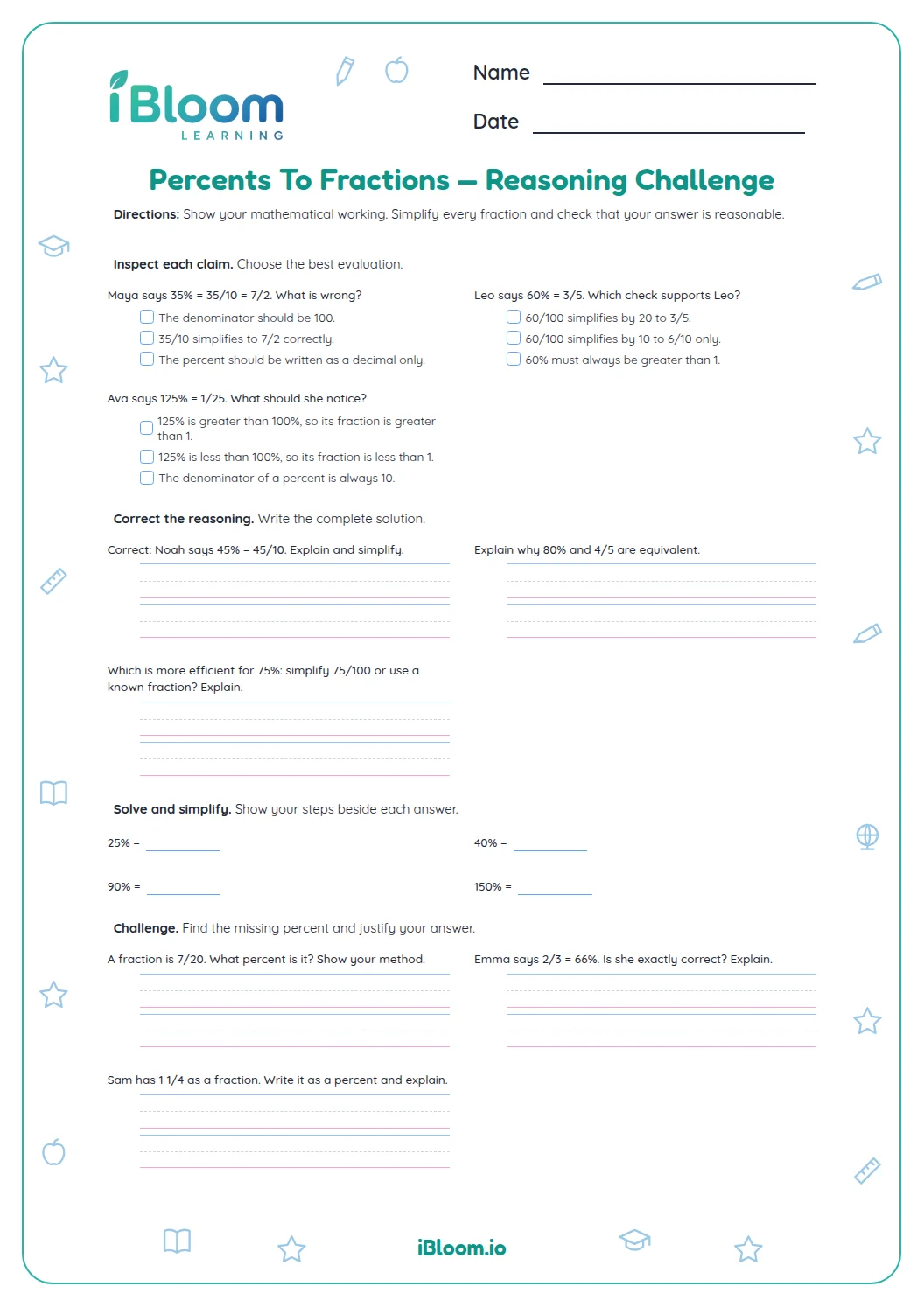
Yes. A percent above 100 is greater than one whole, so its fraction can be improper. For example, 125% is 125/100, which simplifies to 5/4. The worksheet uses this same conversion idea in several forms, so students can compare equivalent values.
How can I check a simplified fraction?
Multiply the numerator and denominator by the same number to see whether you return to the fraction over 100. For 2/5, multiplying both parts by 20 gives 40/100, or 40%. The worksheet uses this same conversion idea in several forms, so students can compare equivalent values.
What does the club question ask students to find?
It asks for 35% of 40 members. Since 35% is 35/100, students can find 0.35 × 40, which is 14 members. The unit helps make clear that the answer is a count of people. The worksheet uses this same conversion idea in several forms, so students can compare equivalent values.
Is an answer key included?
Yes. The separate answer key gives the simplified fractions, comparison, and application answers. Students can finish the questions first, then use the key to check the equivalent forms and calculations. The worksheet uses this same conversion idea in several forms, so students can compare equivalent values.