
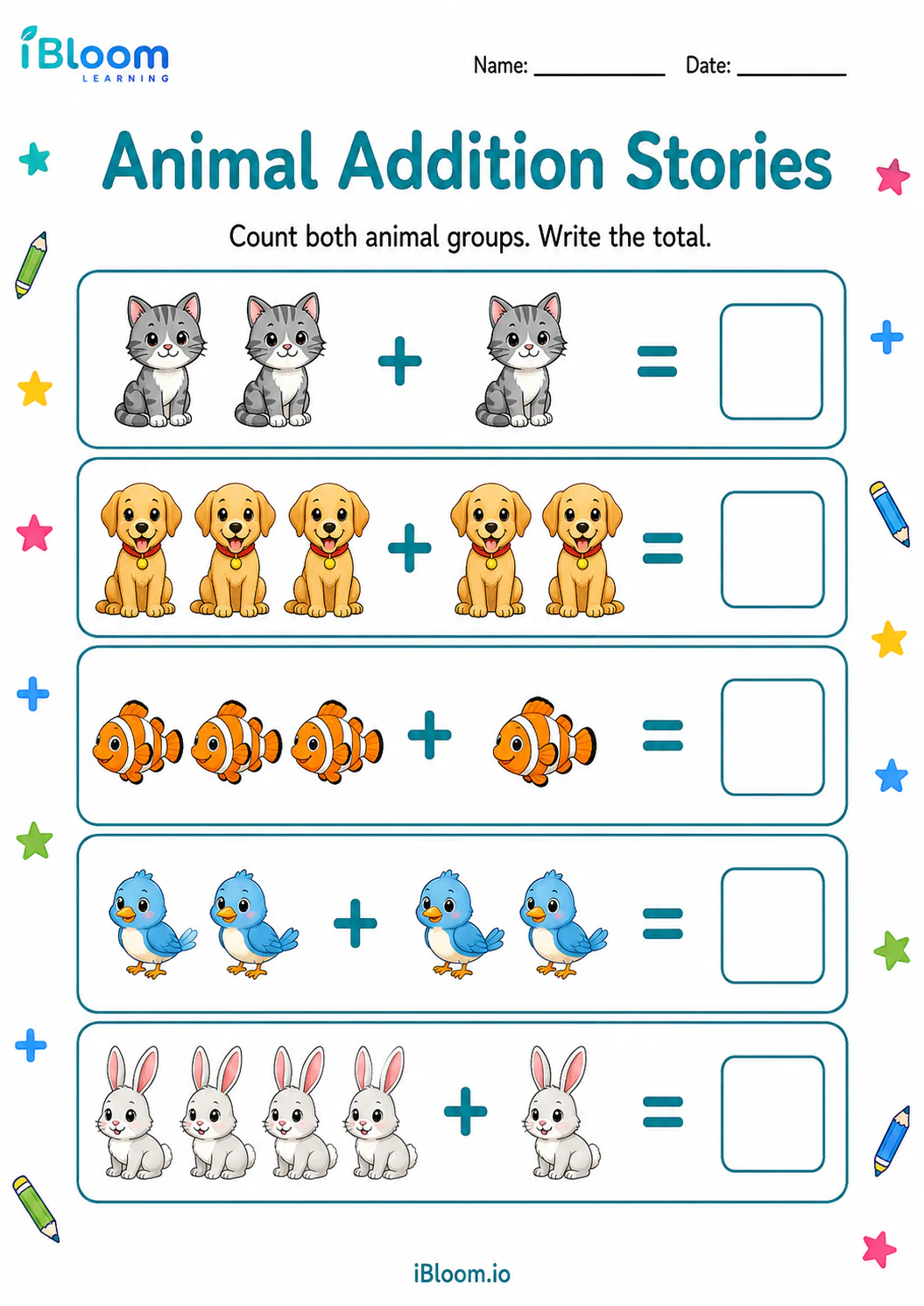
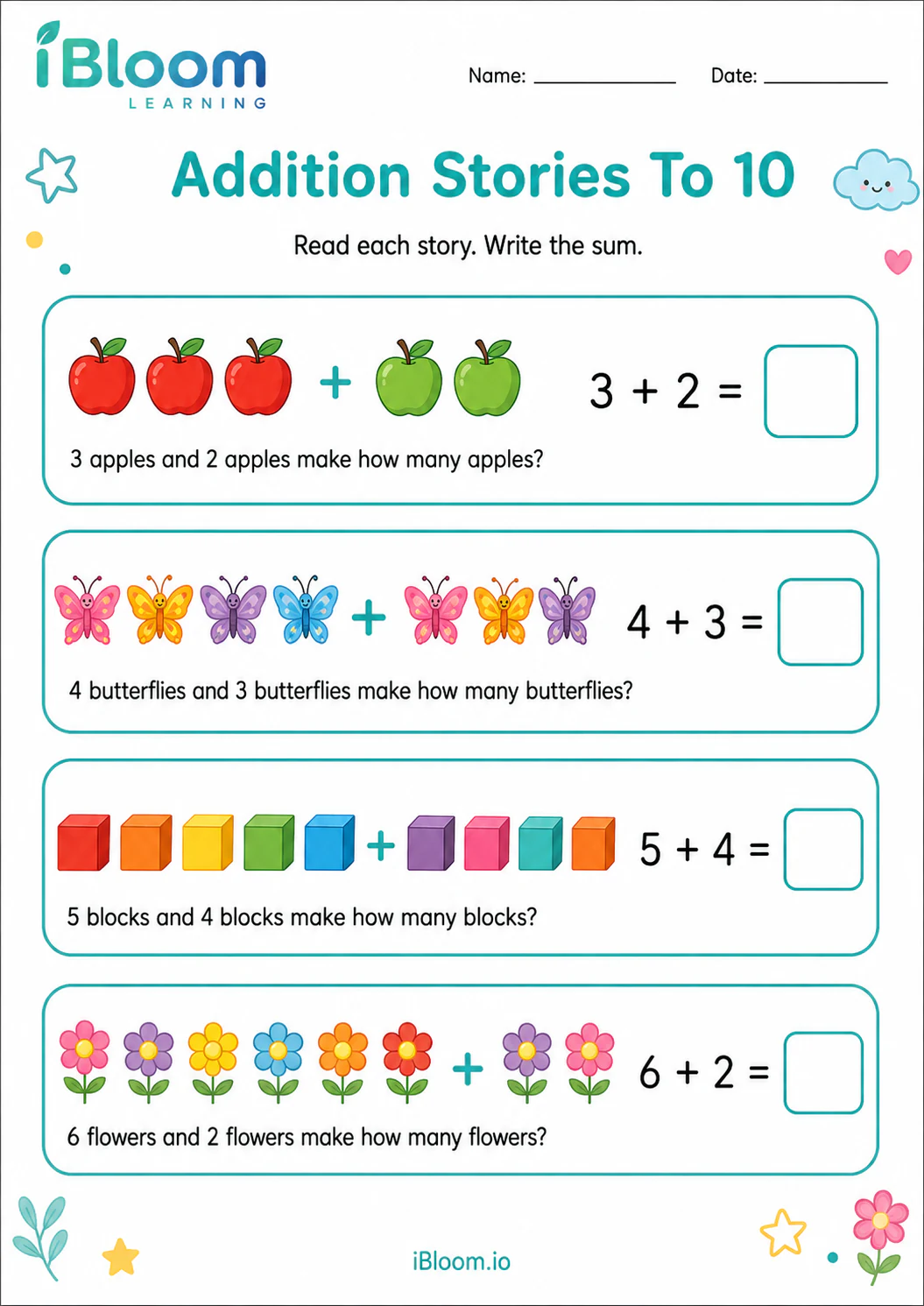
About this worksheet
This Kindergarten printable gives students 20 addition equations with sums from 0 to 5. The facts include zero, doubles, and pairs that make five, so children can practice finding a total and writing it in the blank. The two worksheet pages are followed by a separate answer key. Students can use counters or fingers to represent the addends before recording each sum. The work practices addition within 5, aligned to CCSS K.OA.A.2.
Aligned to K.OA.A.2
Which addition facts are included?
The 20 equations include zero facts such as 5 + 0, doubles such as 2 + 2, and combinations such as 2 + 3 that make five. Every total is between 0 and 5.
How can a student find a sum?
Think of each addend as a group. Count the first group, then continue counting by the number in the second group.
- 12 + 3 = ___
- 2Start at 2 and count on three: 3, 4, 5.
- 3So 2 + 3 = 5.
What does adding zero mean?
Adding zero leaves the group unchanged. In 5 + 0, there are still five altogether; in 0 + 2, the total is two.
How can an adult support this practice?
Use five counters or fingers to show the two addends. Have the student push the groups together, count the total, and then write the number in the blank.
How to use this worksheet
- 1Read the first addend.
- 2Show that many counters or fingers.
- 3Add the second group.
- 4Count all the objects to find the total.
- 5Write the total and check the equation.
Mistakes to watch for
The mistake
Counting the first group twice when counting on.
The fix
Say the first addend, then count on from the next number.
The mistake
Thinking that adding zero changes the total.
The fix
Keep the same number; zero adds no objects.
The mistake
Writing one addend instead of the total.
The fix
Count both groups together before filling in the blank.
Common Core alignment
This worksheet practices the following Common Core skill.
Practice addition equations with totals to 5, within the standard’s range of 10.
On this sheet:
Show the official wordingHide the official wording
Solve addition and subtraction word problems, and add and subtract within 10, e.g., by using objects or drawings to represent the problem.
What to practice next
Make more practice
Further reading
Questions parents and teachers ask
What is on this addition facts to 5 worksheet?
The two student pages contain 20 addition equations with totals from 0 to 5, including zero facts, doubles, and combinations that make five. The separate key lists every total so families can check the completed practice together. The examples stay within the title range.
Does the worksheet have an answer key?
Yes. The answer key lists the total for all 20 equations on separate pages after the student sheet. Students can finish one row, check it, and retry any fact they missed before moving on to the next group.
How can I teach a child to solve these facts?
Use counters, small toys, or fingers to show each addend as a group. Put the groups together, count all of them, and write the total. For small sums, a child may also count on from the first addend.
What does adding zero mean?
Adding zero means no more objects are added, so the amount stays the same. For example, 4 + 0 is still 4, while 0 + 2 is 2. Invite the child to model both equations with counters. The same idea works with any set of counters.
How long does the worksheet take?
Plan for about 15 minutes, with time for counting objects or talking through a few facts. If the child needs more practice, finish one part and return to the remaining equations later in the day. The time can vary with the learner’s pace.