

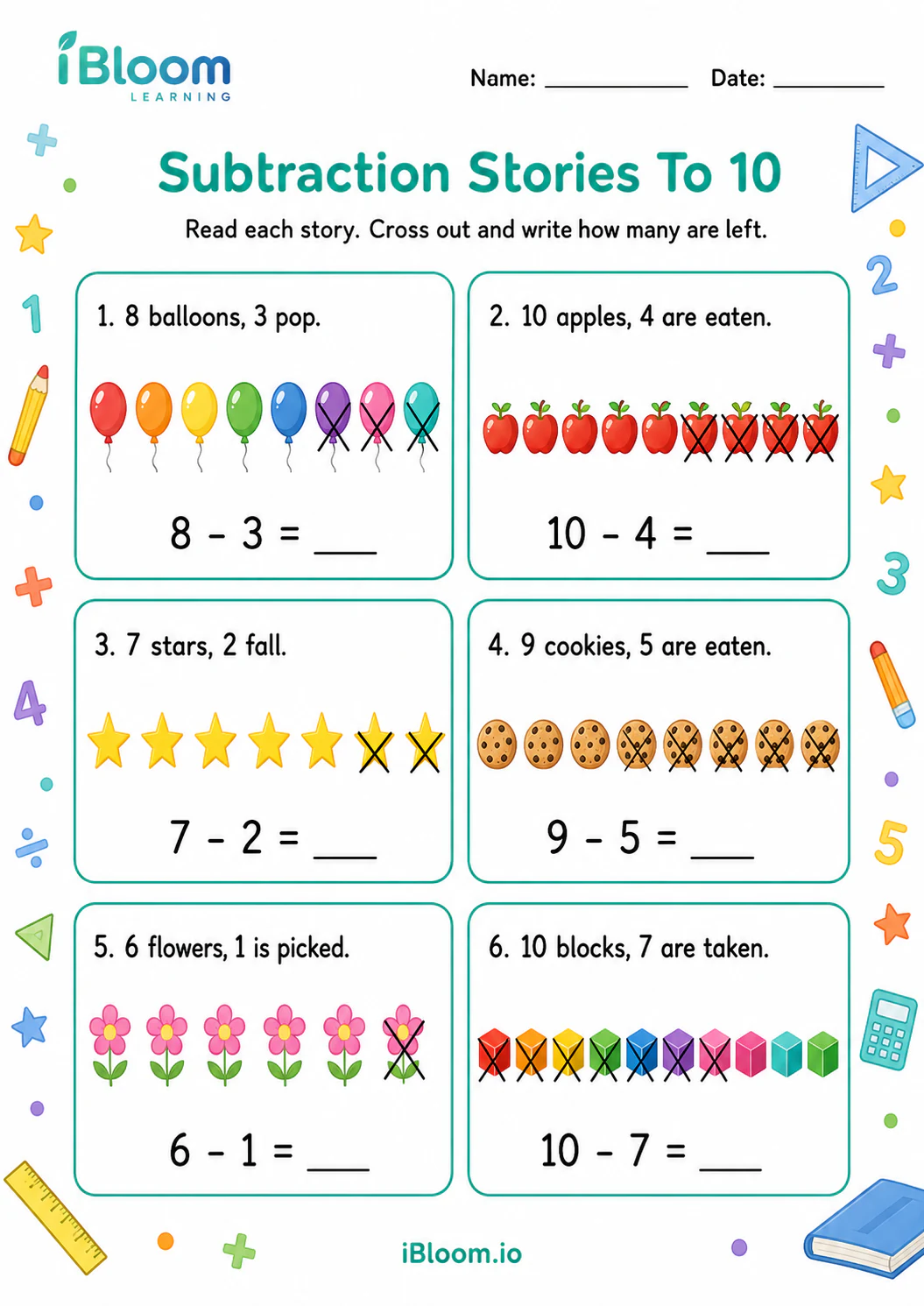
About this worksheet
This Kindergarten printable uses ten-frame counters and subtraction sentences to practice taking away within 5. Children cross out dots, count what remains and record the answer across 16 short items. It replaces the old six-card layout with a two-page set and separate answer key, aligned to CCSS K.OA.A.1.
Aligned to K.OA.A.1
How do dot cards show subtraction?
The full group shows the starting number. Cross out the dots being taken away, then count the dots that remain. For question 1, start with five dots and cross out three. Two dots remain.
- 15 − 3 = 2
- 2Five dots; cross out three; two remain.
What does the learner do?
Each problem shows a small group of dots and a subtraction sentence. Children cross out the dots to match the amount taken away, then record the remaining amount. The answer key gives the number left.
How can I use this worksheet?
- 1Read the first number as the full group of counters.
- 2Cross out exactly the number being taken away.
- 3Count the counters that remain, including zero when none are left.
- 4Write the difference and compare it with the remaining counters.
Common mistakes and quick fixes
The mistake
Crossing out fewer or more counters than the subtraction number.
The fix
Touch and cross out one counter for each number taken away.
The mistake
Counting the crossed-out counters as remaining.
The fix
Count only the counters not crossed out.
The mistake
Writing the number taken away as the answer.
The fix
The answer is the number left after taking away.
Common Core alignment
Represent subtraction with counters, drawings, and equations.
On this sheet: Represent subtraction with counters, drawings, and equations.
Show the official wordingHide the official wording
Represent addition and subtraction with objects, fingers, mental images, drawings, sounds (e.g., claps), acting out situations, verbal explanations, expressions, or equations.
What to practice next
Make more practice
Further reading
Questions parents and teachers ask
Who is this worksheet for?
This worksheet is for Kindergarten learners practicing subtraction within 5. It has 16 questions across the printed practice pages and a separate answer key. A parent or teacher can review one example, then let the learner work through the parts.
How many questions are included?
There are 16 illustrated subtraction questions. Each shows counters in a ten frame and an equation, with starting amounts from one to five and take-away amounts from zero to the full group. The separate key lists how many counters remain.
Does it include an answer key?
Yes. A separate answer key follows the practice pages. Use it to check selected or computed answers after the learner finishes. For questions where the wording can vary, the key provides a sample response that shows the expected idea and reasoning.
How can I help with a missed answer?
Ask the learner to point to the part of the question that determines the answer, then work through that step together. Compare the result with the answer key and have the learner explain any correction in their own words.
Can I print the worksheet and key separately?
Yes. The worksheet and answer key are arranged on separate pages, so you can print the practice pages for the learner and keep the answers for checking. The learner can write directly on the worksheet, then review missed items with an adult.
How should a child use the dot models?
Start with the full group, cross out the number named after the minus sign, and count what remains. Each item has a ten-frame counter model and a subtraction sentence, so a learner can mark the counters directly before writing the difference.
What does a zero difference mean?
A zero difference means no counters remain after all the counters in the starting group are taken away. For example, 5 − 5 = 0. The set includes several take-away-all problems, along with other examples, so learners can compare what remains.