

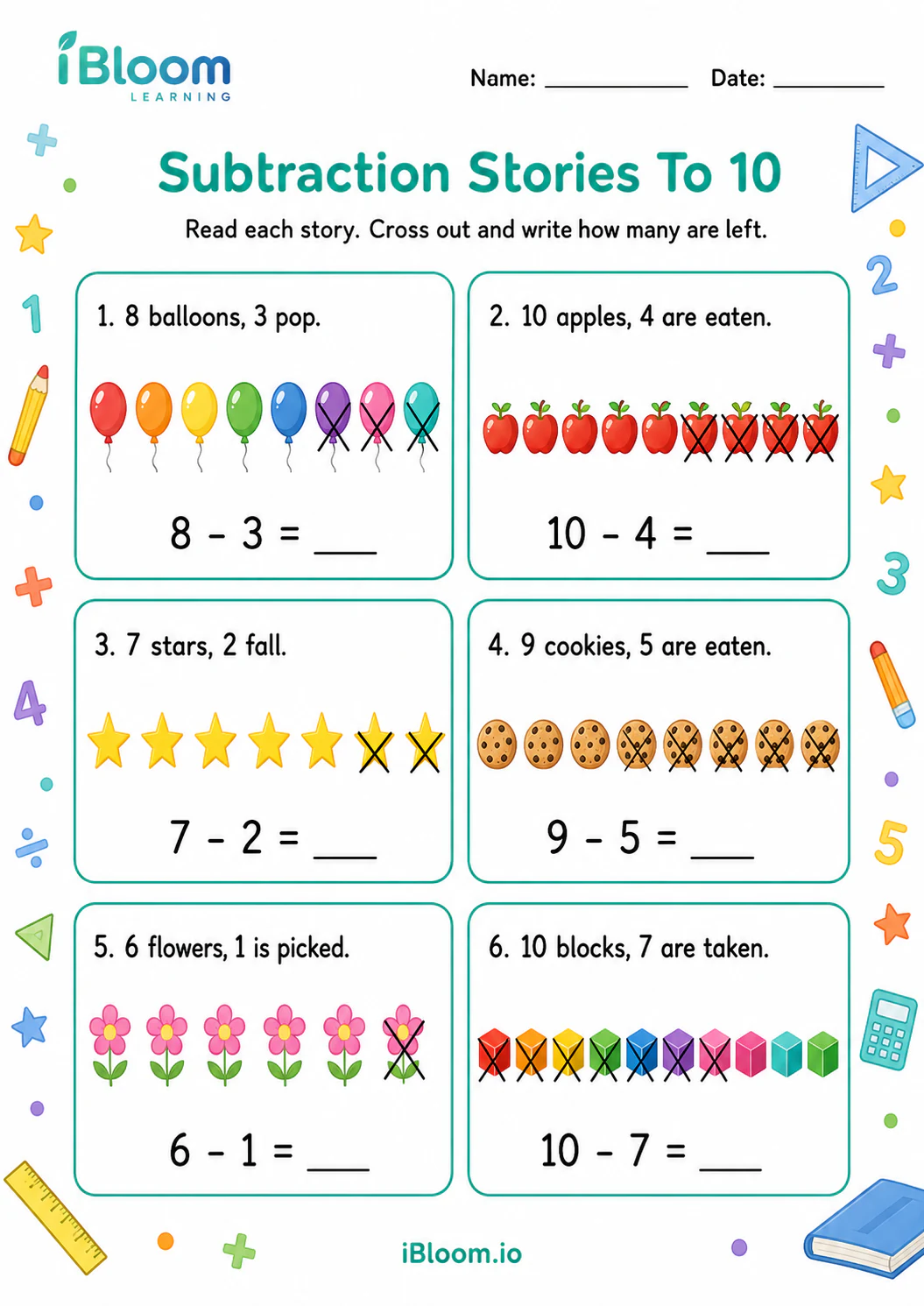
About this worksheet
This printable kindergarten worksheet practices taking away small groups within 5. Children cross out apples in picture groups and count what remains, then complete four number sentences with a missing number. The 16 questions move from visible objects to number sentences, with an answer key for checking. It offers gentle practice with subtraction as taking from a set, in line with CCSS K.OA.A.2.
Aligned to K.OA.A.2
How do pictures help with take-away?
A subtraction problem starts with a group. Cross out the items that leave, then count the uncrossed items. In question 1, five apples start the group; crossing out two leaves three.
The picture keeps the starting amount visible, so children can focus on the action of taking away.
- 1Start with 5 apples.
- 2Cross out 2 apples.
- 3Count the apples not crossed out: 3.
- 4So 5 − 2 = 3.
How do you fill in a missing number?
The last four questions use number sentences. Think about the amount taken away or the amount left, and use the same take-away idea. For 4 − ___ = 1, ask how many must leave 4 to leave 1.
What is included on the printable?
The page begins with apple pictures and ends with short number sentences. The separate key lists each answer in order.
- Questions 1–12: picture subtraction within 5
- Questions 13–16: missing numbers in take-away sentences
- A separate answer key page
How to use the worksheet
- 1Point to and count the whole apple group before crossing anything out.
- 2Read the take-away amount aloud and cross out exactly that many apples.
- 3Count only the apples still visible and say the subtraction sentence.
- 4For the number sentences, use fingers or draw a small group if needed.
- 5Check answers with the key and revisit any problem where the crossed-out count changed.
Common subtraction slips
The mistake
Crossing out the starting amount instead of the amount being taken away.
The fix
Touch each item as you cross it out and stop at the take-away number.
The mistake
Counting crossed-out apples as still remaining.
The fix
Count only the apples that are not crossed out.
The mistake
Writing the starting amount as the answer.
The fix
After crossing out, recount the objects that remain.
Common Core alignment
This page practices early subtraction as taking objects from a group.
Solve subtraction problems within 10 using objects or drawings.
On this sheet: The apple groups model taking objects away, and the last problems record subtraction within 5.
Show the official wordingHide the official wording
Solve addition and subtraction word problems, and add and subtract within 10, e.g., by using objects or drawings to represent the problem.
What to practice next
Make more practice
Further reading
Questions parents and teachers ask
What does this worksheet teach?
Children start with a group of up to five apples, cross out the stated number, and count what remains. Four final number sentences ask for a missing amount. Ask the child to recount only the apples that stay in the group.
How many questions are on the page?
There are 16 questions: 12 picture take-away problems and four missing-number sentences. The pictured groups include examples that leave zero, so children can see that taking away every item leaves none. Which picture would you like to solve together first?
Should an adult read the directions?
Read the direction together, then model crossing out two apples in the first problem. Count the uncrossed apples aloud and write the answer. After the child understands the action, invite them to try the remaining groups with less help.
What is the answer to 5 − 2?
For 5 − 2, begin with five apples and remove two. Three apples remain, so the difference is 3. The same idea works with the pictures and the final number sentences: start with a whole, take away, and find what is left.
Is there an answer key?
Yes. The key lists answers for all 16 items on a separate page. Use it after the child has counted or completed a sentence, and revisit any picture where the crossed-out amount and remaining amount were confused. Ask the child to explain how the key helped them find an answer.