
About this worksheet
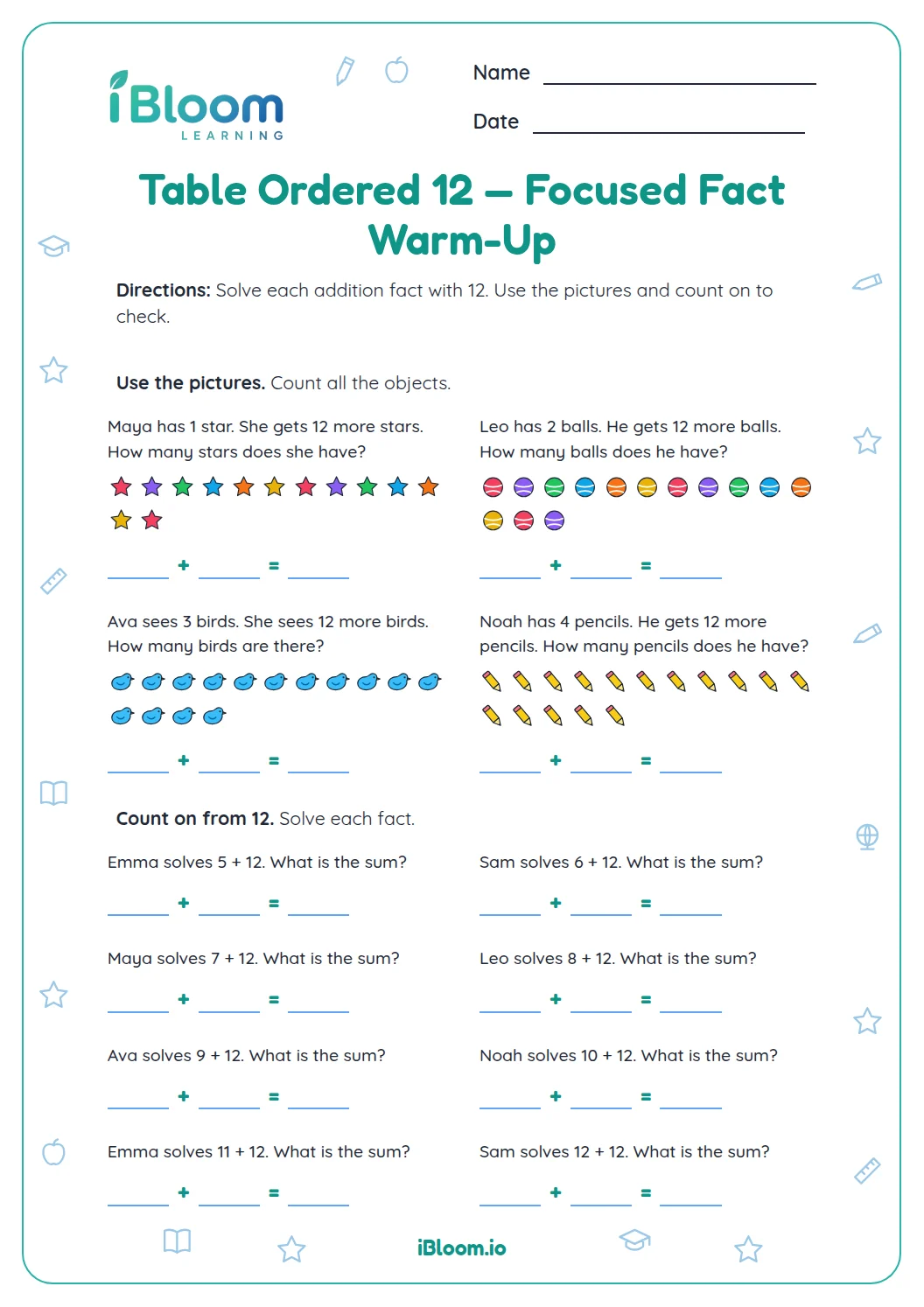
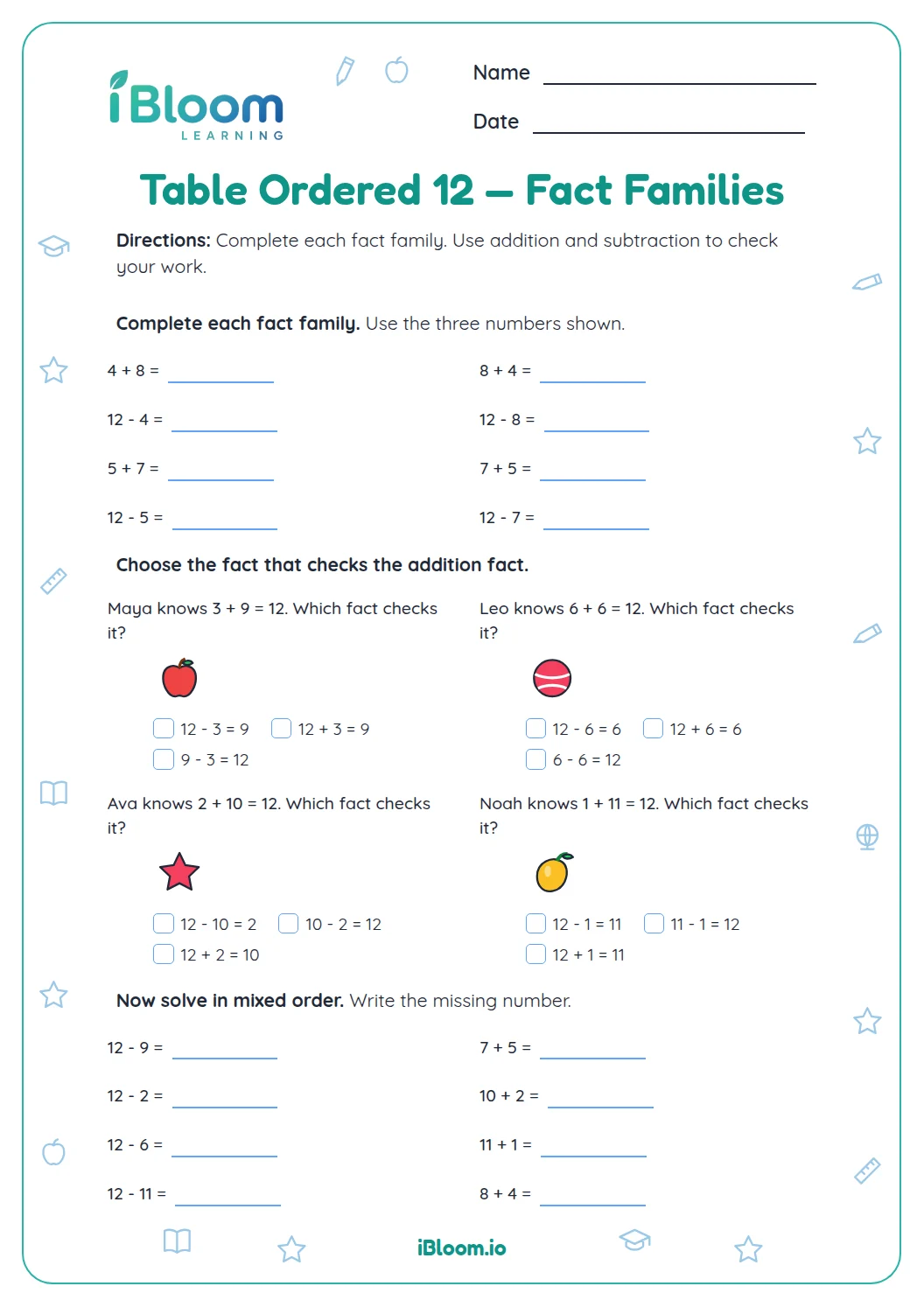
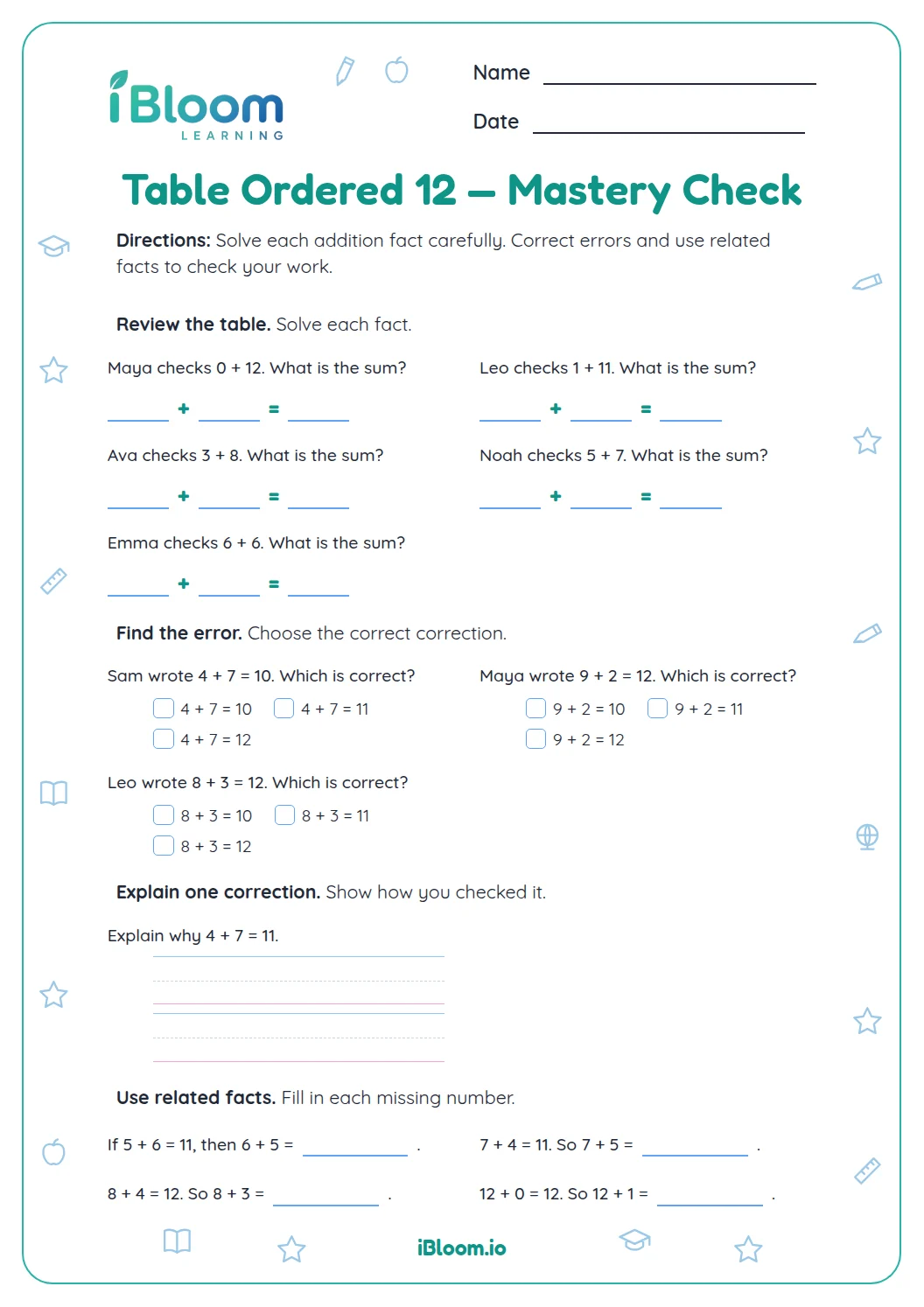
This two-part drill moves from an ordered sequence of addition facts to mixed missing spots. Learners decide whether the blank is an addend or the sum, then use a known fact to complete it.
Aligned to 1.OA.D.8 and 2.OA.B.2
What does the addition drill include?
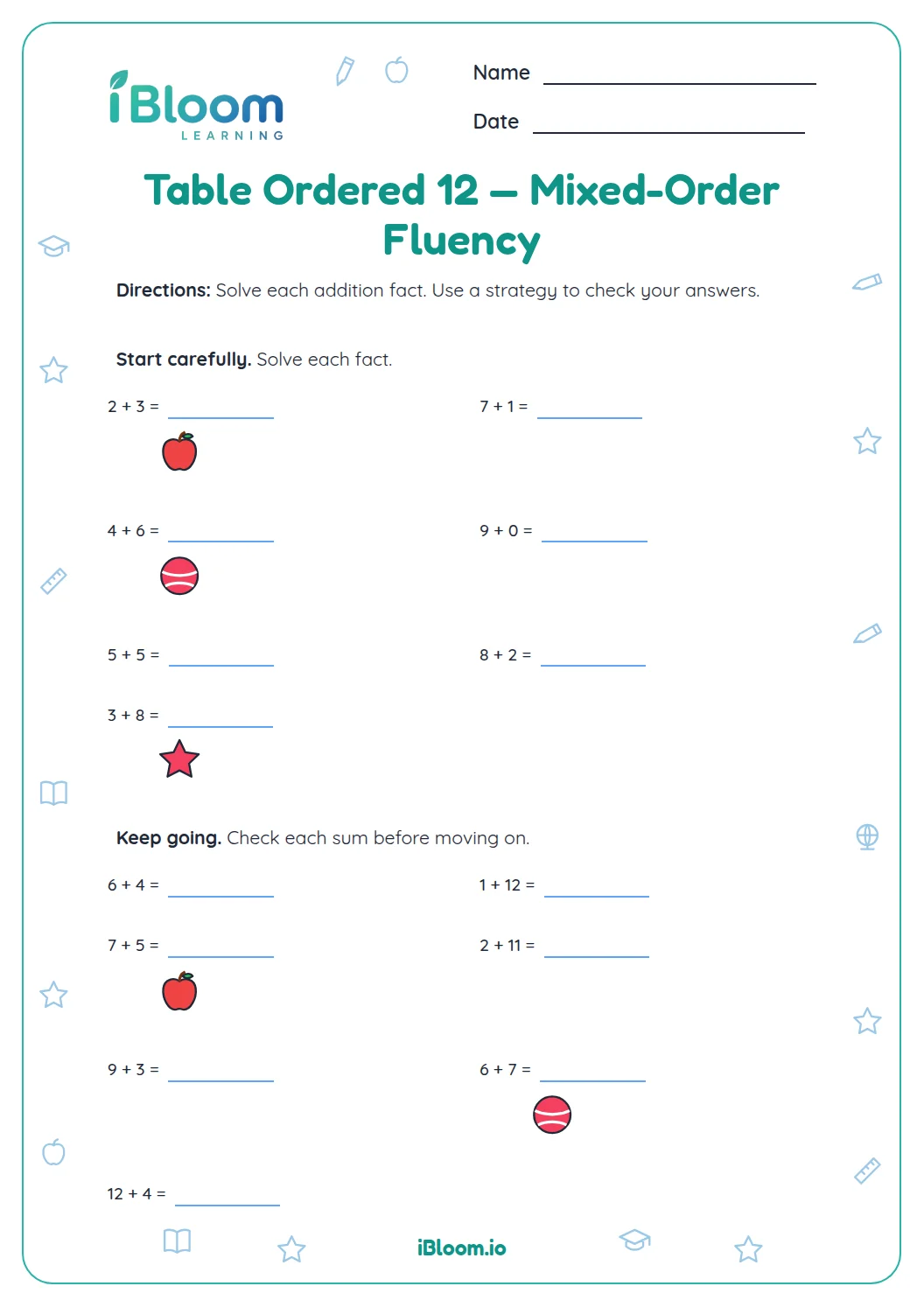
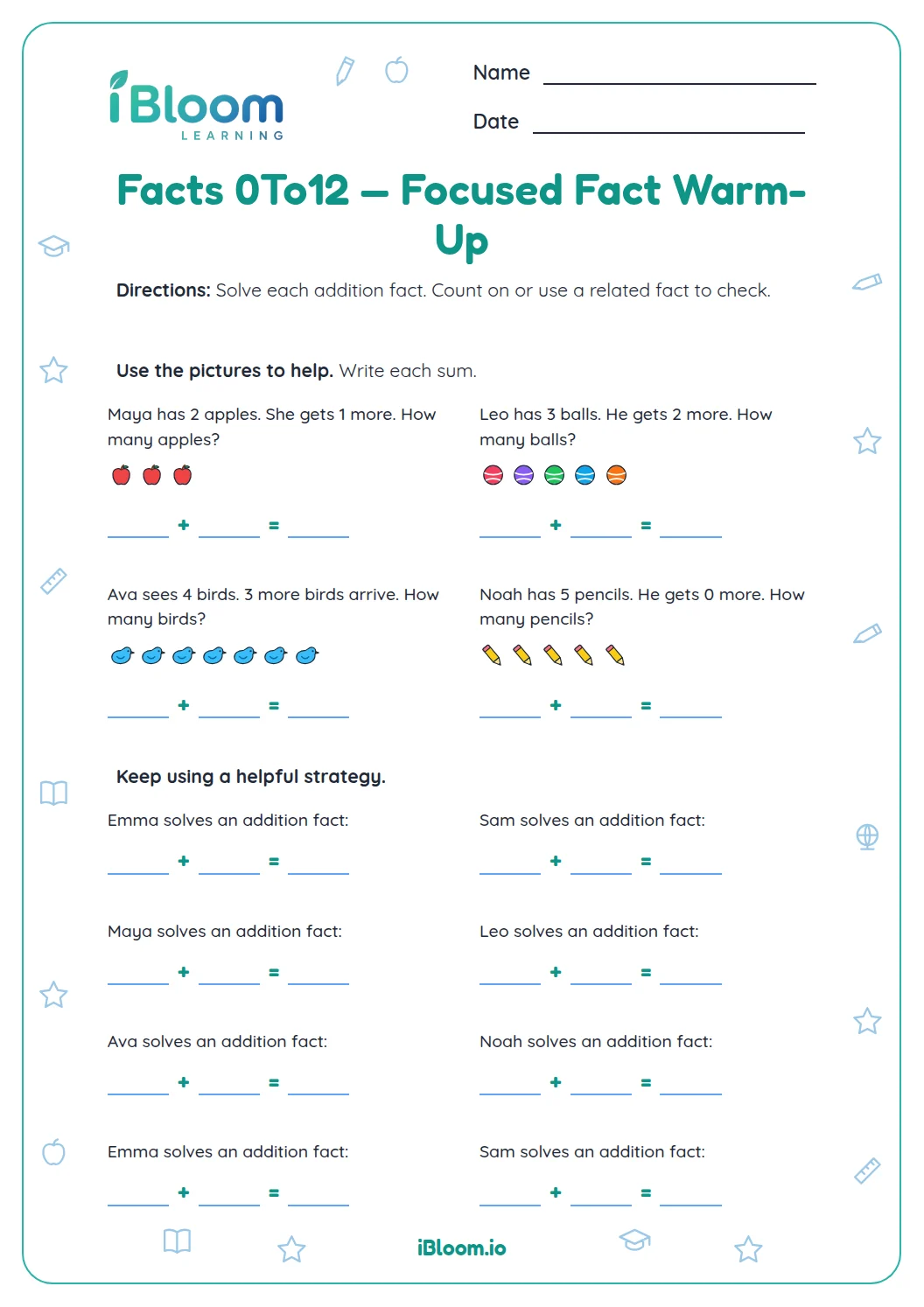
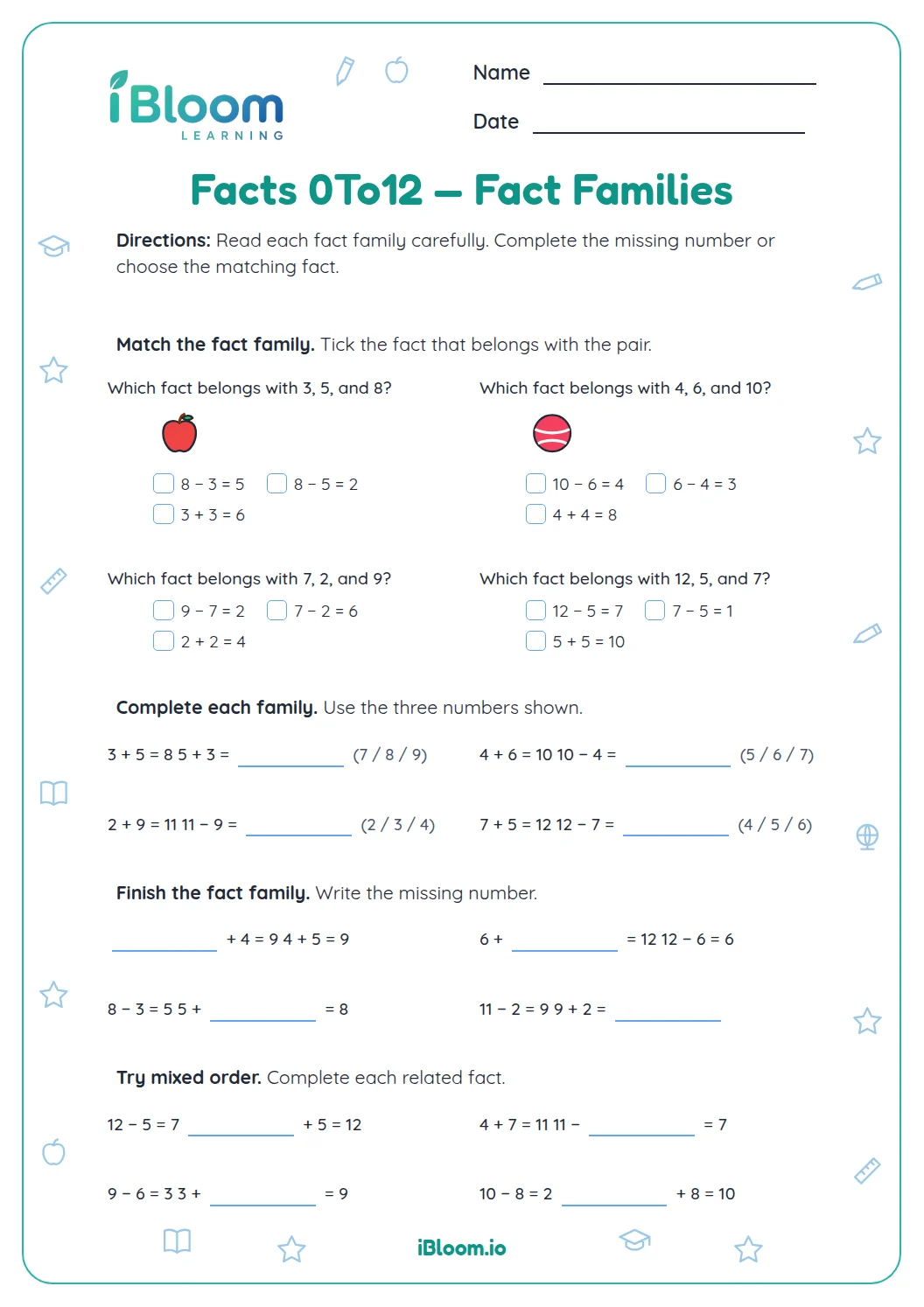
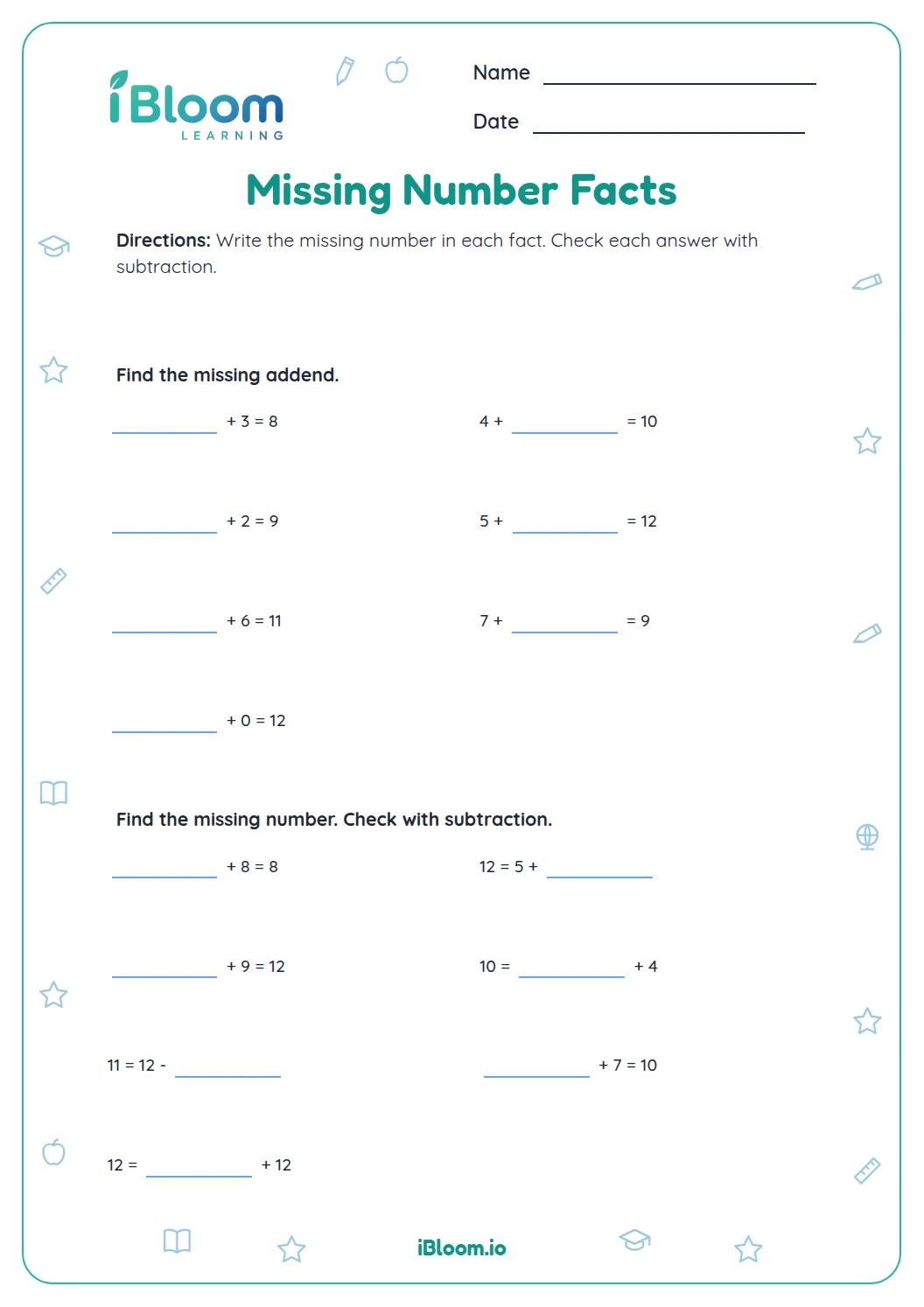
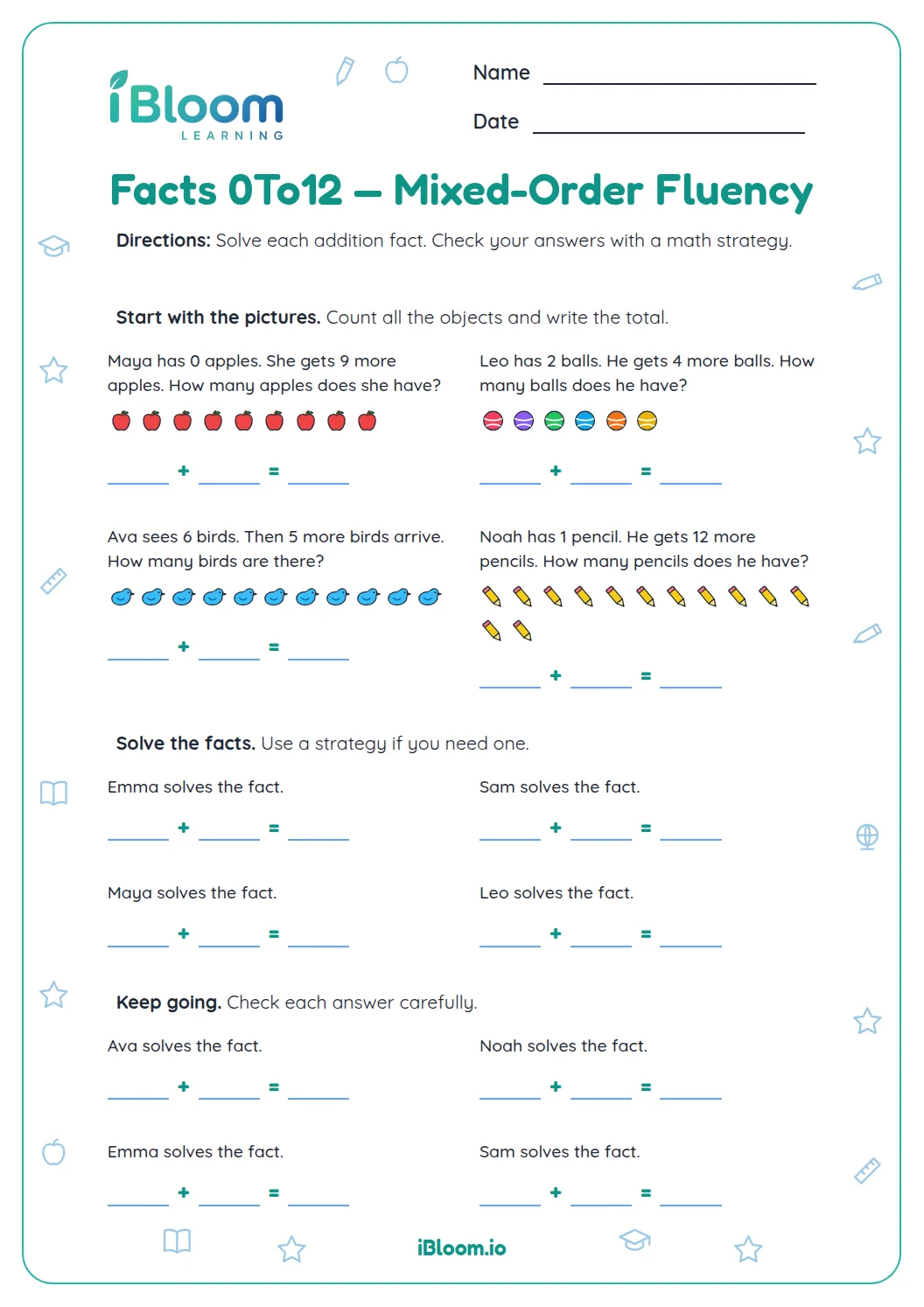
Questions 1–8 ask for sums in addition facts. Questions 9–12 continue with four more sums. Questions 13–20 mix missing addends and missing totals, including related subtraction equations.
- Addends through 12
- Missing addends and missing sums
- One blank per fact
A helpful way to think it through
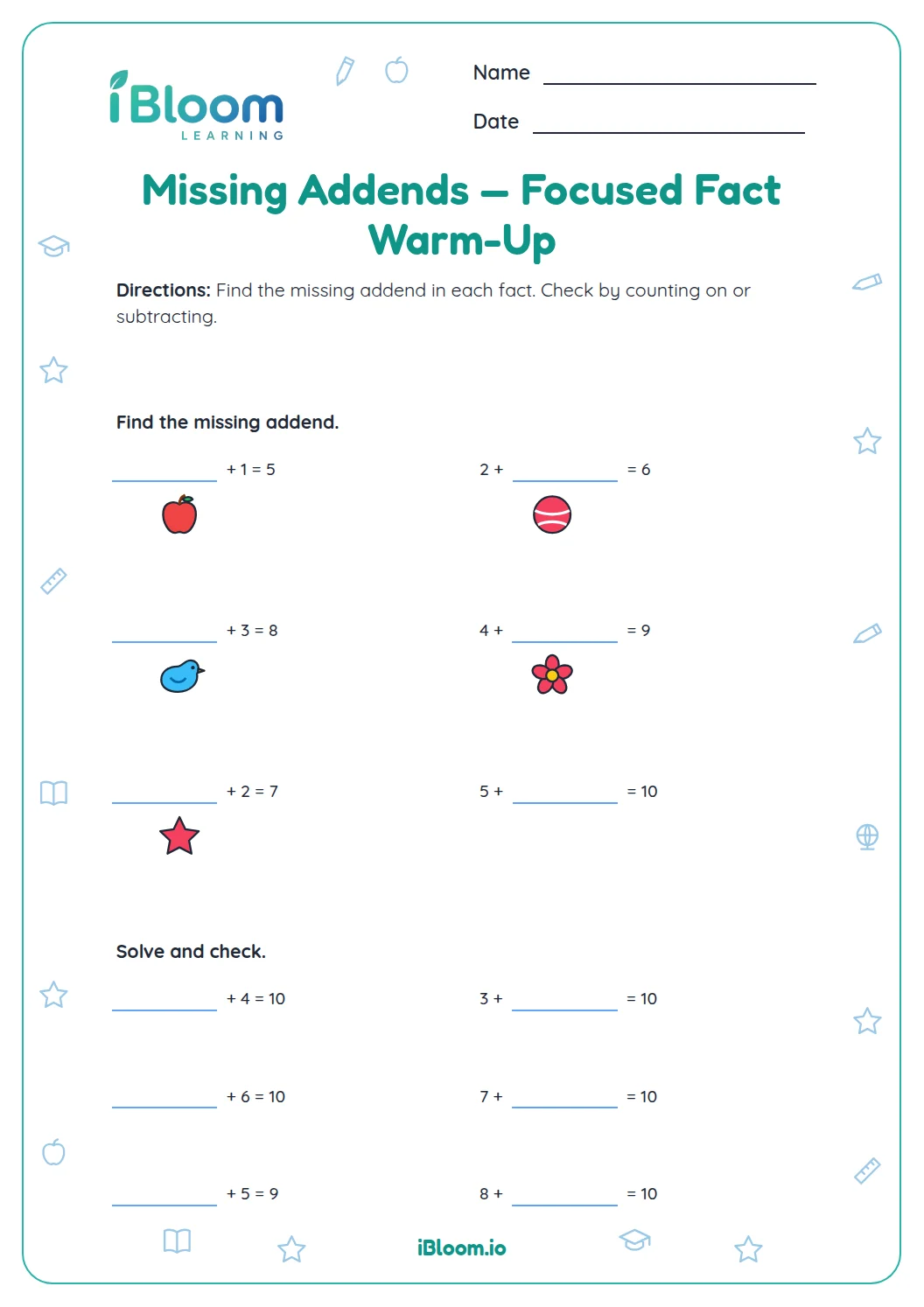
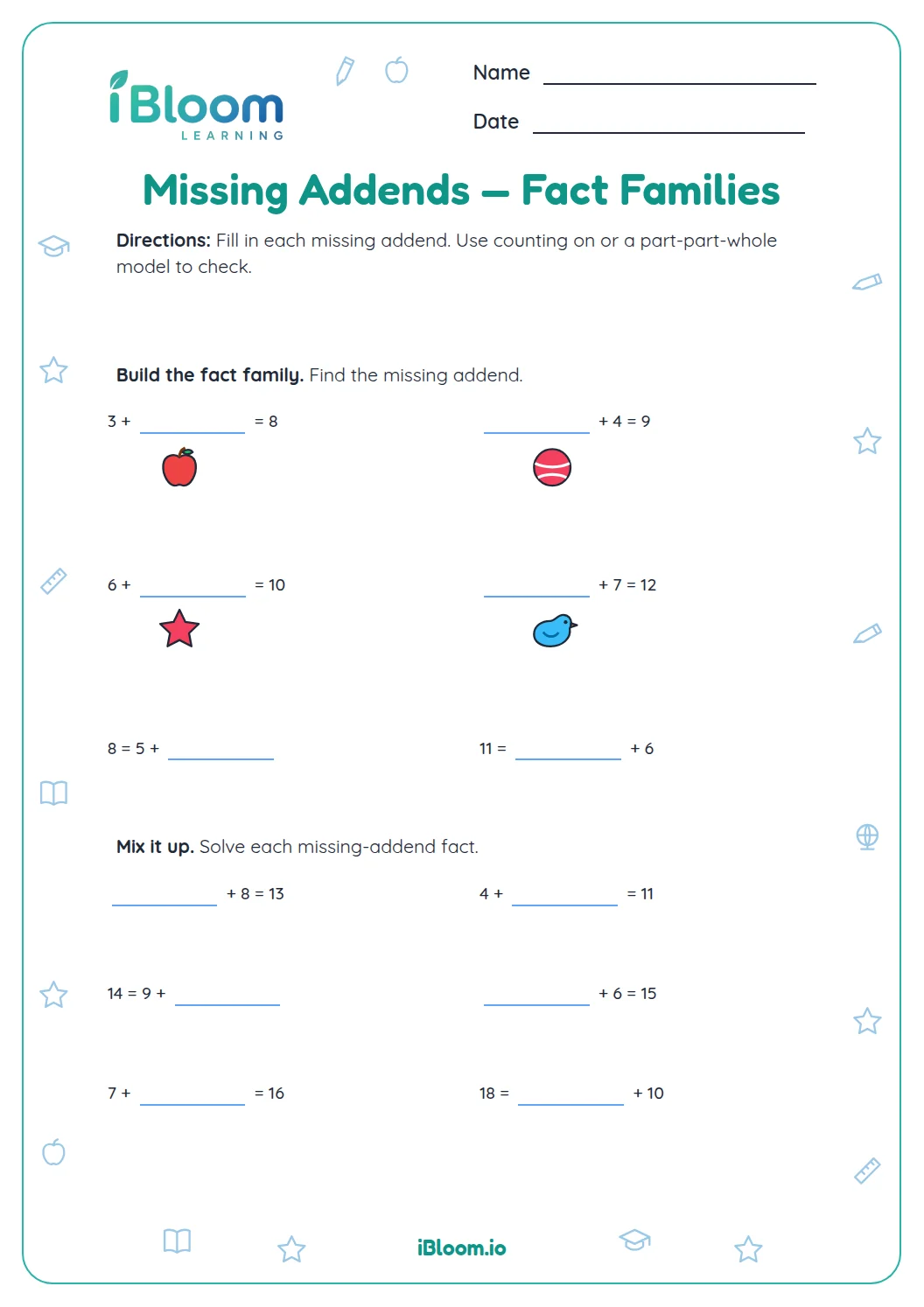
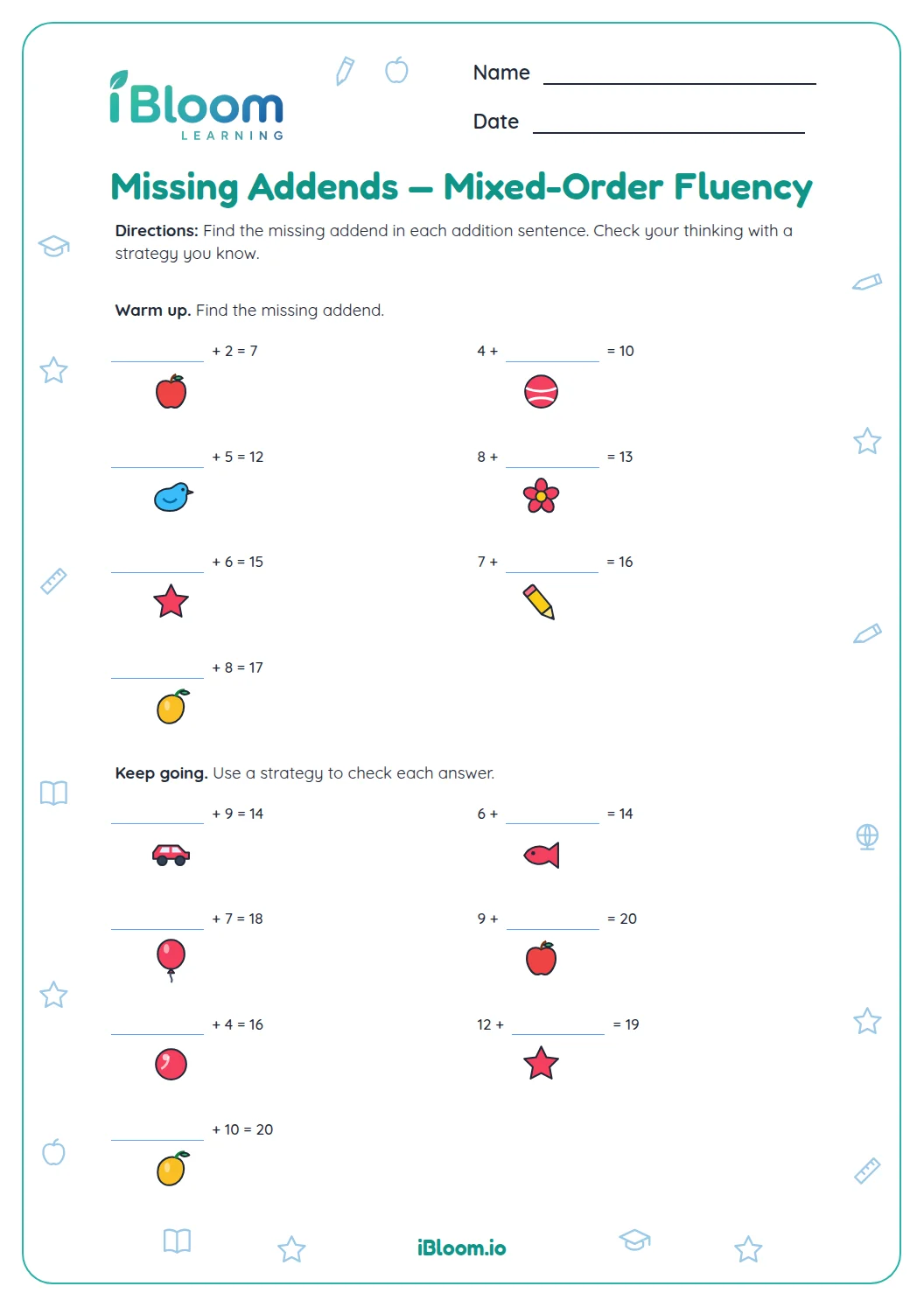
For q15, 6 + ___ = 12. Count on from 6 to 12: six more makes 12, so the missing addend is 6.
How are the facts arranged?
The first eight questions ask for sums in short addition facts. Four more addition facts follow. The final eight equations vary the blank position and include related subtraction equations, so learners must decide whether the unknown is an addend or a total.
Choose a strategy
- 1Read the whole number sentence, including the position of the blank.
- 2For a missing addend, count on from the known addend to the total.
- 3For a missing sum, add the two parts.
- 4Check by putting the missing number into the fact and reading it aloud.
Common mix-ups
The mistake
Writing the total when the blank asks for an addend.
The fix
Check where the blank is. A blank before the equals sign is part of the addition; the answer after the equals sign is the total.
The mistake
Counting the starting number as the first jump.
The fix
Start at the known addend and count forward the number of spaces needed to reach the total.
The mistake
Adding the known addend to the total to find the missing part.
The fix
Use the relationship between addition and subtraction, or count up from the known part to the total.
Common Core alignment
Learners practice addition fact fluency and determine unknown numbers in equations.
Find the unknown whole number in an addition or subtraction equation.
On this sheet: Each question asks learners to determine a missing addend or sum in an addition equation.
Show the official wordingHide the official wording
Determine the unknown whole number in an addition or subtraction equation relating three whole numbers.
Fluently add within 20 using mental strategies.
On this sheet: Part A builds recall of addition facts; Part B extends a few sums beyond 20.
Show the official wordingHide the official wording
Fluently add and subtract within 20 using mental strategies. By end of Grade 2, know from memory all sums of two one-digit numbers.
What to practice next
Make more practice
Further reading
Questions parents and teachers ask
How do I find a missing addend in an addition fact?
Think of the sum as the whole and the known addend as one part. Count on from the known part to the total, or use the related subtraction fact to find the missing part. Then substitute it into the equation to check.
Why does the worksheet include subtraction equations?
Subtraction checks the related addition facts. For example, if 8 plus 4 equals 12, then 12 minus 4 equals 8. This connection helps learners check an answer instead of guessing and shows how fact families fit together. Learners can use this connection to spot and correct a misplaced number.
What does “ordered 12” mean on this drill?
The first twelve questions progress through known addition facts with addends from 1 to 12. The last eight questions mix the missing number position and include related subtraction checks. This offers a familiar sequence followed by a short review.
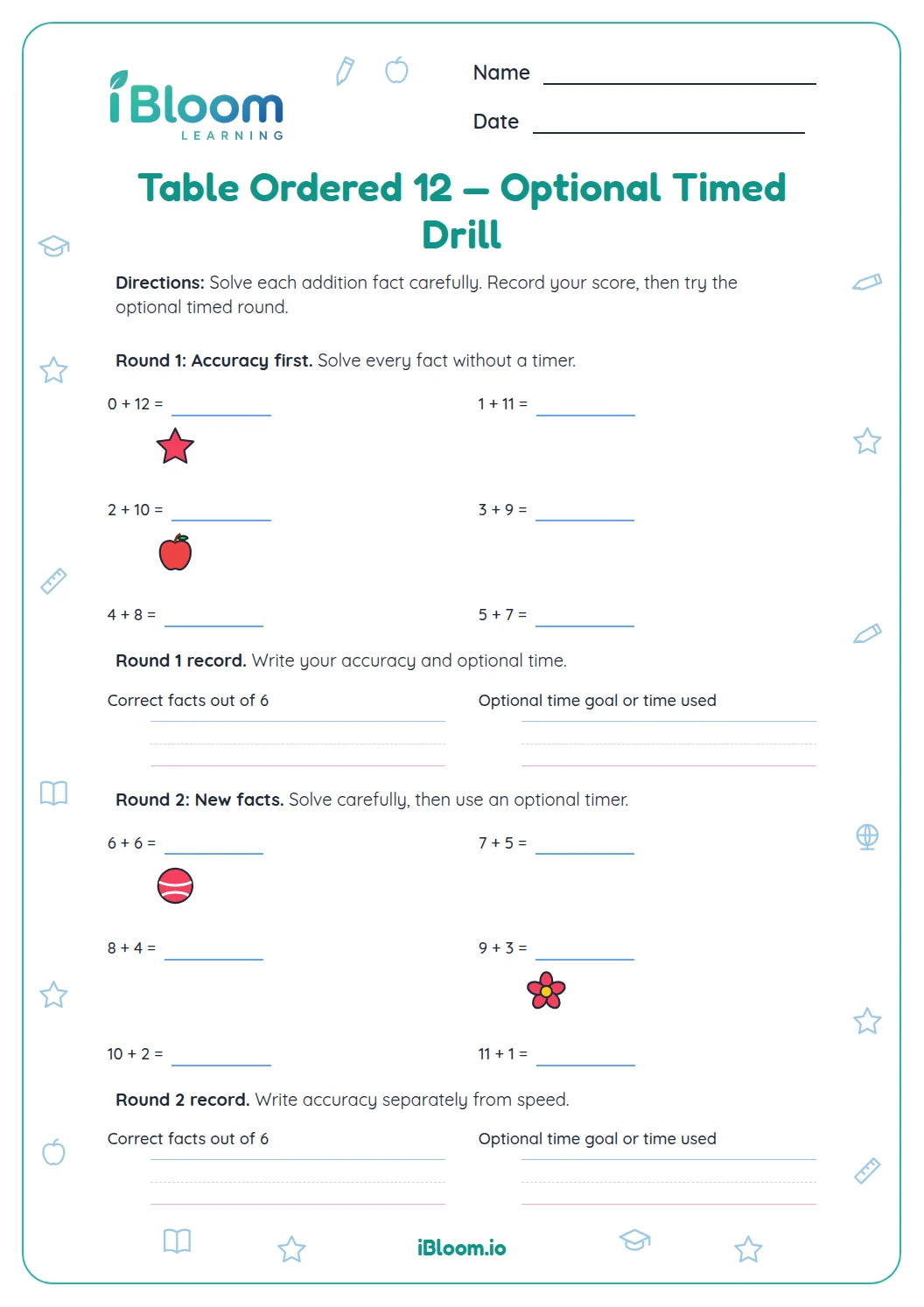
Is this math facts page timed?
No. This page is untimed practice. Learners can work at a steady pace, use a counting-on strategy, and check their work with the answer key after completing the facts. Accuracy and explaining a strategy matter more than speed.
How many equations does this drill include?
There are 20 questions: 12 addition facts ask for sums, and eight later equations ask for a missing part or total. Addends stay from zero through 12, and each answer fits a single blank. A separate two-page answer key gives all 20 values.
What does “ordered 12” mean here?
The worksheet title names an addition-facts table through 12. This page starts with a run of addition facts, adds four more sums, and finishes with mixed unknowns. Use the printed equation to decide what the blank represents before solving.