


About this worksheet
Line up ones through hundred-thousands before adding. A whole-thousands addend changes one place value while leaving the other digits in place.
Aligned to 4.NBT.B.4
How do you add a whole thousands amount?
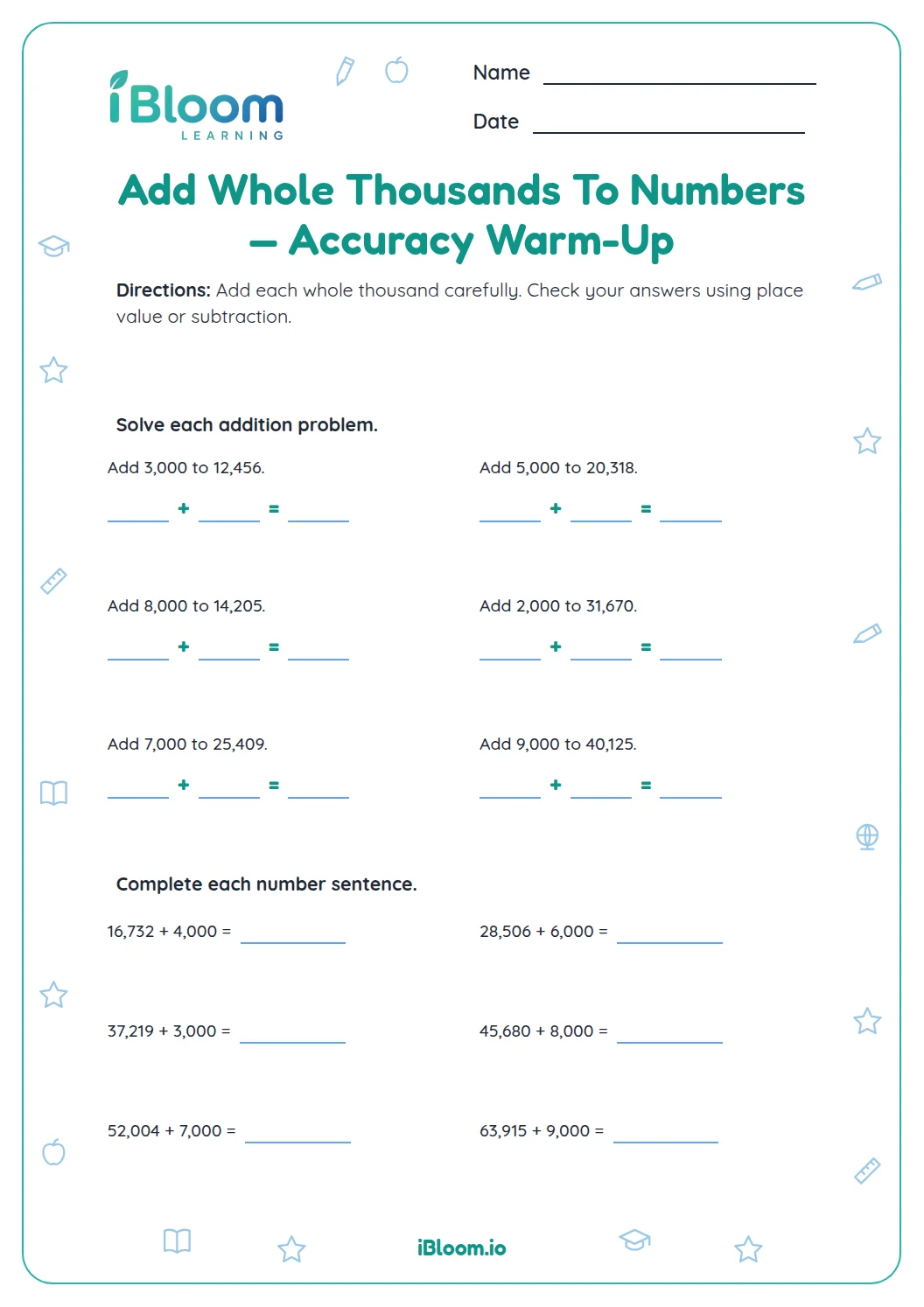
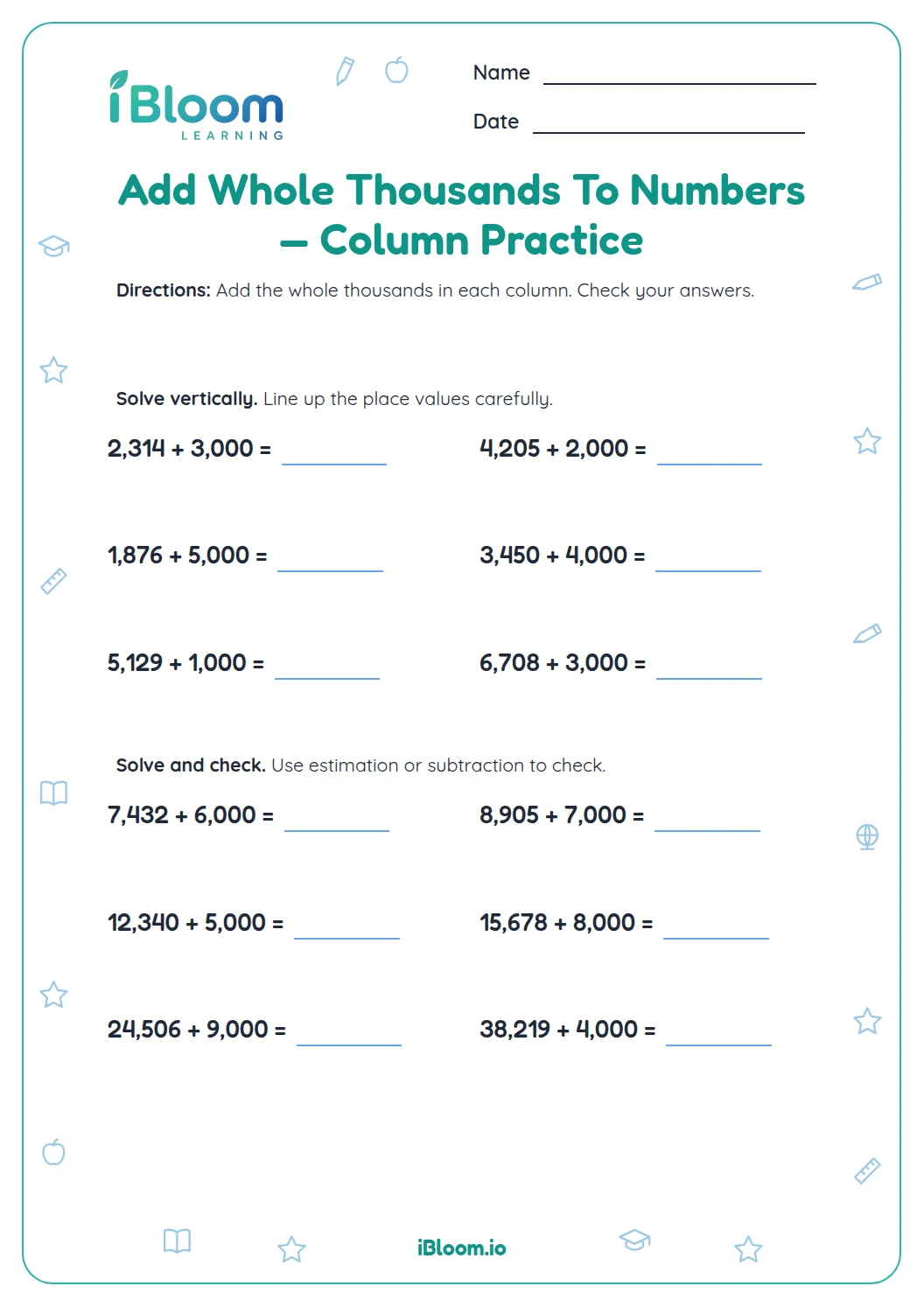
Line up equal place values before adding. For question 1, write 24,316 above 5,000 with the digits in the thousands places aligned. The sum is 29,316.
When the thousands addition crosses ten, regroup to the next place. In 48,999 + 7,000, regrouping gives 55,999.
- 1 24,316
- 2+ 5,000
- 3 29,316
What changes in each part?
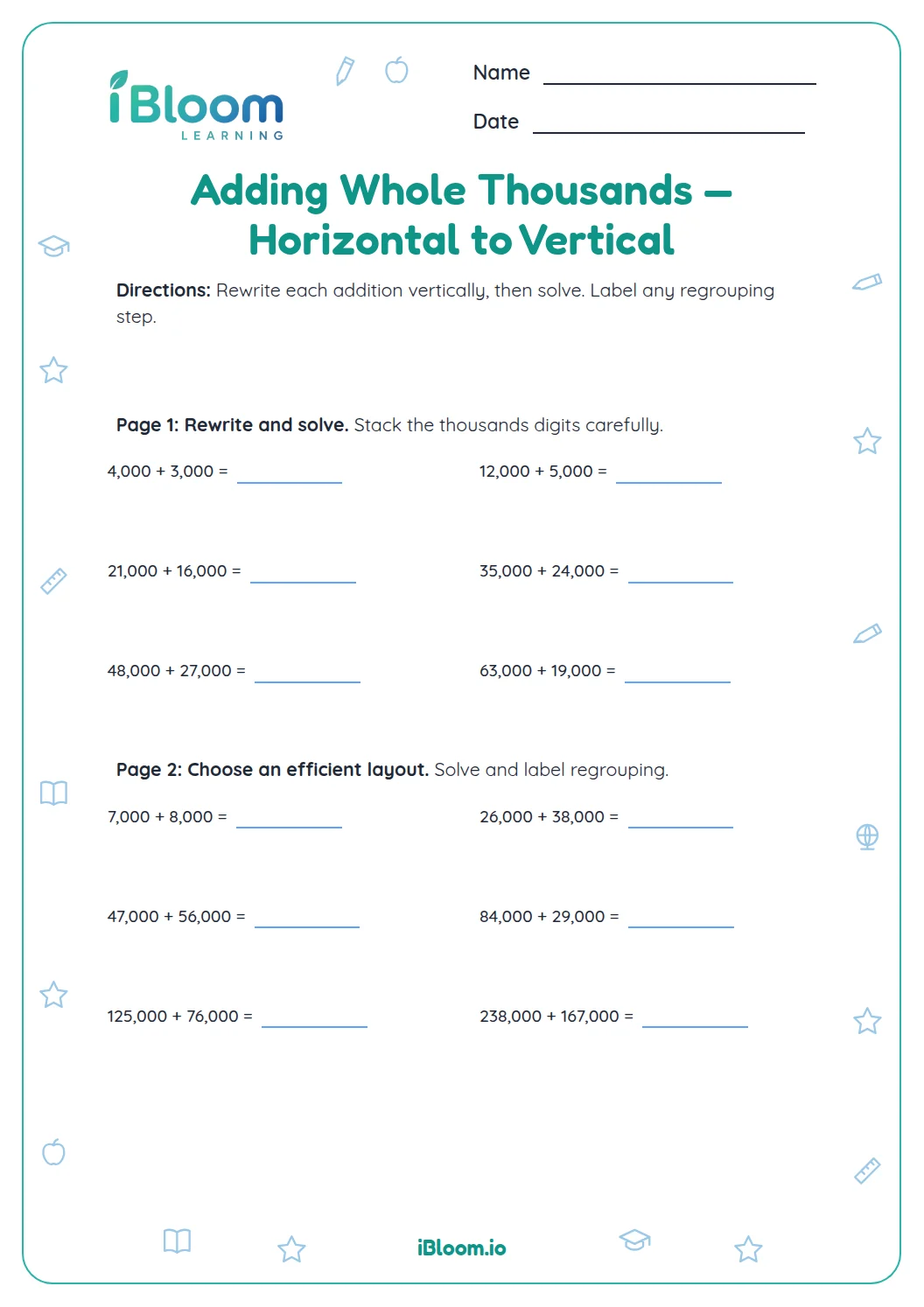
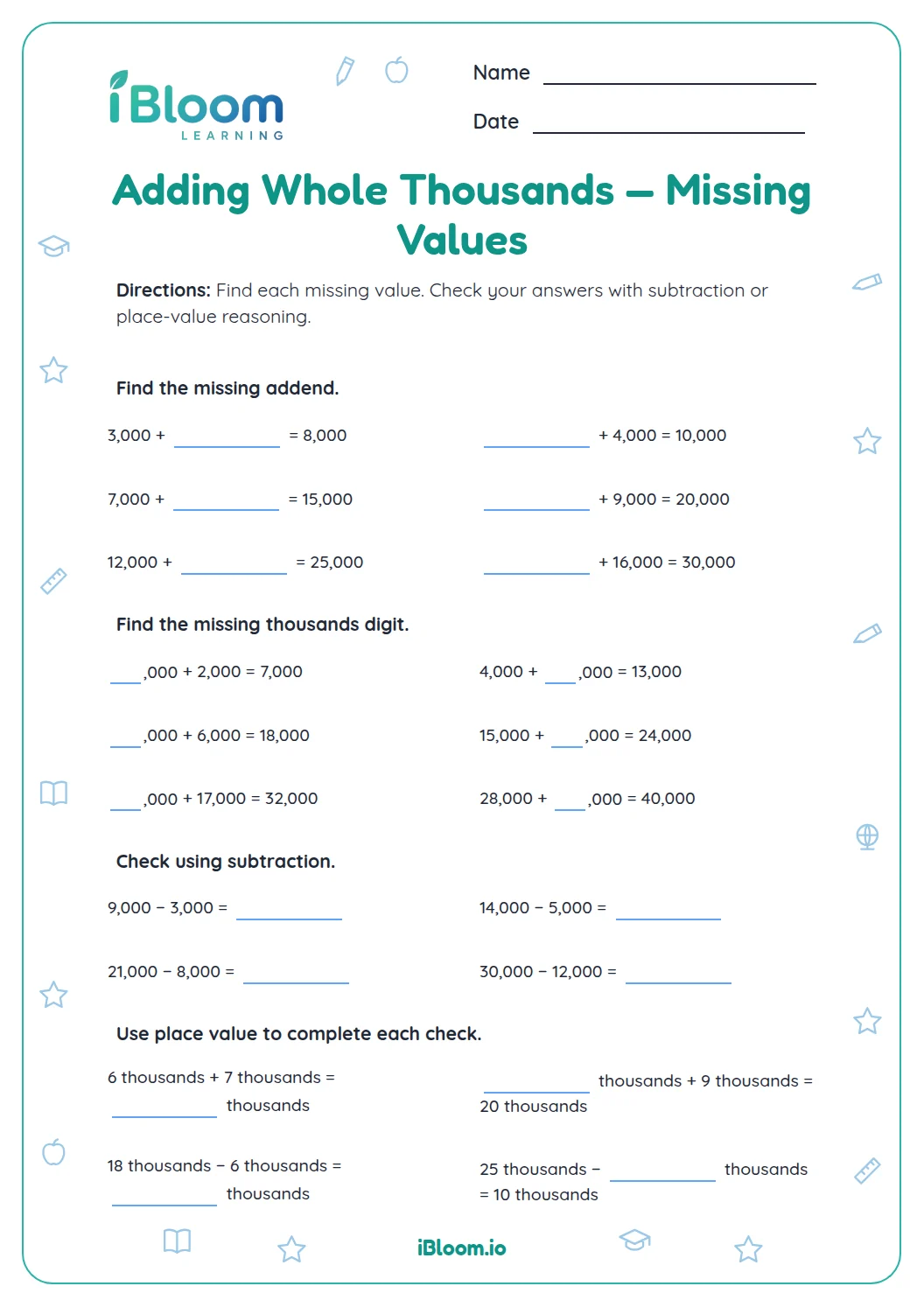
Part A provides working grids to set up four horizontal sums vertically. Part B asks for missing addends or sums, adds thousands in short contexts, fixes an incorrect sum, and connects 40,000 to groups of ten thousand.
The values range into the hundred-thousands, so each digit must stay in its place. A whole-thousands addend changes the thousands places and can trigger regrouping into ten-thousands or higher places.
How to use this worksheet
- 1Read the direction at the start of each part.
- 2Solve each item and use the space provided for your work.
- 3Check each response against the answer key and revisit any missed item.
Common place-value mistakes and fixes
The mistake
Starting the whole-thousands addend under the ones digit.
The fix
Align the rightmost nonzero digit with the thousands place, then check that the three zeros line up under hundreds, tens, and ones.
The mistake
Changing the digits in the larger addend instead of adding the thousands.
The fix
Add the thousands columns and any regrouped amount; keep unaffected place values in place.
The mistake
Forgetting to regroup when a column total is ten or more.
The fix
Write the ones digit in the column and carry the tens value one place left.
Curriculum alignment
This worksheet practices the listed Common Core skill.
Fluently add whole numbers using the standard algorithm and place-value understanding.
On this sheet: Students set up and solve multi-digit sums in columns, including regrouping when a whole-thousands addend crosses a place-value boundary.
Show the official wordingHide the official wording
Fluently add and subtract multi-digit whole numbers using the standard algorithm.
What to practice next
Make more practice
Further reading
Questions parents and teachers ask
How do I line up 24,316 and 5,000?
Place the 5 in the thousands column under the 4 in 24,316. The zeros go under hundreds, tens, and ones. Add by place to get 29,316, as in question 1. The working grid helps keep each digit aligned with the same place value before the addition begins.
Can adding 7,000 require regrouping?
Yes. In 48,999 + 7,000, adding the thousands causes regrouping into the ten-thousands column. Continue adding by place value to reach 55,999. The 9 hundreds, tens, and ones stay in the total, while the thousands addition triggers regrouping. Check the difference by adding it to the first amount.
What does a missing addend ask me to find?
Subtract 43,582 from 49,582 to find the missing addend, 6,000. Check by adding 6,000 back to 43,582 to get the stated total. This is a subtraction check because the starting amount plus the missing amount equals the target total.
How many questions require column work?
Part A has four sums to set up vertically on working grids. Part B has ten questions: missing values, sums, two contexts, a correction, and a place-value statement. The first page has four column setups; the second page holds the remaining ten questions and their varied formats.
How can I check an addition answer?
Check 83,926 + 9,000 by subtracting 83,926 from the claimed total. The difference should be 9,000; that confirms the corrected answer is 92,926. The correction item asks students to replace the written result with the total that follows from the addends. This is the final place-value item on the worksheet.
What does 40,000 equal in groups of ten thousand?
Forty thousand equals four groups of ten thousand because 4 × 10,000 = 40,000. The final question checks this place-value relationship. Each group contains 10,000, so four groups combine to make 40,000. It reinforces the connection between a place and the value it represents.