


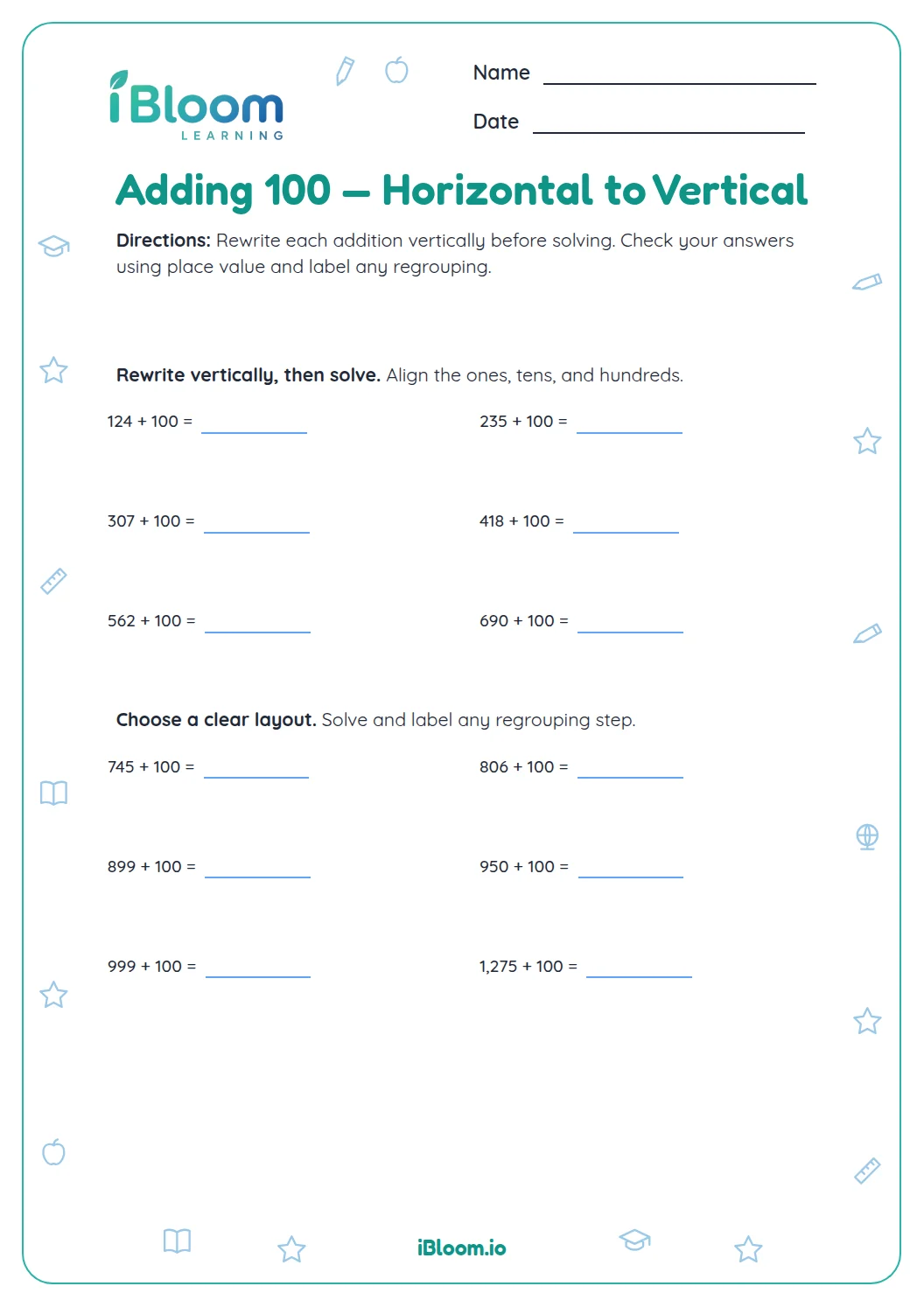
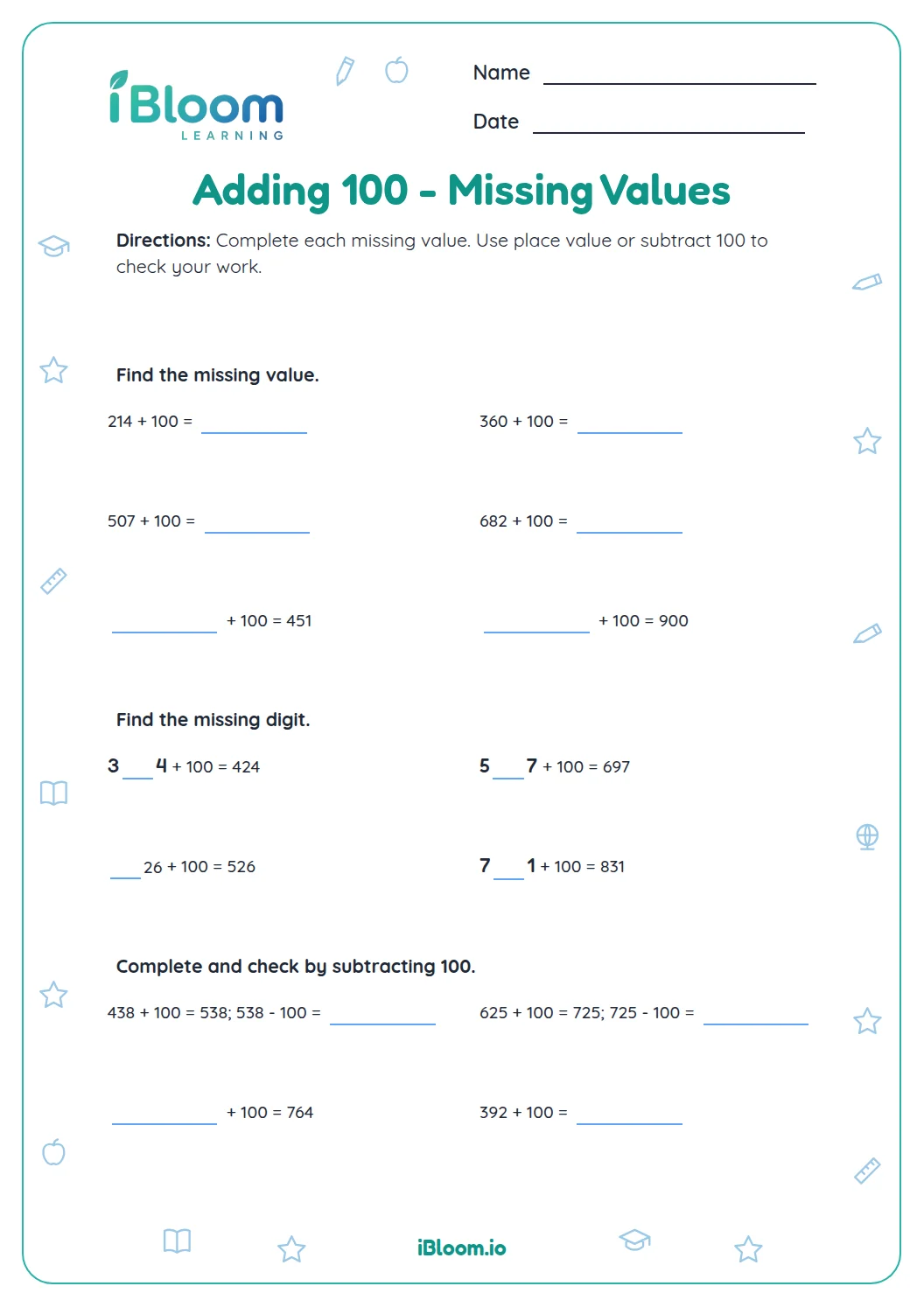
About this worksheet
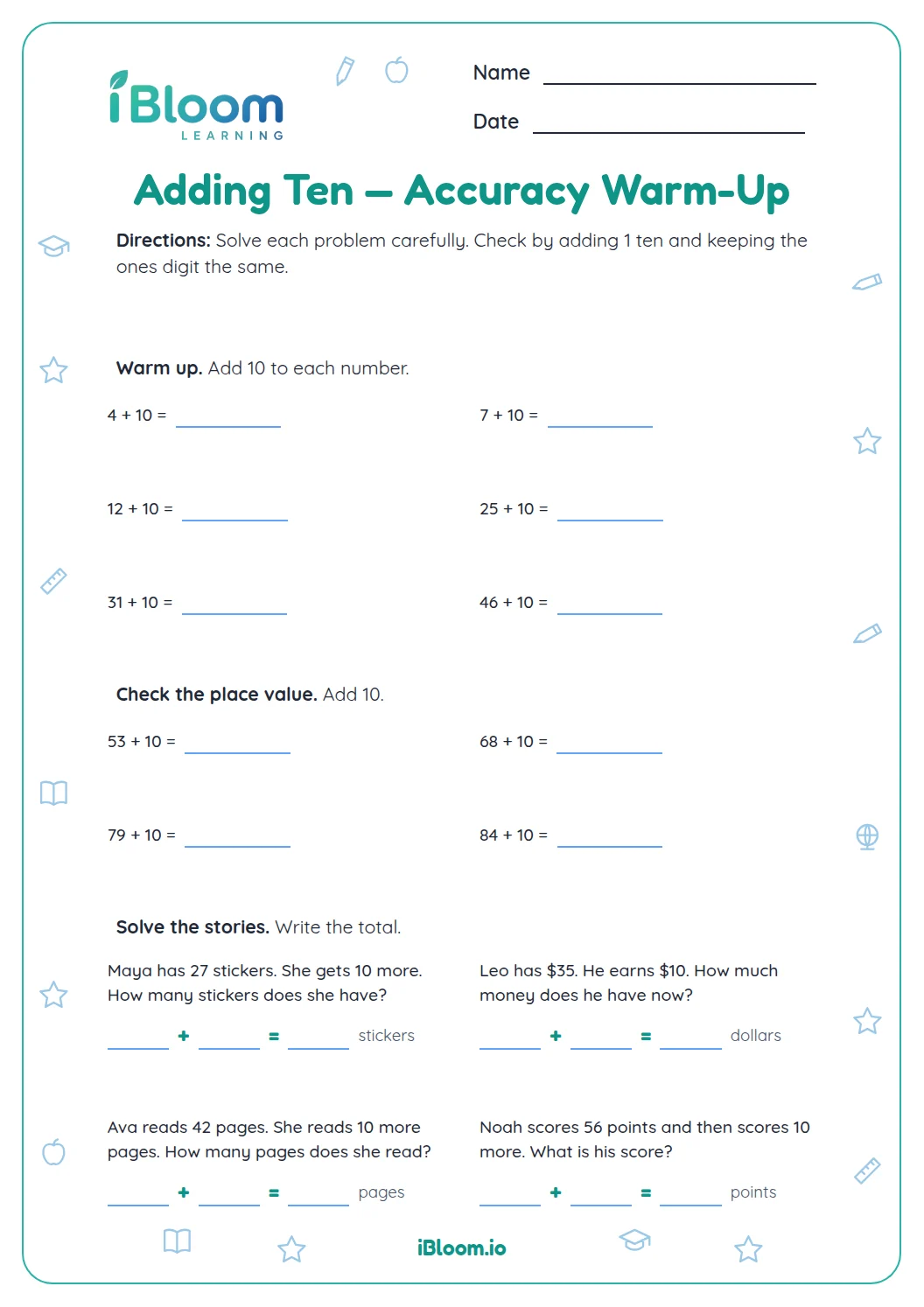
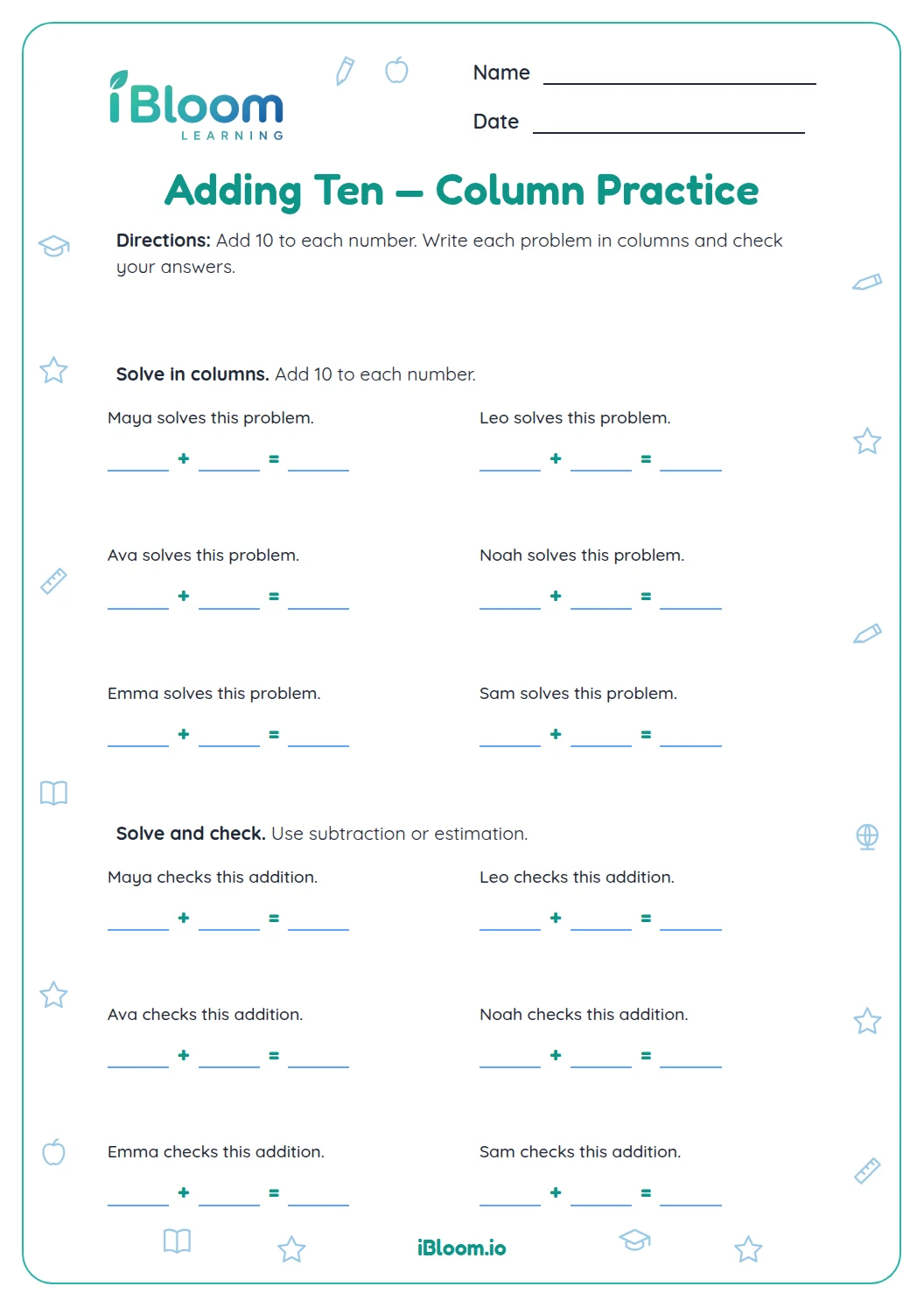
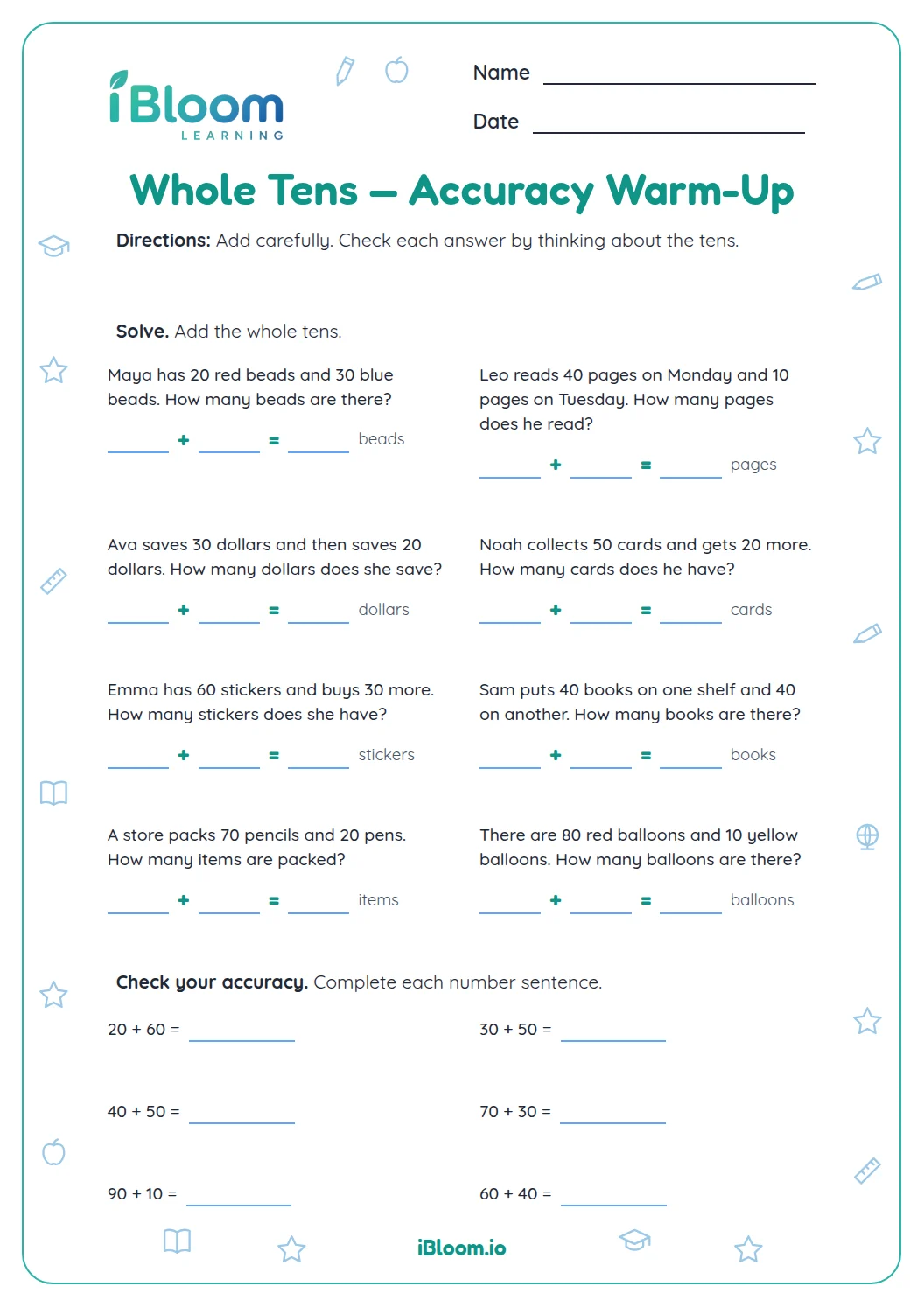
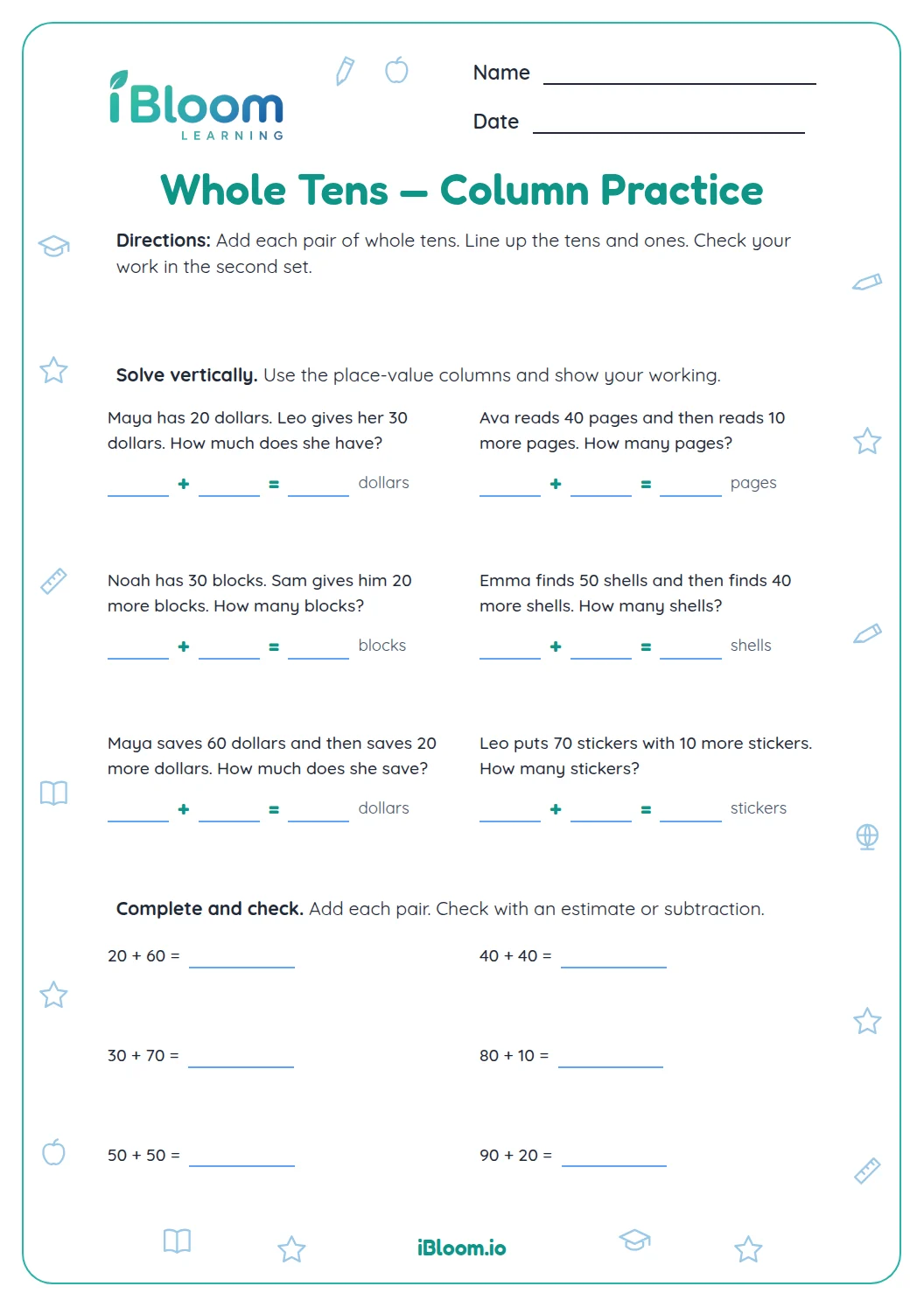
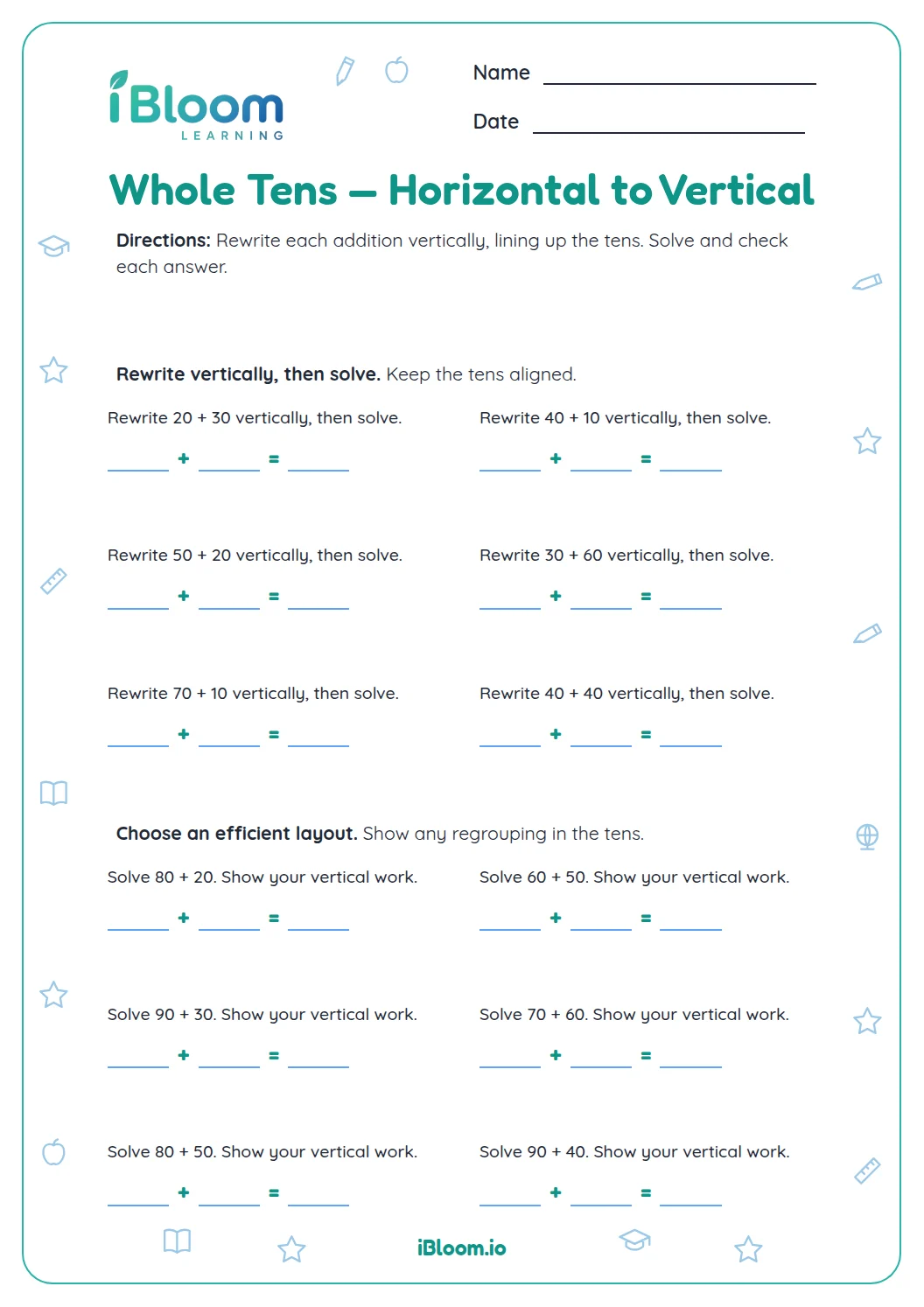
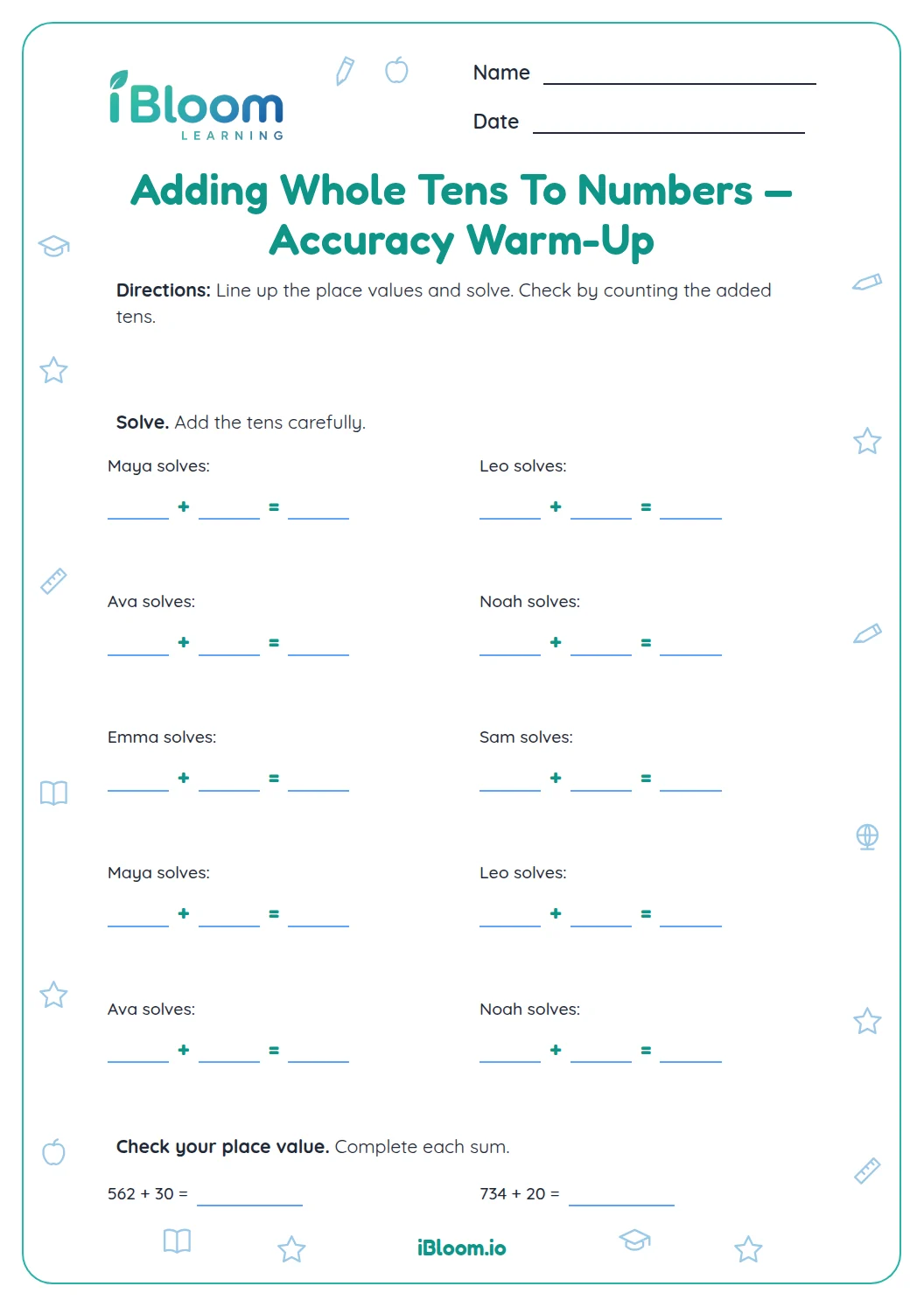
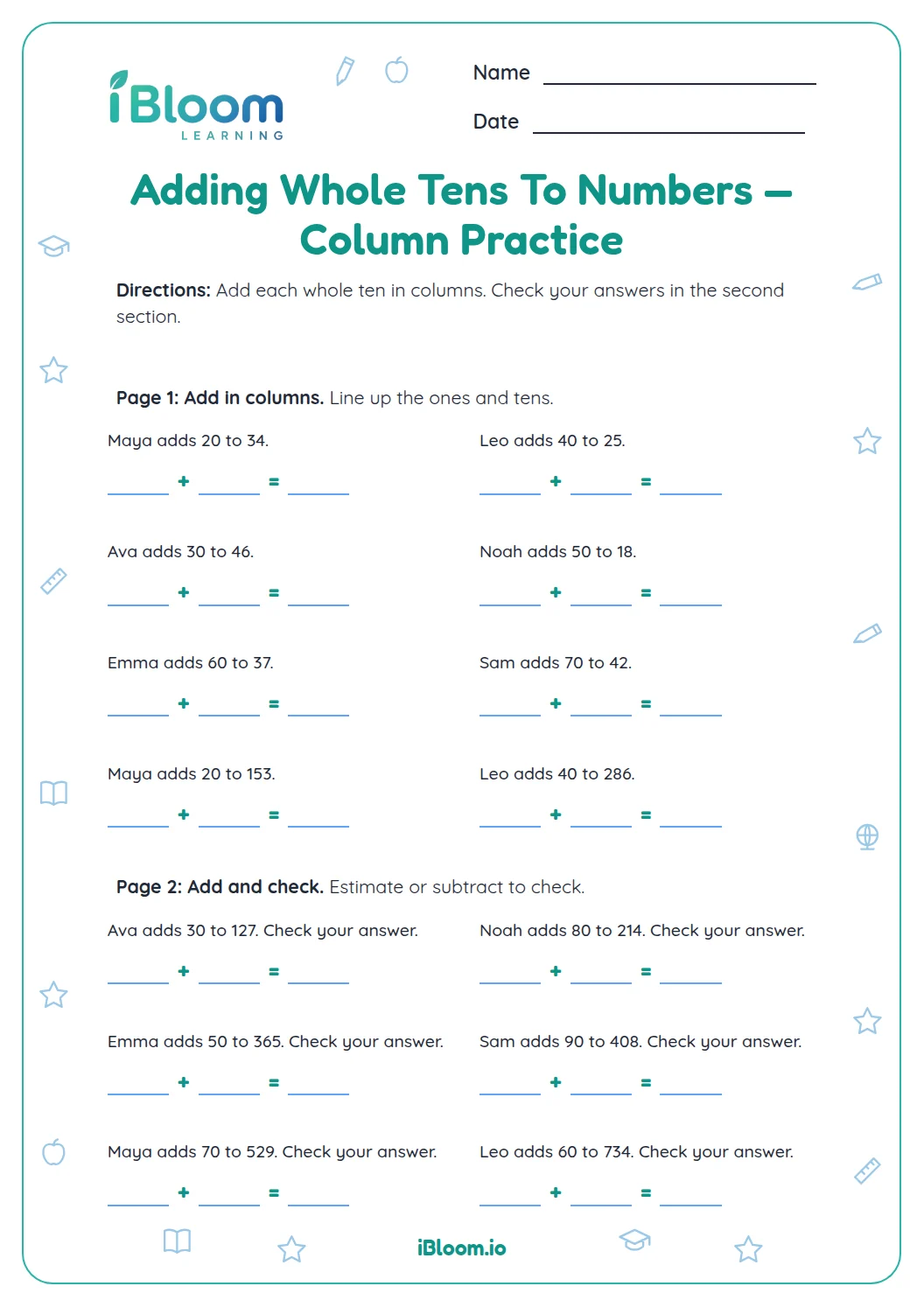
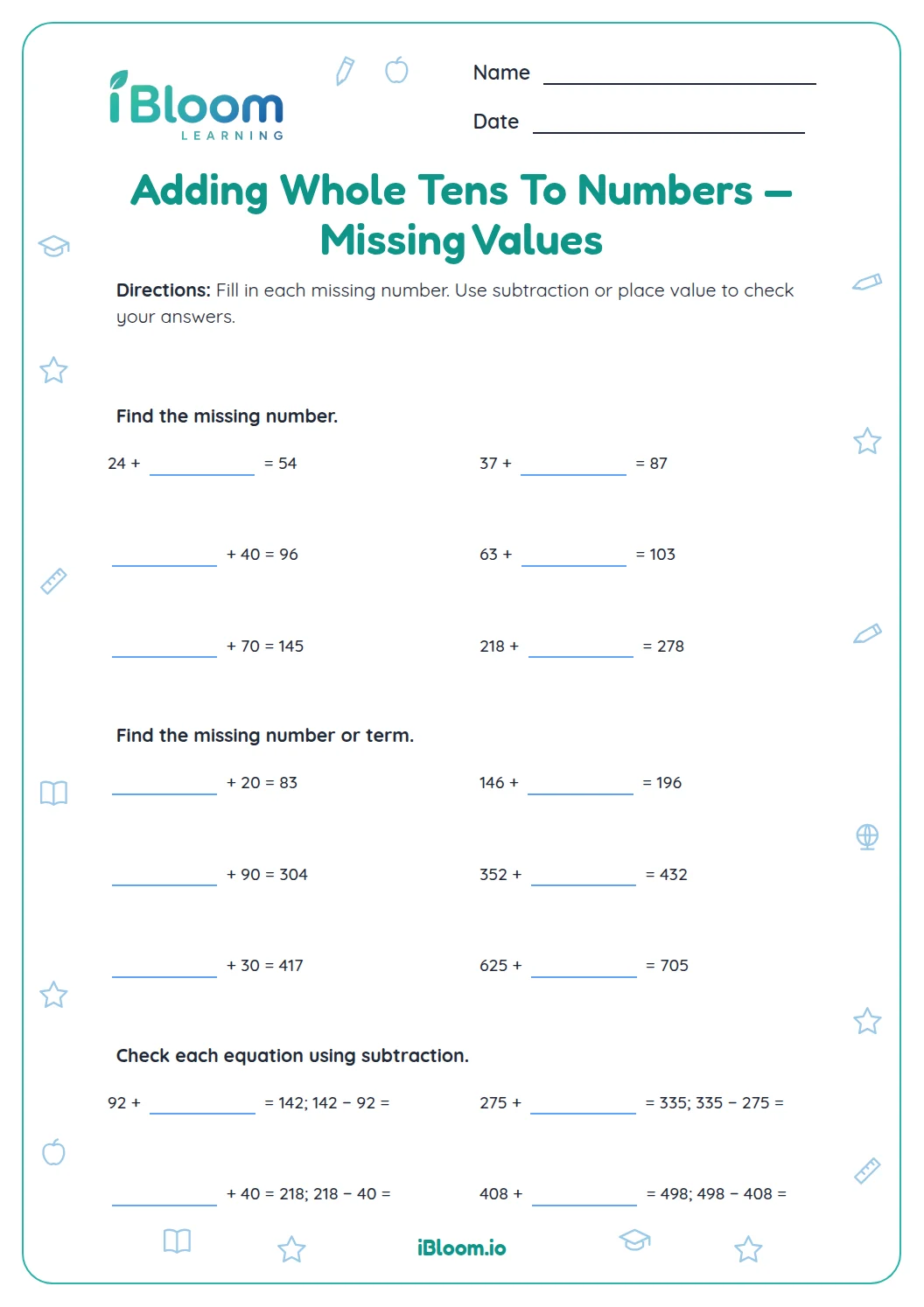
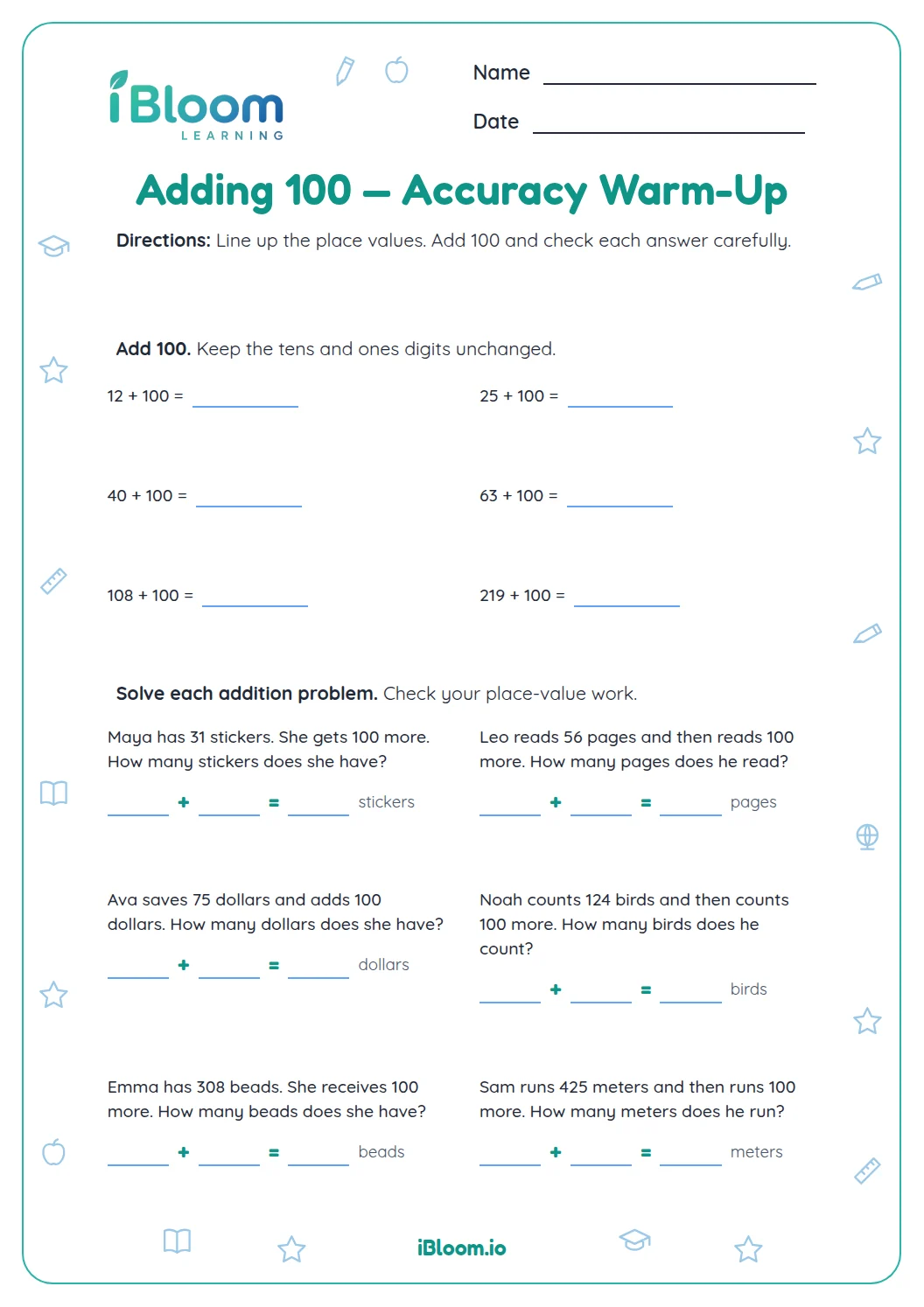
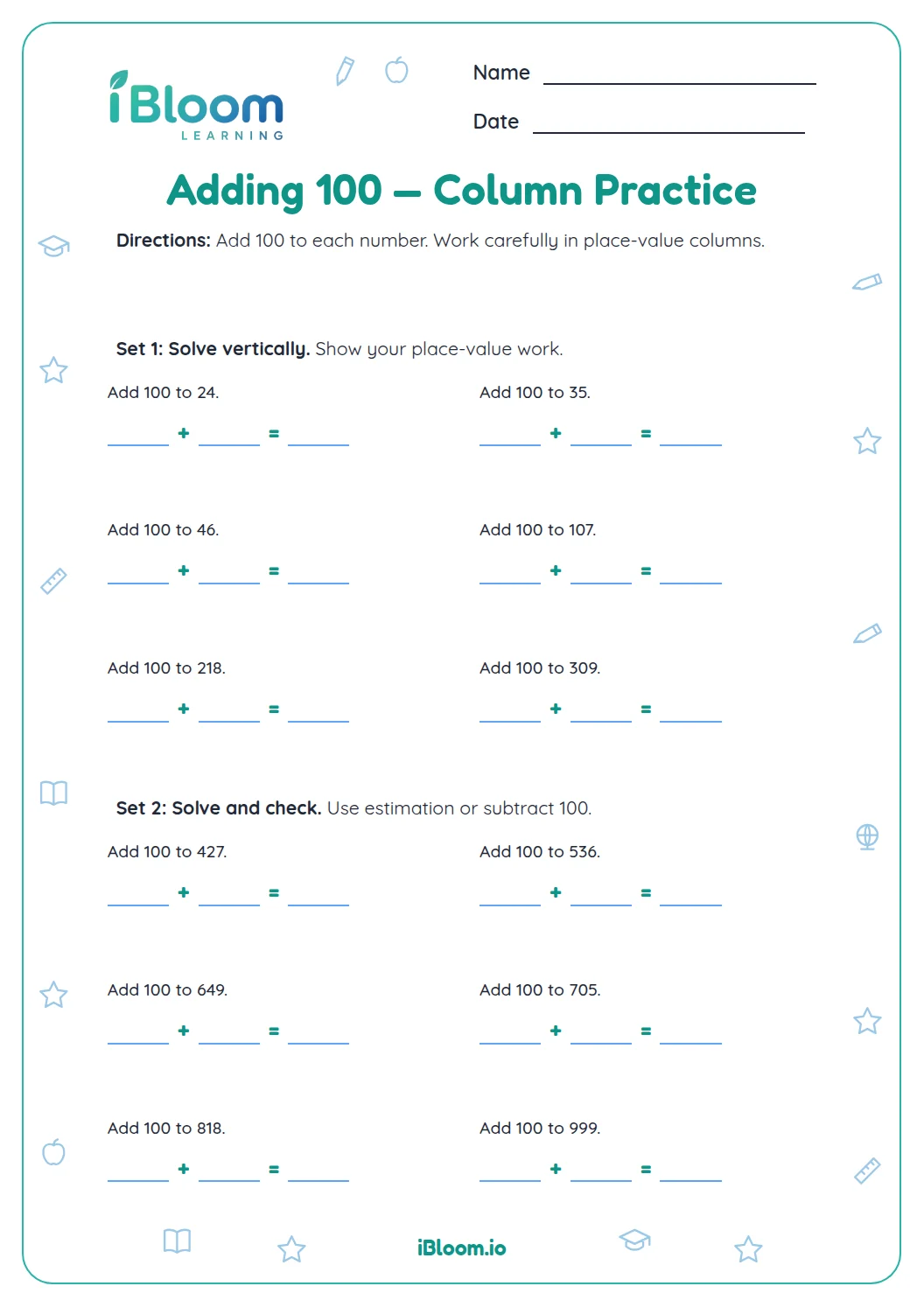
This free printable adding-ten worksheet gives students in Grades 2–4 fourteen problems that connect mental addition with vertical notation. Part A starts with six two-digit sums, from 24 + 10 to 89 + 10. Part B applies adding ten to eight stories about stickers, savings, reading, cards, beads and walking. Students use grids for the vertical sums and write totals with units for the mental story problems. The three-digit story problems practice Common Core 2.NBT.B.8. Two worksheet pages and a separate two-page answer key provide space to work and totals to check.
Aligned to 2.NBT.B.8
Where does the 10 go in a vertical sum?
Line up place values from the right. The zero belongs in the ones column, and the one belongs in the tens column. In question 1, write 24 above 10 with 4 above 0 and 2 above 1.
Add the ones, then the tens. The ones stay the same because adding ten adds zero ones.
- 124 + 10
- 2Write 24 above 10: 4 above 0, 2 above 1.
- 3Ones: 4 + 0 = 4. Tens: 2 + 1 = 3.
- 4The sum is 34.
What happens when the tens digit is 9?
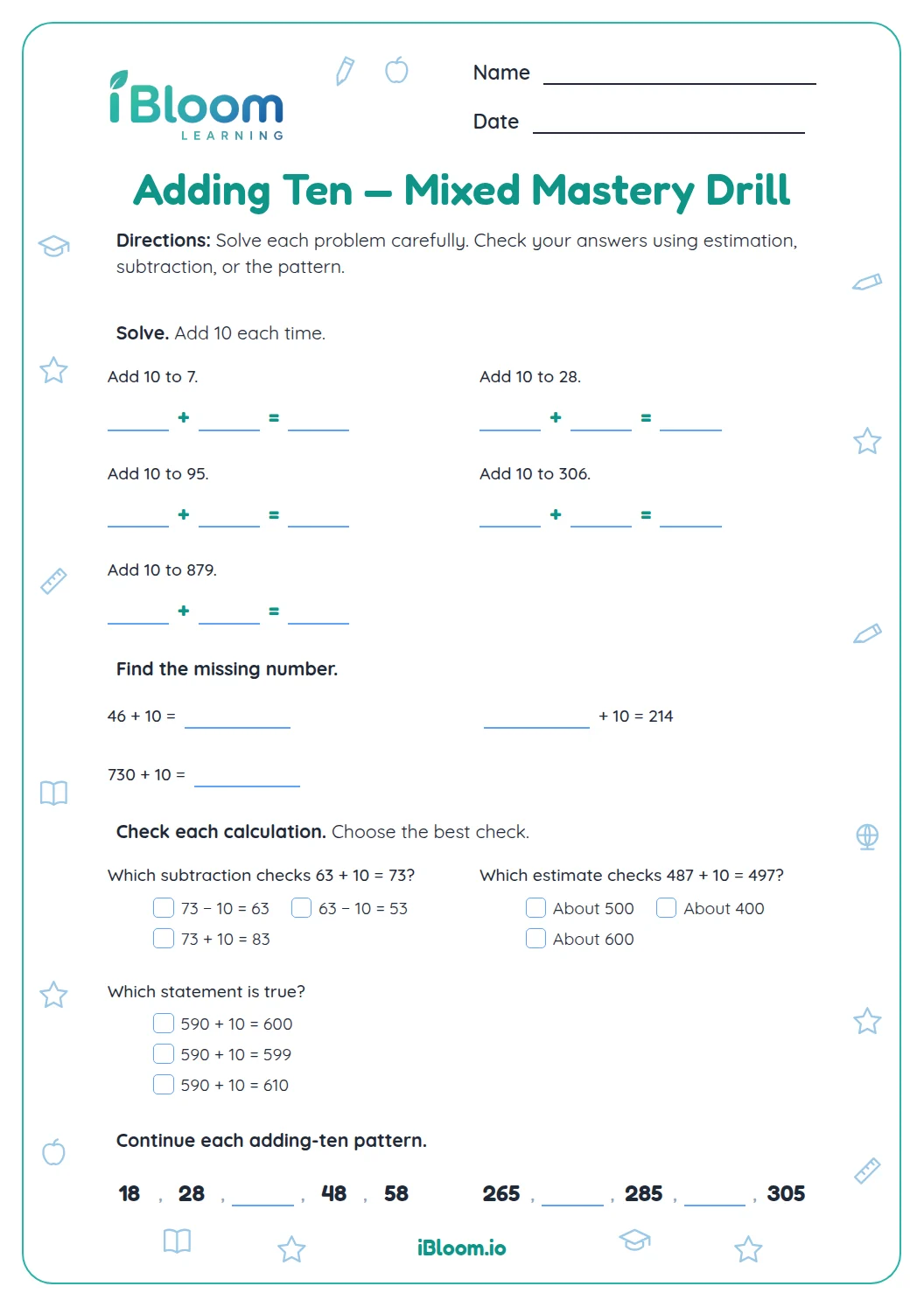
Adding a ten to nine tens makes ten tens, which become one hundred. In question 11, Emma starts with 590 beads and adds 10. Her 5 hundreds and 10 tens become 6 hundreds, so she has 600 beads.
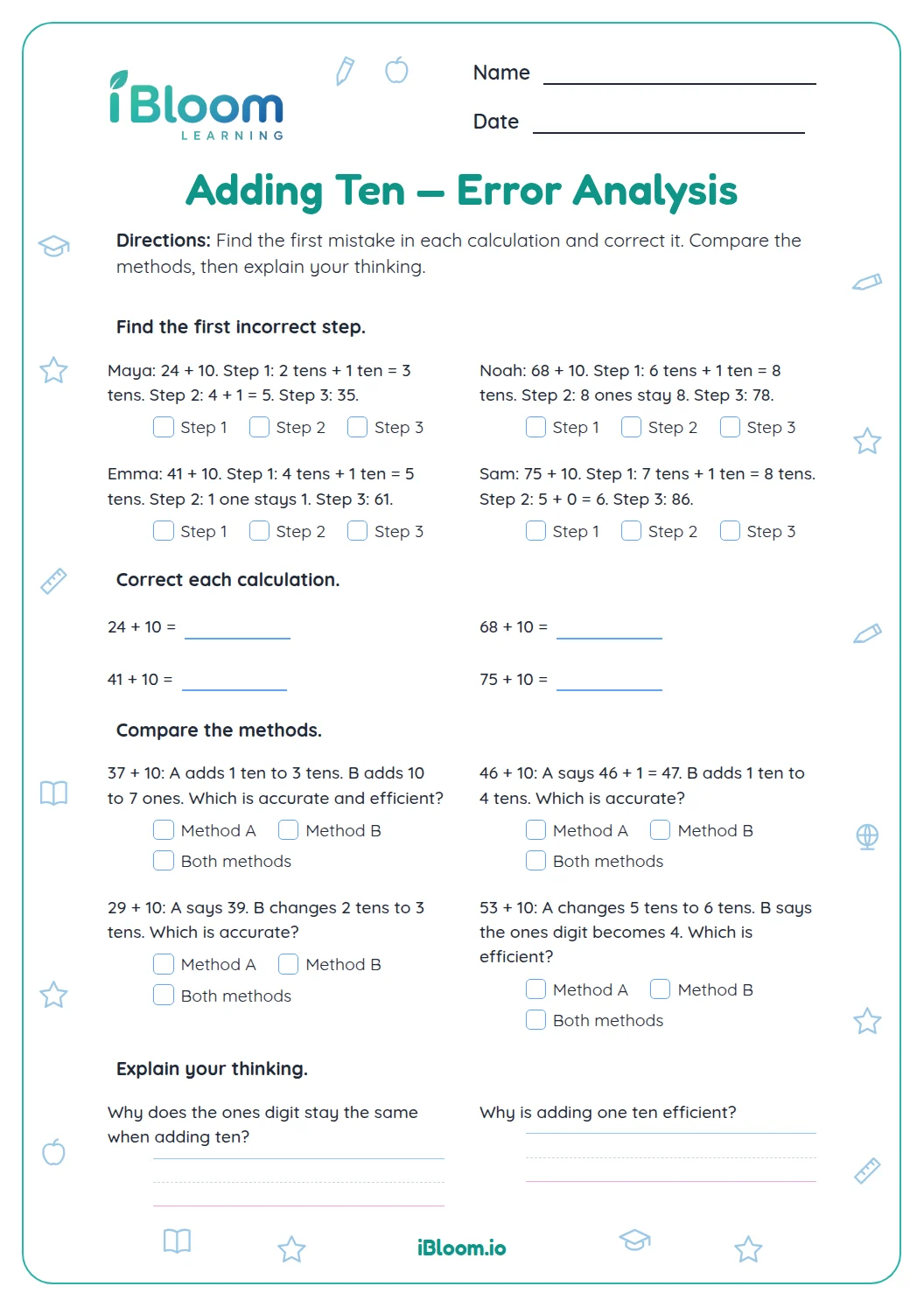
Compare 590 and 600: the ones stay zero, while the tens and hundreds digits change. Saying “add one ten” is more reliable than saying “increase the tens digit by one.”
How do the stories connect mental math and columns?
Part B asks students to find each total mentally. For Maya’s stickers, 125 + 10 = 135, so write 135 stickers on the answer line. If a child needs support, use scrap paper to check the sum in columns.
The key supplies totals with units. Check the grids in Part A as well: the 0 in 10 belongs below the ones digit, and the 1 belongs below the tens digit.
How to use this worksheet
- 1Read 24 + 10 aloud and identify the tens and ones.
- 2Model question 1 by writing 24 above 10 with matching place values aligned.
- 3Let the child rewrite and solve the remaining five sums in Part A.
- 4For each Part B story, add ten mentally and write the total with its unit.
- 5Check the totals and units with the key, and inspect the six Part A grids for column alignment.
Mistakes to notice and how to help
The mistake
Putting the 1 from 10 beneath the ones digit.
The fix
Align the rightmost digits first: the 0 must go under the ones digit.
The mistake
Changing the ones digit when adding ten.
The fix
Compare 24 and 34. Both have four ones; only a ten was added.
The mistake
Writing 590 + 10 as 500.
The fix
Nine tens plus one ten make a new hundred. Rename 5 hundreds and 10 tens as 6 hundreds: 600.
Common Core alignment
Add 10 mentally to three-digit amounts in eight short stories.
On this sheet: Part B asks students to add 10 mentally to eight three-digit numbers between 100 and 900.
Show the official wordingHide the official wording
Mentally add 10 or 100 to a given number 100-900, and mentally subtract 10 or 100 from a given number 100-900.
What to practice next
Make more practice
Further reading
Questions parents and teachers ask
Does my child need to write every sum vertically?
Part A asks for six vertical sums, and Part B asks for eight mental story totals. Use the grids to align the ones and tens in Part A. For each Part B answer, include the unit from the story, such as stickers, dollars or feet.
Why is 590 + 10 equal to 600?
Adding ten to 590 makes 600 because nine tens plus one ten become one hundred. The zero ones stay in place. In Emma’s bead problem, ask your child to regroup the ten tens and check that 600 is exactly ten more than 590.
What should I check besides the final answer?
Check where the child wrote 10 in each vertical calculation. Its zero belongs under the ones digit and its one under the tens digit. A correct total can come from mental calculation, so also look at the written setup to see whether the child understands alignment.
Can Grades 3 and 4 use this drill?
Yes, older students can use it to review adding ten and clear vertical notation. Part A uses two-digit starting numbers; Part B uses three-digit amounts in short stories. Ask students to explain the change from 590 to 600 and include the correct unit with each story answer.
Is there an answer key for the vertical practice?
Yes, the separate two-page answer key gives all fourteen totals, including units for the eight stories. It leaves the Part A working grids open, so check column alignment on the student’s sheet yourself. If a total is wrong, compare the ones and tens before trying the addition again.