
About this worksheet
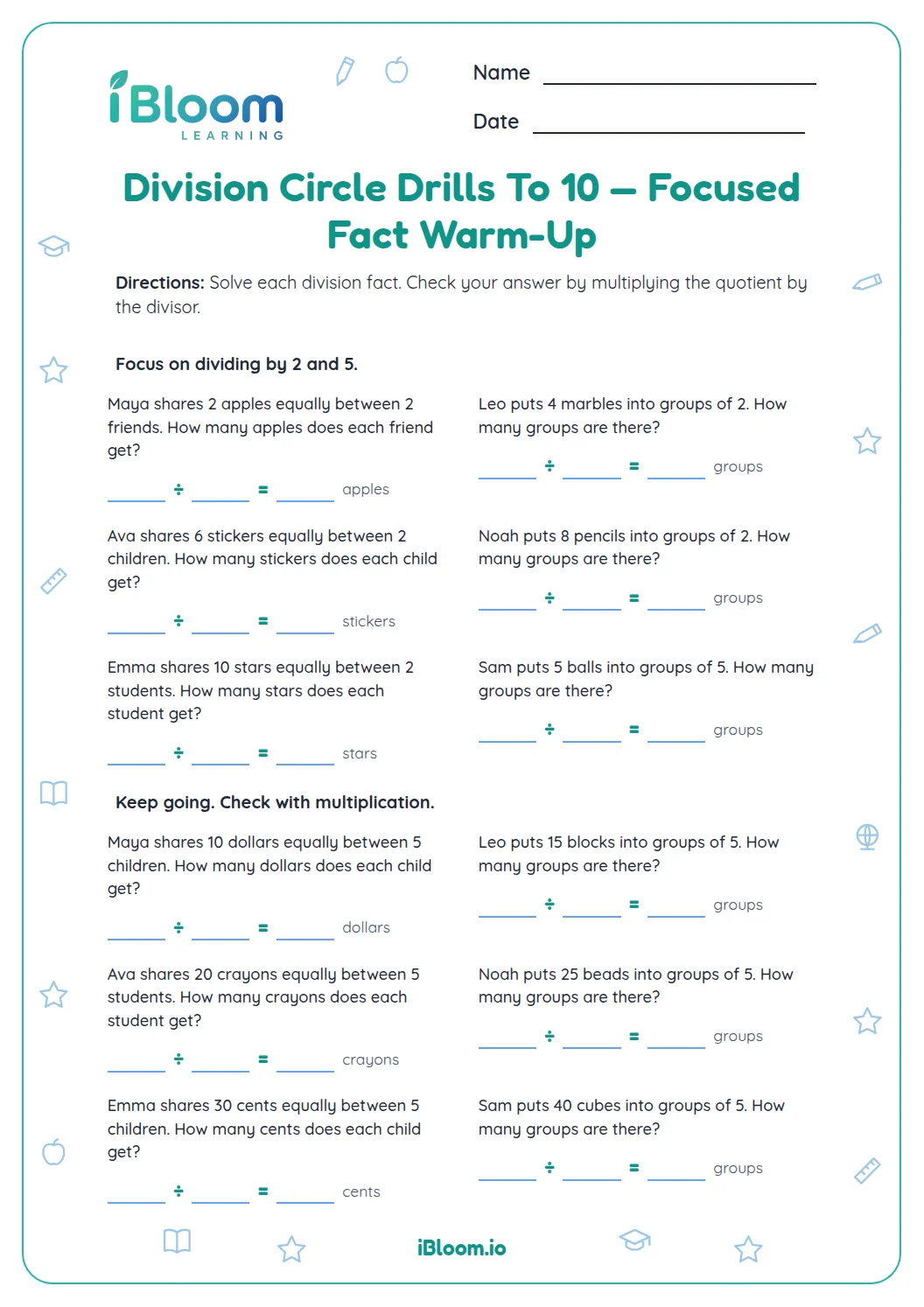
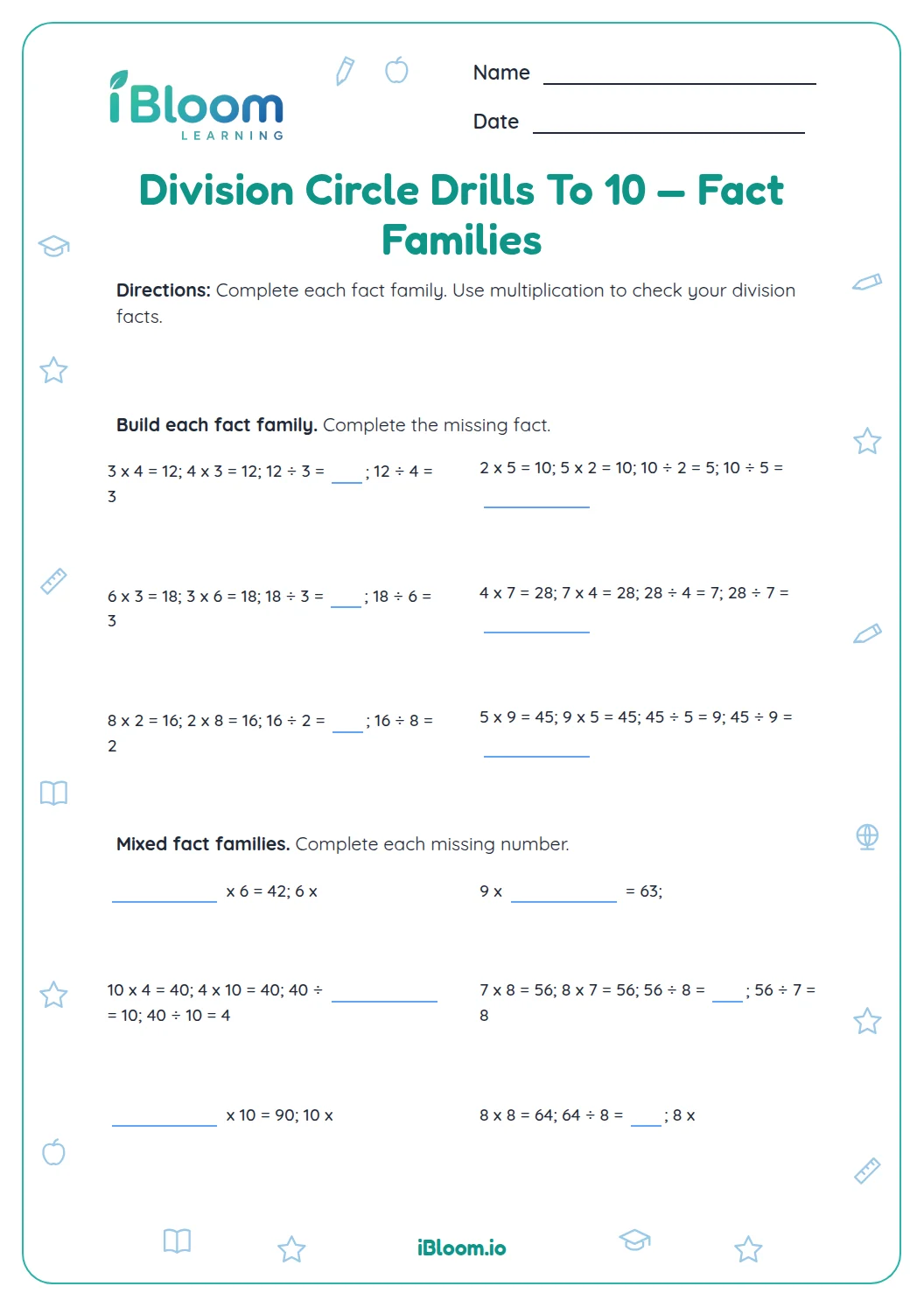
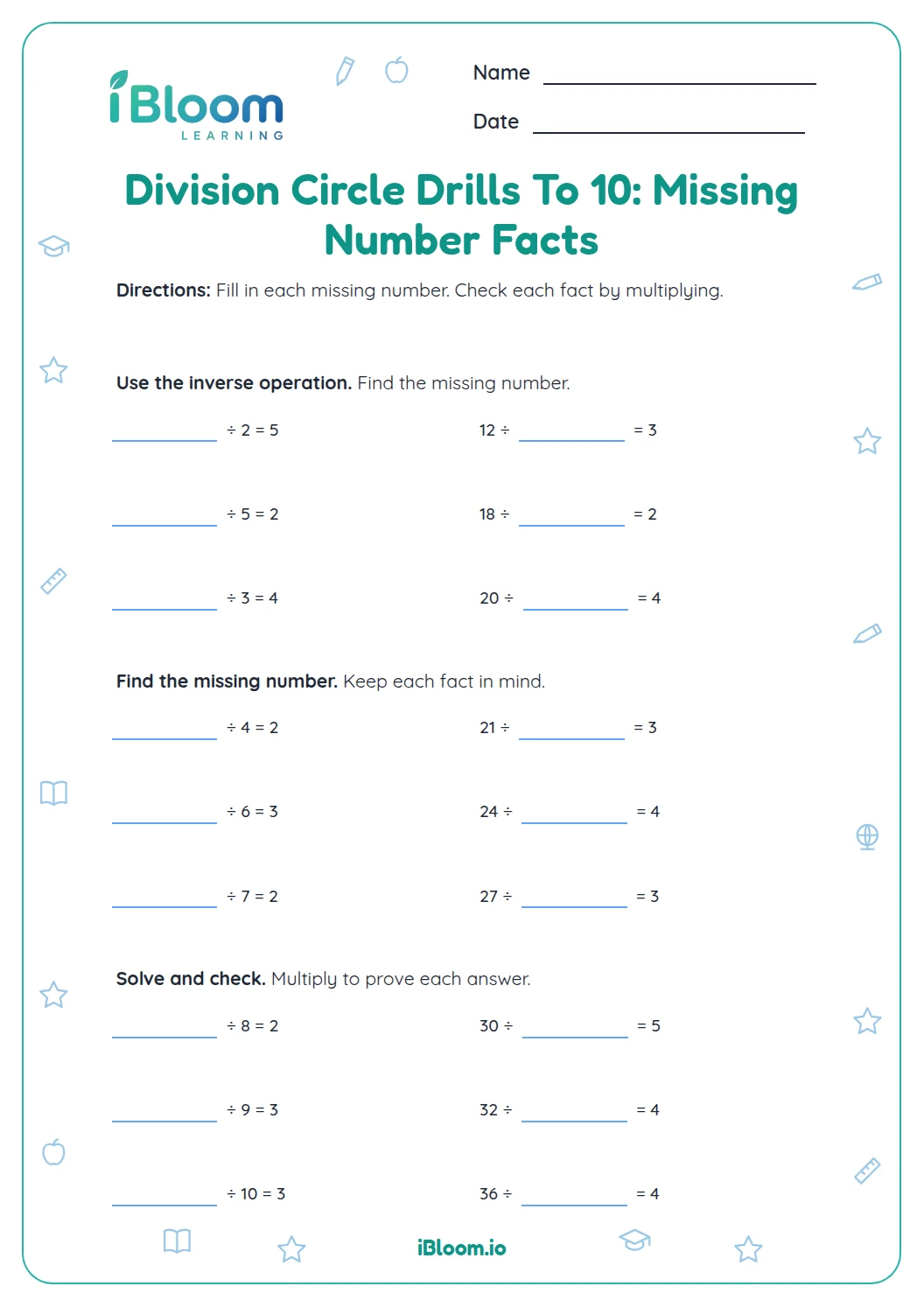
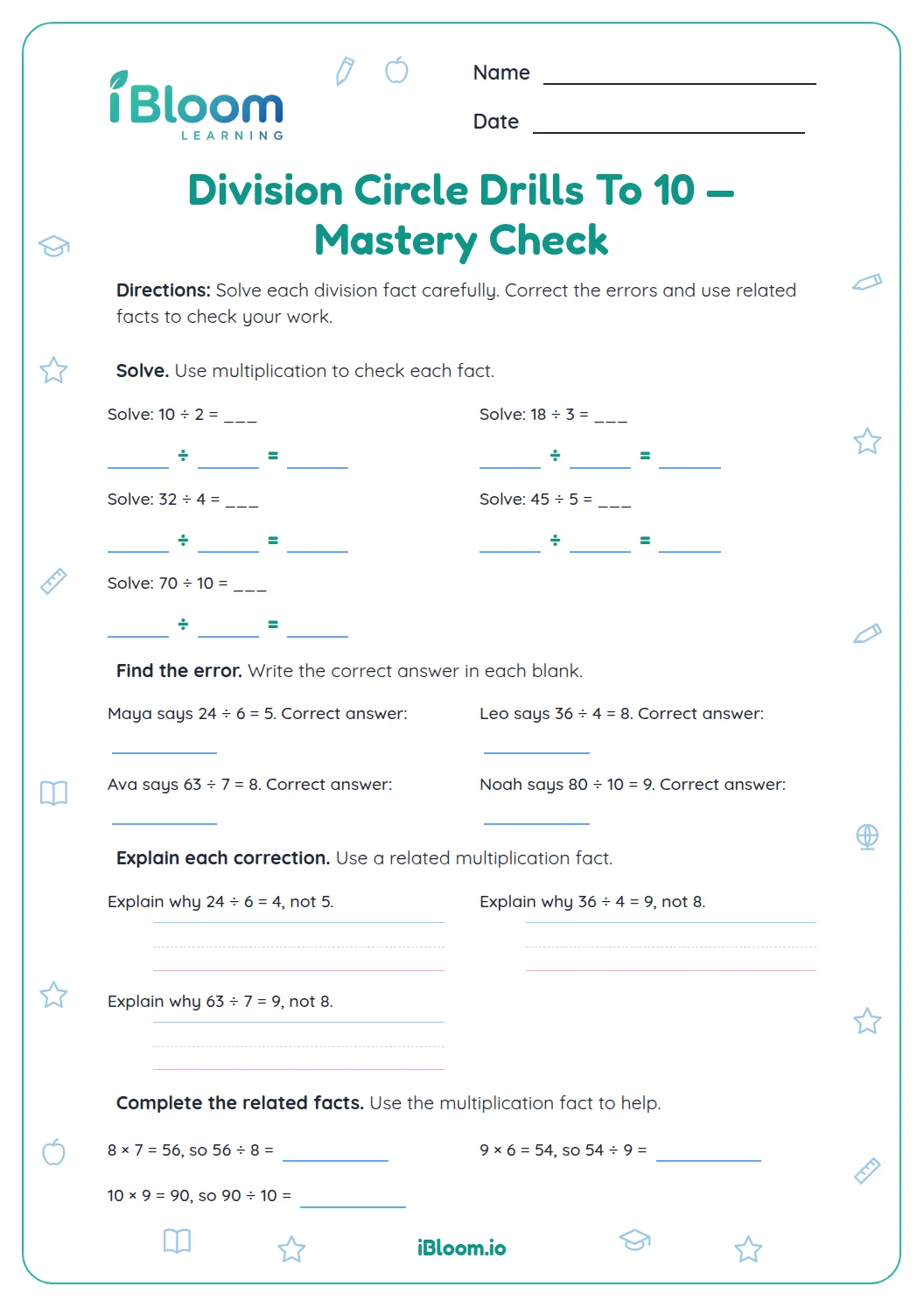
This Grade 3 printable pairs two ten-spoke multiplication circles with 12 division equations using divisors through 10. Complete each circle, then use multiplication facts to find the quotients. The answer key lists all circle products and division answers. Timing is optional.
Aligned to 3.OA.C.7
How do fact circles connect to division?
Each circle pairs the center factor with eight outer factors. Multiply each pair to make a product, then use the factors and product to state a related division fact.
- 1Center 4 and outer number 5 make 20.
- 2A related division fact is 20 ÷ 5 = 4.
What comes after the circles?
The two circles include 16 products, with factors through 10. Use each multiplication fact to check a related division fact.
When should timing be used?
First work carefully without a timer. A teacher or family member may time a later round after the facts are accurate.
How to use this worksheet
- 1Complete the first fact circle without timing.
- 2Write the products in order around the circle.
- 3Solve each division equation.
- 4Multiply a quotient by its divisor to check.
- 5Use timing only for a later accurate round.
Common mistakes and quick fixes
The mistake
Dividing the divisor by the dividend.
The fix
Ask what number times the divisor equals the dividend.
The mistake
Writing circle products out of order.
The fix
Follow the outer numbers clockwise from the first position.
The mistake
Rushing to beat a timer.
The fix
Complete the untimed facts accurately before tracking speed.
Common Core alignment
This worksheet practices the following Common Core skill.
Use related multiplication facts to divide within 100.
On this sheet: The questions directly ask learners to apply this skill.
Show the official wordingHide the official wording
Fluently multiply and divide within 100, using strategies such as the relationship between multiplication and division (e.g., knowing that 8 × 5 = 40, one knows 40 ÷ 5 = 8) or properties of operations. By the end of Grade 3, know from memory all products of two one-digit numbers.
What to practice next
Make more practice
Further reading
Questions parents and teachers ask
How do you use a fact circle?
Multiply the center number by each outer number and write the products in order. Each product and its factors make a multiplication fact, which can be turned around into a related division fact. For instance, 24 ÷ 3 = 8 because 3 × 8 makes 24.
Which division facts are included?
The mixed section has 12 equations with divisors from 2 through 10. The eight circles also build products that can be used to state related division facts. Both activity types connect multiplication and division. Children can say the multiplication sentence aloud before naming the related quotient.
Is the timed drill required?
No. Timing is optional. Children can first solve each fact carefully and use multiplication to check. A teacher or parent can introduce a time goal only after the answers are accurate. An untimed first pass gives children room to check each answer carefully.
How can multiplication check division?
Multiply the quotient by the divisor. For 54 ÷ 6 = 9, check 9 × 6 = 54. If the product matches the dividend, the quotient is correct. This inverse check confirms the quotient and helps catch a multiplication slip.
How many problems and pages are there?
There are 14 numbered questions: two circles with ten products each and 12 division equations. The worksheet prints on two pages, followed by a separate two-page answer key. The key lists the circle products and division answers in the same order as the practice.