
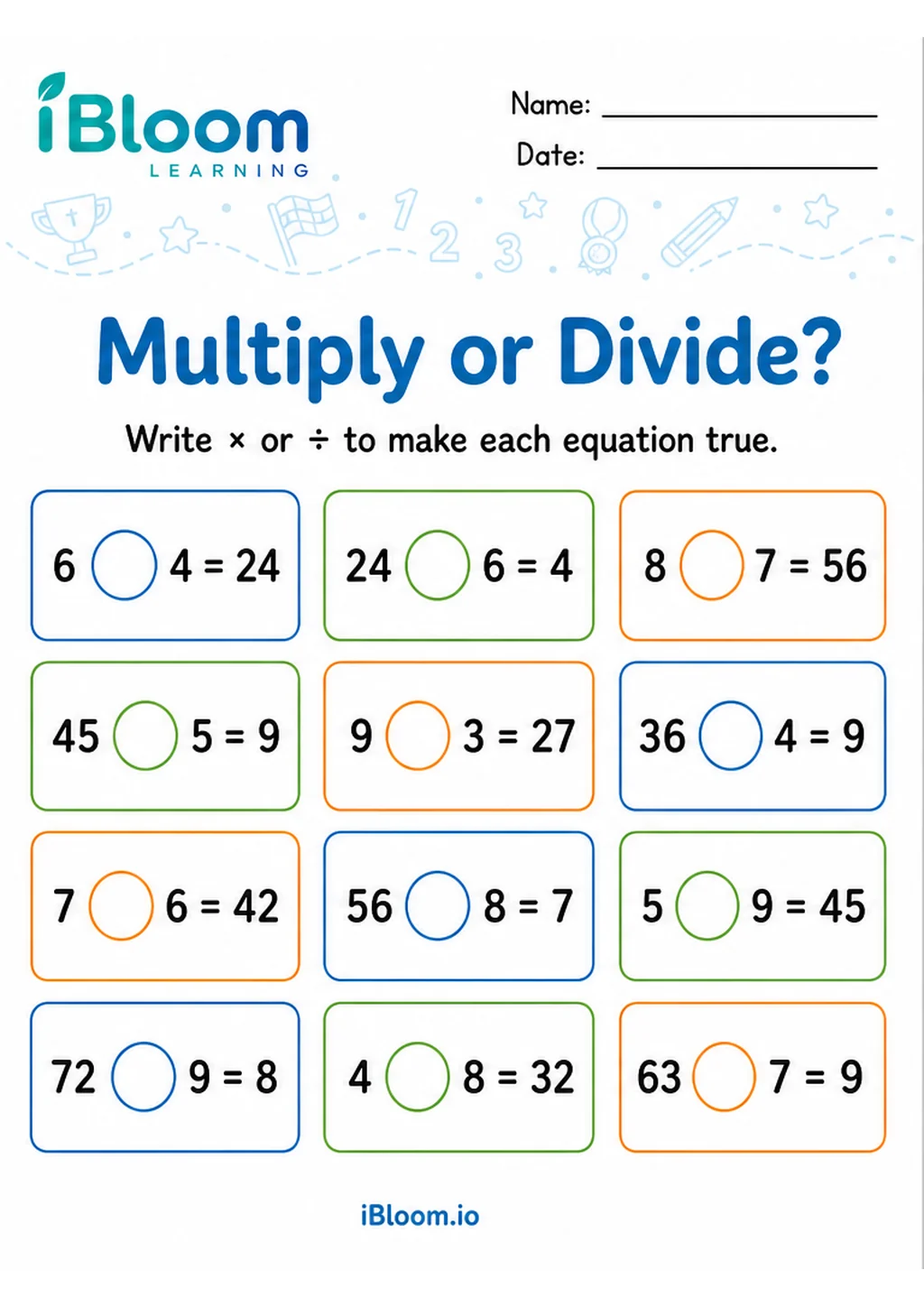
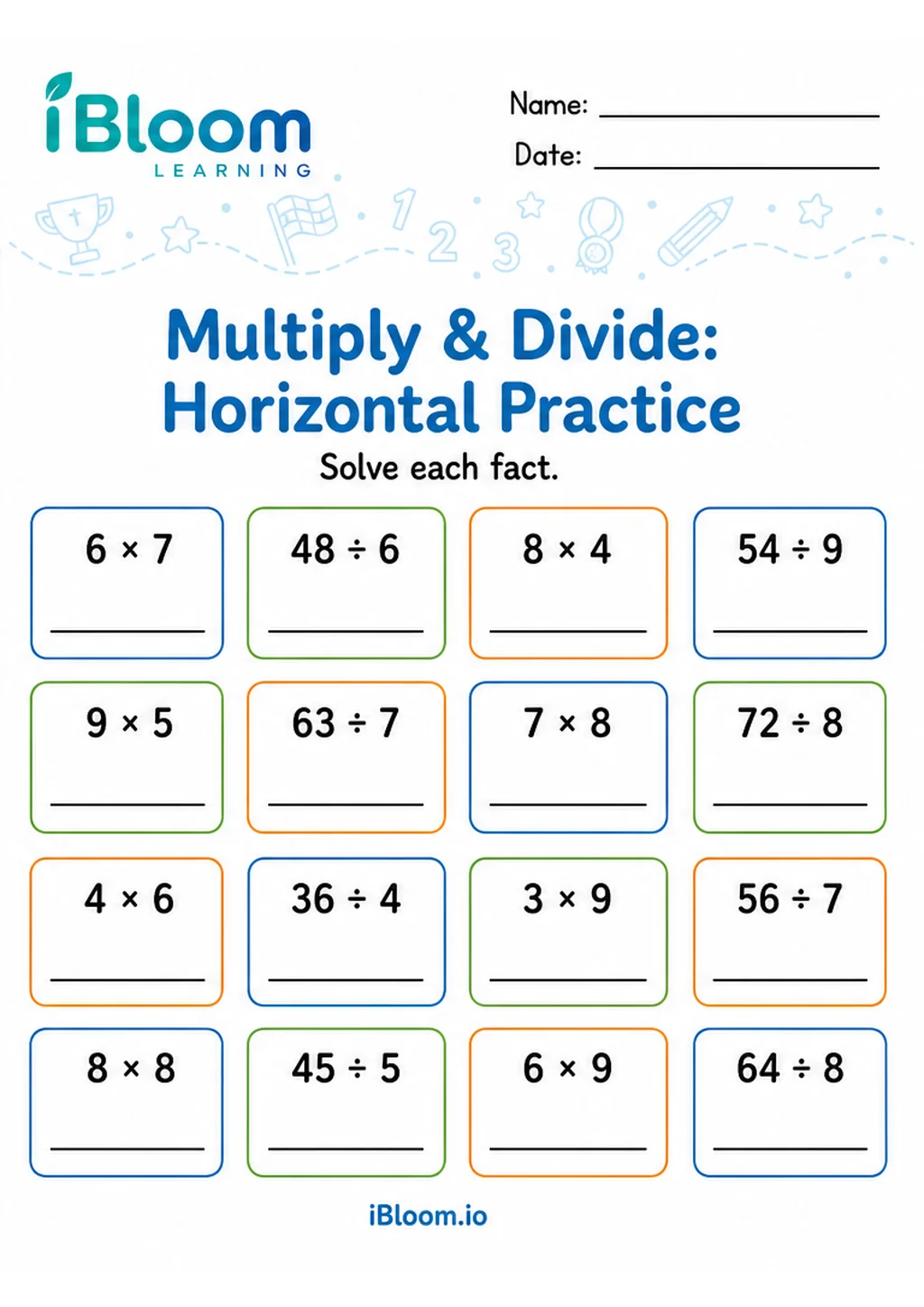
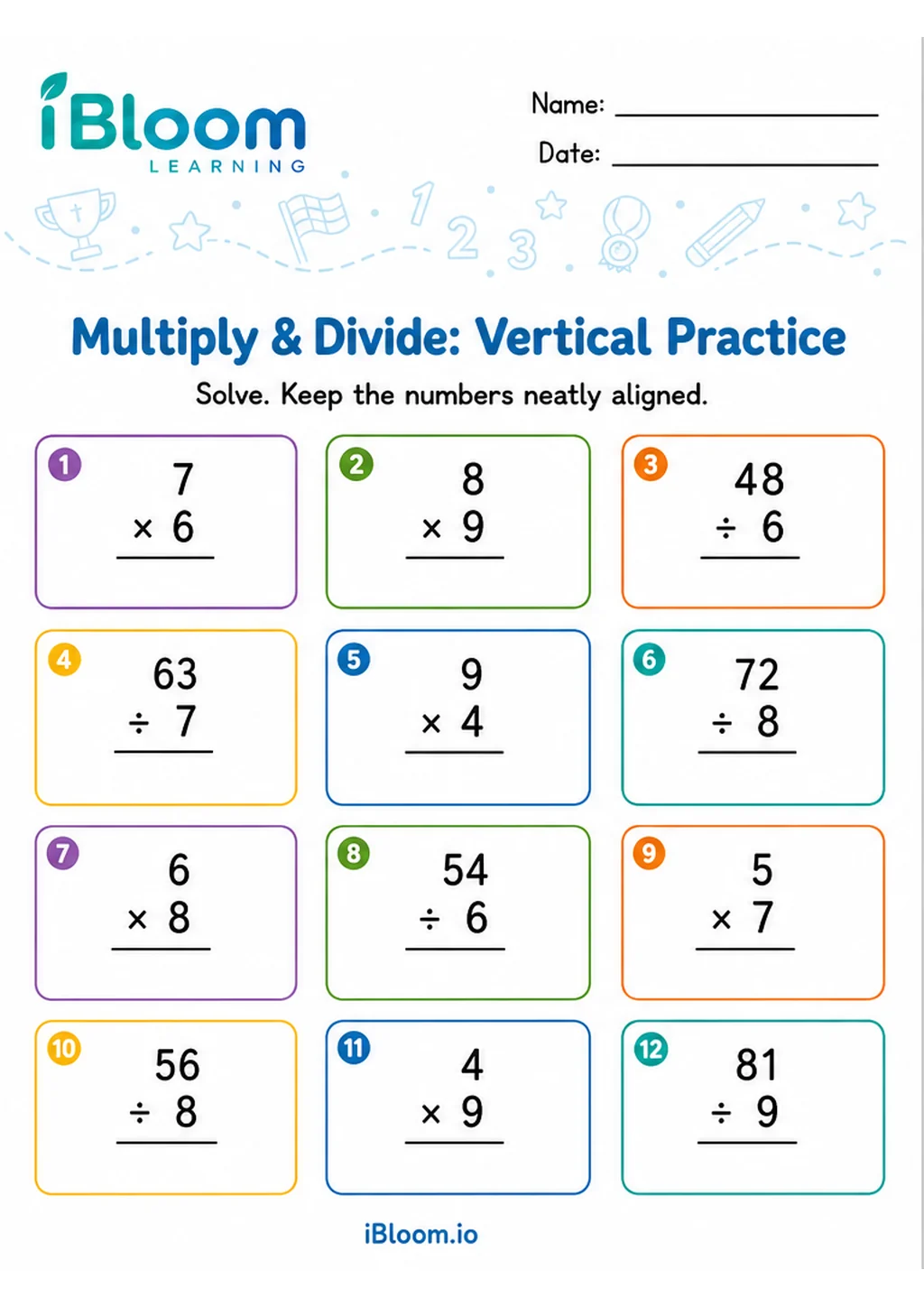
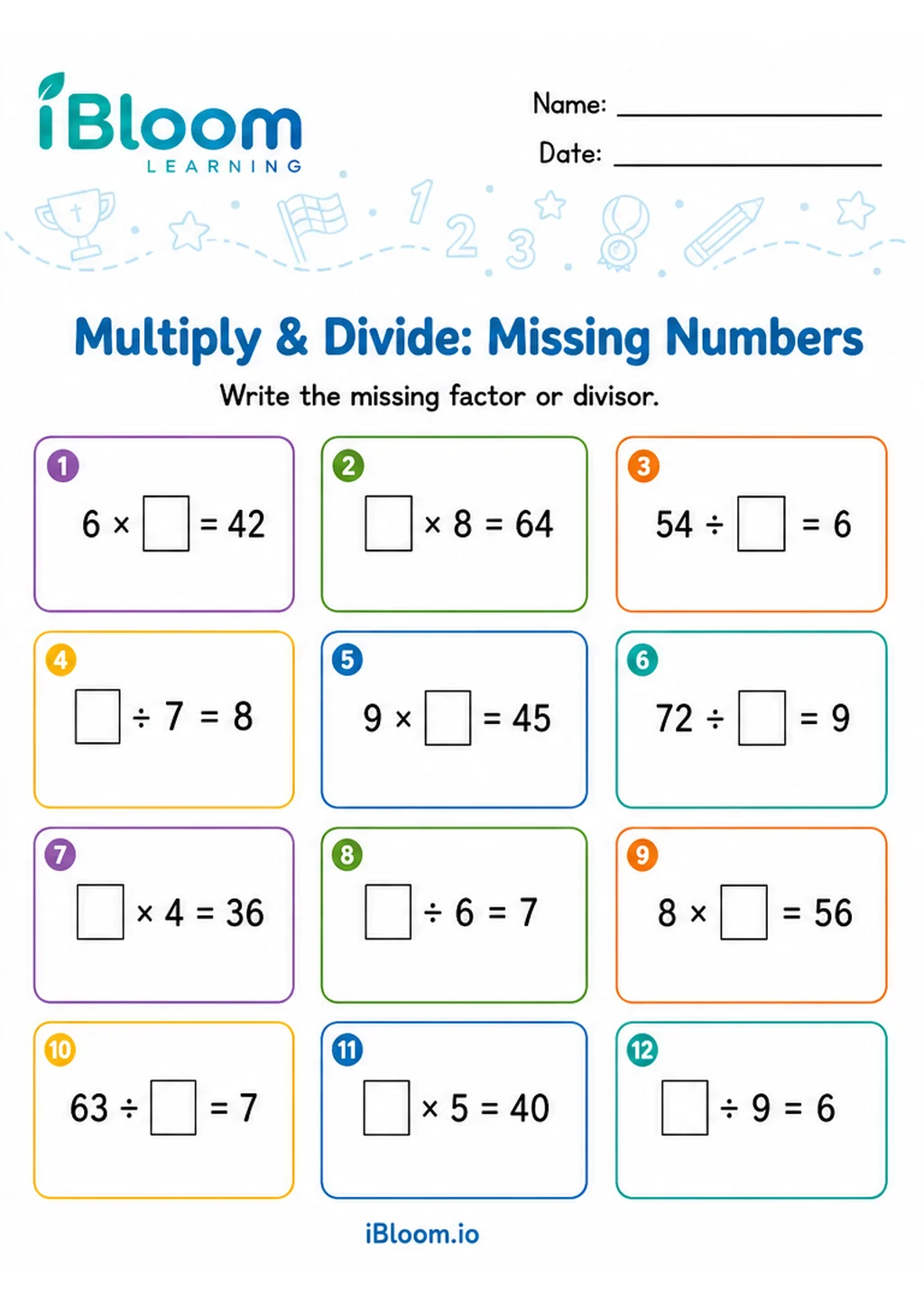
About this worksheet
This printable gives learners 16 horizontal facts across addition, subtraction, multiplication, and division. The sequence starts with addition and subtraction within 20, practices one-digit multiplication and related division, then mixes all four operations. A separate answer key makes checking quick. The listed Common Core standards describe the addition/subtraction and multiplication/division practice.
Aligned to 2.OA.B.2 and 3.OA.C.7
How are the facts organized?
Part A practices addition and subtraction within 20. Part B adds more of those facts. Part C shifts to one-digit multiplication and related division. Part D mixes all four operations so learners must read each sign before calculating.
- The answer key is a separate page
How can a multiplication fact check a division fact?
Multiplication and division undo each other. If the product and one factor are known, use the other factor to check the quotient.
- 1For 36 ÷ 6, ask what number times 6 equals 36.
- 26 × 6 = 36.
- 3So 36 ÷ 6 = 6.
How can you avoid mixing up the operations?
Pause at each sign before calculating. Addition combines quantities, subtraction finds a difference, multiplication finds a product, and division asks how many equal groups or how many in each group.
How to use this worksheet
- 1Read the operation sign before working on each equation.
- 2Solve addition and subtraction facts within 20.
- 3Use multiplication facts to support the division facts.
- 4Check multiplication and division with the inverse operation.
- 5Compare each result with the separate key.
Common mistakes and quick fixes
The mistake
Treating a subtraction fact like addition.
The fix
Say the operation aloud and check whether the result is a difference.
The mistake
Confusing the factor and product.
The fix
In multiplication, the factors are multiplied to make the product.
The mistake
Using the wrong related fact for division.
The fix
Multiply the quotient by the divisor to see whether it gives the dividend.
Common Core alignment
add and subtract within 20 using mental strategies
On this sheet: The addition and subtraction questions use sums and differences within 20.
Show the official wordingHide the official wording
Fluently add and subtract within 20 using mental strategies. By end of Grade 2, know from memory all sums of two one-digit numbers.
recall multiplication and division facts and use related facts
On this sheet: Questions q3, q4, q7, q8, q11, q12, q15, and q16 practice one-digit multiplication and related division facts.
Show the official wordingHide the official wording
Fluently multiply and divide within 100, using strategies such as the relationship between multiplication and division (e.g., knowing that 8 × 5 = 40, one knows 40 ÷ 5 = 8) or properties of operations. By the end of Grade 3, know from memory all products of two one-digit numbers.
What to practice next
Make more practice
Further reading
Questions parents and teachers ask
Which operations are included?
The worksheet includes addition, subtraction, multiplication, and division. The first two parts use addition and subtraction, the third practices multiplication and division, and the final part mixes all four. The multiplication and division facts use one-digit factors and related quotients, including familiar fact-family pairs.
How many math facts are on the page?
There are 16 horizontal equations on the worksheet and a separate answer key. The problems include four facts for each operation. Addition and subtraction answers stay within 20, while multiplication products and division dividends remain manageable facts. Review each operation group separately.
Are the division facts connected to multiplication?
Yes. Each division item can be checked with a related multiplication fact. For example, 48 ÷ 8 = 6 because 6 × 8 = 48. The final section changes operation signs between questions, so pausing to identify each sign supports accurate work.
What number range do the addition and subtraction problems use?
The addition sums are 13, 14, 16, and 20; the subtraction differences are 7, 8, 14, and 8. Each result is within 20. A learner can cover the answer key, solve the equations, and then use it to spot any fact to review.
Is the page timed?
No time limit is printed. Learners can focus on reading the operation sign and checking each answer with an inverse fact or the separate key. Use this as untimed practice; the directions ask learners to solve, and no speed score is part of the sheet.