
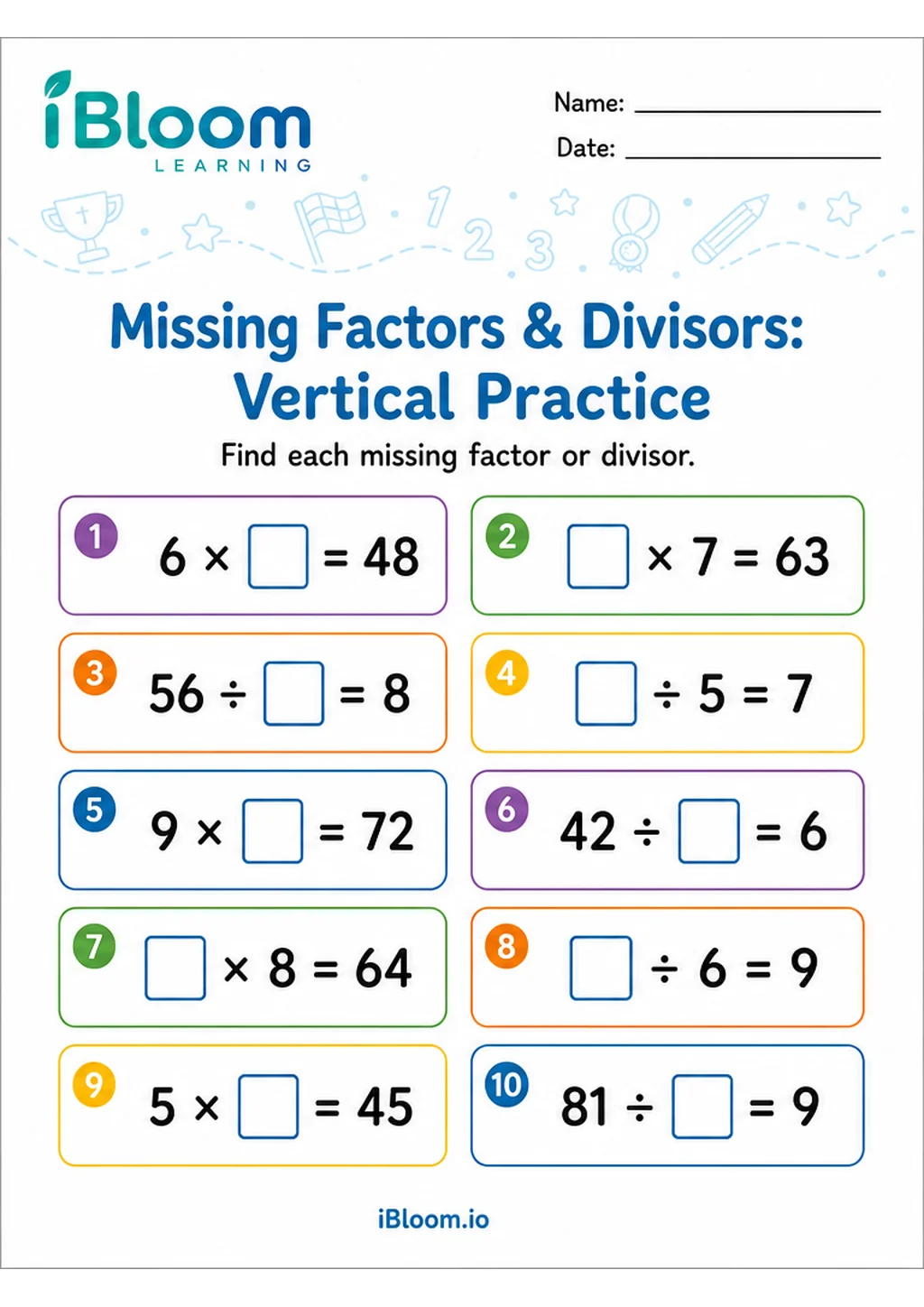
About this worksheet
This Grade 3 printable gives students 16 equations with one missing number, then four short word problems. The equations practice addition, subtraction, multiplication, and division, with every missing value from 1 to 10. Students use inverse operations to check each answer. The answer key lists the missing values and word-problem answers. The multiplication and division items practice CCSS 3.OA.C.7 through one-digit facts and their inverse relationships.
Aligned to 3.OA.C.7
How can you find a missing addend?
Think of addition as a total made from two parts. If the total is 10 and one part is 4, subtract 4 from 10 to find the other part. The first four equations practice that relationship.
- 1___ + 4 = 10
- 210 − 4 = 6, so the missing number is 6.
How do you solve a subtraction equation with a blank?
Check what role the blank plays. In 9 − ___ = 3, the blank is the amount taken away, so 9 − 3 gives 6. When the blank comes first, as in ___ − 2 = 7, add the difference and the amount taken away.
How do multiplication and division help each other?
A multiplication fact can check a division fact, and division can reveal a missing factor. For ___ × 6 = 24, divide 24 by 6 to find 4. For 8 ÷ ___ = 4, ask what number times 4 makes 8: the divisor is 2.
How to use this worksheet
- 1Read the whole equation before choosing an operation.
- 2For a missing addend, subtract the known addend from the total.
- 3For subtraction, notice whether the blank is the starting number or the amount removed.
- 4For a missing factor or divisor, use the related multiplication fact.
- 5Put your answer back in the original equation to check both sides.
Common mistakes and quick fixes
The mistake
Using addition to find the missing addend but adding the known part to the total.
The fix
Subtract the known addend from the total; the two parts must add back to the whole.
The mistake
Treating ___ − 2 = 7 like 9 − ___ = 3.
The fix
Check the blank’s position. A missing starting number is the difference plus the amount removed.
The mistake
Guessing a divisor from the dividend alone.
The fix
Use multiplication to check: divisor × quotient must equal the dividend.
Curriculum alignment
The practice connects to this grade-level standard.
Use multiplication and division facts and their inverse relationship to find missing factors and quotients.
On this sheet: The multiplication and division equations ask students to use one-digit facts and the inverse relationship to find a missing number.
Show the official wordingHide the official wording
Fluently multiply and divide within 100, using strategies such as the relationship between multiplication and division (e.g., knowing that 8 × 5 = 40, one knows 40 ÷ 5 = 8) or properties of operations. By the end of Grade 3, know from memory all products of two one-digit numbers.
What to practice next
Make more practice
Further reading
Questions parents and teachers ask
What operations appear on the worksheet?
The 16 equations practice addition, subtraction, multiplication, and division. Questions 1–8 use addition and subtraction, while questions 9–16 use multiplication and division. Every missing value is from 1 to 10, and the four word problems apply the same operations.
How do I find a missing addend?
Subtract the addend you know from the total. For example, in ___ + 4 = 10, the missing part is 10 − 4, or 6. Put 6 back into the equation to check that the two addends combine to make 10.
How can multiplication help with a missing divisor?
Use the related multiplication fact. For 8 ÷ ___ = 4, ask what number multiplied by 4 equals 8. Since 2 × 4 = 8, the missing divisor is 2. Multiplication gives a quick check for a division equation.
Are the equations limited to numbers from 1 to 10?
The missing values on this page range from 2 to 9. Some known numbers and totals are larger, such as 14 − 6 and 36 ÷ 6, so students practice identifying the missing value within familiar facts. The full answer key shows each value.
What is a common mistake with subtraction blanks?
Students may solve every subtraction equation as if the blank were the number being taken away. Look at ___ − 2 = 7: the starting number is missing, so 7 + 2 gives 9. In 9 − ___ = 3, the amount removed is missing, so 9 − 3 gives 6.