
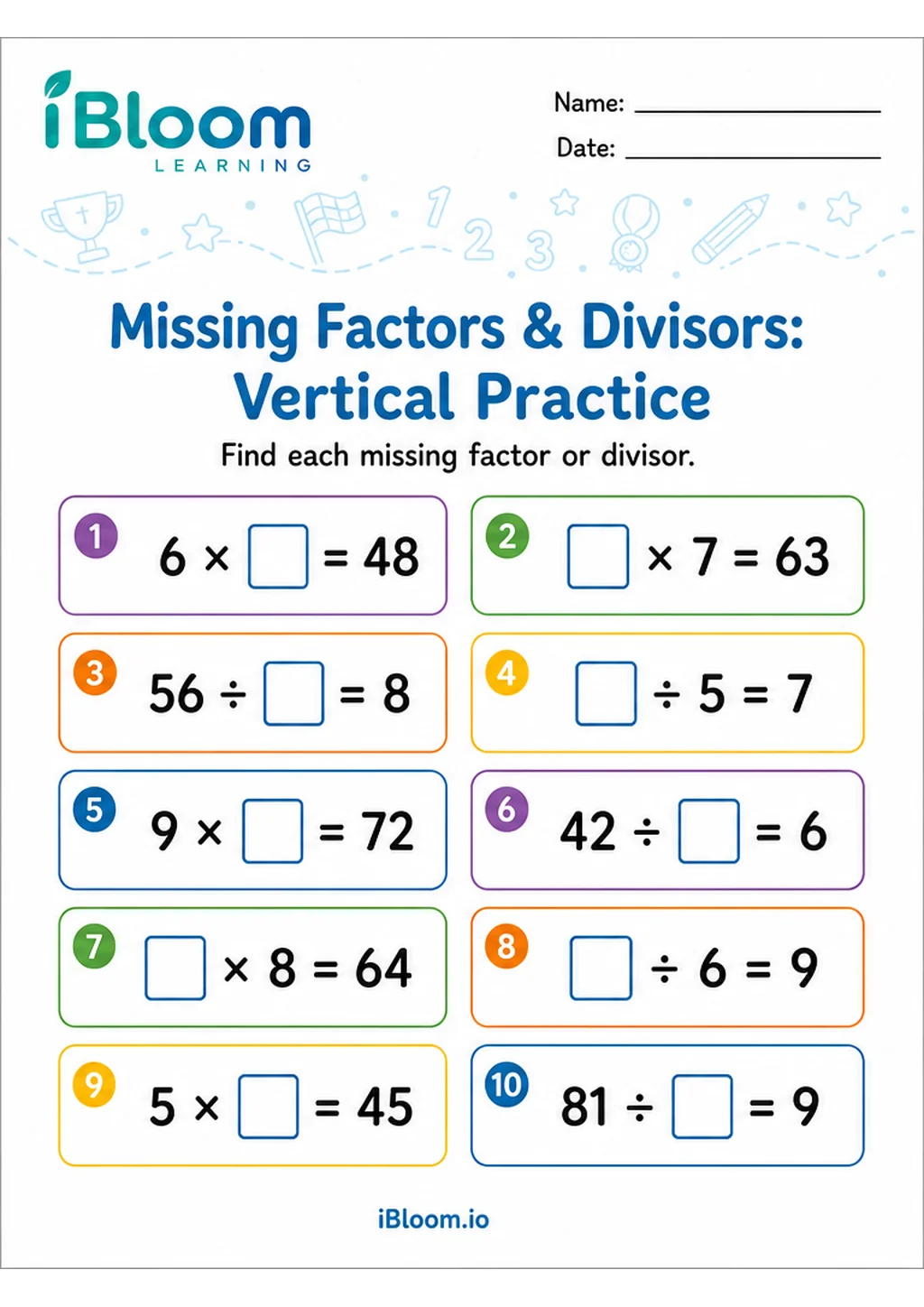
About this worksheet
This free printable gives students practice finding missing numbers in addition and subtraction equations within 10. The first part focuses on addition, the second on subtraction, and the last mixes the two operations. Students must attend to the operation sign and the blank’s position. The practice supports CCSS 1.OA.C.6 through addition and subtraction facts within 10.
Aligned to 1.OA.C.6
How do you find a missing addend?
Think of the number that combines with the known addend to make the total. In ___ + 4 = 9, the missing number is 5 because 5 + 4 makes 9. Students can count on from four or use a known addition fact.
- 1___ + 4 = 9
- 25 + 4 = 9, so the blank is 5.
How can addition help with subtraction?
Subtraction can be understood as an unknown-addend question. For 8 − ___ = 3, ask what number added to 3 makes 8. The answer is 5. Part B includes blanks in different positions so students attend to what the equation asks.
How should students handle mixed equations?
Check the operation sign before solving. Then identify whether the blank is a part or the result. In Part C, equations mix addition and subtraction and place the blank in different positions.
- Part A: find an addend or sum
- Part B: find a subtraction part or difference
- Part C: choose a strategy after noticing the sign
How to use this worksheet
- 1Read the whole equation, including its operation sign.
- 2Name the known total or parts.
- 3For addition, find the number that completes the total.
- 4For subtraction, use the related addition fact if helpful.
- 5Substitute your answer into the blank and check the equation.
Common mistakes and quick fixes
The mistake
Solving every blank by counting up even when the sign is subtraction.
The fix
Check the sign first and consider the related addition fact.
The mistake
Subtracting the known number from the total in the wrong order.
The fix
Ask which two parts combine to make the whole.
The mistake
Writing the total when the blank is one of the parts.
The fix
Replace the blank and test whether both sides are equal.
Common Core alignment
These standards describe the writing or math work practiced on this page.
Build fluency with addition and subtraction facts within 10.
On this sheet: Students solve addition and subtraction equations with unknown numbers and totals no greater than 10.
Show the official wordingHide the official wording
Add and subtract within 20, demonstrating fluency for addition and subtraction within 10. Use strategies such as counting on; making ten (e.g., 8 + 6 = 8 + 2 + 4 = 10 + 4 = 14); decomposing a number leading to a ten (e.g., 13 - 4 = 13 - 3 - 1 = 10 - 1 = 9); using the relationship between addition and subtraction (e.g., knowing that 8 + 4 = 12, one knows 12 - 8 = 4); and creating equivalent but easier or known sums (e.g., adding 6 + 7 by creating the known equivalent 6 + 6 + 1 = 12 + 1 = 13).
What to practice next
Make more practice
Questions parents and teachers ask
What number range is used?
Every equation uses whole numbers from 0 to 10, and every answer stays within that range. The worksheet uses addition and subtraction facts in horizontal form. Students fill the blank and can verify by putting their answer back into the equation.
Why does the blank move to different places?
The missing number can be an addend, the starting number in subtraction, the number being subtracted, or the total. Changing its position helps students read the full equation instead of assuming that every blank asks for the same role.
How can addition help solve subtraction?
Treat subtraction as an unknown-addend question. For 8 − ___ = 3, ask “3 plus what makes 8?” Since 3 + 5 = 8, the missing number is 5. This relationship is practiced in the subtraction and mixed sections.
What is a good way to check an answer?
Substitute the answer into the blank and evaluate both sides. For ___ + 4 = 9, put 5 in the blank and check that 5 + 4 equals 9. For a subtraction equation, check the subtraction directly or confirm its related addition fact.
How many questions are included?
The worksheet contains 18 equations: six addition facts, six subtraction facts, and six mixed equations. It prints on one worksheet page, with a separate one-page answer key. The key gives the missing value for every blank. Students can check one equation at a time.
What should students do after this page?
Fact-family practice connects each addition equation to its related subtraction equations. Students who are ready for a broader set can use the general addition and subtraction fact page. The missing-number generator can also make additional equations for short practice rounds.