
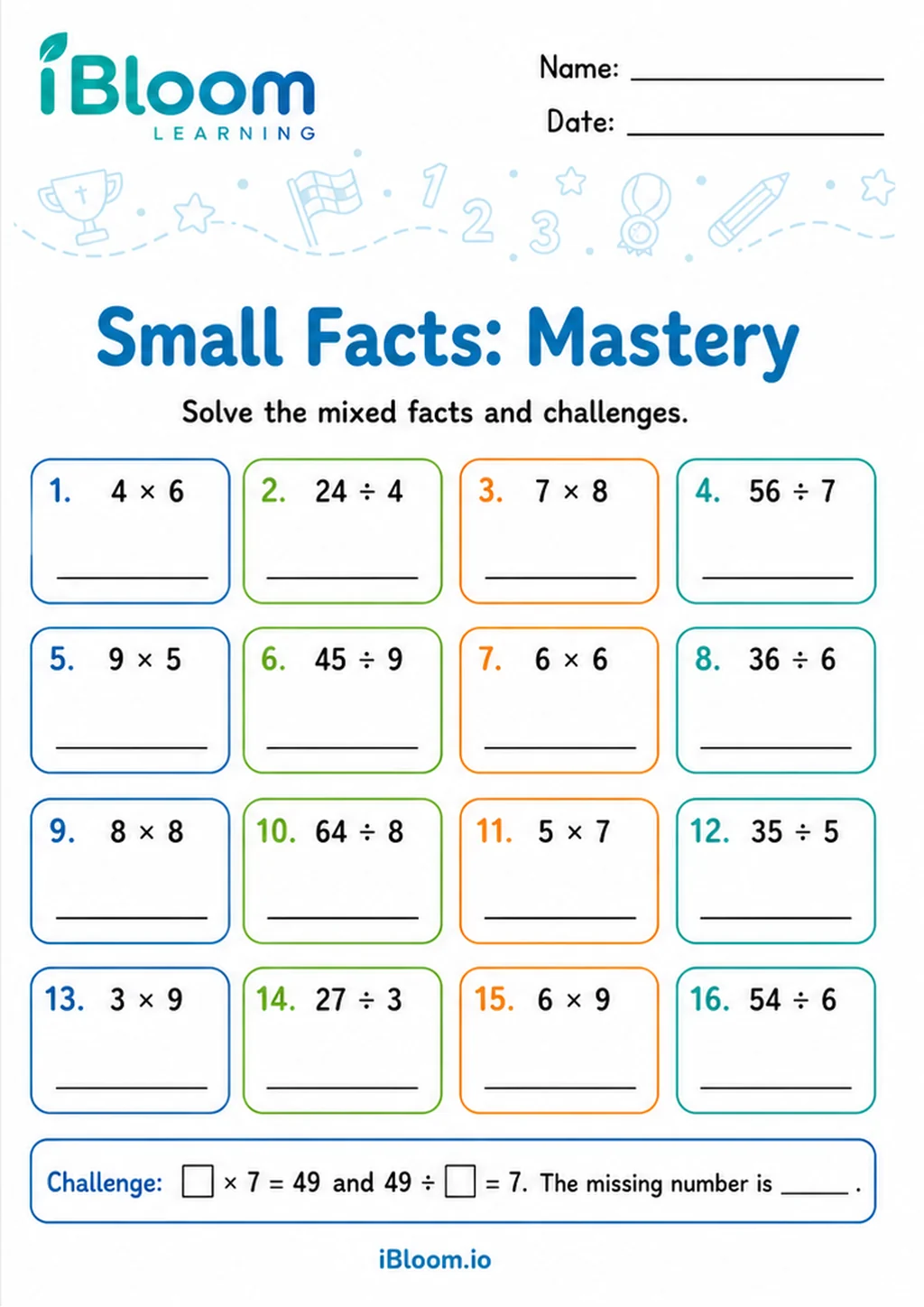
About this worksheet
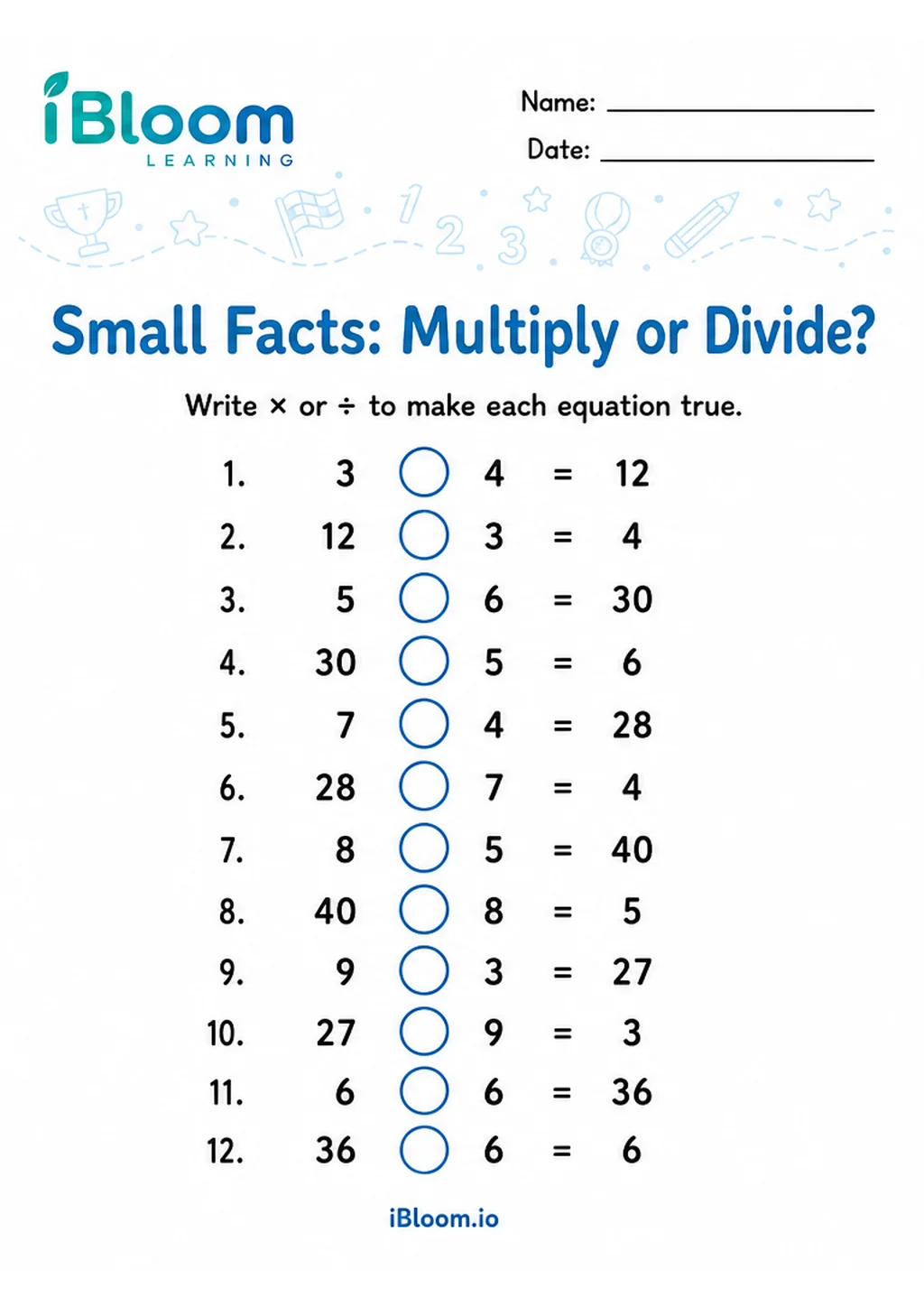
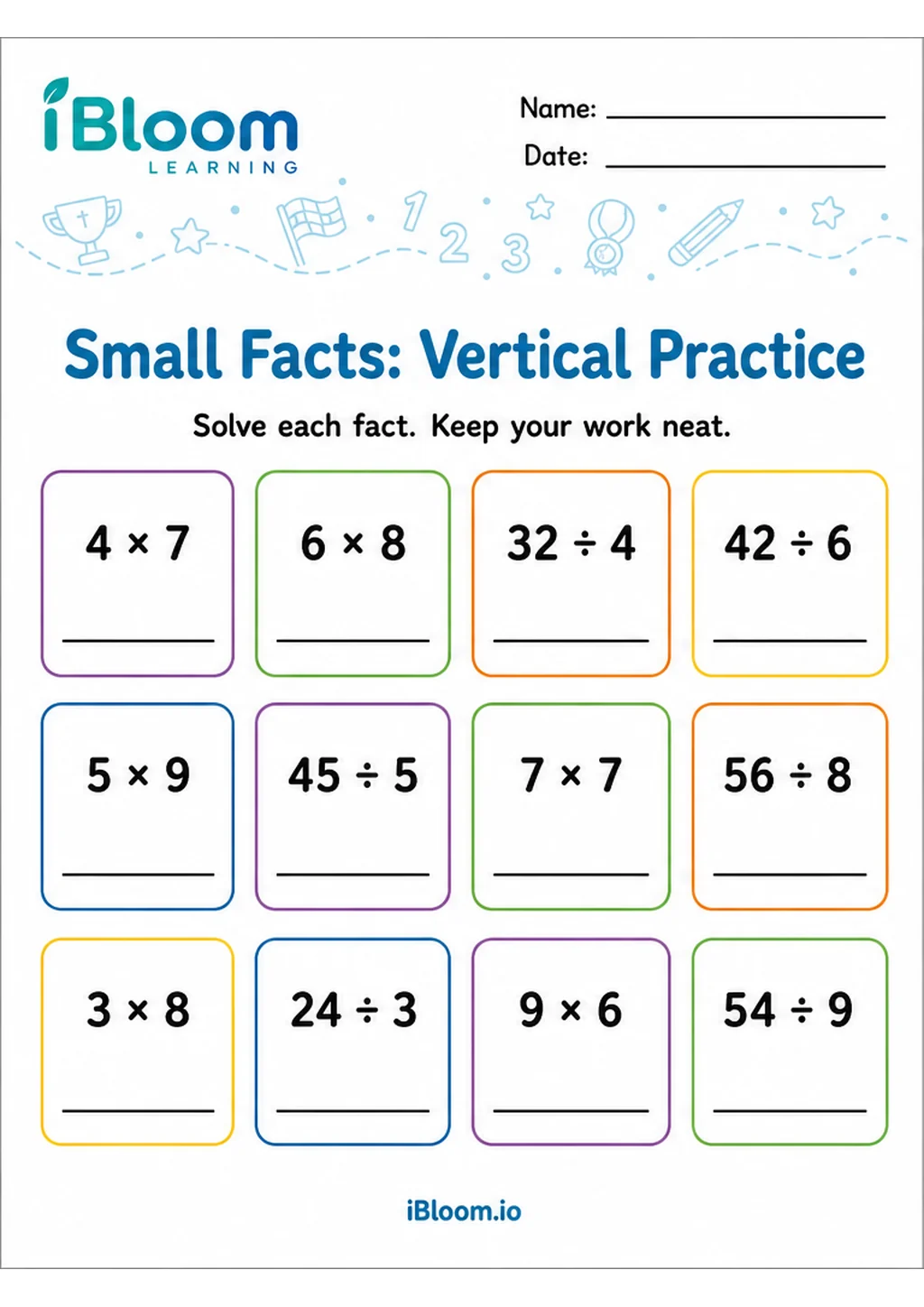
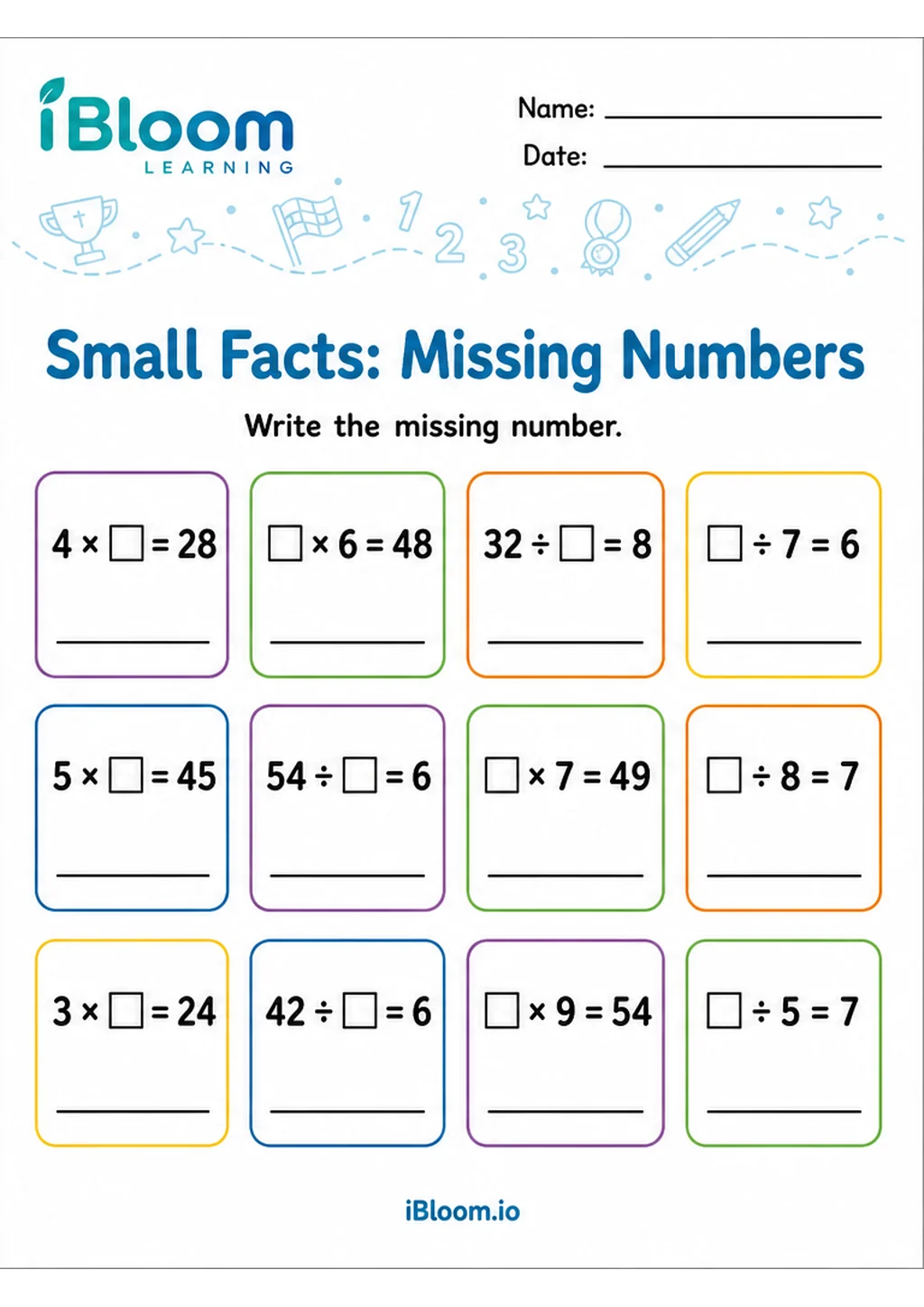
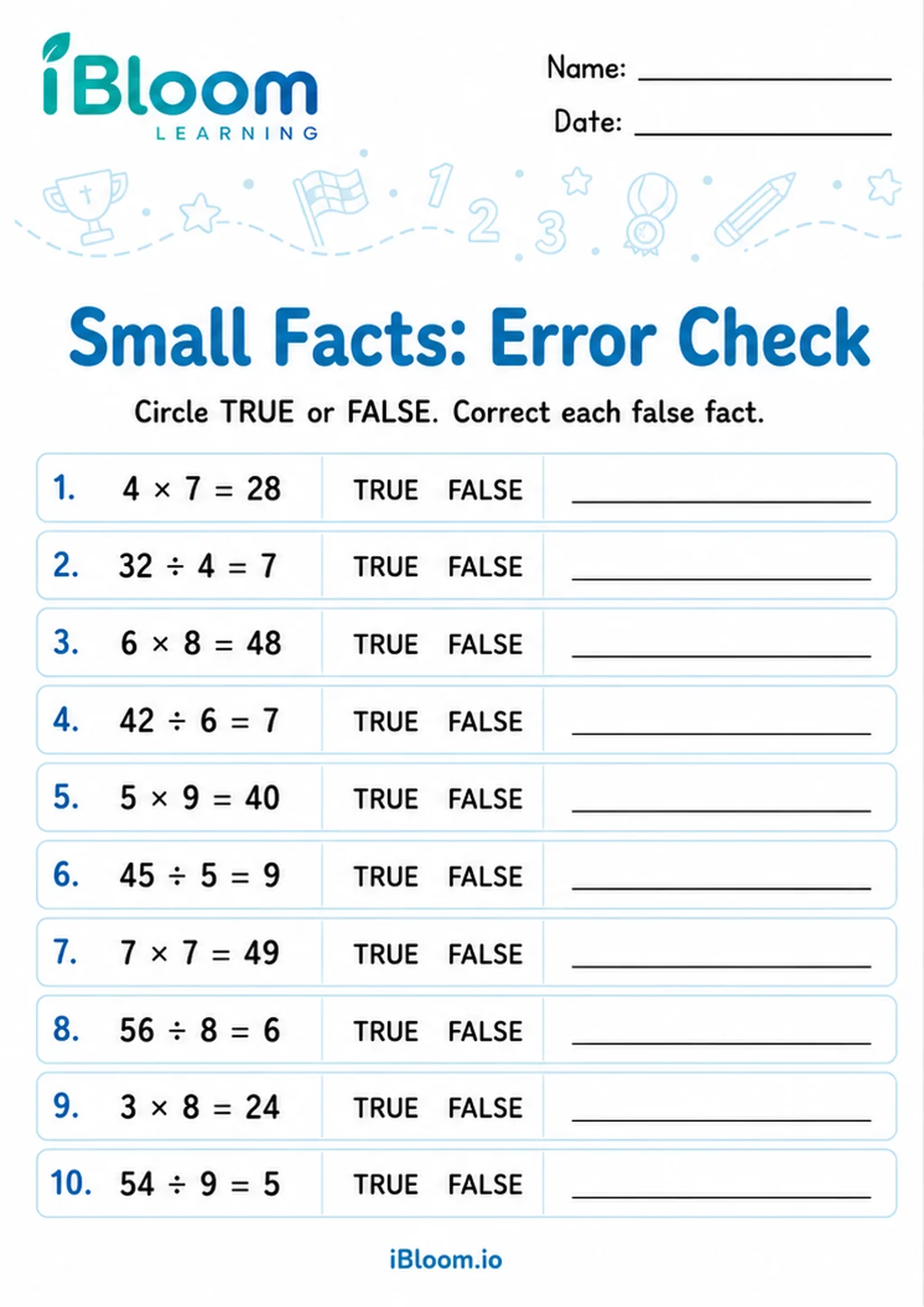
This free printable math worksheet gives Grades 3–6 learners 16 small multiplication and division facts to solve horizontally. The problems alternate between finding a product and finding a quotient, so students use fact relationships in both directions. It practices Common Core 3.OA.C.7, multiplying and dividing within 100. Two short parts keep the practice moving, and a separate answer key makes checking quick.
Aligned to 3.OA.C.7
How do I read each fact?
Look at the sign before you calculate. A multiplication item asks for a product; a division item asks how many equal groups or how many in each group. The blank marks the missing number.
How can a multiplication fact help with division?
The two operations undo each other. If 6 × 7 = 42, then 42 ÷ 7 = 6 and 42 ÷ 6 = 7. Recall the multiplication fact when a division fact feels less familiar.
- 142 ÷ 7 = ___
- 2Ask: what number times 7 equals 42?
- 36 × 7 = 42, so 42 ÷ 7 = 6.
What is on the two parts?
Part A has eight facts that mix multiplication and division. Part B continues the alternation with eight more facts. Products and quotients stay within 100.
- Part A: questions 1–8
- Part B: questions 9–16
- Write one number in each blank
How to use this worksheet
- 1Read the operation sign before doing the fact.
- 2For division, ask which multiplication fact has the dividend as its product.
- 3Write only the missing number in each blank.
- 4Check a division answer by multiplying it by the divisor.
- 5Use the answer key after finishing both parts.
Common mistakes and quick fixes
The mistake
Using the wrong operation after moving quickly.
The fix
Point to × or ÷ and say the operation name before solving.
The mistake
Dividing the divisor by the dividend.
The fix
Check that divisor × quotient equals the dividend.
The mistake
Writing an unrelated product in the division blank.
The fix
Use the matching fact family, such as 6 × 7 = 42 and 42 ÷ 7 = 6.
Common Core alignment
This worksheet practices the listed Common Core skill through its questions.
Use fact relationships to multiply and divide within 100.
On this sheet: The 16 horizontal items alternate one-digit multiplication and division facts within 100.
Show the official wordingHide the official wording
Fluently multiply and divide within 100, using strategies such as the relationship between multiplication and division (e.g., knowing that 8 × 5 = 40, one knows 40 ÷ 5 = 8) or properties of operations. By the end of Grade 3, know from memory all products of two one-digit numbers.
What to practice next
Make more practice
Further reading
Questions parents and teachers ask
How many problems are on this worksheet?
There are 16 number sentences split into two parts. Eight ask for products and eight ask for quotients, with multiplication and division alternating throughout. Each blank needs one number. The separate answer key lists all 16 results so a learner can check each fact after finishing.
What grade is this mixed fact practice for?
The page is labeled for Grades 3–6 and uses one-digit factors and divisors with answers within 100. Grade 3 learners can use related multiplication facts to solve division items, while older students can use the set for a quick fluency review.
How do the multiplication and division questions connect?
Yes. For example, 6 × 7 = 42 and 42 ÷ 7 = 6 belong to the same fact family. On this worksheet, recalling a product can help with a division fact, and multiplying a quotient by its divisor checks the result.
Should students use a calculator?
The worksheet is designed for fact practice, so students can first recall a fact or use the related operation to reason it out. A caregiver can check the answer key afterward and revisit any item that needs more practice. The page has space for all 16 answers across its two practice parts.
Is an answer key included?
Yes. The separate answer key gives the missing number for every item. For a division question, check the result by multiplying the answer by the divisor; the product should match the dividend in the number sentence. The two pages keep the answer list separate from the student practice.