





About this worksheet
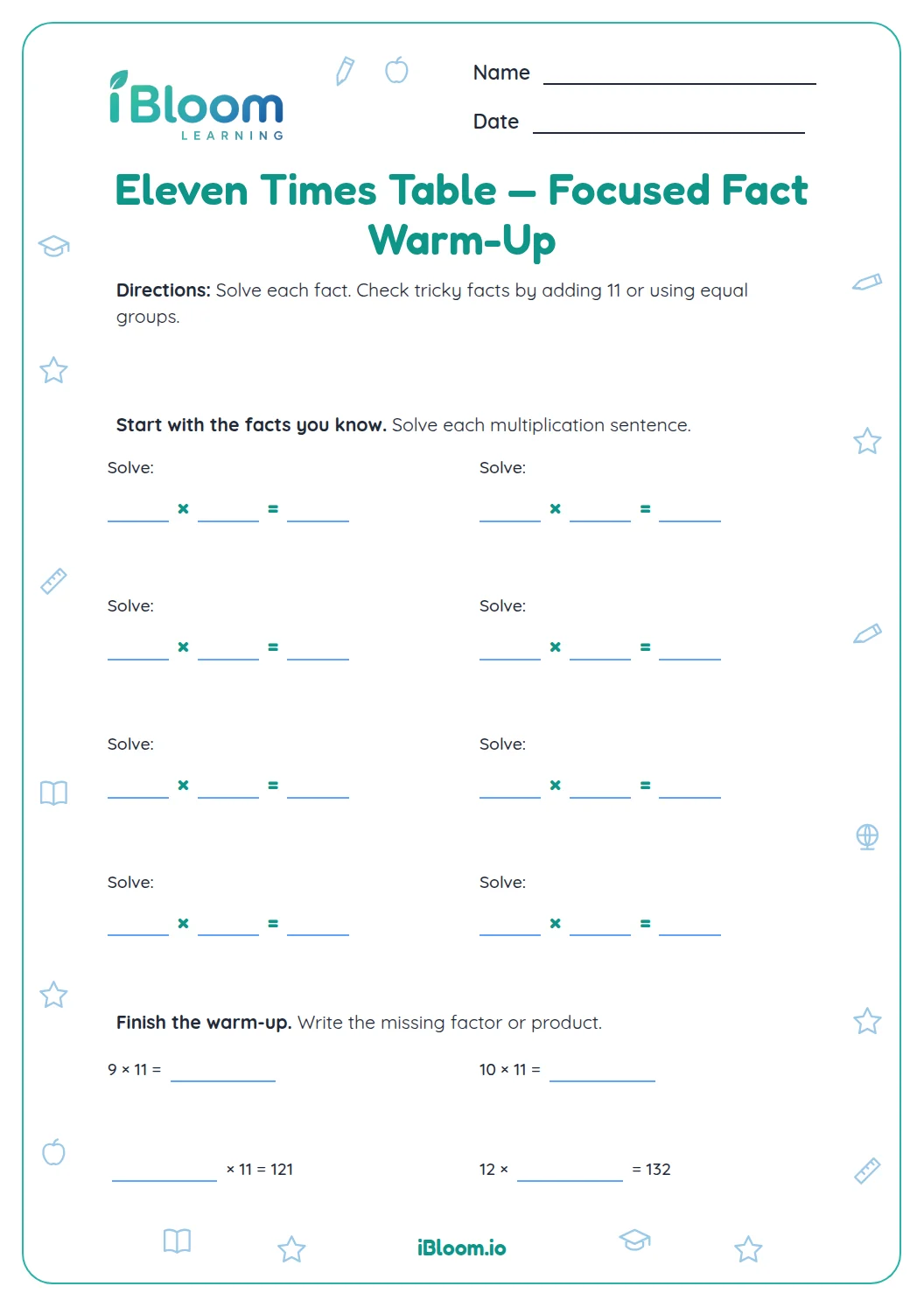
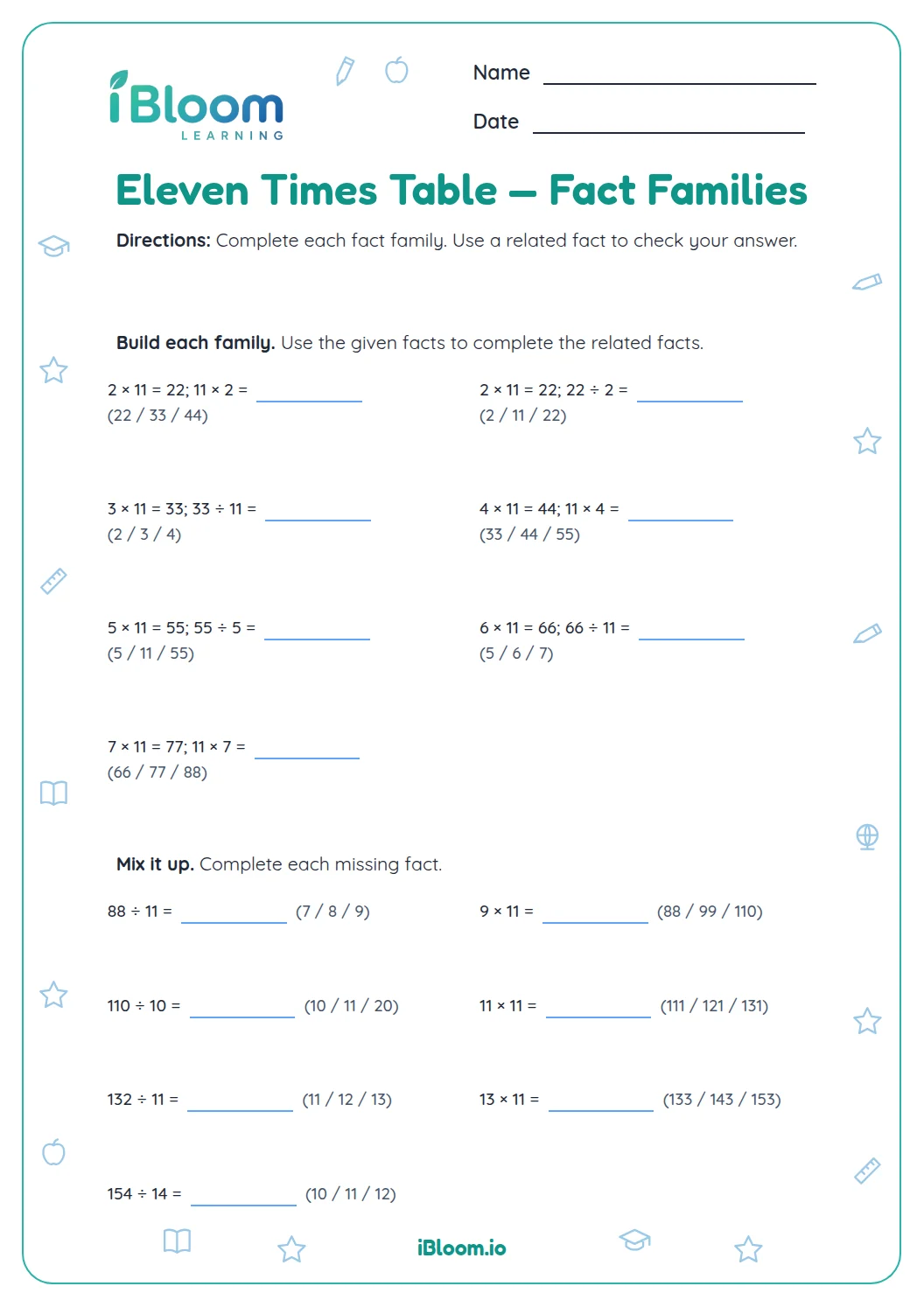
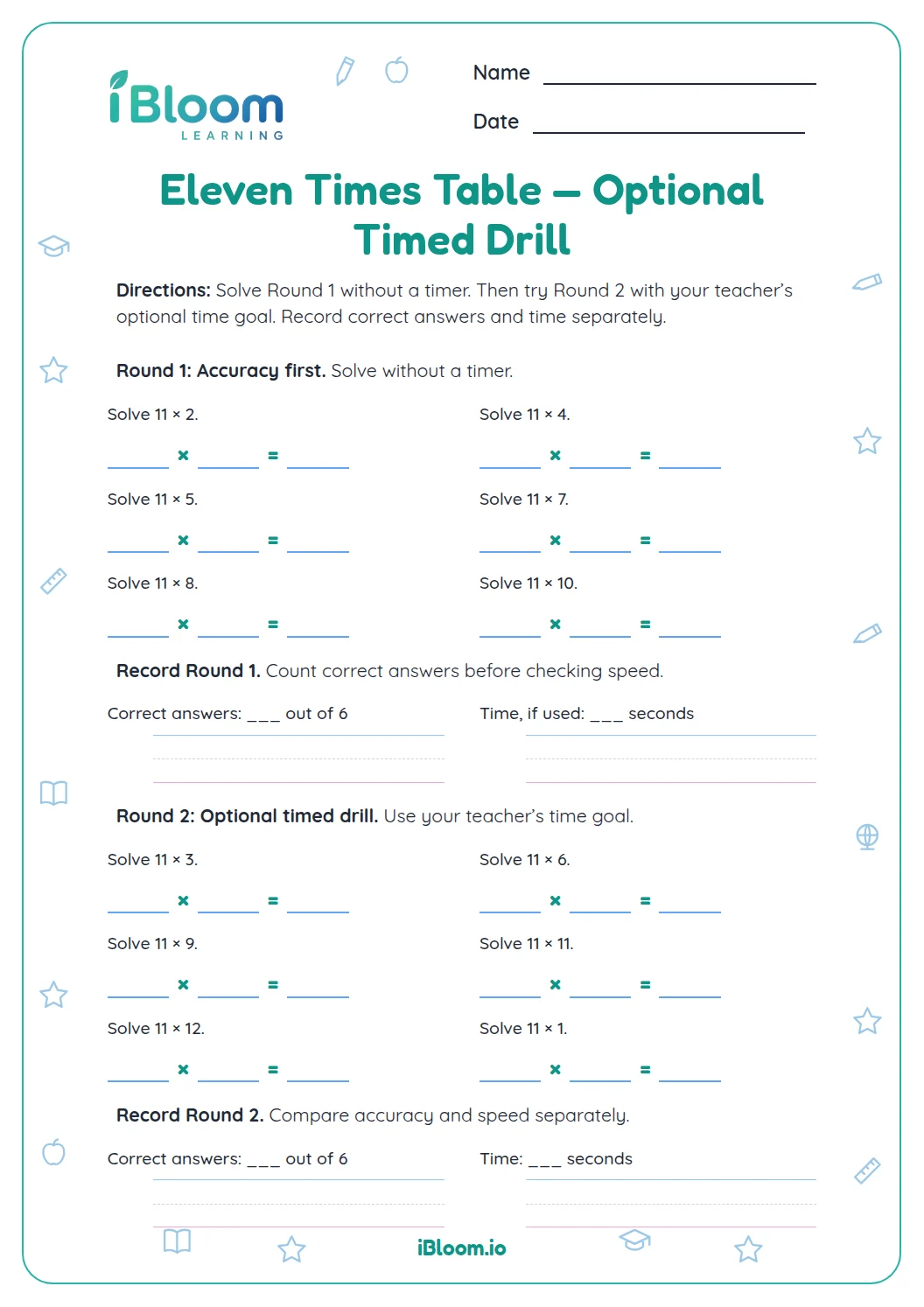
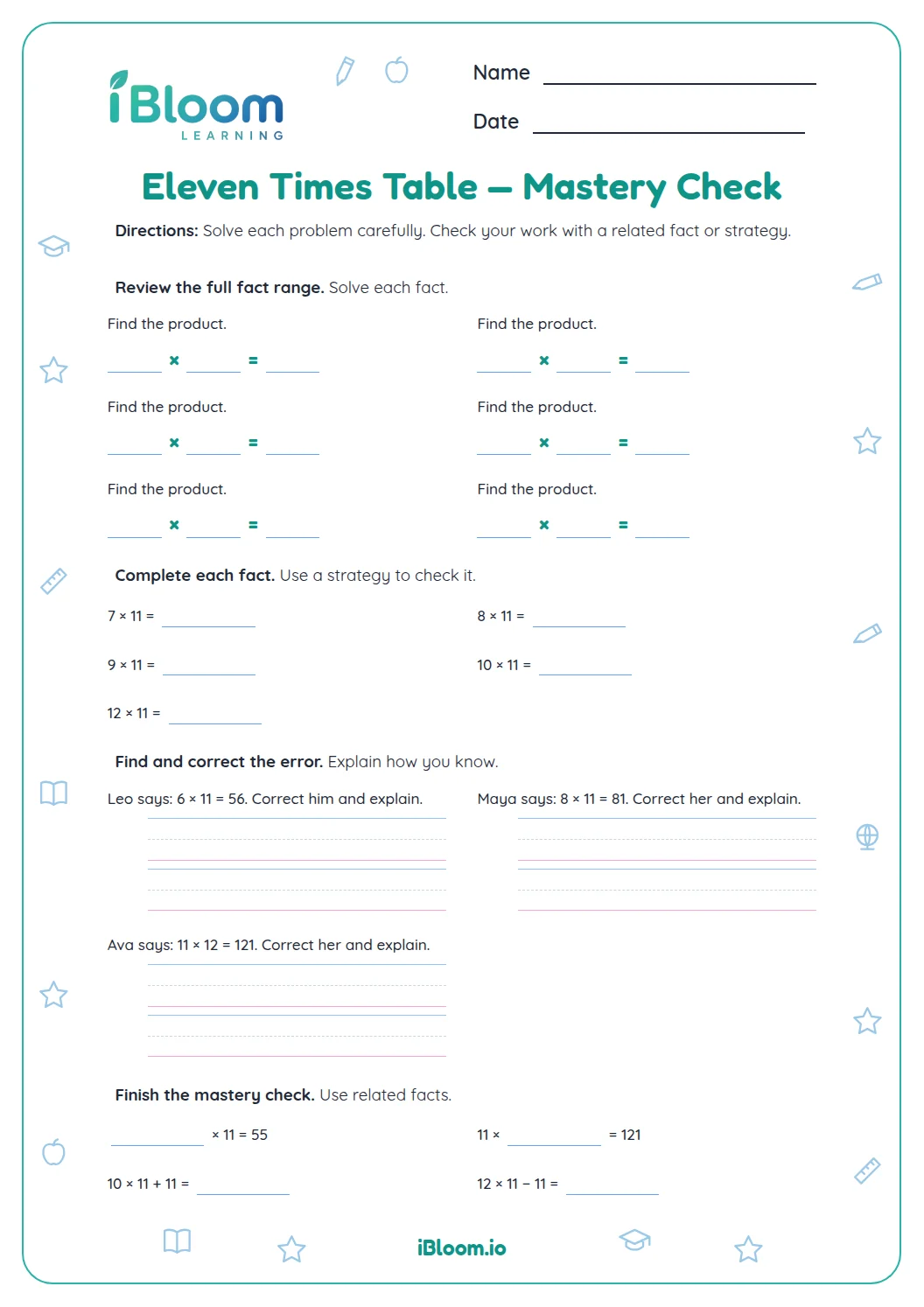
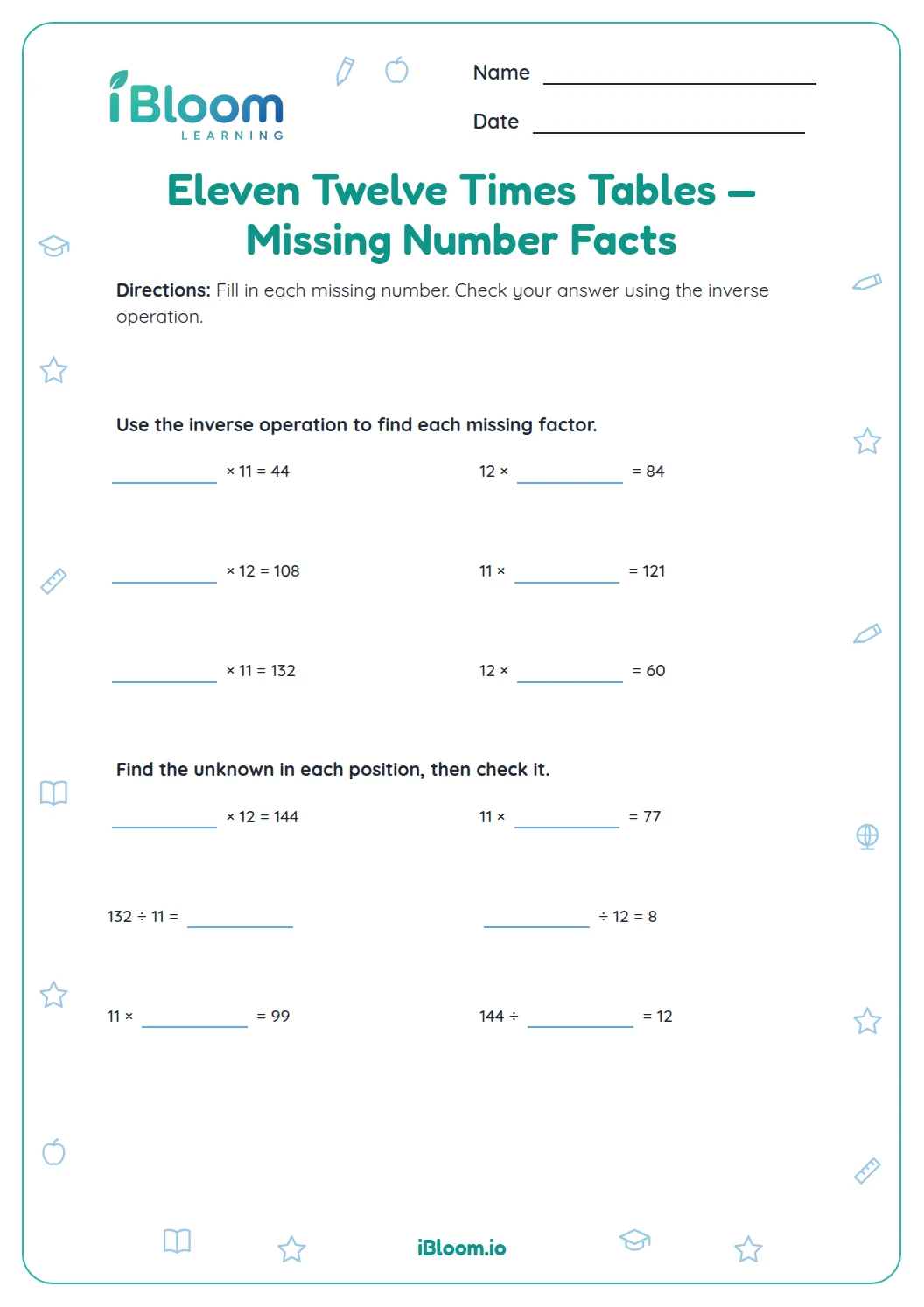
This free eleven times table worksheet gives students in Grades 3–4 sixteen missing-number equations. Part A hides factors, Part B breaks eleven groups into ten groups and one more group, and Part C mixes larger facts with related division equations. The facts include multipliers from 0 through 13. Students practice using properties of operations as multiplication and division strategies, supporting CCSS 3.OA.B.5. A separate answer key supplies each missing value, so students can substitute it and check that both sides are equal.
Aligned to 3.OA.B.5
Why split eleven into ten and one?
Ten groups are easy to calculate, and one more group brings the count to eleven. In question 7, 11 × 3 is split into 10 × 3 and one group of 3. The blank is 3, the extra group’s value.
This same reasoning works when the factor has two digits. It avoids relying only on the repeated-digit pattern seen in facts such as 11 × 4 = 44.
- 1Question 13: 11 × ___ = 132
- 2Try 12: (10 × 12) + 12 = 120 + 12.
- 3120 + 12 = 132, so the missing factor is 12.
What changes when the blank moves?
A blank before or after the multiplication sign stands for a factor. In a division equation, the blank may be the starting total, group size, or number of groups. Read the complete equation before deciding what to find.
For question 14, ___ ÷ 11 = 7 asks for the total in seven groups of eleven, so 77 is missing. For question 15, 88 ÷ ___ = 8 asks for a group size of eleven.
How should students check the completed facts?
Put the answer back into the original equation. Both sides must describe the same value. For a division fact, multiply the divisor by the quotient to recover the starting total.
The sixteen questions include zero, factors in either position, and products beyond 99. Allow time for explanation before using the sheet for a quicker second attempt.
How to use this worksheet
- 1Warm up with 10 × 6 and explain why 11 × 6 is one more group of six.
- 2Complete the six missing factors in Part A.
- 3In Part B, name the value of the extra group before filling its blank.
- 4Read each Part C equation aloud, naming what the blank represents.
- 5Substitute every answer and use the key to check any uncertain fact.
Mistakes to notice and fix
The mistake
Putting 33 in the blank in 11 × 3 = 30 + ___.
The fix
Thirty is already on the right; only the extra group of three is missing.
The mistake
Repeating digits to claim 11 × 12 = 1212.
The fix
Use 120 + 12 to find 132.
The mistake
Writing 7 in ___ ÷ 11 = 7.
The fix
The blank is the starting total: 11 × 7 = 77.
Common Core alignment
Use ten-plus-one decomposition and factor order to work out eleven times facts.
On this sheet: Part B explicitly decomposes eleven groups; students use that strategy to check missing factors and division facts.
Show the official wordingHide the official wording
Apply properties of operations as strategies to multiply and divide.
What to practice next
Make more practice
Further reading
Questions parents and teachers ask
Which eleven times facts appear on the sheet?
The worksheet includes multipliers from 0 through 13 across its three parts. Smaller factors appear in Part A, four ten-plus-one splits appear in Part B, and Part C includes 110, 121, 132, and 143 alongside division checks. Each question has one missing value to complete.
What belongs in the split-fact blanks?
Each split-fact blank holds the value of one extra group. For example, 11 × 3 = 30 + 3. Ten groups already account for 30, so another three makes 33. Ask the child to name the extra group before writing the full product.
Why include zero in the eleven times table?
Zero checks the meaning of multiplication as equal groups. Eleven groups containing zero objects have a total of zero, so the missing factor in 11 × ___ = 0 is zero. Substituting that value provides a quick check and makes the fact more than a memorized pattern.
Can students solve the division questions with multiplication?
Yes, multiplication gives a direct check for each division question. For 88 ÷ ___ = 8, ask what number multiplied by eight gives 88. Eleven fits. For a missing starting total, multiply the two given numbers, then read the completed division equation to confirm it makes sense.
Should I time this drill?
Begin with an untimed attempt so the child can explain the ten-plus-one strategy and notice the blank’s position. The sheet is designed for careful missing-number practice. If you reuse it, compare accuracy and independence first; a timing goal can remain a personal choice after the facts feel secure.