





About this worksheet
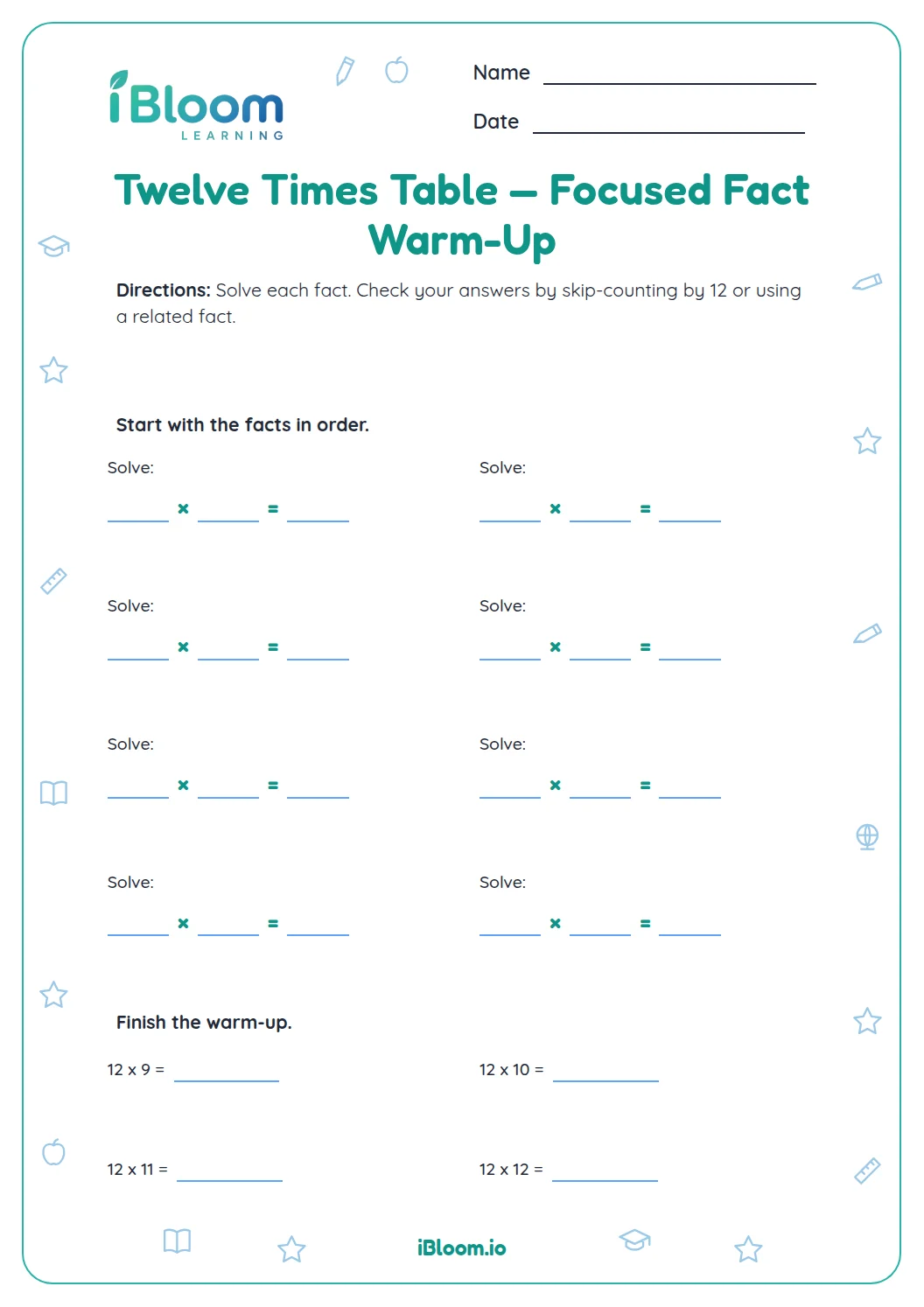
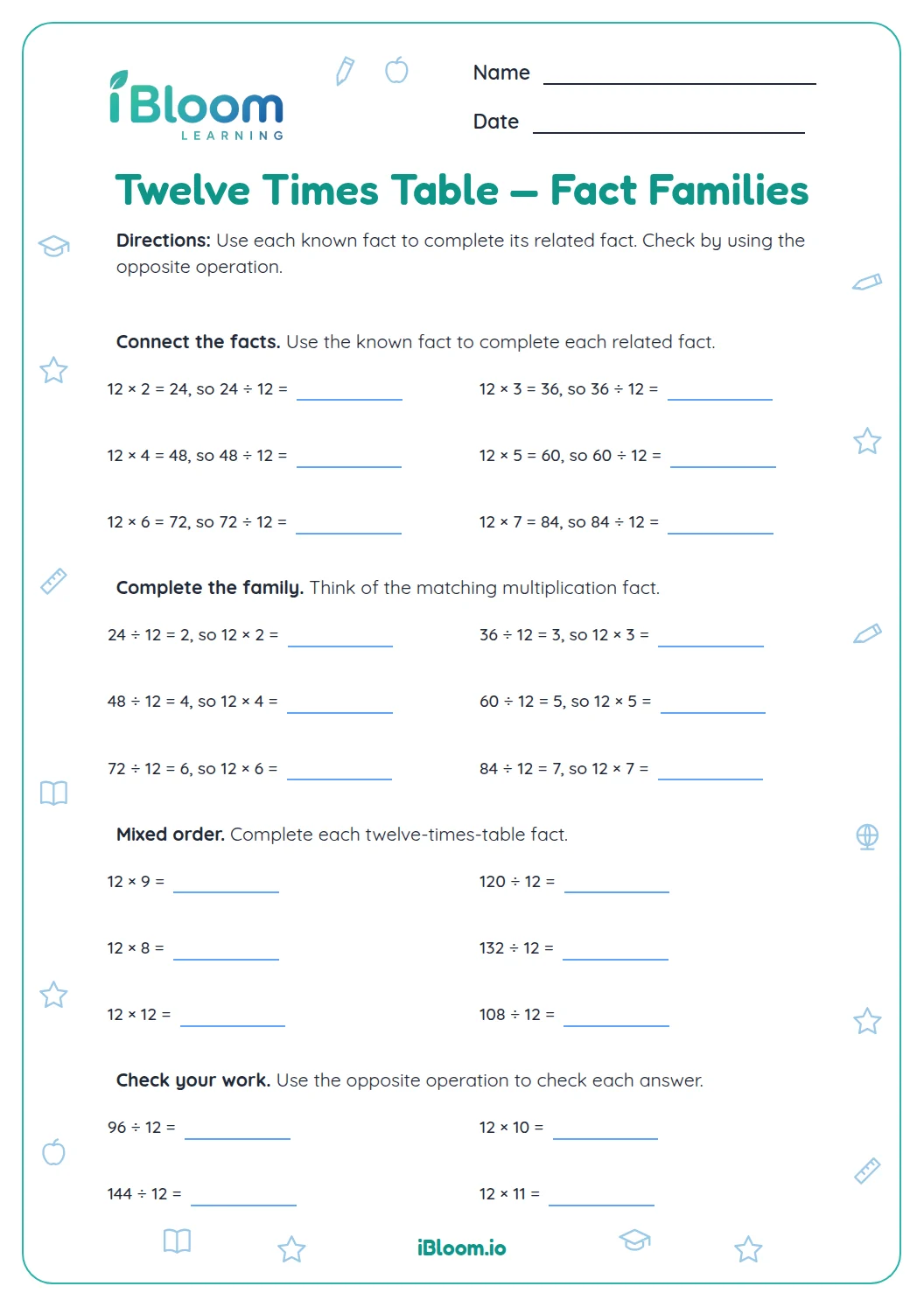
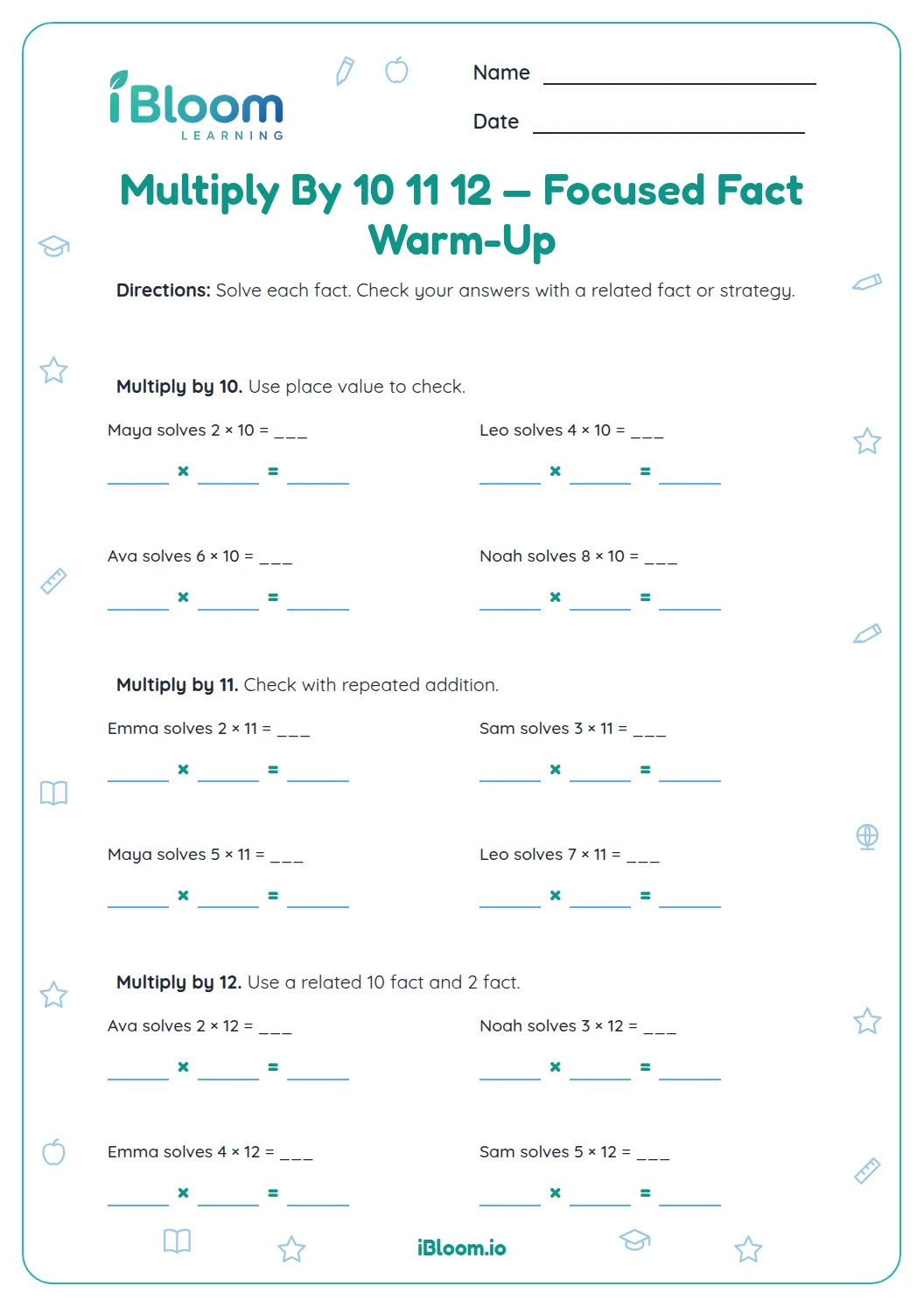
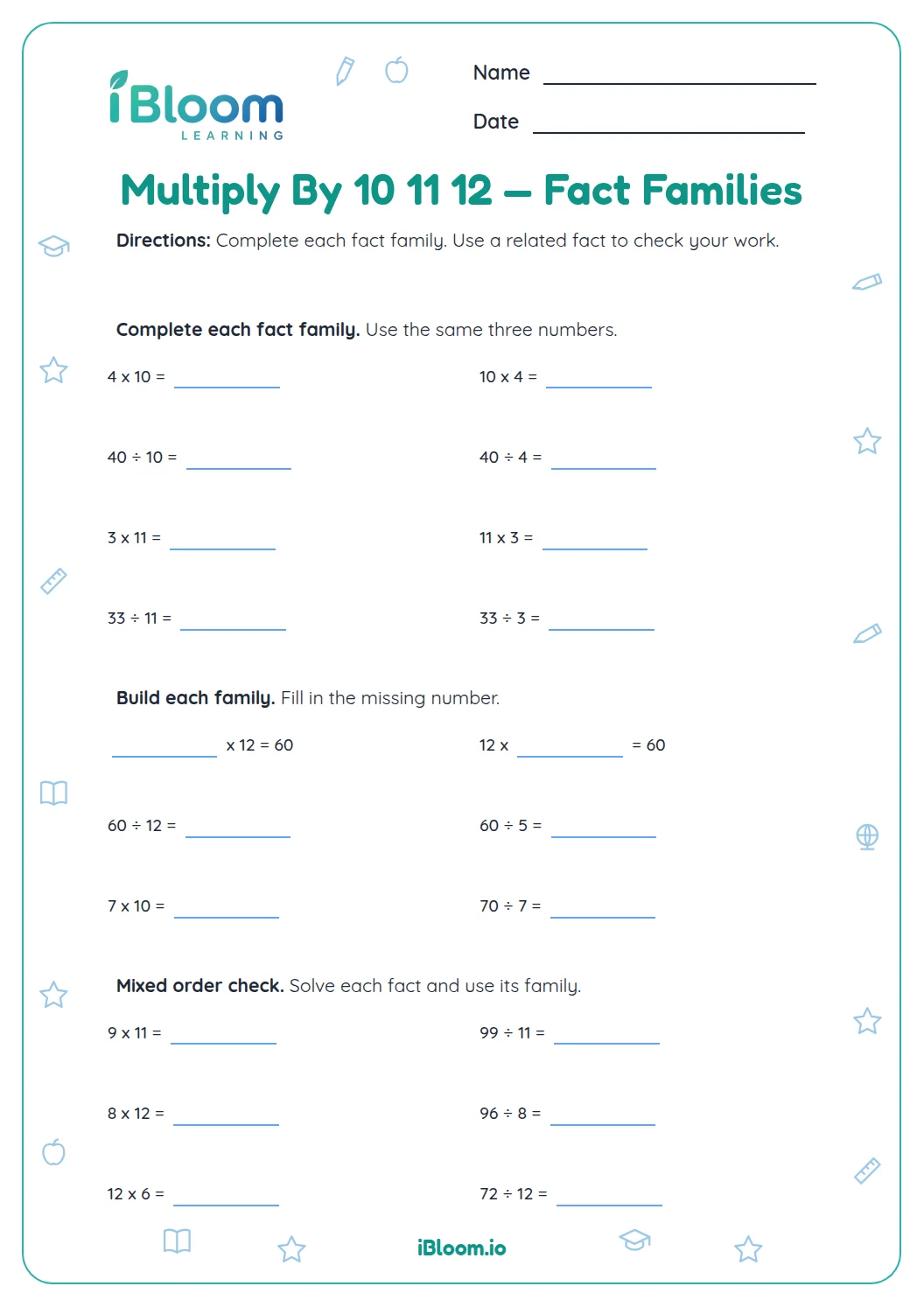
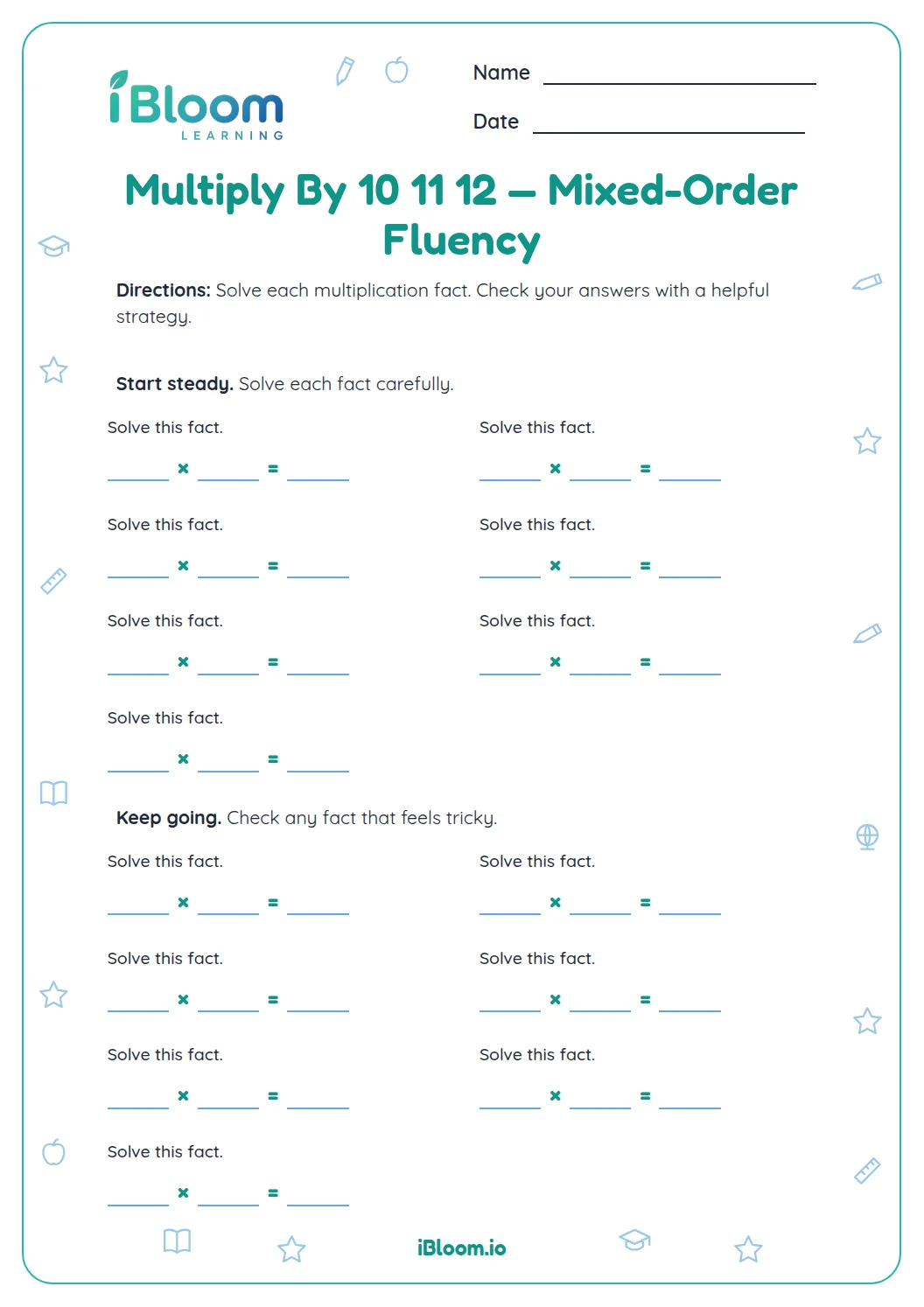
This free worksheet gives students all 24 facts in the 11 and 12 times tables: each table includes factors 1 through 12, arranged in mixed order. Students can use a known fact, skip-counting, or a nearby multiplication fact to check an uncertain product. The separate answer key lists every product, including results above 100. The worksheet is designed for fact practice across Grades 3–4.
How does the warm-up build accuracy?
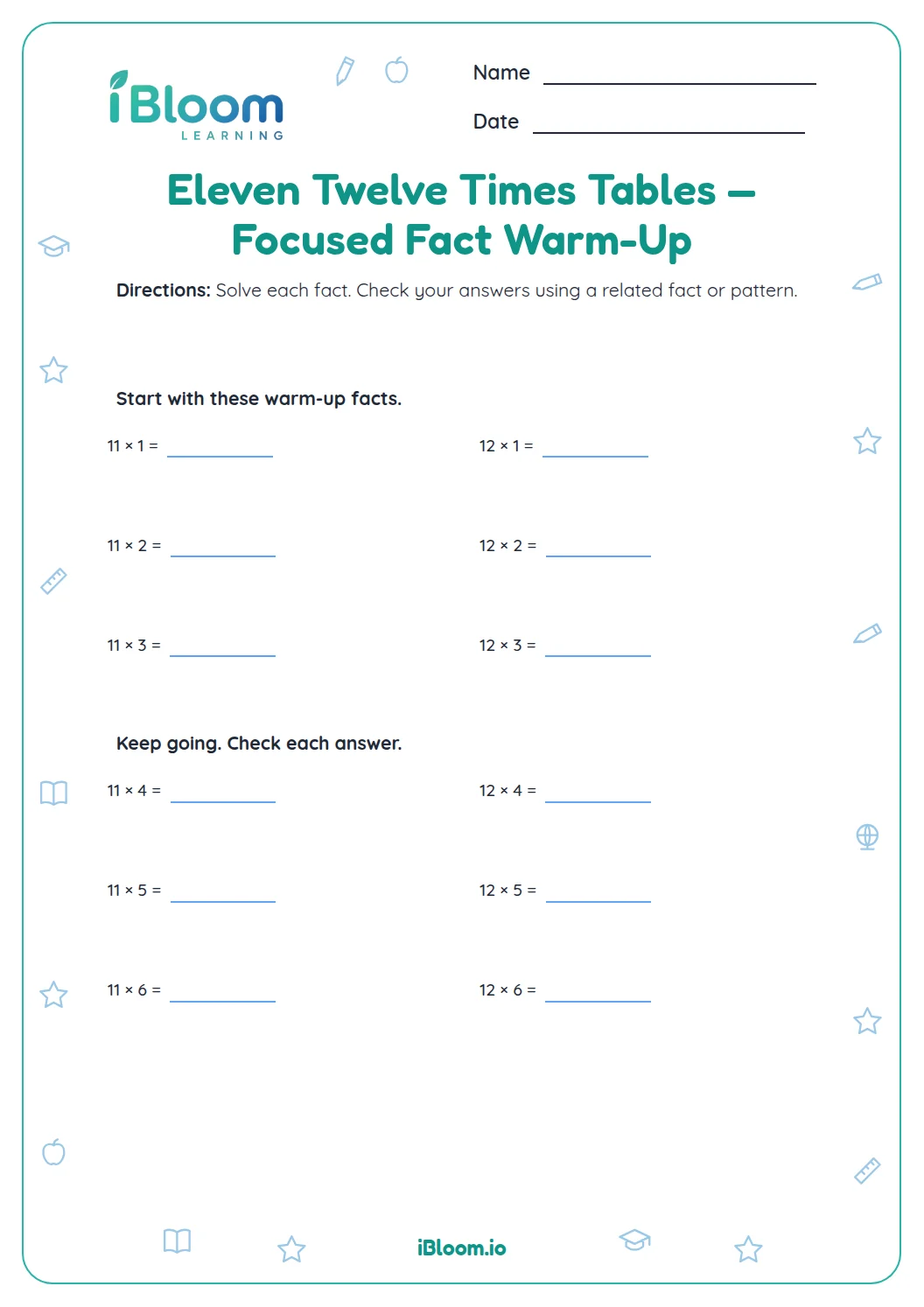
Part A mixes facts from both tables and includes the first half of each factor range. Read both factors, recall or build the product, and record it in the blank.
What can help with an unfamiliar fact?
Part B uses related facts and skip-counting. For example, 12 × 8 can be checked as 10 × 8 + 2 × 8, which is 80 + 16 = 96.
How does the sheet cover both tables?
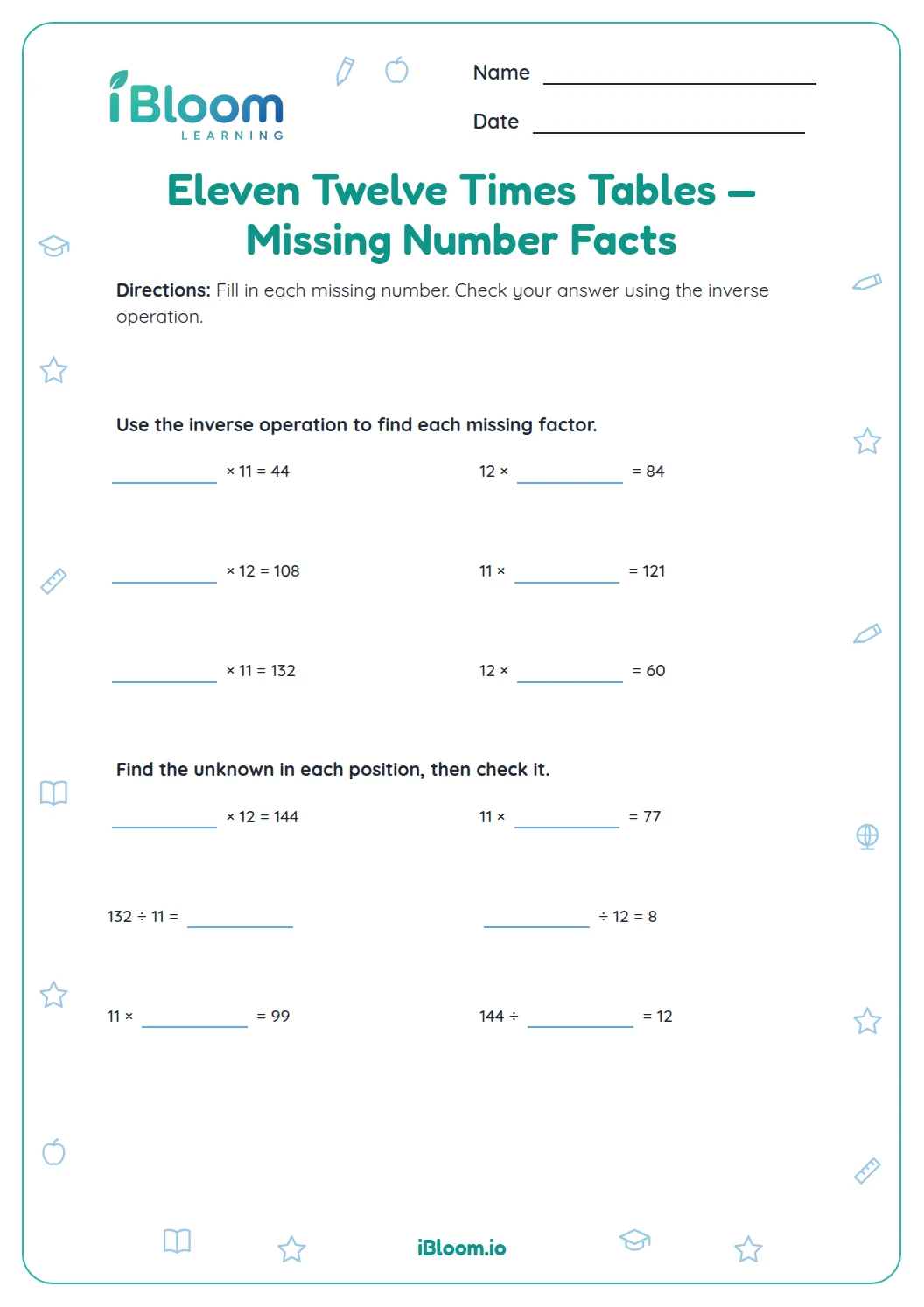
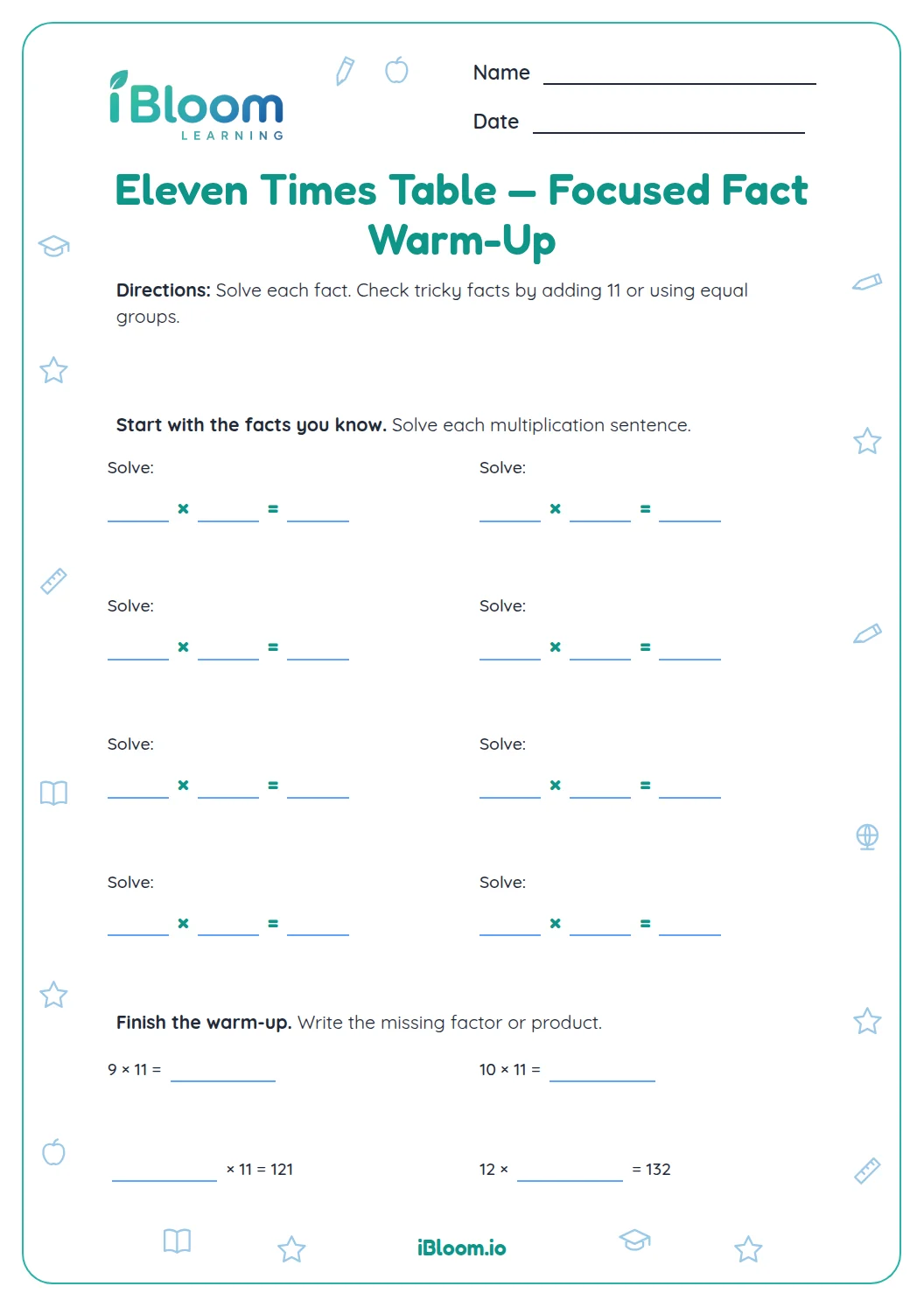
Part C completes the mixed set. Across the three parts, every factor from 1 through 12 appears once with 11 and once with 12. Check that both factors are copied correctly before reviewing the separate key.
How to use this worksheet
- 1Read both factors before calculating.
- 2Recall a known product or build it from a related fact.
- 3Write the product in the blank.
- 4Use skip-counting or a nearby fact to check uncertain answers.
- 5Compare all 20 products with the answer key after finishing.
Common mistakes and quick fixes
The mistake
Using the 11 fact for a 12 fact, or reversing which factor is 11 or 12.
The fix
Point to both factors and say the complete fact before writing the product.
The mistake
Stopping at 100 when the product is larger.
The fix
Keep counting by 11s or 12s; products such as 12 × 12 reach 144.
The mistake
Adding the factors instead of finding equal groups.
The fix
Think of the first factor as the number of groups and the second as the amount in each group.
What to practice next
Make more practice
Further reading
Questions parents and teachers ask
What does this worksheet practice?
It gives students all 24 facts in the 11 and 12 times tables. Each table includes factors from 1 through 12, and the facts appear in mixed order across three parts. Students can recall or build each product, then check every answer with the separate key.
How many questions and pages are included?
There are 24 fill-in multiplication equations in three parts, covering the complete 1–12 range for both tables. The worksheet and separate answer key each use two pages. Students can complete a part at a time and review products after finishing.
What is one way to solve 12 × 7?
Use a nearby fact: 10 × 7 = 70 and 2 × 7 = 14. Add 70 + 14 to get 84. The worksheet includes 12 × 7 as q2, and the answer key lists 84 so the student can check the result.
Are all the products below 100?
No. Products in the 12 times table can be greater than 100; for example, 12 × 12 = 144. The final part reminds students to keep calculating beyond 100 rather than stopping at a familiar benchmark. The answer key lists every product for a quick check.
Does the worksheet include every fact in both tables?
Yes. The 11 and 12 tables each include factors 1 through 12 exactly once. The mixed order makes students read each factor pair rather than relying on a sequence, and the answer key provides all 24 products. No facts are skipped.
Is an answer key included?
Yes. The separate two-page key lists the correct product for each of the 24 equations. Students can complete a part first, then use skip-counting or a related fact to understand any answer that differs from the key. Review one part at a time.