






About this worksheet
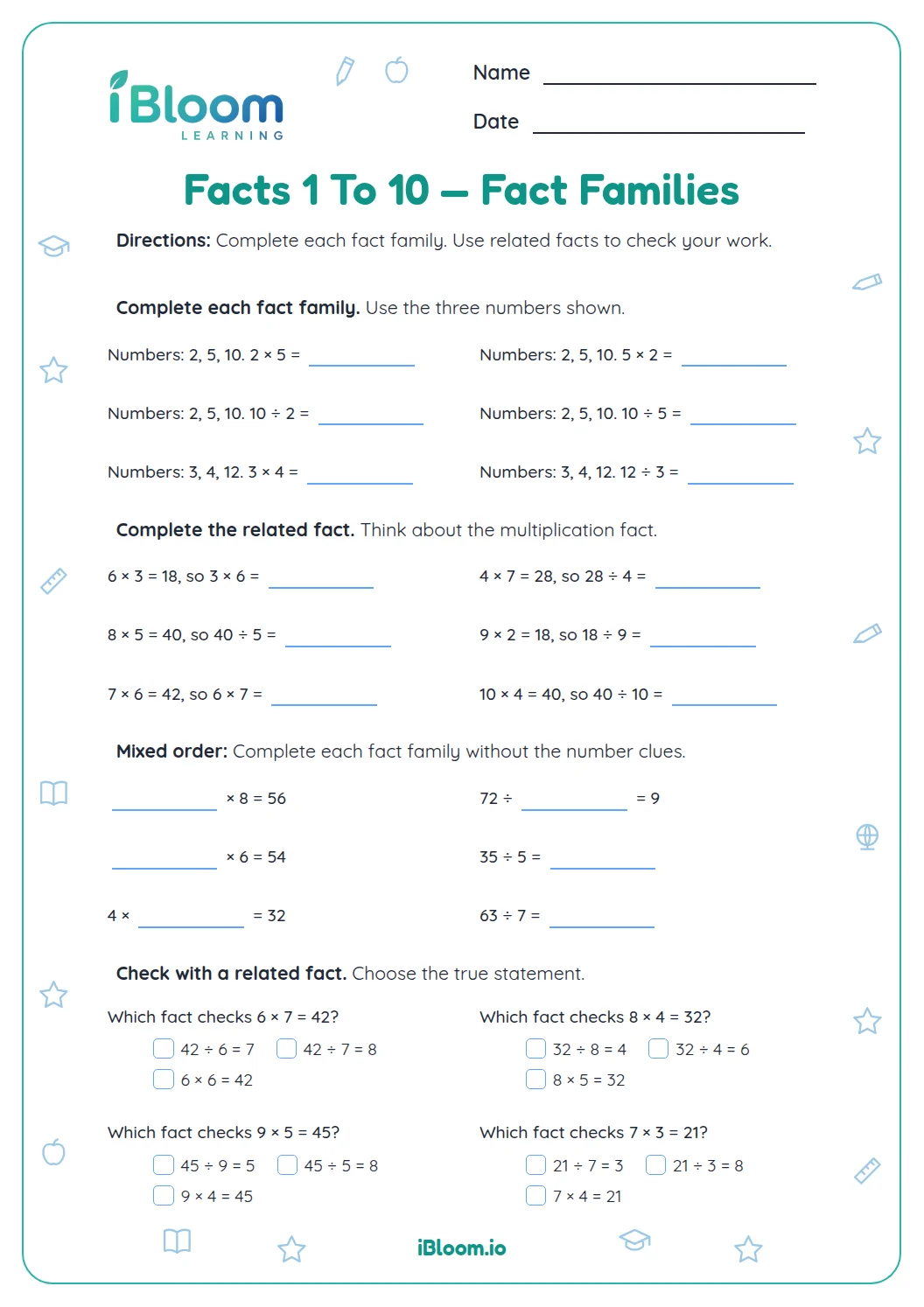
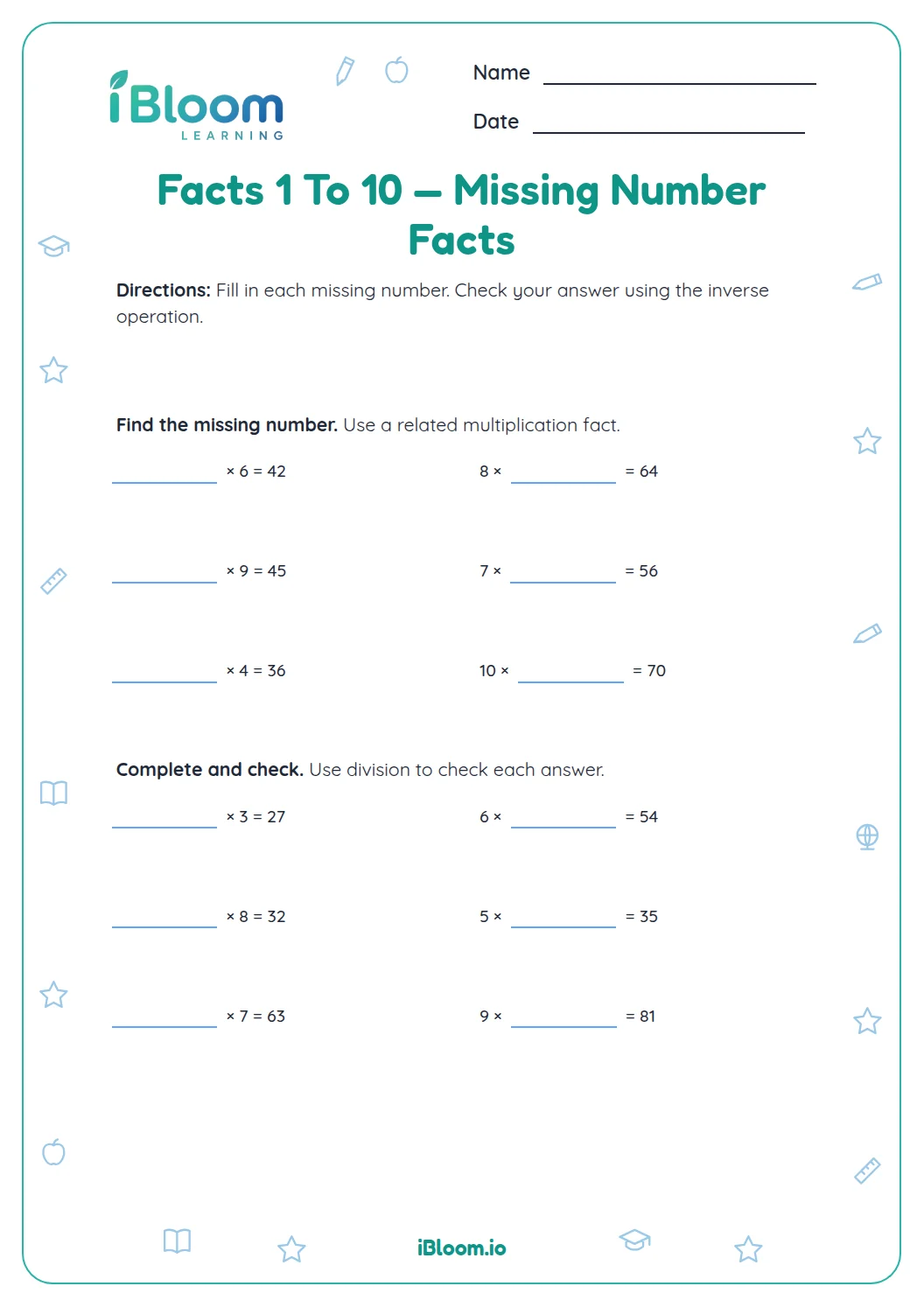
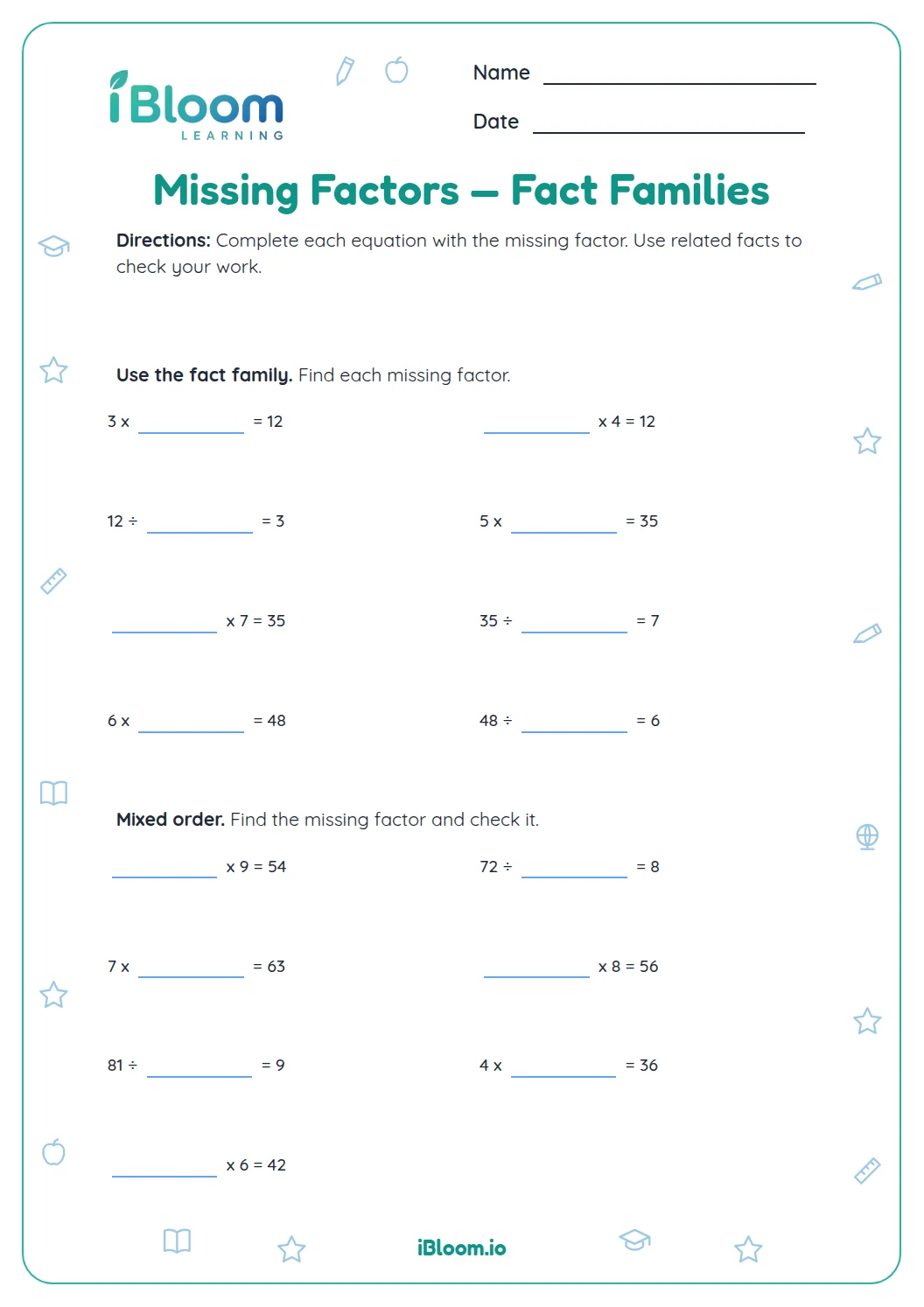
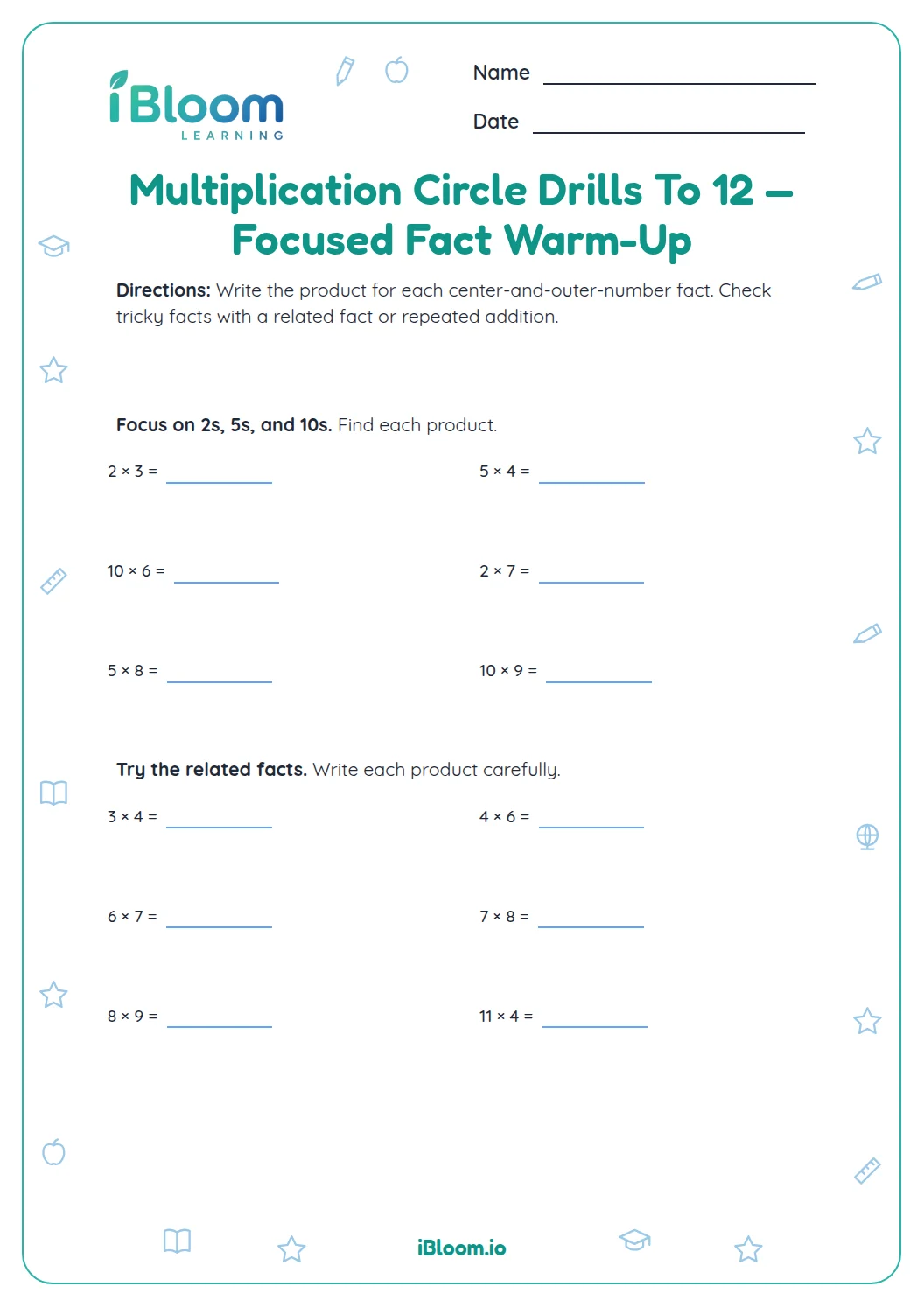
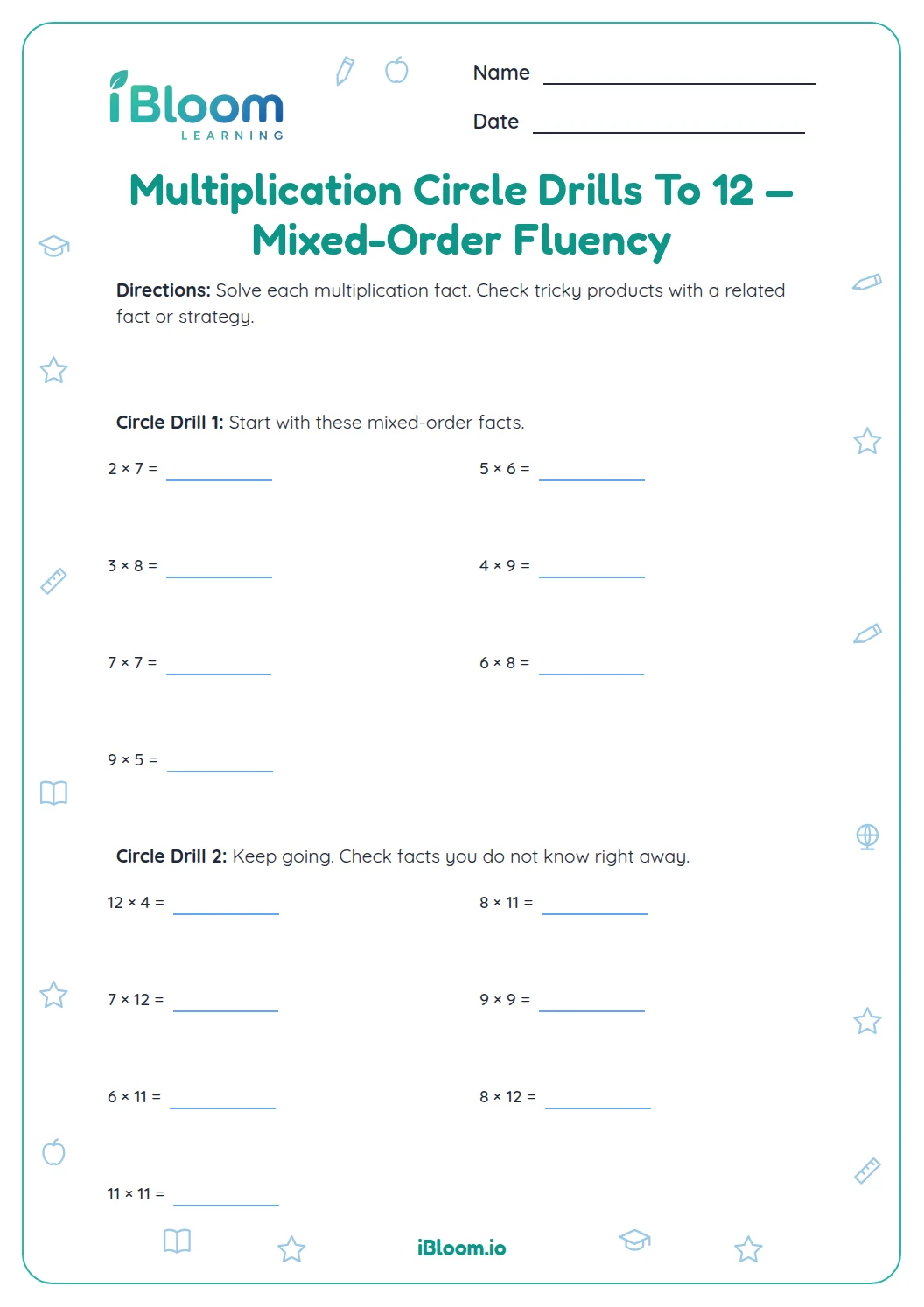
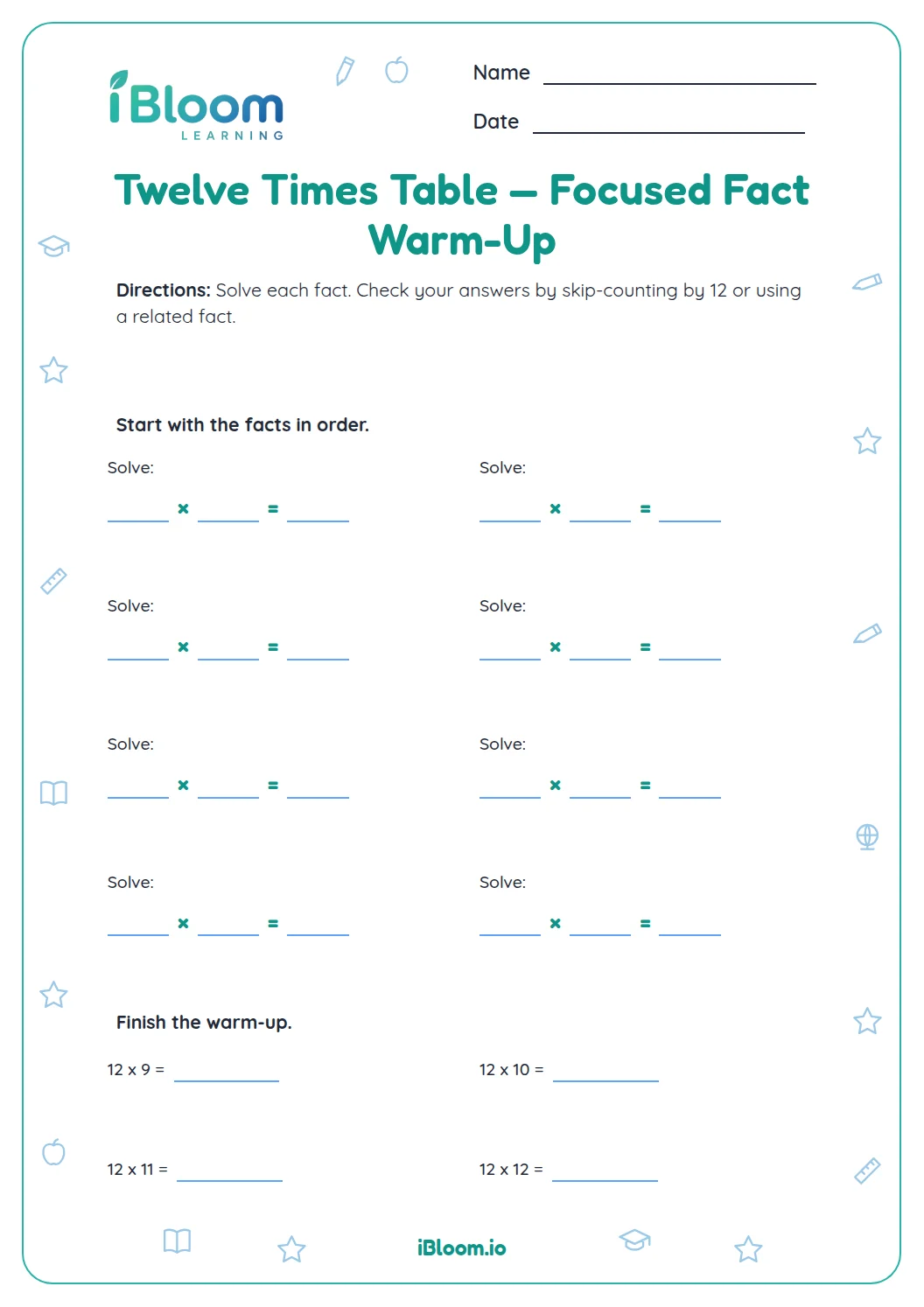
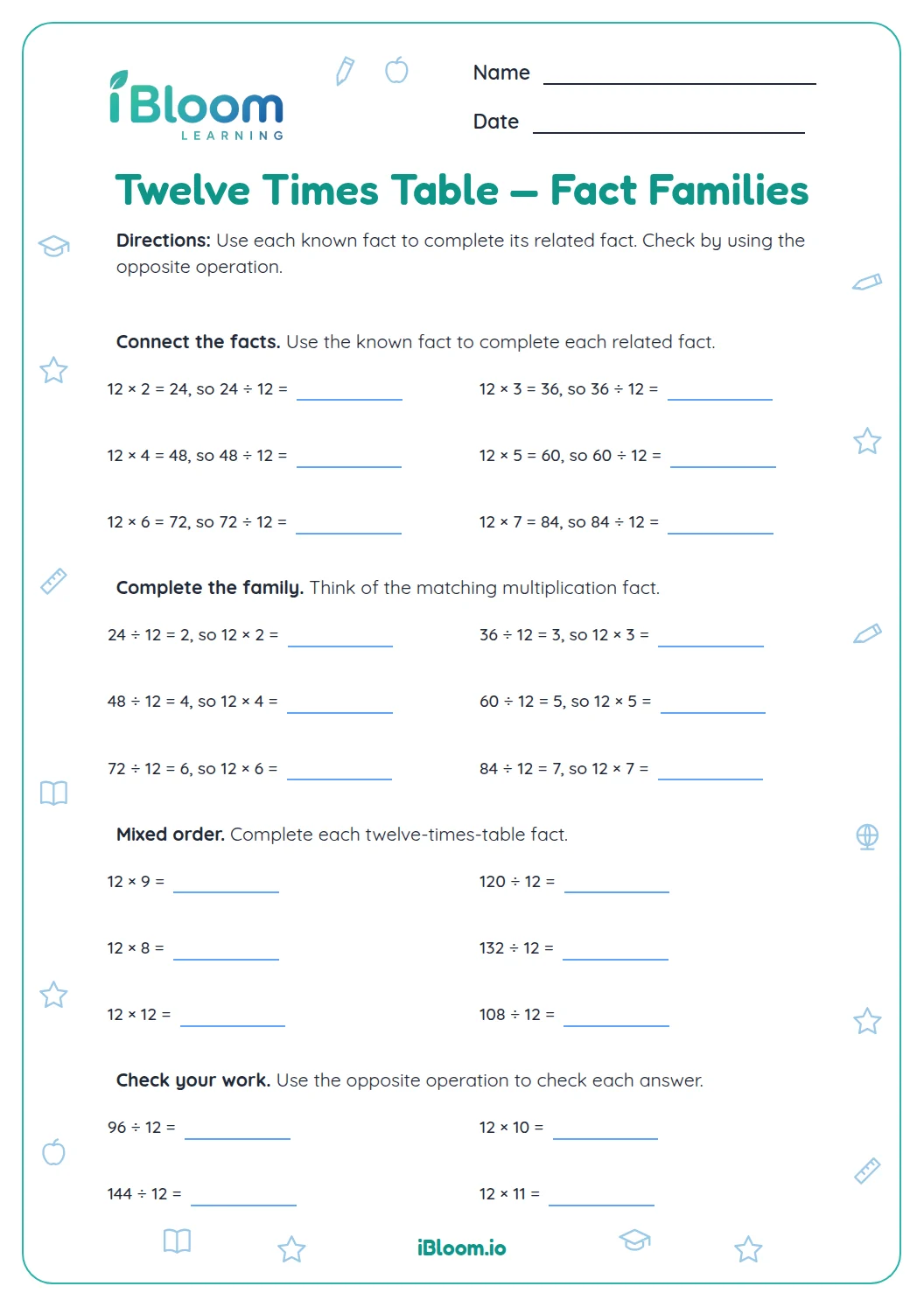
This printable practices multiplication fact families across the 1–12 tables. Children use each product to complete a related multiplication or division equation, following the original sheet’s family method. There are 20 missing-fact questions across two pages, with a separate answer key.
How do multiplication and division facts connect?
A fact family uses the same three numbers in multiplication and division. For example, 6 × 7 = 42 connects to 42 ÷ 6 = 7 and 42 ÷ 7 = 6.
Each question gives some facts and leaves one related fact to complete.
- 11 × 8 = 8 and 8 × 1 = 8
- 2Use the same three numbers: 8 ÷ 1 = 8
- 3Answer: 8
What changes from one question to the next?
All 12 tables appear in the first set, with the missing fact changing between multiplication and division. The final eight questions give more practice using a product to find a factor or quotient.
How to use this worksheet
- 1Find the three numbers in the family.
- 2Use the multiplication fact to check the product.
- 3For division, divide the product by the known factor.
- 4Write only the missing number in the blank.
- 5Check that the same three numbers appear in all related facts.
Common mistakes and quick fixes
The mistake
Dividing by the product instead of the known factor.
The fix
Use product ÷ known factor = missing factor.
The mistake
Changing one of the family numbers.
The fix
Keep the same two factors and product in every fact.
The mistake
Mixing up which factor is missing.
The fix
Check the divisor and quotient against the multiplication fact.
What to practice next
Make more practice
Questions parents and teachers ask
What is a multiplication fact family?
A multiplication fact family connects two factors, their product, and two division facts. For 6, 7, and 42, the related facts include 6 × 7 = 42, 42 ÷ 6 = 7, and 42 ÷ 7 = 6. This worksheet asks students to complete one missing related fact at a time.
How many questions are on this worksheet?
There are 20 questions across the 1–12 multiplication tables. Each one shows related multiplication or division facts and leaves exactly one number blank. Students complete the missing fact, then check that it uses the same factors and product. A separate answer key lists every missing number.
How can multiplication help with division?
If you know the product and one factor, use the multiplication fact to find the other factor. The same relationship gives a division fact: 56 ÷ 8 = 7 because 8 × 7 = 56. Students use that connection throughout the practice.
Why do the same numbers appear in several equations?
The same factors and product make a fact family. Seeing those numbers together helps students connect multiplication with division and use a known multiplication fact to solve a missing-fact equation. The questions vary which related equation has the blank.
How should my child check an answer?
Put the missing number back into the equation, then check it with the related multiplication fact. For example, if 72 ÷ 8 = 9, verify that 8 × 9 = 72. The answer key can confirm the result after the child has tried it.