

About this worksheet
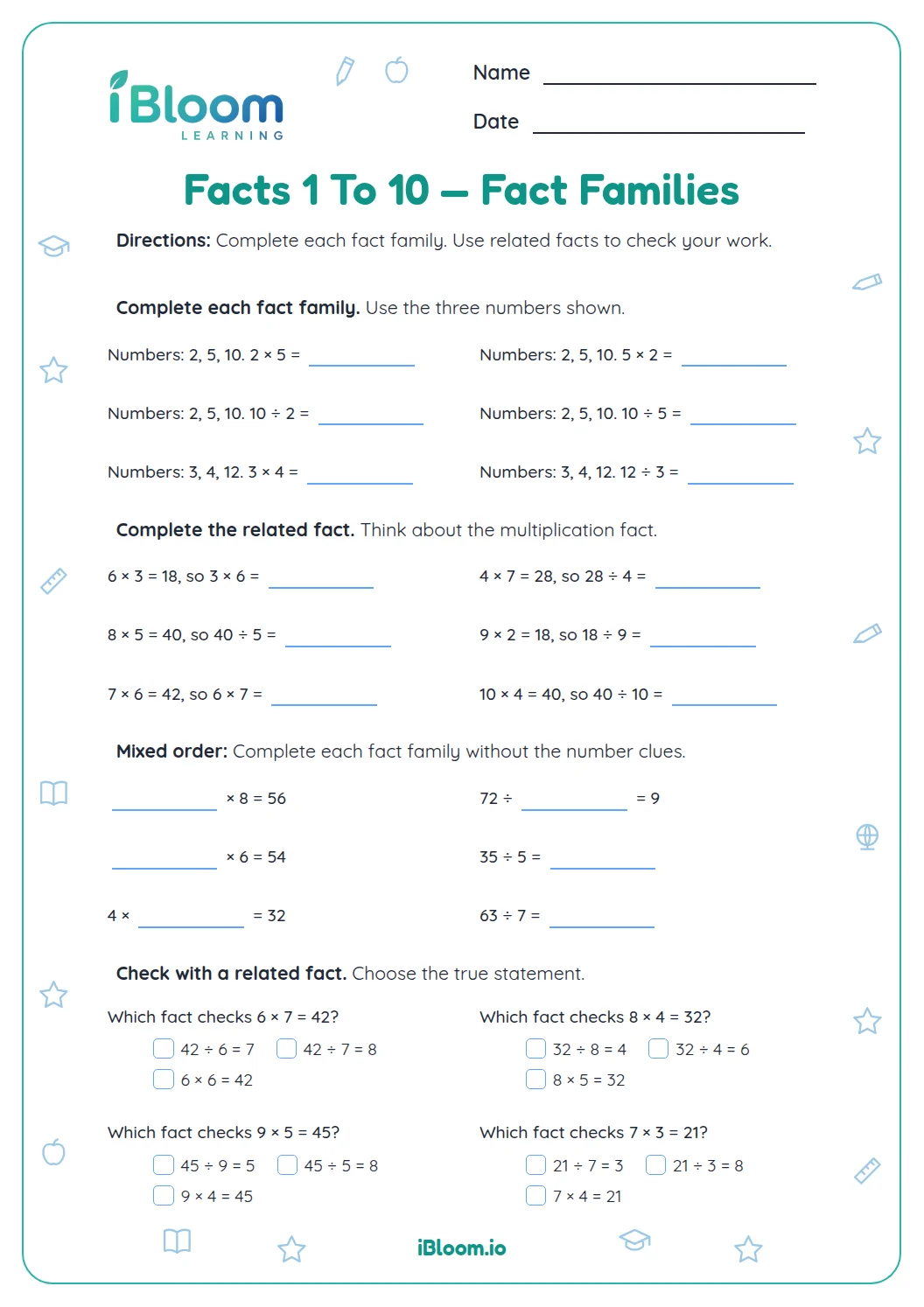
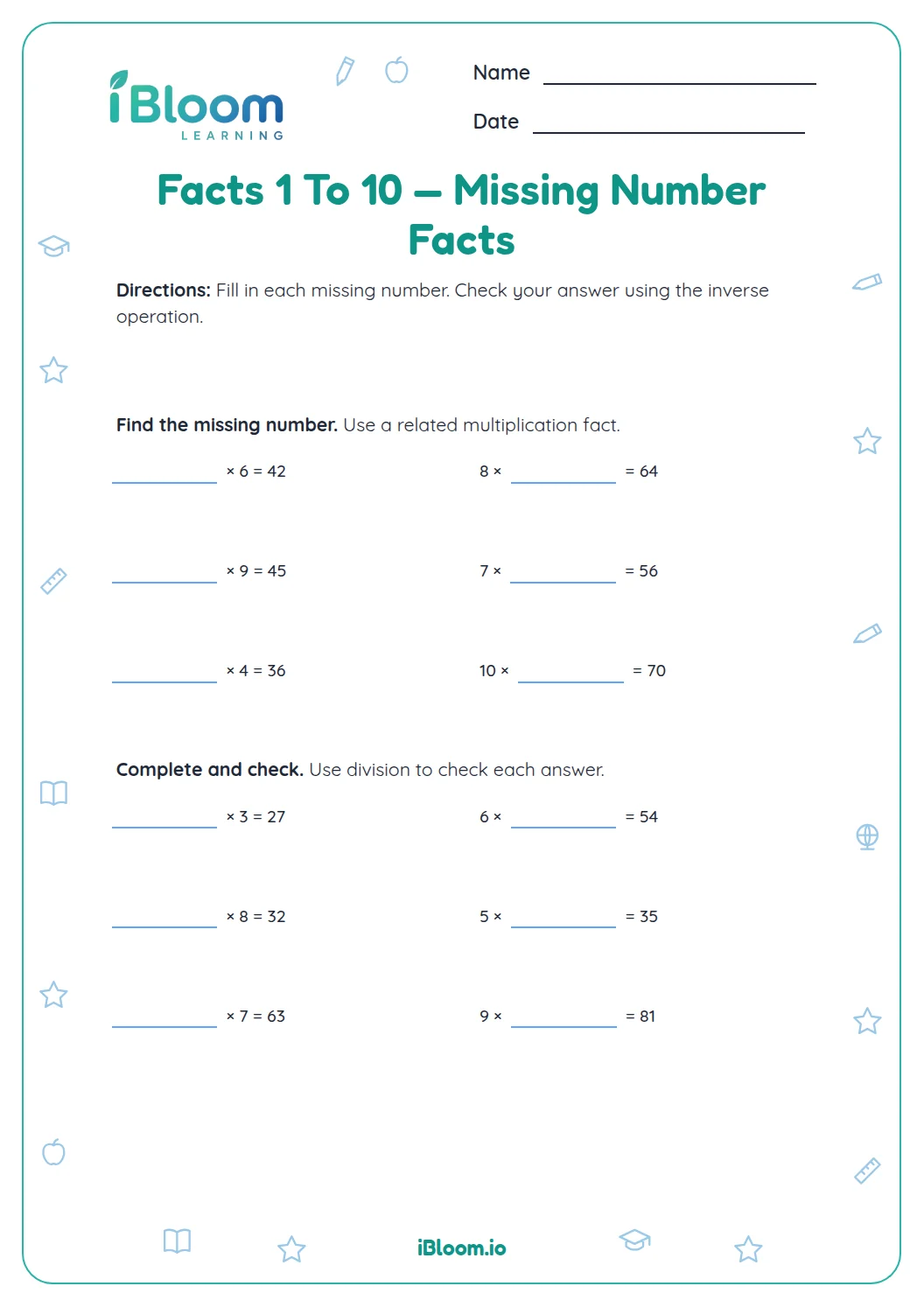
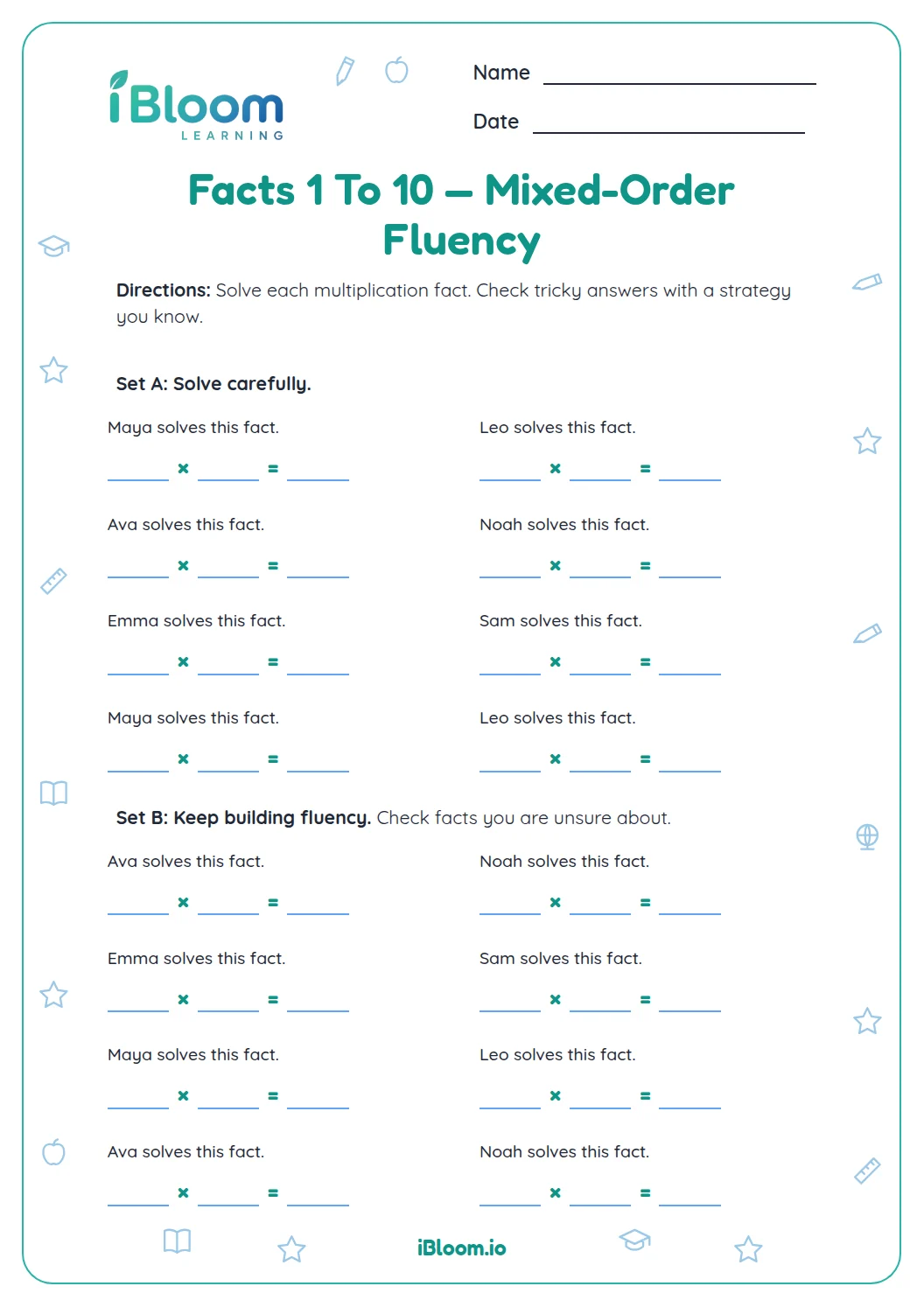
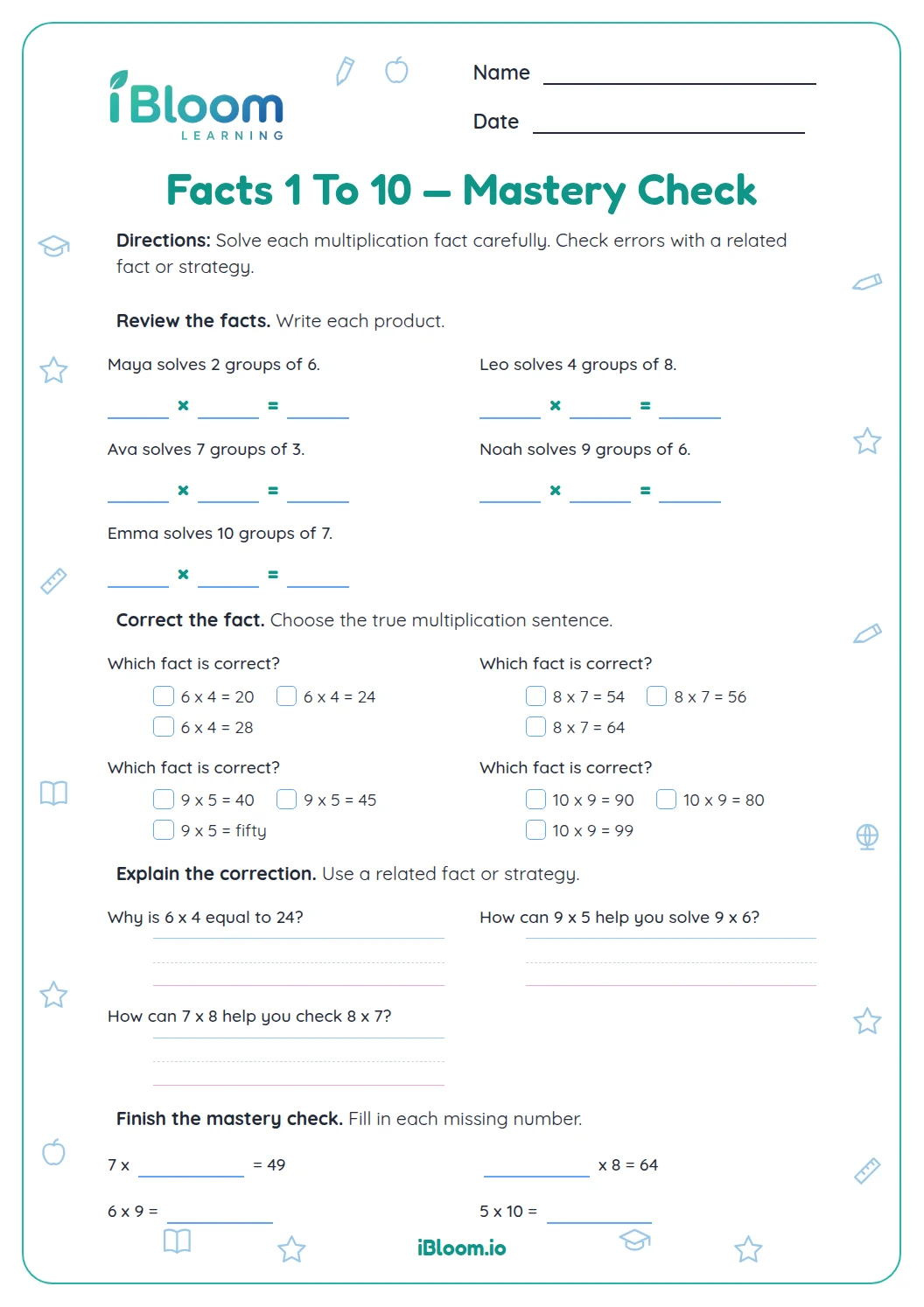
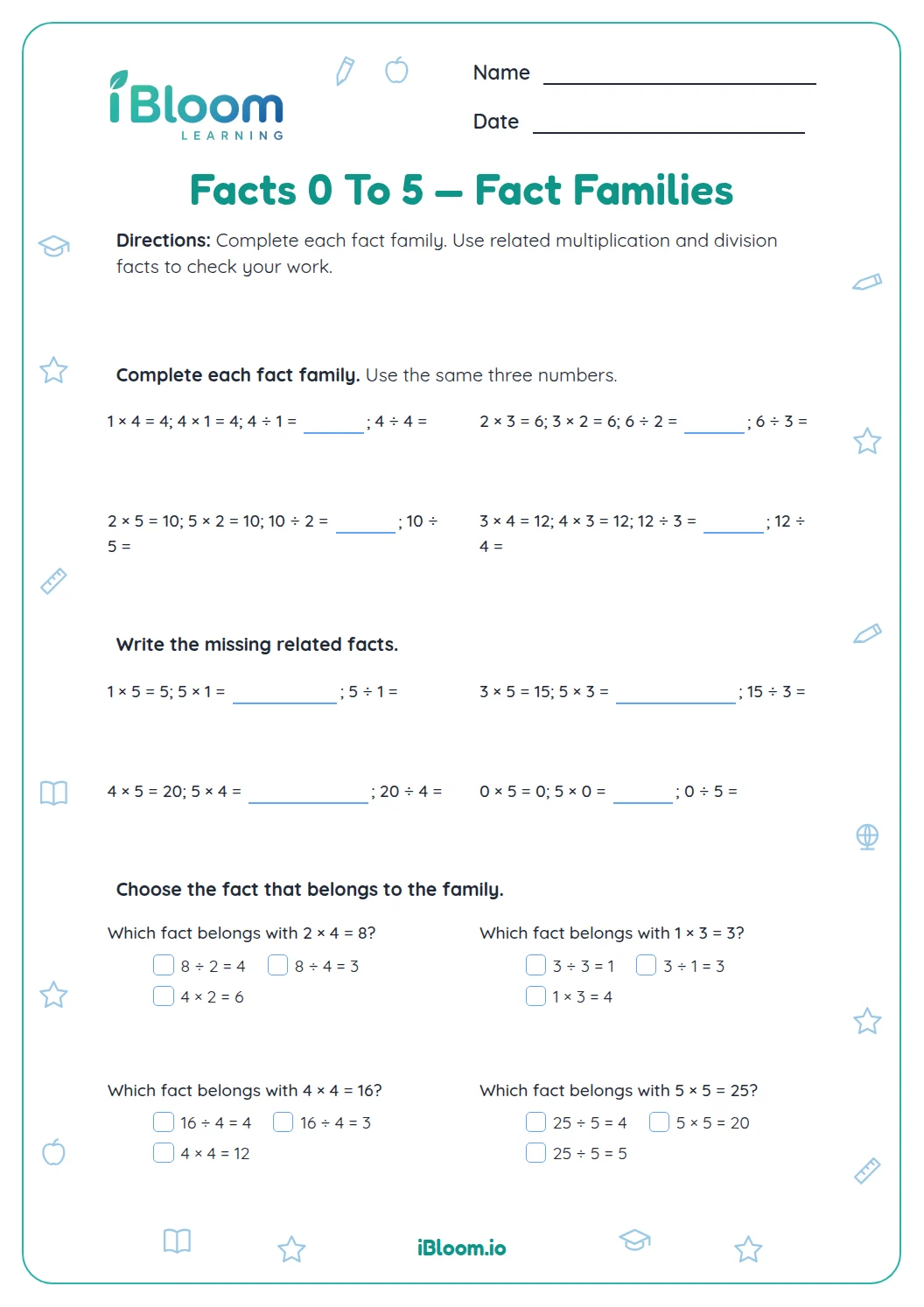
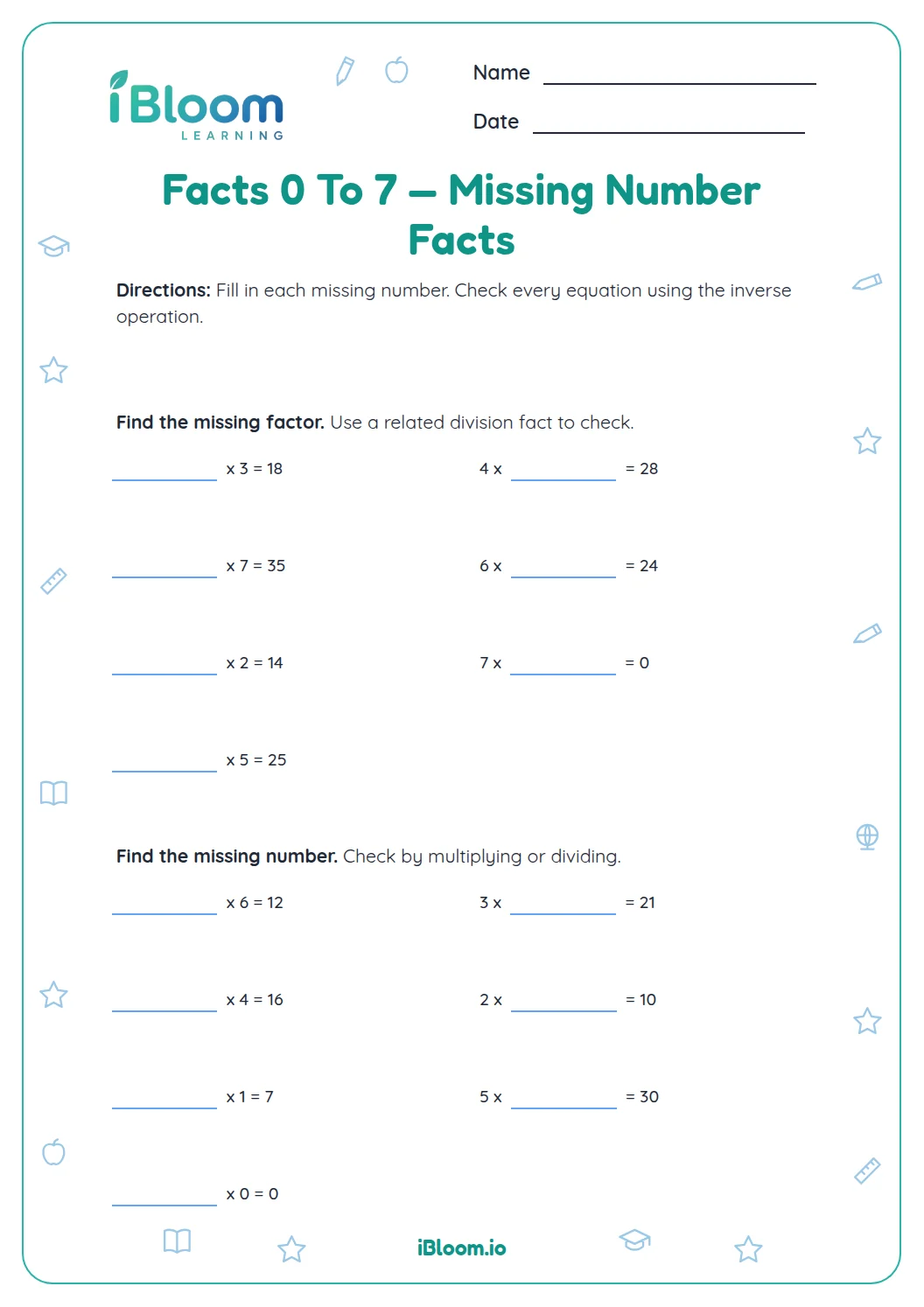
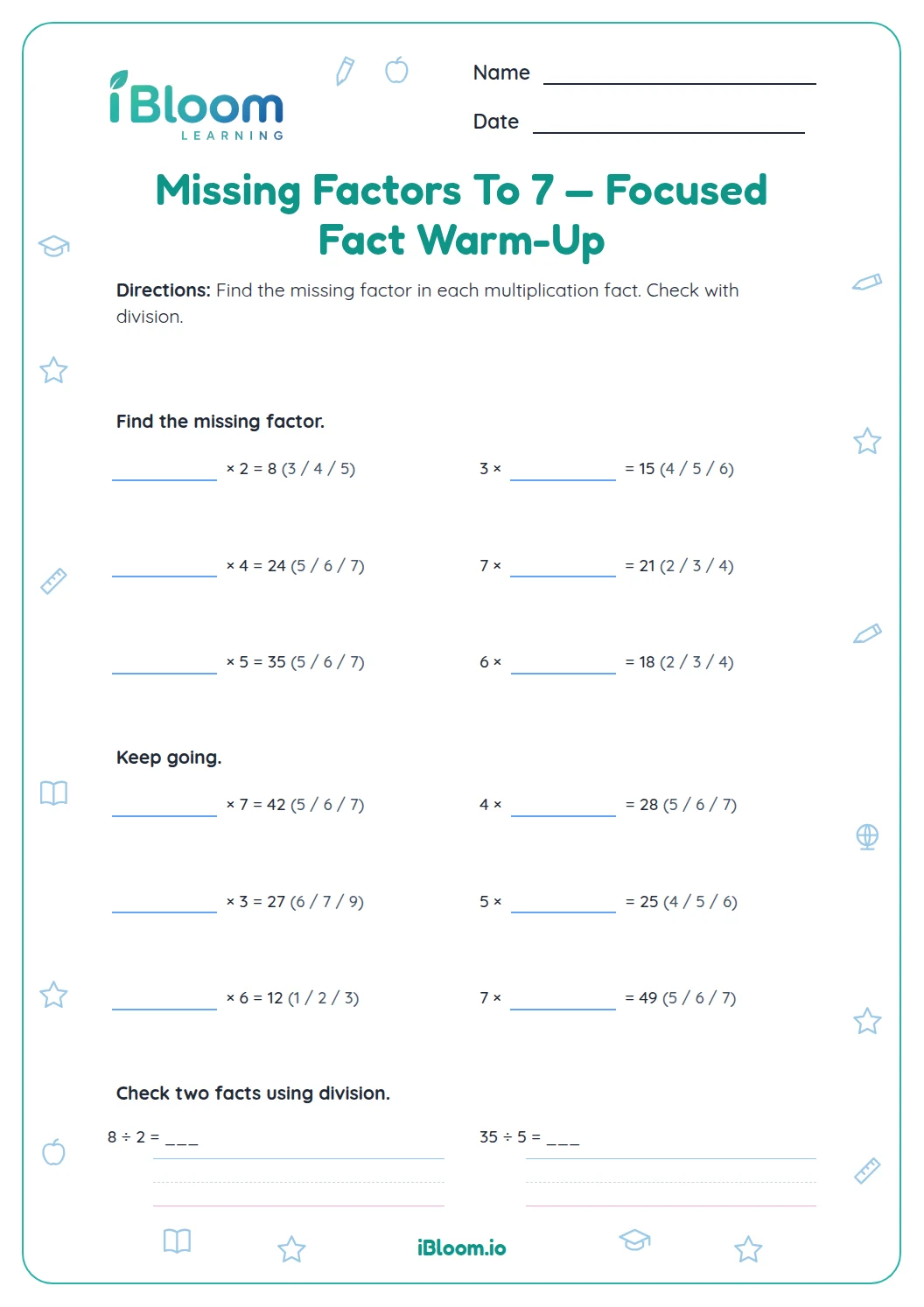
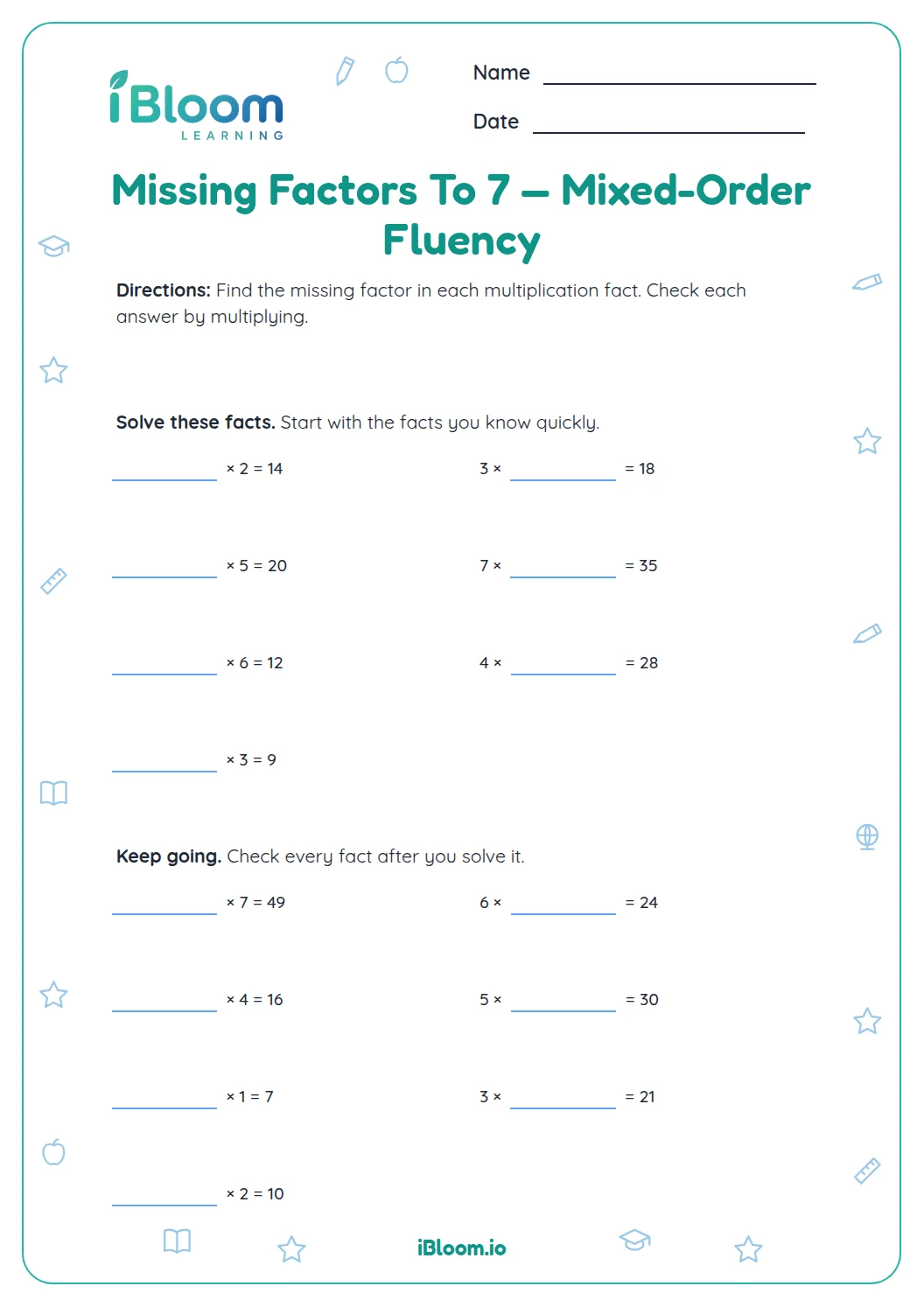
This free Grade 3 printable gives students 24 multiplication facts using factors from 1 through 10. Part A builds products, Part B asks students to find missing factors, and Part C checks selected products. The related-fact approach from the old warm-up remains useful: a known fact can help verify a product. A separate answer key lists all 24 answers.
Aligned to 3.OA.C.7
What facts does the sheet practice?
The 24 questions cover factors 1 through 10. First students find products, then solve for an unknown factor, and finally choose products in a quick check.
How can a known fact check an answer?
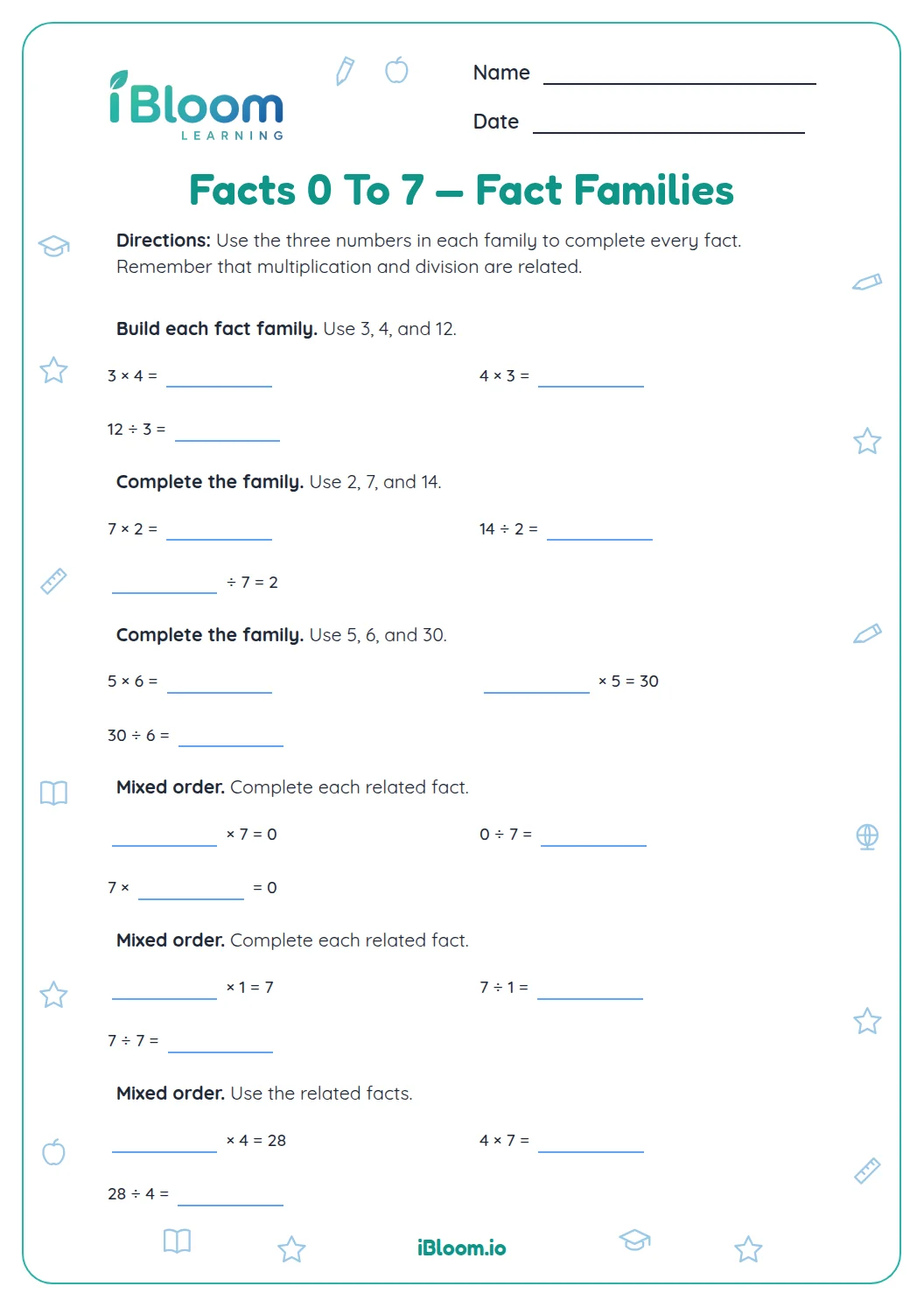
For 6 × 9, think of 6 groups of 9 or recall 6 × 9 = 54. To check, reverse the relationship: 54 ÷ 9 = 6.
- 16 × 9 = ___
- 26 × 9 = 54
- 3Check: 54 ÷ 9 = 6
What does a missing factor ask?
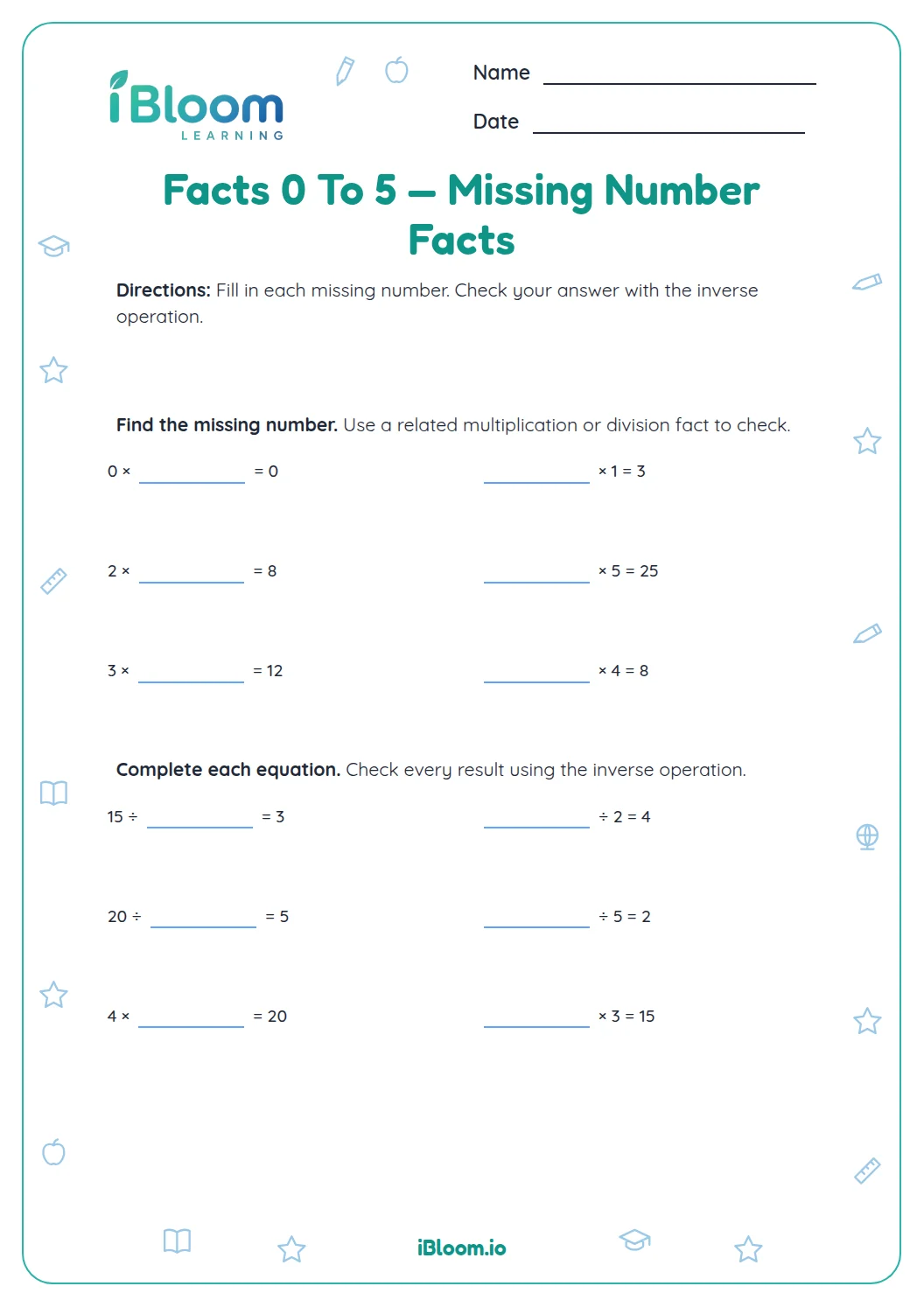
In 8 × ___ = 72, the student finds the number that makes 72 when multiplied by 8. Since 8 × 9 = 72, the missing factor is 9.
How to use this worksheet
- 1Work through Part A and say a known fact aloud before writing the product.
- 2For each Part B blank, ask which factor makes the product shown.
- 3Try the five Part C checks without looking back at earlier answers.
- 4Use a related division fact to check a product or missing factor.
- 5Compare all 20 responses with the answer key and correct any missed fact.
Common mistakes and quick fixes
The mistake
Using addition instead of the multiplication fact
The fix
Count equal groups or use a related fact, such as 5 × 8 to find 10 × 8 by doubling.
The mistake
Writing the product as the missing factor
The fix
Substitute the candidate into the equation and check that both sides match.
The mistake
Mixing up a fact family
The fix
Keep the product fixed: if 6 × 9 = 54, then 54 ÷ 9 = 6.
Common Core alignment
Build fluency with one-digit multiplication facts and related division facts.
On this sheet: Students solve one-digit multiplication facts and check products with related facts.
Show the official wordingHide the official wording
Fluently multiply and divide within 100, using strategies such as the relationship between multiplication and division (e.g., knowing that 8 × 5 = 40, one knows 40 ÷ 5 = 8) or properties of operations. By the end of Grade 3, know from memory all products of two one-digit numbers.
What to practice next
Make more practice
Further reading
Questions parents and teachers ask
What grades can use this worksheet?
It is written for Grade 3 students practicing one-digit multiplication facts. The questions include factors from 1 through 10, so a Grade 4 learner can also use the page for a short fluency review. The separate answer key lists each product and missing factor.
How many questions are on the page?
There are 24 questions in three parts. Ten ask for products, five ask for a missing factor, and nine are multiple-choice product checks. Together, the parts move from direct recall to using the multiplication relationship to work backward.
How can my child check a multiplication answer?
Use the related division fact. For example, if the product is 54 for 6 × 9, check that 54 ÷ 9 equals 6. A familiar skip-count or a known fact can also help confirm the product before checking the answer key.
Does the worksheet include an answer key?
Yes. A separate answer-key page gives an answer for all 24 questions. Students can finish the worksheet first, then use the key with an adult to mark answers and revisit any fact that needs another strategy. Ask the learner to explain one corrected answer.
How long should this practice take?
Plan for about 20 minutes. Students who know most facts may finish sooner; learners who pause to use skip-counting or related facts may need more time. There is no timer, so accuracy and a careful check can guide the pace.